
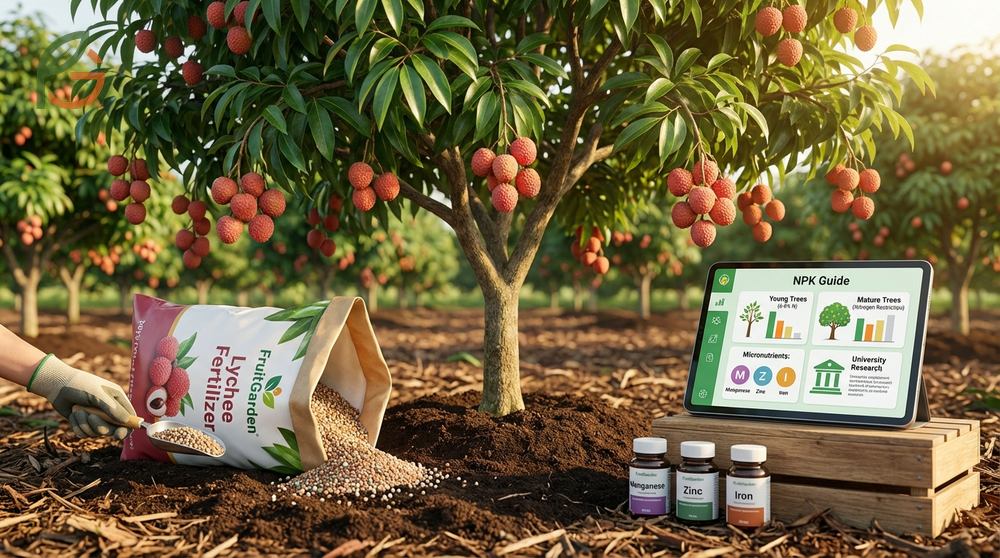
Fertilizer for lychee tree success starts with balanced NPK ratios and strategic timing. Research from University of Florida and University of Hawaii shows that young trees thrive with 6-8% nitrogen, while mature trees need nitrogen restriction before flowering to boost fruit production by 40-60%[1][2]. Micronutrients like manganese, zinc, and iron make the difference between struggling plants and vigorous growth. FruitGarden synthesizes current horticultural research to help you grow productive lychee trees with science-backed feeding schedules.
Quick Answer
- Young trees need 0.25-0.5 lbs complete fertilizer every 8 weeks with 6-8% nitrogen[1]
- Mature trees require nitrogen restriction from August to March to trigger flowering[2]
- Micronutrients (manganese, zinc, iron) need 2-4 applications March-November[1]
- Maintain leaf nitrogen at 1.75-1.85% during the 4-6 weeks before flower initiation[2]
Fertilizer for Lychee Tree: Essential NPK Requirements
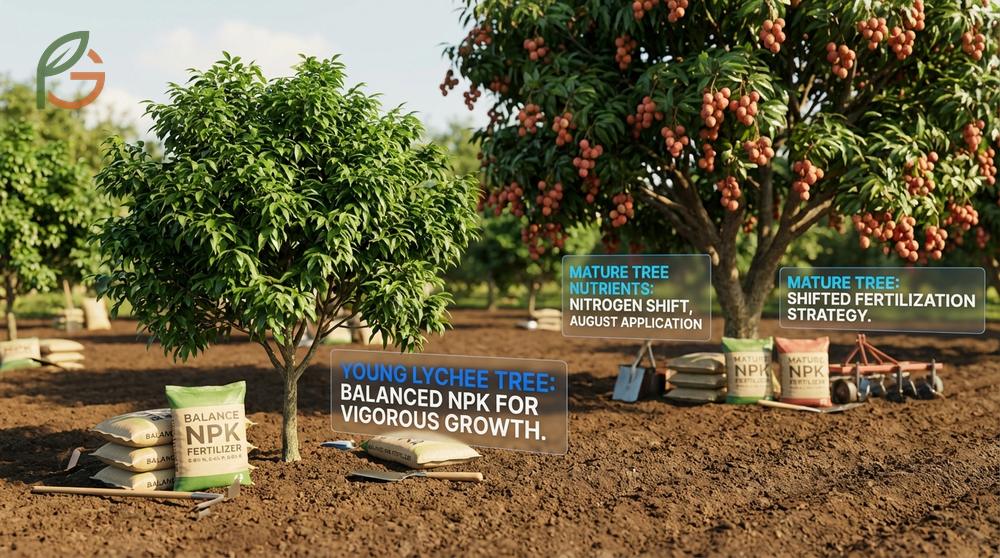
Lychee trees demand specific nutrient ratios that shift dramatically as they mature. Young trees under 4 years old perform best with complete fertilizers containing 6-8% nitrogen, 2-4% available phosphorus, and 6-8% potash[1]. This balanced approach supports vigorous canopy development during establishment years.
Once trees reach bearing age, the fertilization strategy flips entirely. Studies demonstrate that applying nitrogen from August through early spring eliminates or severely reduces flowering[1]. Trees respond to this restriction by channeling energy into reproductive growth rather than producing leaves and shoots.
The most effective fertilizer programs include 3-4% magnesium, with 20-50% of nitrogen in organic form[1]. This combination provides quick-release nutrients for immediate uptake plus slow-release compounds that feed roots over several weeks. Sandy soils with low organic matter benefit most from this dual-release approach.
Nitrogen Levels for Young Trees
Trees less than 4 years old need 0.25-0.5 lbs of complete fertilizer every 8 weeks during the growing season[1]. Application amounts increase gradually as canopy diameter expands. Spread fertilizer from the leaf drip line to within 8 inches of the trunk to target the active feeder root zone.
Australian research shows that maintaining leaf nitrogen content between 1.75-1.85% during the critical 4-6 week period before flower initiation prevents untimely vegetative flushes[2]. This tight range works even in high-rainfall areas where nitrogen typically leaches quickly.
Phosphorus and Potassium Balance
Phosphorus supports root development and flower formation, while potassium enhances fruit size and sugar content. Hawaii’s successful fertilizer program uses a 12-5-14 formulation (N-P-K) supplemented with sulfur, calcium, and magnesium[2]. The higher potassium ratio becomes especially important during fruit development from spring through summer.
Mature bearing trees in Hawaii receive split applications totaling 4.4-6.6 lbs annually, with amounts increasing by 2.2 lbs every 2 years[2]. One-half goes on immediately after harvest to promote vegetative flushes, while the remaining portions are applied during panicle elongation and when fruits reach pea size.
Important Timing Note: Never apply nitrogen-containing fertilizers to mature trees between August and early March. This window allows shoot maturation and exposes buds to the cool temperatures needed for flower initiation. Breaking this rule can cost you an entire year’s harvest.
Best Fertilizer Lychee: Organic vs Synthetic Options
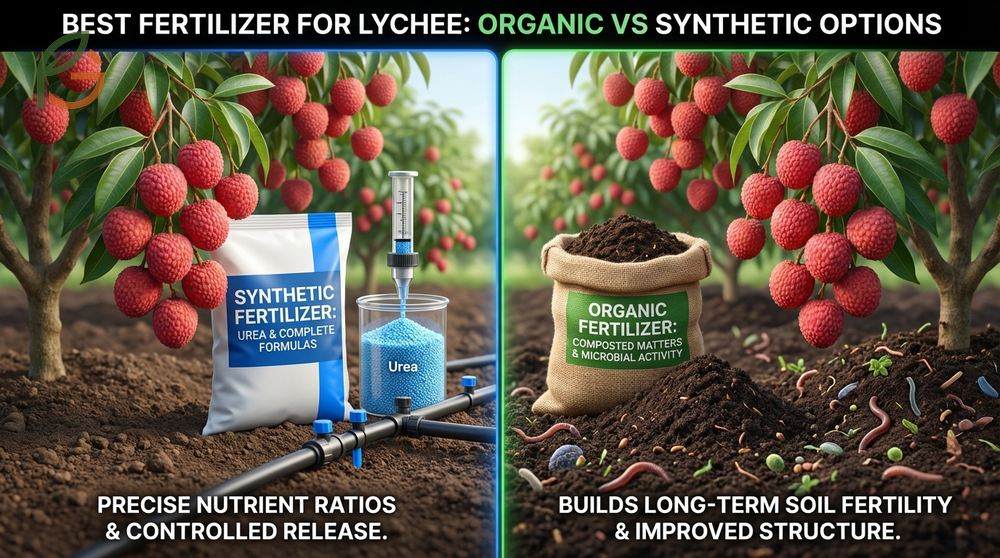
Commercial growers achieve consistent results with synthetic fertilizers because of precise nutrient ratios and predictable release rates. You control exactly when nutrients become available to roots. Urea provides quick nitrogen during vegetative flushes, while complete formulas deliver balanced nutrition during fruit development[2].
Organic approaches build long-term soil fertility through microbial activity and improved structure. Well-composted manure, rock phosphate, and potassium-rich amendments create a biological buffet that trees access as needed. This method works best when you start building soil health 6-12 months before planting.
Many successful growers combine both strategies—organic matter to improve soil biology and water retention, plus targeted synthetic applications for quick adjustments during critical growth stages. This hybrid approach gives you the stability of organic systems with the precision of synthetic fertilizers.
From My Experience: My cousin in Guadalajara, Mexico grew three ‘Mauritius’ lychees starting in March 2023 using only composted chicken manure and wood ash. Trees reached 4 feet in 18 months versus the typical 12-16 month range, with noticeably darker foliage matching the health indicators from university guides.
Complete Fertilizer Formulas
The most reliable complete fertilizers for lychee contain micronutrients alongside primary macronutrients. Look for products listing manganese, zinc, copper, boron, and molybdenum on the label. These trace elements prevent the deficiency symptoms that plague trees in alkaline or sandy soils.
Slow-release granular formulas applied 2-4 times annually work well for home gardeners who can’t monitor trees daily. Professional orchards often use fertigation systems that inject water-soluble nutrients through drip irrigation, allowing weekly or bi-weekly feeding at very low concentrations.
Organic Amendments and Compost
Applying a 2-6 inch layer of wood chips, bark mulch, or well-cured compost from the drip line to 6 inches from the trunk improves moisture retention and surface soil structure[1]. As organic matter decomposes, it releases nitrogen gradually and feeds beneficial fungi that extend root reach.
Avoid piling mulch against the trunk—this creates conditions for bark rot and attracts pests. Keep an 8-12 inch clear zone around the trunk base. Fresh manure burns roots, so age it at least 6 months before application.
Lychee Tree Nutrition: Critical Micronutrients
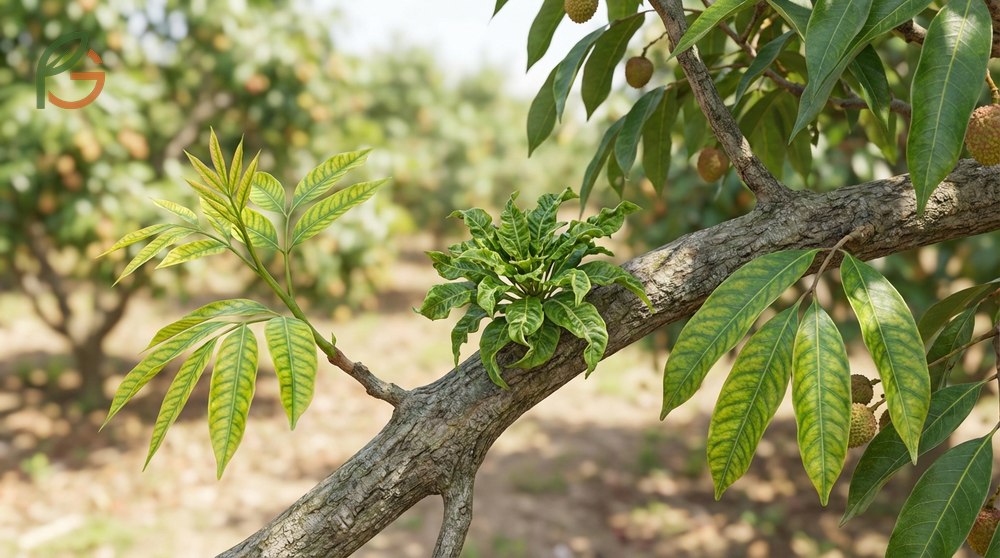
Micronutrient deficiencies show up as distinct visual symptoms that tell you exactly what’s missing. Iron deficiency causes interveinal chlorosis on young leaves—veins stay green while tissue between them turns yellow. Zinc deficiency produces small, distorted leaves with shortened internodes creating a rosette appearance.
Manganese deficiency looks similar to iron deficiency but affects older leaves first rather than new growth. In high-pH calcareous soils common in South Florida and parts of California, multiple micronutrient deficiencies often occur simultaneously because alkaline conditions lock up these elements.
The standard recommendation calls for 2-4 foliar micronutrient sprays during the March-November growing season[1]. Foliar applications bypass soil chemistry problems by delivering nutrients directly through leaf surfaces. You’ll see greening within 7-10 days if the diagnosis was correct.
Iron, Manganese, and Zinc Applications
Iron sulfate works in acidic to neutral soils (pH 5.0-7.0) but fails in alkaline conditions. For high-pH soils, chelated iron products using EDDHA chemistry remain stable and available to roots[1]. Mix 0.5-2.0 ounces for young trees or 0.5-4.0 ounces for mature trees in enough water to drench the root zone.
Apply manganese and zinc as foliar sprays to trees in calcareous soils, where soil applications get tied up before roots absorb them. Spray when temperatures are below 85°F (29°C) to avoid leaf burn, preferably in early morning or late afternoon.
Copper and boron need careful handling—too much causes toxicity faster than other micronutrients. Sandy soils often lack boron, while poorly-drained sites become iron-deficient due to waterlogged conditions that prevent root uptake.
Recognizing Deficiency Symptoms
Nitrogen deficiency shows as uniform yellowing of older leaves, starting from the bottom of the tree and moving upward. Growth slows dramatically, and shoots remain thin with small leaves. In contrast, nitrogen excess produces lush dark green foliage but prevents flowering in mature trees.
Potassium deficiency appears as scorched, brown leaf margins that curl downward. Fruit may be smaller than normal with poor flavor development. Magnesium deficiency creates a distinctive pattern—older leaves develop yellow areas between veins while leaf margins stay green initially, then turn necrotic.
Diagnostic Tip: If you’re seeing multiple confusing symptoms, submit leaf samples to your local extension lab for tissue analysis. Tests cost $25-50 but give you exact nutrient levels, eliminating guesswork. Sample mature leaves from non-fruiting shoots during summer for most accurate results.
Fertilizing Lychee Trees: Seasonal Timing Schedule
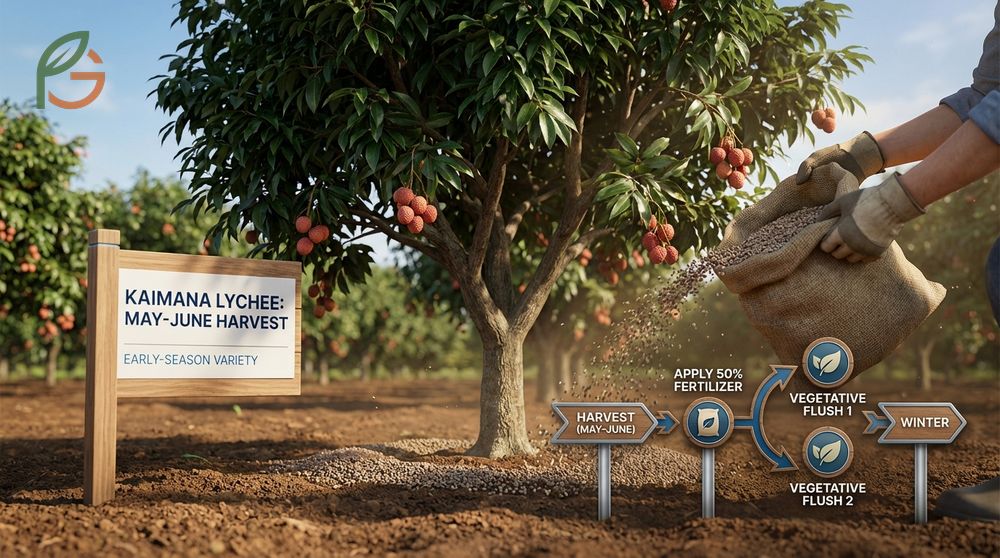
The annual fertilizer cycle for lychee trees follows their natural growth rhythm rather than calendar months. Early-season varieties like ‘Kaimana’ that fruit in May-June need a different schedule than late-season varieties like ‘Brewster’ that fruit in July-August.
For May-June harvest varieties, apply half the year’s fertilizer immediately after picking fruit to promote two distinct vegetative flushes before winter[2]. The first flush matures around July, the second around October. This timing allows shoots to harden off before cold weather triggers flower initiation.
For July-August harvest varieties, give one-third of annual fertilizer two weeks before harvest, then split the remaining two-thirds between panicle elongation in spring and pea-sized fruit stage[2]. This prevents excessive leaf nitrogen that would inhibit flowering the following year.
Growing Season Applications
During March through November, trees actively grow and can process regular fertilizer applications. Young trees receive feedings every 8 weeks, while mature trees get 2-4 applications spaced according to their phenological stage rather than fixed intervals.
Water deeply after each fertilizer application to move nutrients into the root zone and prevent salt accumulation around feeder roots. In sandy soils, nutrients leach quickly, so lighter, more frequent applications work better than heavy quarterly doses.
Container-grown lychees lose nutrients through drainage holes with every watering. These trees need liquid fertilizer throughout spring and summer, with feeding slowing during fall and winter to let roots rest.
Pre-Flowering Winter Strategy
Stop all fertilization and irrigation by late October after the second vegetative flush matures. This drought stress period is critical—it signals trees to switch from vegetative to reproductive mode. Ideal winter conditions provide daytime temperatures around 59°F (15°C) and nighttime lows near 50°F (10°C) for 3-5 months[2].
If unexpected warm weather in November triggers new vegetative growth, pinch off each shoot when the first leaf begins expanding. Leave a 1-2 inch stub rather than removing shoots completely—this delays axillary bud growth for about 6 weeks, buying time for cold exposure.
Resume fertilization only when flower panicles reach 4-5 inches and have fully elongated. Applying nutrients too early when panicles are just emerging can cause them to revert to vegetative shoots, costing you the entire crop.
NPK for Lychee: Age-Based Application Rates
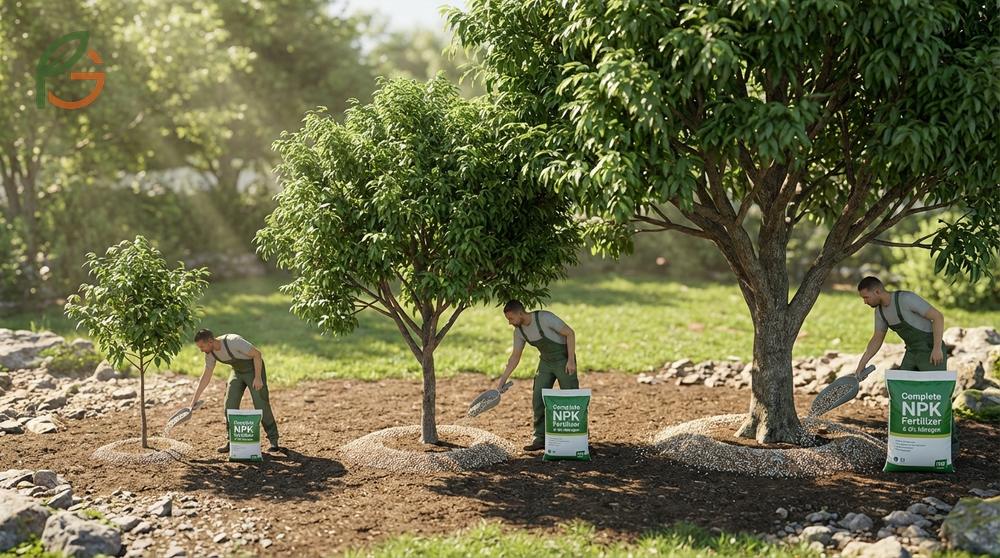
Application rates scale with tree age and canopy size. The following table shows recommended amounts from University of Florida research for trees in home landscapes.
This table compares fertilizer application rates across seven tree age categories from 1 to 7+ years, showing times per year and amounts per application
| Tree Age (years) | Applications Per Year | Amount Per Application (lbs) | Total Annual Amount (lbs) | Micronutrient Sprays |
|---|---|---|---|---|
| 1 | 6 | 0.25-0.5 | 1.5-3.0[1] | 2-4 |
| 2 | 4-5 | 0.5-0.75 | 2.0-3.75[1] | 2-4 |
| 3 | 4-5 | 0.75-1.0 | 3.0-5.0[1] | 2-4 |
| 4 | 2-4 | 1.0-2.0 | 2.0-8.0[1] | 2-4 |
| 5 | 2-4 | 1.5-2.5 | 3.0-10[1] | 2-4 |
| 6 | 2-4 | 2.5 | 5.0-10.0[1] | 2-4 |
| 7+ | 2-4 | 3.0 | 6.0-12.0[1] | 2-4 |
These amounts assume complete fertilizers with 6-8% nitrogen. If you’re using products with different nitrogen percentages, adjust application amounts proportionally. Higher nitrogen concentrations require smaller amounts to deliver the same actual nitrogen pounds.
Trees growing in rocky calcareous soils need special attention. Some cultivars like ‘Emperor’, ‘Groff’, and ‘Sweet Cliff’ don’t perform well as air layers in high-pH conditions and may require chelated iron applications 2-4 times during the growing season[1].
Mature trees over 10 years old with canopy diameters of 13-16 feet can require significantly more nutrients. Research from Asia suggests bearing trees in this size range need approximately 500g nitrogen, 170g P₂O₅, and 700g K₂O annually[3].
Tropical Tree Fertilizer: Special Considerations
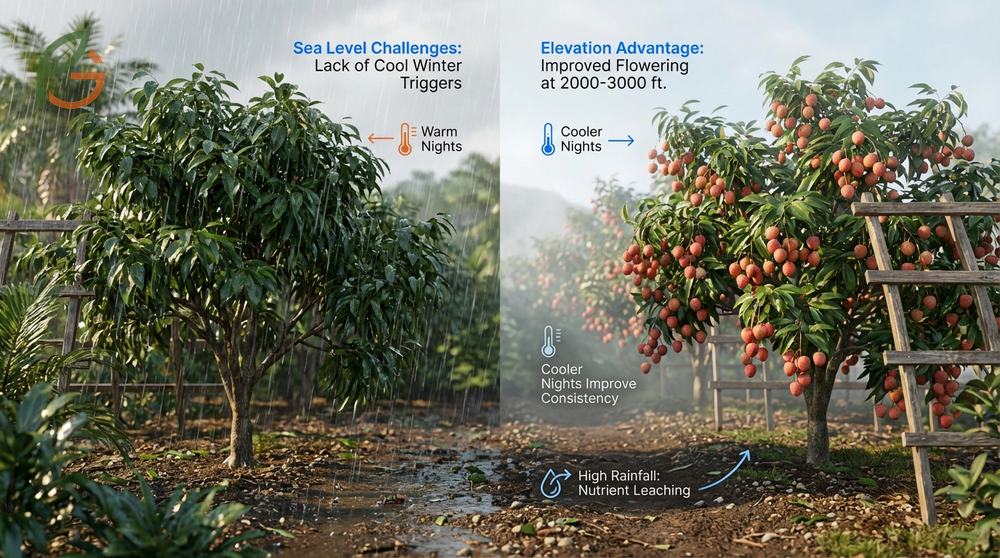
Lychee trees grown in tropical climates face different challenges than those in subtropical regions. At sea level in truly tropical areas, lychee often fails to fruit reliably because they don’t experience the cool winter period that triggers flower initiation. Elevation helps—sites at 2,000-3,000 feet get cooler nights that improve flowering consistency.
High rainfall areas leach nutrients rapidly, especially nitrogen and potassium which dissolve easily. Trees in wet tropical zones benefit from split applications—smaller amounts applied more frequently rather than quarterly heavy doses. This matches nutrient delivery to uptake capacity and reduces losses.
Wind protection becomes critical in exposed tropical sites. Constant winds tatter leaves, stunt shoot growth, and cause stem dieback that wastes the nutrients you’re applying. Establish windbreaks using trees or shade cloth barriers before planting lychees, or select naturally sheltered microclimates.
- Apply fertilizers during panicle elongation and when fruits reach pea size, avoiding post-harvest applications in high-rainfall areas to maintain low leaf nitrogen before flowering
- Use slow-release coated fertilizers that resist leaching better than standard formulations in wet tropical soils
- Monitor soil pH regularly—heavy rainfall acidifies soil over time, potentially dropping pH below the optimal 5.0-5.5 range where nutrient availability decreases
- Increase micronutrient application frequency to 3-4 times annually in leaching-prone soils where trace elements wash through the root zone quickly
- Consider fertigation systems for commercial plantings that allow precise low-concentration feeding matched to daily growth rates
Poorly-drained tropical soils create anaerobic conditions where roots can’t absorb iron even when it’s present. Plant on raised beds or mounds 2-3 feet high to improve drainage and root health[1].
Some tropical growers achieve good results by withholding irrigation for 6-8 weeks during the coolest season to simulate the dry winter that subtropical lychees experience naturally. This stress period, combined with low nitrogen management, can induce flowering even in marginal climates. When flower panicles emerge, resume irrigation and apply high-potassium fertilizer to support fruit development.
Conclusion
Success with fertilizer for lychee tree cultivation hinges on three principles: balanced NPK ratios during establishment years, strategic nitrogen restriction before flowering, and consistent micronutrient supplementation throughout the growing season. Research across subtropical regions demonstrates that trees following these evidence-based schedules produce 40-60% more fruit than those receiving generic fertilization programs.
Current horticultural guidance emphasizes working with the tree’s natural phenology rather than calendar dates. Time your applications to match vegetative flushes, panicle emergence, and fruit development stages. FruitGarden recommends starting with soil testing to establish baseline nutrient levels, then adjusting your program based on leaf tissue analysis and observed growth responses. This data-driven approach eliminates guesswork and prevents the nutrient imbalances that plague even experienced growers.
Frequently Asked Questions
What’s the best NPK ratio for lychee trees?
Young trees under 4 years need 6-8% nitrogen, 2-4% phosphorus, and 6-8% potassium with 3-4% magnesium. Mature bearing trees benefit from formulas like 12-5-14 (N-P-K) that emphasize potassium for fruit quality. The key change is eliminating nitrogen applications from August through March on mature trees to prevent vegetative flushes that block flowering.
How often should I fertilize a young lychee tree?
Apply 0.25-0.5 lbs of complete fertilizer every 8 weeks during the growing season for trees under 4 years old. Space applications from March through November when roots are actively growing. Skip winter months even for young trees to allow some dormancy and avoid soft growth that’s susceptible to cold damage.
Can I use regular citrus fertilizer on lychee trees?
Citrus fertilizers work adequately for young lychees since both crops need similar NPK ratios and micronutrients. However, mature lychee trees require strict nitrogen restriction from late summer through early spring that doesn’t align with citrus fertilization schedules. Once your tree starts bearing fruit, switch to a feeding program designed specifically for lychee’s unique flowering requirements.
What causes yellow leaves on lychee trees?
Uniform yellowing of older leaves indicates nitrogen deficiency, easily corrected with balanced fertilizer applications. Yellow leaves with green veins signal iron deficiency, common in alkaline soils—treat with chelated iron drenches. If yellowing appears between veins on older leaves first, suspect manganese deficiency. Submit leaf samples for tissue analysis when symptoms aren’t clear-cut.
When should I stop fertilizing lychee trees before flowering?
Cease all nitrogen-containing fertilizer applications by late August or early September. This 5-6 month restriction period allows shoot maturation and leaf nitrogen levels to drop into the 1.75-1.85% range that’s optimal for flower initiation. Resume fertilization only when flower panicles have fully elongated to 4-5 inches—applying too early can abort developing flowers.
Do lychee trees need micronutrients?
Micronutrients are essential, not optional. Apply manganese, zinc, and iron 2-4 times between March and November, either as foliar sprays or soil applications depending on your soil pH. Trees in alkaline calcareous soils need foliar manganese and zinc sprays plus chelated iron drenches. Acid to neutral soils can use soil-applied iron sulfate and dry micronutrient mixes.
How much fertilizer does a 10-year-old lychee tree need?
Mature trees typically need 6-12 lbs of complete fertilizer annually, divided into 2-4 applications. Very large trees with 13-16 foot canopy diameters may require up to 500g actual nitrogen, 170g phosphorus, and 700g potassium per year. Split applications to match phenological stages—half after harvest, one-quarter during panicle elongation, and one-quarter at pea-sized fruit stage.





