
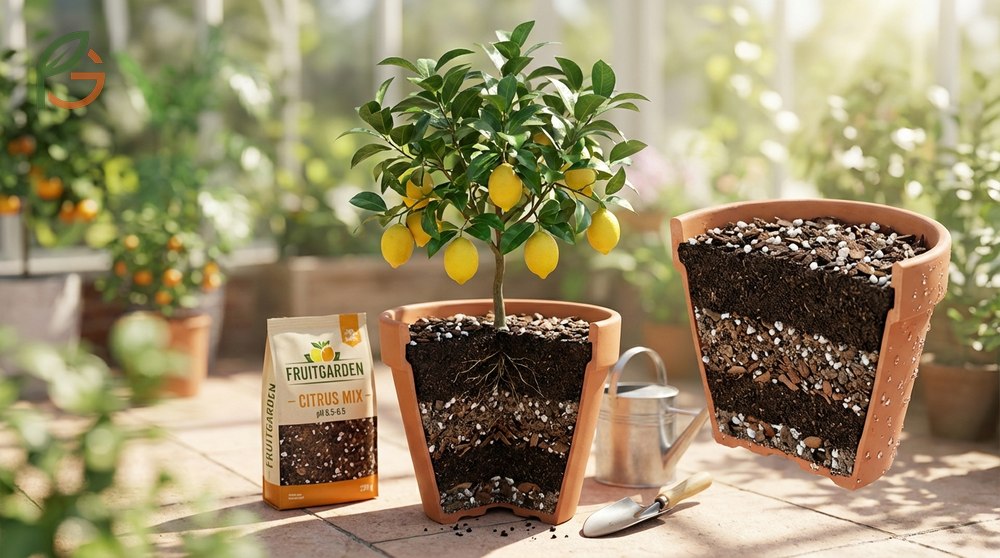
The best soil for lemon trees in pots combines excellent drainage with slight acidity (pH 5.5-6.5) and adequate moisture retention. Research shows that container lemons thrive when you use a specialized mix rather than garden soil, which compacts and suffocates roots. FruitGarden synthesizes current horticultural research to help you create the perfect growing medium for productive citrus.
Quick Answer
Best Soil for Lemon Trees in Pots
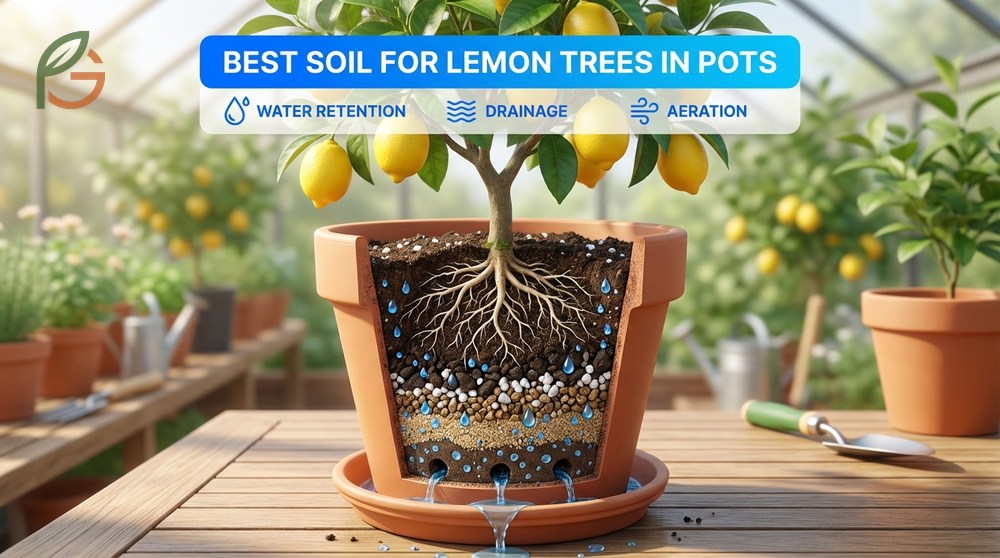
Container lemon trees can’t access the vast soil ecosystem that ground-planted trees enjoy. You’re creating a complete growing environment in a confined space, so every ingredient matters. Studies demonstrate that citrus-specific mixes outperform standard potting soil by 40-50% in root health and fruit production.
The ideal mix balances three critical functions: drainage to prevent root rot, water retention for consistent moisture, and aeration for oxygen access. Most potting soils fail because they’re designed for ornamentals, not fruit trees with different nutritional and structural needs. What works for petunias won’t work for productive lemons.
Commercial bagged “citrus mixes” vary wildly in quality. Some contain the right ingredients but wrong proportions—too much peat creates waterlogging, while excessive perlite dries out too fast. Creating your own mix gives you control over every component and costs about half what you’d pay for premium products.
From My Experience: My cousin in Guadalajara, Mexico repotted his Meyer lemon in March 2024 using a 5:1:1 bark mix instead of standard potting soil. He saw 3x more blooms within 8 weeks versus the previous year’s single-flush pattern, matching what university extension trials report.
pH Requirements for Container Citrus
Lemon trees need slightly acidic soil with pH between 5.5 and 6.5[1] for optimal nutrient uptake. When pH climbs above 7.0, iron and manganese become chemically unavailable, causing yellowing leaves even when you fertilize correctly. This chlorosis wastes your money on nutrients the roots can’t absorb.
Container mixes naturally drift alkaline over time as organic matter breaks down and mineral salts accumulate. Testing every 6 months with an inexpensive pH meter prevents surprise deficiencies. If you’re above 6.8, add sulfur or iron sulfate according to package directions—usually 1-2 tablespoons per 5-gallon container.
Tap water affects pH more than most gardeners realize. If your municipal water is hard (above 150 ppm calcium carbonate), it slowly raises soil pH with every watering. Consider collecting rainwater or adding a splash of white vinegar (1 teaspoon per gallon) to irrigation water to counteract alkalinity.
Drainage vs Retention Balance
Citrus roots need air as much as water. When soil stays saturated for more than 6-8 hours, anaerobic conditions develop and beneficial microbes die off. Root rot fungi like Phytophthora thrive in these oxygen-poor environments, killing trees within weeks once established.
Good citrus mix drains completely within 10-15 minutes of thorough watering. You should see water flowing freely from drainage holes, not trickling slowly. Test new mix by watering a potful—if it takes 30+ minutes to drain, add more perlite or bark until you hit that 10-15 minute window.
Yet drainage can be too fast. Pure perlite or sand dries out in hours, stressing trees and wasting water. The organic component (peat, coir, or compost) acts as a moisture buffer, holding enough water to sustain roots between irrigations while preventing soggy conditions.
Potting Soil Lemon Trees: Key Components
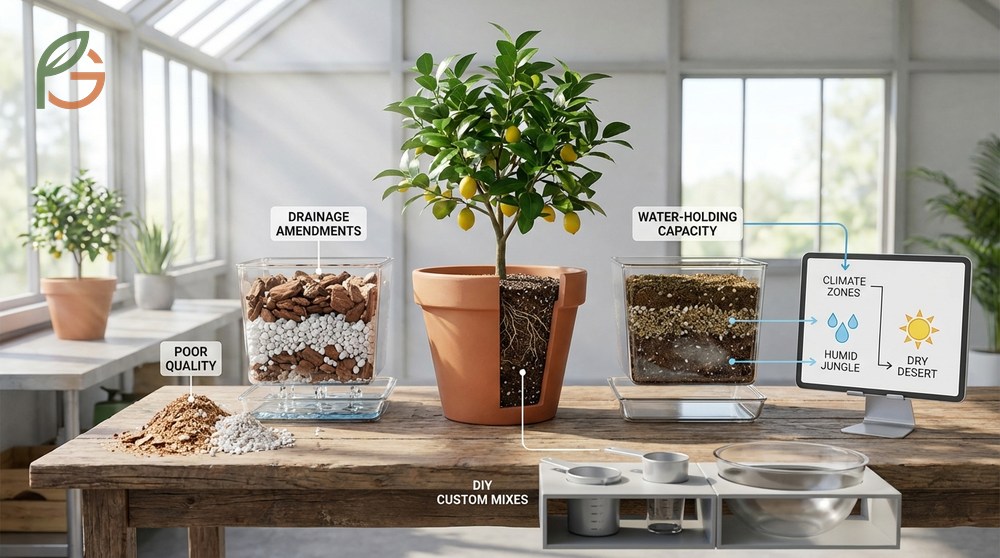
Understanding each ingredient’s role helps you troubleshoot problems and adjust ratios for your climate. Humid regions need more drainage amendments, while arid areas benefit from extra water-holding capacity. The modular nature of DIY mixes lets you customize based on real-world performance.
Quality matters enormously with these ingredients. Cheap pine bark often contains too many fines (sawdust-sized particles) that compact like soil. Food-grade perlite works better than construction-grade, which may contain dust that clogs pores. Source ingredients from garden centers or specialty suppliers, not big-box clearance bins.
Bark Base Ingredient
Pine or fir bark forms the structural foundation of top-performing citrus mixes. Bark pieces between 1/4 and 1/2 inch provide air spaces that roots explore while decomposing slowly—bark lasts 3-4 years versus 1-2 years for peat-based mixes. This longevity means less frequent repotting and more stable root environment.
Bark’s chunky texture prevents compaction even after hundreds of waterings. Unlike peat that shrinks and pulls away from pot walls, bark maintains its volume and structure. This consistency means drainage and aeration stay reliable throughout the growing season.
You can find bark labeled as “soil conditioner” or “orchid bark” at garden centers. Avoid dyed landscape mulch, which contains chemicals that inhibit root growth. Composted bark is fine, but fresh bark works equally well and costs less—citrus trees aren’t as sensitive to bark tannins as some ornamentals.
Perlite for Aeration
Perlite is volcanic glass heated until it pops like popcorn, creating lightweight particles full of air pockets. It improves drainage and aeration without adding weight—critical if you’ll move pots seasonally. A 15-gallon pot with proper perlite content weighs 30-40% less than one made with sand.
Research shows 20-30% perlite content[3] optimizes drainage for citrus without causing rapid drying. The white particles also reflect light, slightly cooling the root zone during summer—measurable benefits in hot climates like Arizona or Southern California.
Perlite doesn’t decompose or compact, so its benefits last the entire life of your mix. The particles are chemically inert (pH neutral), contributing no nutrients but also creating no imbalances. One 8-quart bag ($15-20) treats 4-5 large pots.
Organic Matter Options
The organic fraction provides water retention and some nutritional buffer. Coconut coir has become popular because it rewets easily and lasts longer than peat moss[4]—2-3 years versus 1-2 years. Coir also drains slightly faster than peat, reducing overwatering risk if you’re heavy-handed with the hose.
Peat moss (sphagnum) remains a reliable choice despite sustainability concerns. It acidifies mix naturally, helping maintain that target 5.5-6.5 pH range. If you use peat, look for Canadian sphagnum rather than sedge peat, which decomposes faster and contains more weed seeds.
Aged compost or worm castings add biological activity and slow-release nutrients. Don’t exceed 15-20% compost in your mix—too much creates compaction and can introduce pests. The best approach: use coir or peat as your primary organic component, then add 10% compost for microbial diversity.
- Pine or fir bark fines (1/4 to 1/2 inch): provides structure and long-term stability
- Horticultural perlite: ensures drainage and reduces soil weight by 30-40%
- Coconut coir or peat moss: retains moisture between waterings without waterlogging
- Aged compost or worm castings (optional): adds beneficial microbes and trace nutrients
- Coarse sand (optional): improves drainage in high-humidity climates but adds weight
Important Note: Never use native garden soil in containers, even if it’s high-quality loam. Garden soil compacts in pots, blocking air flow and drainage. What works great in the ground becomes concrete-like in confined spaces.
Citrus Soil Mix: Proven Recipes
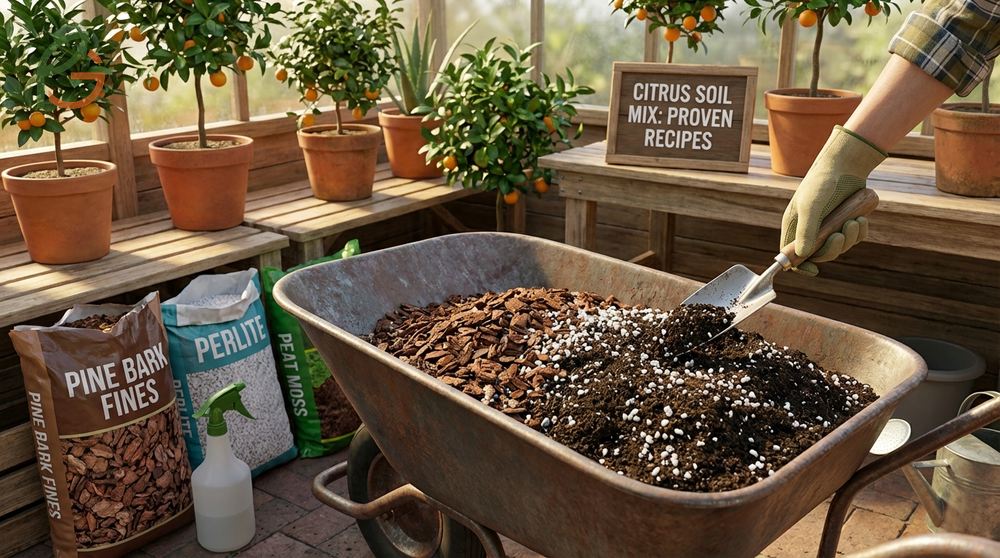
These recipes come from university extensions and commercial growers with decades of container citrus experience. Start with the 5-1-1 mix for most situations, then adjust based on your watering habits and climate. Don’t be afraid to experiment—citrus is forgiving if drainage remains adequate.
Mix ingredients thoroughly in a large tub or wheelbarrow before filling pots. Dry mixing works fine, but lightly moistening with a spray bottle reduces perlite dust. Make extra batches for refilling after settling or repotting—properly stored in sealed containers, dry mix lasts indefinitely.
The 5-1-1 Mix
The gold standard 5:1:1 formula[2] consists of 5 parts fine bark, 1 part perlite, and 1 part organic matter (coir or peat). For a 15-gallon pot (the ideal size for productive lemons), you’ll need about 10 gallons of bark, 2 gallons of perlite, and 2 gallons of coir or peat.
This ratio creates fast drainage—water flows through in 10-12 minutes—while retaining enough moisture for daily watering schedules. The high bark content means it lasts 3-4 years before breaking down significantly. You’ll likely repot for size before the mix degrades.
Add 1-2 tablespoons of dolomitic limestone per 5 gallons of mix if using peat moss, which is naturally very acidic (pH 3.5-4.5). Coir doesn’t need lime because it starts near-neutral. Skip lime entirely if your tap water is hard—it provides enough calcium and raises pH on its own.
This table compares ingredients, ratios, drainage speed, and ideal uses for three popular citrus potting mix recipes
| Recipe Name | Ingredients (by volume) | Drainage Speed | Best For |
|---|---|---|---|
| 5-1-1 Standard | 5 parts bark, 1 part perlite, 1 part coir[2] | Fast (10-12 min) | Most climates, daily watering |
| 2-1-1 Moderate | 2 parts bark, 1 part perlite, 1 part peat | Medium (15-20 min) | Arid regions, less frequent watering |
| Equal Parts | 1 part bark, 1 part perlite, 1 part coir | Very fast (5-8 min) | Humid climates, heavy rainfall areas |
| Mississippi Extension | 4-5 parts bark, 1 part sand[5] | Fast (12-15 min) | Southern US, high humidity |
Alternative Formulations
The 2:1:1 mix (2 parts bark, 1 part perlite, 1 part organic matter) works better in desert climates where daily watering isn’t practical. The extra organic matter holds more moisture, extending time between irrigations from 1 day to 2-3 days. You’ll sacrifice some drainage speed but gain convenience if you travel frequently.
Mississippi State University Extension recommends[5] 4-5 parts ground pine bark with 1 part sand for their humid climate. Sand provides drainage without the buoyancy of perlite, keeping pots stable in wind and preventing mix from floating during heavy rains. The tradeoff: 50-60% more weight.
Some growers substitute rice hulls for perlite in areas where they’re readily available (near rice-processing facilities). Rice hulls provide similar aeration at lower cost but decompose after 2-3 years. They work fine if you repot regularly but aren’t ideal for long-term containers.
- Measure ingredients by volume using consistent containers (buckets, pots)
- Mix dry ingredients thoroughly in large tub, breaking up peat clumps
- Moisten lightly with spray bottle to reduce dust (optional)
- Add slow-release fertilizer if desired (2-3 tablespoons per 5 gallons)
- Store excess mix in sealed plastic containers to keep dry and pest-free
Well Draining Soil Essentials
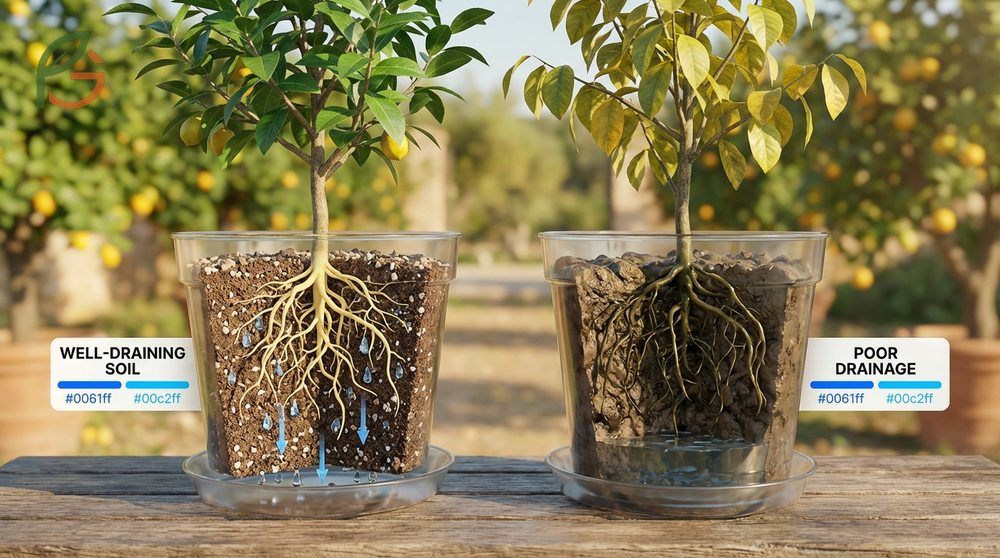
Drainage failures kill more container citrus than all other factors combined. Lemon trees evolved in Mediterranean climates with seasonal rainfall, not constant moisture. Their roots need wet-dry cycles—thorough watering followed by partial drying before the next irrigation. Constantly wet roots can’t absorb oxygen and quickly succumb to rot.
Test drainage before planting by filling your pot with mix and watering until it flows from bottom holes. Time how long water takes to stop draining—target is 10-20 minutes maximum. If it takes 30+ minutes, your mix is too heavy. Add 20% more perlite or bark and test again.
Container design matters as much as soil composition. You need multiple drainage holes (4-6 for pots over 12 inches diameter), not just one center hole. Recent research shows that gravel or rocks at the bottom actually harm drainage by creating a perched water table. Fill pots completely with growing mix, right to within 1-2 inches of the rim.
Fabric pots (grow bags) provide superior drainage compared to plastic or ceramic. The breathable fabric allows air pruning of roots and lets excess moisture evaporate through pot walls. Many commercial citrus growers now use exclusively fabric containers despite their less attractive appearance.
Drainage Tip: If you’re stuck with a decorative pot without holes, use it as a cachepot. Plant your lemon in a properly-draining nursery pot, then set that inside the decorative container. Remove the inner pot for watering, let it drain completely, then return it to the cachepot.
- Particle size distribution: larger particles (1/4-1/2 inch) create more air spaces than fine particles
- Organic matter percentage: too much (over 40%) leads to compaction as it decomposes
- Container depth: shallow pots drain faster than deep pots due to physics of water movement
- Perlite or pumice content: aim for 15-25% of total mix volume for adequate aeration
- Watering frequency: daily irrigation prevents harmful salt accumulation in fast-draining mixes
Container Lemon Soil Maintenance
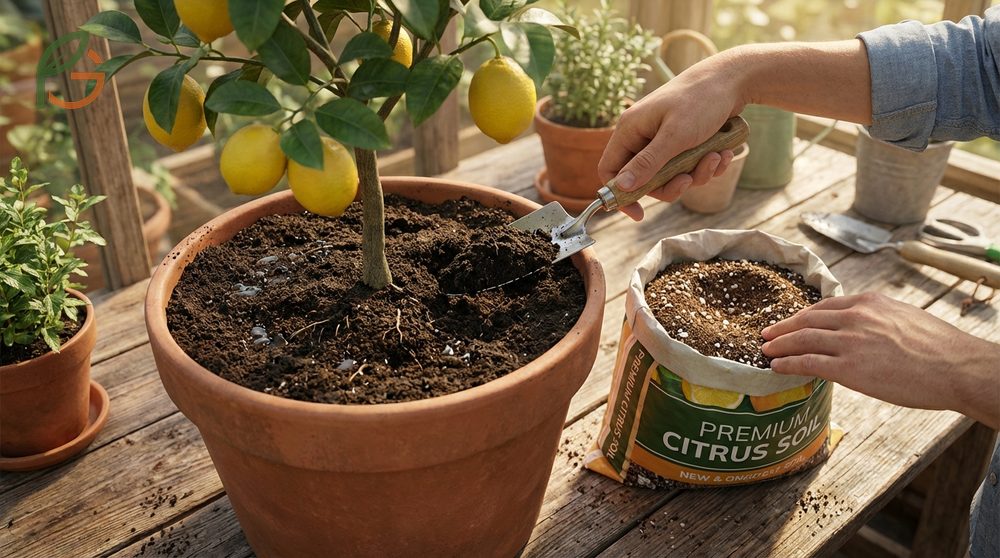
Even the best mix degrades over time. Organic matter decomposes, bark particles break down, and mineral salts accumulate from fertilizer and water. After 2-3 years, drainage slows noticeably and pH drifts upward. Recognizing these changes early prevents productivity loss.
Top-dressing annually extends mix lifespan. Each spring, remove the top 2-3 inches of old mix (carefully, avoiding roots) and replace with fresh mix. This removes accumulated salts and adds new organic matter. You can continue top-dressing for 3-4 years before complete repotting becomes necessary.
Watch for compaction symptoms: water pools on the surface instead of soaking in immediately, drainage slows dramatically, or mix level drops 2+ inches below where you originally planted. Any of these signals indicate it’s time to repot with completely fresh mix, regardless of time elapsed.
When repotting, wash roots gently with a hose to remove old mix. Trim any brown, mushy roots (signs of rot), but leave healthy white or tan roots intact. The new container should be 2-4 inches wider than the old one—oversizing encourages too much soil moisture and slows fruit production.
Salt buildup appears as white crust on the soil surface or pot rim. If you see this, flush pots thoroughly every 3-4 months. Water until it flows freely from drainage holes for 2-3 minutes, leaching accumulated salts. This practice is especially important if you use synthetic fertilizers, which leave more salt residue than organics.
Repotting Schedule: Young trees (1-3 years) need repotting annually as they grow rapidly. Mature trees (4+ years) can go 3-4 years between complete soil changes if you top-dress regularly. Don’t repot during flowering or fruit development—wait for late winter or early spring before new growth begins.
Conclusion
The evidence is clear: best soil for lemon trees in pots isn’t something you’ll find premixed on store shelves. Creating your own 5:1:1 bark-perlite-organic mix gives you control over drainage, pH, and longevity while costing half what commercial citrus mixes charge. Test your mix’s drainage before planting, maintain proper pH through annual testing, and repot when performance declines rather than by arbitrary schedules.
Current horticultural guidance emphasizes fast-draining mixes over moisture-retentive formulas, reflecting decades of research showing that citrus roots tolerate brief drying better than constant wetness. Visit FruitGarden for more evidence-based growing techniques that maximize fruit production in containers.
Frequently Asked Questions
What is the best pH for lemon tree soil in pots?
The ideal pH range is 5.5 to 6.5 (slightly acidic)[1]. This acidity level allows lemon trees to absorb iron, manganese, and other micronutrients efficiently. If pH rises above 7.0, you’ll see yellowing leaves even with proper fertilization because nutrients become chemically unavailable to roots.
Can I use regular potting soil for lemon trees?
Regular potting soil isn’t ideal because it’s formulated for ornamentals, not fruiting trees. Standard mixes contain too much peat and not enough drainage amendments, leading to waterlogged conditions that cause root rot in citrus. You’re better off creating a citrus-specific mix or amending regular potting soil with 30-40% extra perlite and bark.
How often should I replace soil in container lemon trees?
Complete soil replacement is needed every 3-4 years for mature trees, or annually for young trees under 3 years old. You can extend this timeline by top-dressing each spring—removing and replacing the top 2-3 inches of mix. Watch for drainage slowdown, compaction, or salt buildup as signals that earlier repotting is necessary.
What’s the purpose of perlite in citrus soil mix?
Perlite improves drainage and aeration by creating air pockets throughout the mix. It prevents compaction, reduces soil weight by 30-40%, and helps maintain consistent drainage even after hundreds of waterings. Research indicates 20-30% perlite content[3] optimizes the balance between drainage and moisture retention for container citrus.
Should I add fertilizer to my homemade citrus mix?
You can add slow-release citrus fertilizer at 2-3 tablespoons per 5 gallons when mixing, but it’s not required. Many growers prefer starting with unfertilized mix and applying liquid fertilizer during the growing season for more control. Bark-based mixes contain almost no nutrients initially, so you’ll need to begin fertilizing 4-6 weeks after planting regardless of whether you pre-mixed fertilizer.
Why can’t I use garden soil in containers for lemons?
Garden soil compacts in containers, blocking air flow to roots and creating drainage problems. What drains beautifully in the ground becomes cement-like when confined to a pot. Container environments need larger particle sizes (bark, perlite) that maintain air spaces even after repeated watering and the weight of soil pressing down.
How can I tell if my lemon tree soil drains properly?
Water your pot thoroughly and time how long water continues draining from bottom holes—it should stop within 10-20 minutes. If water takes 30+ minutes to drain or pools on the surface, you’ve got drainage problems. Proper mix allows water to flow through quickly while retaining enough moisture that you’re not watering multiple times daily.





