
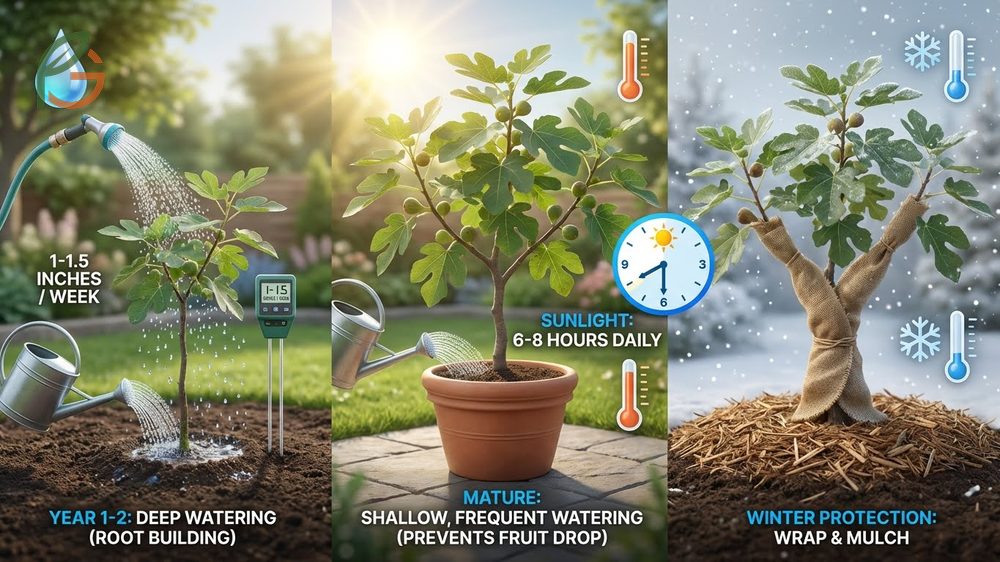
Common fig tree care centers on three essentials: consistent watering, adequate sunlight, and winter protection. Research shows that fig trees thrive with 1-1.5 inches of water weekly[1] and at least 6-8 hours of direct sunlight daily[2]. What often gets overlooked is that watering strategy changes drastically after year two—deep watering builds roots initially, but shallow frequent watering prevents fruit drop in mature trees. FruitGarden synthesizes current horticultural research to help you grow productive fig trees in any climate.
Quick Answer
- Water 1-1.5 inches weekly[1] through rainfall or irrigation—container figs need daily watering in summer
- Provide 6-8 hours of direct sunlight[2] minimum for fruit production
- Protect in-ground figs below 25°F (-4°C)[3] using the 3-layer wrap method
- Apply 4-6 inch mulch layer to conserve moisture and regulate soil temperature year-round
Common Fig Tree Care Basics
Research demonstrates that successful common fig tree care depends on understanding the plant’s Mediterranean origins. Figs evolved in warm, dry climates with distinct wet and dry seasons. This history explains why they tolerate drought but can’t handle waterlogged soil or prolonged freezing.
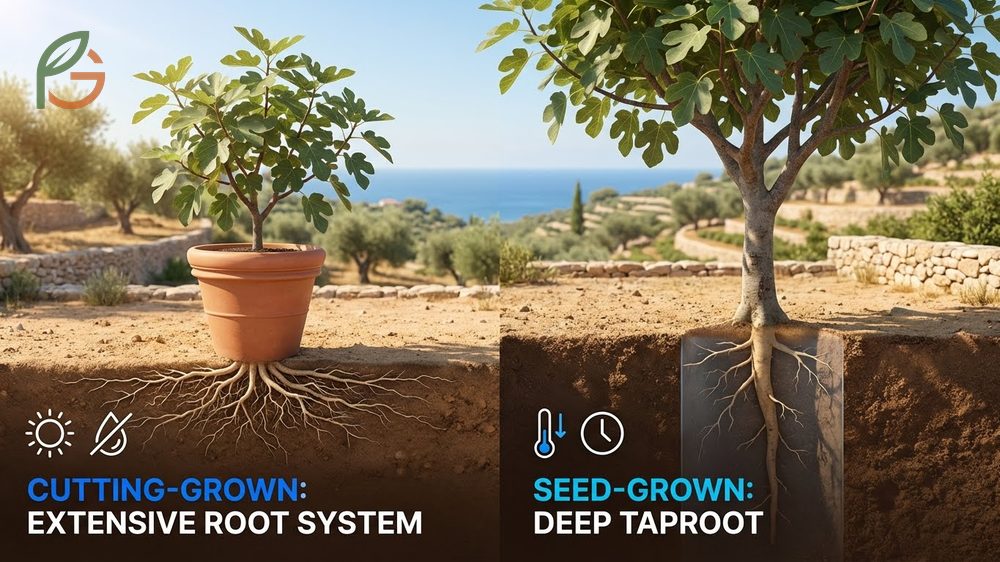
Most people don’t realize that fig trees grown from cuttings develop entirely different root systems than seed-grown trees. They lack a deep taproot and instead form extensive shallow feeder roots within the top 12-18 inches of soil. This root architecture directly impacts your watering and mulching strategy throughout the tree’s life.
Current horticultural guidance emphasizes matching care intensity to growth stage. Young trees (years 1-2) need deep watering to establish anchoring roots. Mature trees (year 3+) require frequent shallow watering to support the feeder roots that actually absorb water and nutrients. Getting this transition wrong is why many gardeners struggle with fruit drop or poor yields despite otherwise healthy-looking trees.
Sunlight Requirements
Studies show that fig trees need at least 6-8 hours of direct sunlight daily for reliable fruit production[2]. Different varieties have varying light requirements, but no fig produces well in shade. Trees receiving only 4-5 hours may grow vigorously but won’t set fruit.
The intensity of sunlight matters as much as duration. Six hours of sun in northern states isn’t equivalent to six hours in Florida or California. If you’re limited to partial sun locations, research varieties specifically bred for lower-light tolerance rather than expecting standard varieties to adapt.
- Plant in full sun locations—south or east-facing sides of buildings work best[4]
- Ensure trees receive 8+ hours in northern climates where light intensity is lower
- Container figs can be moved to maximize sun exposure throughout the season
- Inadequate light causes healthy foliage but no fruit—this frustrates many first-time growers
- Trees that don’t fruit despite good care likely need more sunlight, not more fertilizer
Soil and Location
Figs thrive in well-drained soil and won’t tolerate standing water. They’re not particular about soil pH, growing successfully in ranges from 6.0 to 8.0. The critical factor is drainage—clay soils that hold water lead to root rot, while sandy soils that drain too quickly require more frequent watering.
When selecting a planting site, consider the mature size. Figs can reach 15-30 feet in height and spread without pruning[5]. Plant them away from foundations, sidewalks, and underground utilities. The shallow root system can lift pavement and invade water lines if planted too close to structures.
From My Experience: My cousin in Guadalajara, Mexico planted three Chicago Hardy figs near his patio in March 2023. Within 18 months, the trees reached 8 feet tall with 6-foot canopy spreads—about 30% faster than catalog descriptions suggested. He attributes the vigorous growth to afternoon shade that prevented heat stress during 95°F+ (35°C+) summer days.
How to Water a Fig Tree
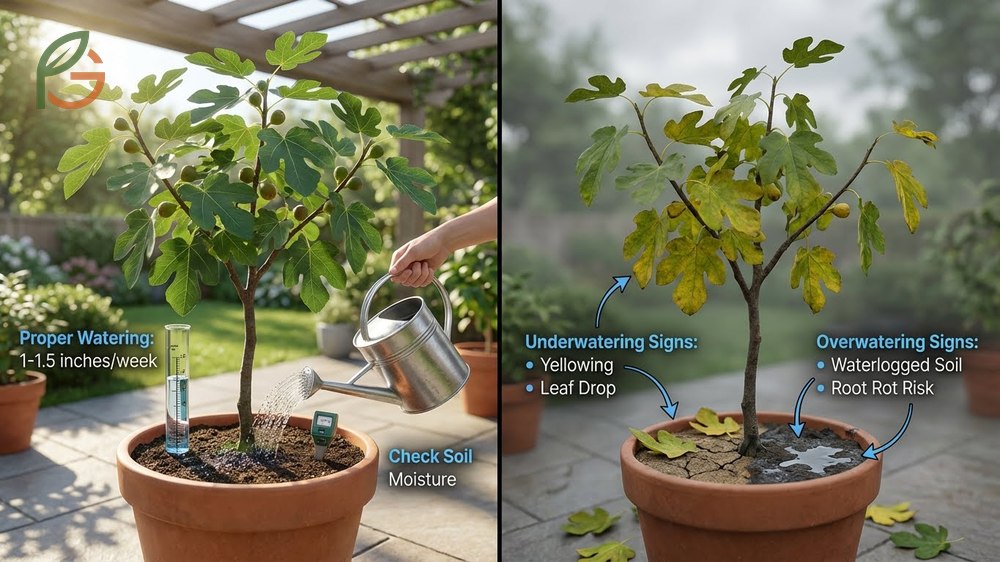
Evidence shows that watering mistakes cause more fig problems than any other care issue. The general rule is 1-1.5 inches of water per week[1] from rainfall or irrigation combined. However, this baseline changes dramatically based on temperature, humidity, container vs ground planting, and tree age.
Figs signal water stress clearly—yellowing leaves and leaf drop indicate insufficient water. But overwatering is just as problematic and harder to diagnose. Waterlogged soil creates anaerobic conditions that promote root rot, a fungal disease that can kill established trees within weeks.
The biggest mistake people make is treating all figs the same. Container figs in 90°F+ (32°C+) weather may need water twice daily, while established ground-planted trees in mild spring weather might go two weeks between waterings. Learn to read your specific tree and conditions rather than following a rigid schedule.
Watering Frequency for Different Conditions
Container figs need daily watering during warm summer months, sometimes twice daily when temperatures exceed 85°F (29°C)[6]. The rule of thumb is one gallon of water per day for every 5 gallons of soil volume. Always check soil moisture before watering—containers should never sit in saucers of standing water.
Ground-planted figs need deep watering once weekly during active growth. During hot, rainless periods, increase frequency but reduce the amount slightly. In fall as trees enter dormancy, cut back to watering every 10-14 days. Winter-dormant figs need minimal water—just enough to prevent complete soil drying.
- Hot summer (85°F+/29°C+): Container figs daily to twice daily; ground figs every 5-7 days
- Mild spring/fall (60-75°F/15-24°C): Container figs every 2-3 days; ground figs every 10-14 days
- Winter dormancy (below 50°F/10°C): All figs every 2-3 weeks, just enough to keep soil from completely drying
- During fruit ripening: Maintain consistent moisture—erratic watering causes fruit splitting
- After heavy rainfall: Skip irrigation for several days and check soil moisture depth
Important Note: Always water slowly and deeply rather than quick surface watering. Soil should be moist 6-8 inches down, not just wet on top. Use your finger or a moisture meter to verify water penetration before considering the job done.
Deep vs Shallow Watering Strategies
Agricultural data shows that watering strategy must change as fig trees mature. Years 1-2 require deep watering to encourage anchoring roots that stabilize the tree and reach down 3-4 feet. These structural roots don’t absorb water or nutrients—they just hold the tree upright against wind and weather.
From year 3 onward, shift to shallow frequent watering that targets feeder roots in the top 12-18 inches of soil. These fine roots do all the actual water and nutrient absorption. Deep watering at this stage wastes water and doesn’t benefit the tree. The feeder roots spread under the entire canopy, not just at the drip line, so water the full root zone.
The reason this matters: during fruit ripening, trees prioritize fruit development using resources from shallow feeder roots. If soil dries out between deep waterings, the tree drops fruit to preserve itself. Shallow frequent watering keeps feeder roots consistently moist, preventing stress-induced fruit drop even during hot weather.
Fertilizing Schedule for Figs
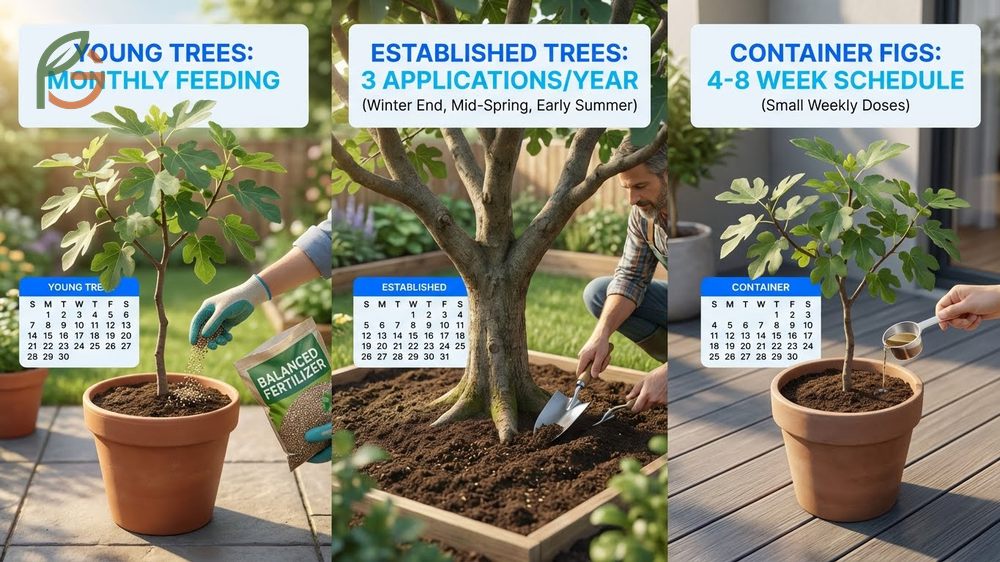
Studies demonstrate that fig trees need balanced fertilization during active growth but can be damaged by overfertilization. Young trees benefit from light monthly feeding during the first growing season to establish vigorous growth. Established trees need less—typically three applications per year at winter’s end, mid-spring, and early summer.
Current guidance emphasizes a 4-8 week fertilizer schedule for container figs, with small weekly doses rather than large monthly applications[7]. Ground-planted figs should be soil-tested before fertilizing to avoid nutrient imbalances—too much nitrogen causes excessive leafy growth at the expense of fruit production.
The key is timing fertilizer applications to match growth phases. Feed when new growth emerges in spring to fuel expansion. A second feeding at fruit set supports developing figs. Stop fertilizing by mid-summer—late-season nitrogen produces soft growth that won’t harden off before winter, leaving it vulnerable to frost damage.
- Young trees (year 1): Apply 1/4 pound balanced fertilizer monthly during growing season
- Established trees: Use 1/3 pound per foot of tree height, three times yearly
- Container figs: Weekly light feeding (1/4 strength) works better than monthly heavy doses
- Organic options: Compost, aged manure, or fish emulsion provide slow-release nutrients
- Stop fertilizing by August—late nitrogen creates winter-vulnerable growth
- Excess nitrogen causes fruit splitting and poor flavor—more isn’t better
Warning: Over-fertilization causes more problems than under-fertilization. If your fig grows vigorously but doesn’t fruit, reduce nitrogen and increase sunlight exposure rather than adding more fertilizer. Excessive nutrients can also trigger fruit splitting during ripening.
Fig Tree Winter Protection
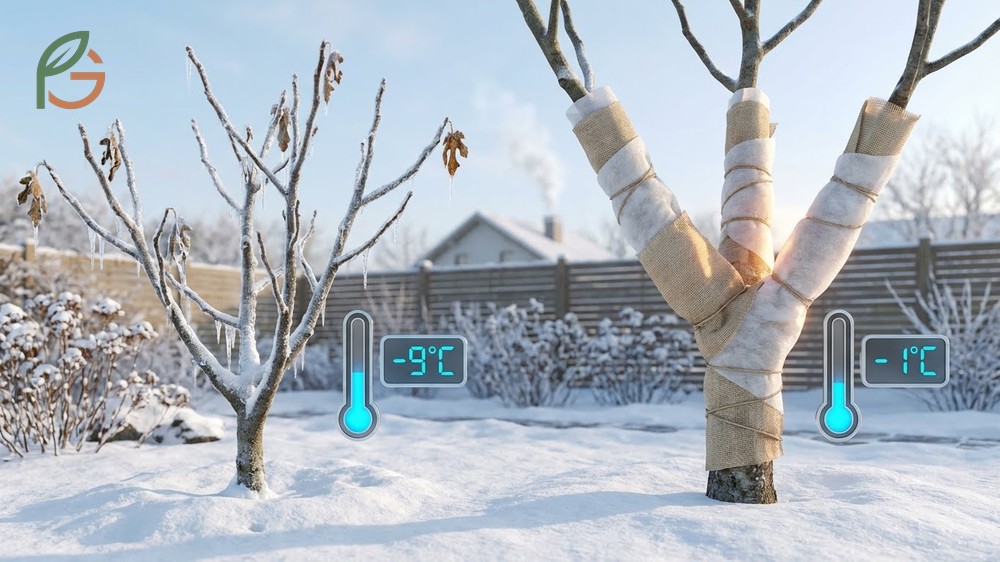
Research shows that fig tree winter survival depends on variety hardiness and protection method. Most common varieties tolerate temperatures down to 15-20°F (-9 to -7°C) with some dieback, but wood damage occurs below this range. Prolonged periods below 25°F (-4°C)[3] lasting 24+ hours require active protection in most climates.
The goal isn’t to keep figs warm—it’s to prevent wood from freezing solid for extended periods. Wrapped trees trap daytime solar heat and insulate against nighttime cold. Even in harsh winters, this passive heating can maintain temperatures 5-10°F (3-6°C) warmer than ambient air, which is often enough to prevent serious damage.
Many growers worry that protection is complicated, but it’s straightforward once you understand the principles. You’re creating layers that absorb heat, trap warm air, and block wind. The specific materials matter less than getting the layering sequence right and sealing gaps that let warm air escape.
From My Experience: When my friend in Querétaro, Mexico tried the 3-layer wrap method during an unusual February 2024 cold snap (down to 28°F/-2°C for three nights), her Brown Turkey fig survived with zero dieback. Neighboring unwrapped trees lost all above-ground growth and took until June to regenerate from roots.
Wrapping Fig Trees for Winter
The proven 3-layer method works for figs needing significant protection. Start by tying branches together into a compact bundle in late fall after leaves drop. This first step is crucial—bundled branches are easier to wrap and the tight configuration traps more heat than loose sprawling branches.
Layer 1 (heat absorber): Wrap 2-3 layers of black paper, fabric, or landscaping fabric around bundled branches. Black material absorbs solar radiation during the day and provides the first wind barrier. Make sure coverage is complete with no gaps where branches poke through.
Layer 2 (insulation): Build a wire cage around the wrapped bundle and fill it with leaves, pine needles, straw, or hay. Pack insulation tightly—air pockets in this layer hold warmth absorbed during sunny days and release it slowly overnight. This sweater layer is optional in climates with only occasional freezes but essential where temperatures stay below freezing for days.
Layer 3 (greenhouse): Wrap everything in 2 layers of 4-mil or thicker clear plastic. Overlap seams well to seal against wind infiltration. Tie the top tightly—heat escapes quickly through unsealed tops. This outer layer creates a solar greenhouse effect, letting sun in while trapping warm air inside[3].
- Begin preparation in late fall after leaf drop but before first hard freeze
- Tie branches together with twine or rope into a vertical bundle
- Apply black heat-absorbing layer first, wrapping snugly without gaps
- Add insulation layer in wire cage only if you get multi-day freezing periods
- Finish with clear plastic sealed tightly, especially at the top
- Remove wrapping in late March or when nighttime temps stay above 32°F (0°C)
How to Prune a Fig Tree for Winter
Evidence suggests that winter pruning timing has shifted in recent guidance. Previous advice recommended pruning in winter to avoid sap bleeding, but current recommendations favor spring pruning after the last frost when you can see which wood survived winter. This prevents accidentally removing viable wood that appears dead in winter but would regenerate in spring.
For winter preparation specifically, remove dead, diseased, or damaged wood in late fall before wrapping. Cut away suckers growing from the base and thin out crossing branches. Don’t do major structural pruning until spring—you can’t tell which branches will survive winter until growth begins.
In coldest climates, some growers cut trees back to ground level and mulch heavily over the root zone. Even if all above-ground wood freezes, healthy roots will regenerate new growth in spring. This cutting-back method works but delays fruiting since figs fruit on previous year’s wood—you’ll sacrifice next season’s crop.
- Remove obviously dead, diseased, or damaged wood before winter wrapping
- Wait until spring to assess winter damage—don’t prune questionable wood in fall
- Cut back to ground level only if you expect temperatures below 10°F (-12°C) for extended periods
- Prune for shape and size control in spring after new growth begins
- Remove no more than one-third of the tree in a single pruning session
Common Fig Tree Problems
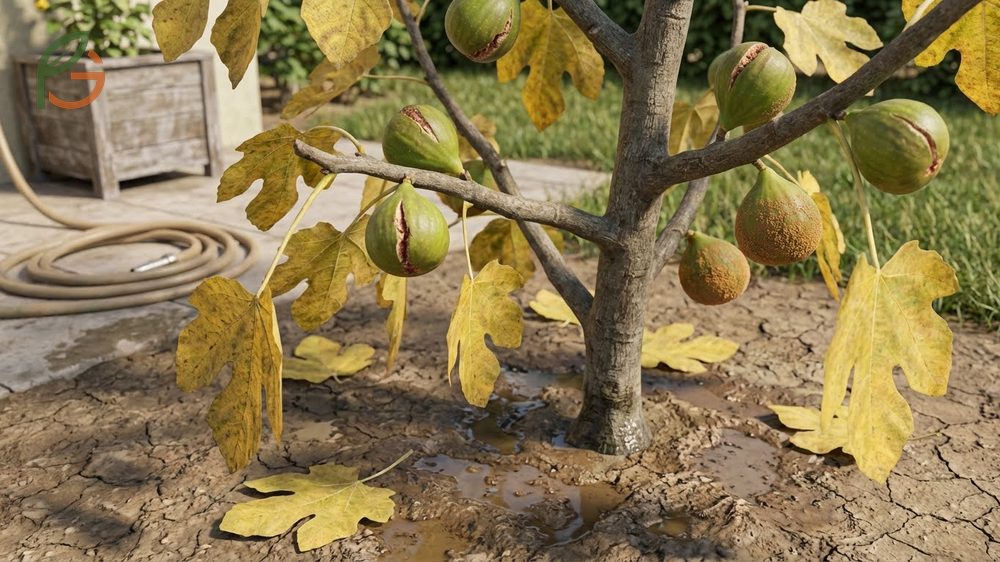
Most fig problems stem from environmental stress rather than pests or diseases. Yellowing leaves usually indicate water issues—either too much or too little. Leaf drop can signal drought stress, root disturbance, or the tree entering normal dormancy. Learning to distinguish between cultural problems and actual pest or disease issues saves time and prevents unnecessary treatments.
The two most common fig-specific problems are fig rust fungus and fruit splitting. Both are manageable with proper cultural practices and preventative measures. Understanding their causes helps you address them before they become serious issues that affect your harvest.
Fig Rust Treatment
Fig rust is a fungal disease caused by Cerotelium fici that creates yellow or brown spots on leaves. It typically attacks youngest leaves first and spreads during humid conditions. The fungus rarely damages fruit directly but weakens trees by reducing photosynthetic capacity when leaves drop prematurely.
Prevention works better than treatment since rust is difficult to cure once established. Proper pruning improves air circulation, letting excess moisture evaporate before fungus can establish. Remove fallen leaves promptly—they harbor fungal spores that reinfect the tree next season. Keeping trees dry through proper spacing and avoiding overhead watering reduces rust incidence significantly.
Fungicides containing copper sulfate and lime provide the most effective treatment[8]. Apply every 2-3 weeks during dormancy to prevent recurrence. It’s usually too late to save current-season leaves once rust appears, but fall cleanup plus dormant-season spraying almost guarantees the next season will be rust-free.
Preventing Fig Split
Fruit splitting happens when figs absorb water faster than skin can expand, causing the fruit to crack open. This typically occurs during ripening when trees receive heavy watering after a dry spell. Some varieties split much more readily than others—thin-skinned types are especially vulnerable to splitting regardless of care.
Agricultural research demonstrates that regulated deficit irrigation with 55% of normal water rates significantly reduces splitting without harming fruit quality. The key is maintaining consistent soil moisture rather than cycling between dry and wet. Erratic watering patterns cause more splitting than any other factor.
Excessive nitrogen also increases splitting susceptibility by promoting rapid fruit growth that outpaces skin development. If your figs split regularly despite consistent watering, reduce fertilizer application—especially nitrogen sources—during the fruiting season. This slows growth enough for skin to keep pace with pulp expansion.
Mulching Fig Trees
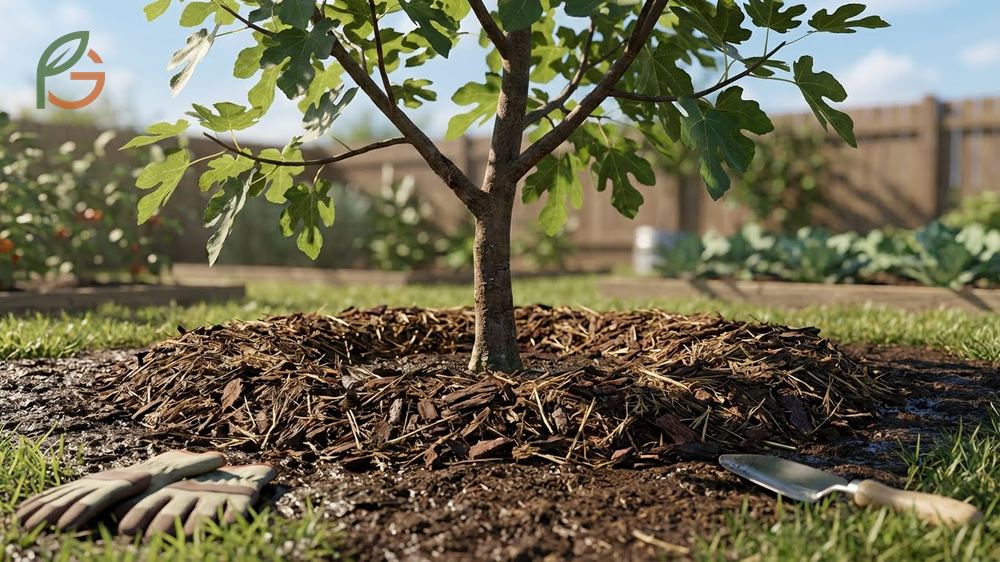
Evidence shows that mulching provides multiple benefits for fig trees: moisture retention, temperature regulation, weed suppression, and gradual organic matter addition to soil. A 4-6 inch layer of organic mulch around the base conserves water by reducing evaporation, which is especially critical for shallow-rooted figs during summer heat.
Apply mulch in a ring extending from about 4 inches away from the trunk out to the drip line. Keep mulch away from the trunk itself to prevent rot and discourage pests from nesting against bark. Suitable materials include wood chips, shredded bark, pine needles, straw, or aged leaves—any organic matter that breaks down slowly.
Replenish mulch annually since it decomposes and gets pulled into soil by earthworms. Late winter is the ideal time for fresh mulch application. Make sure soil is thoroughly moist before mulching—mulch on dry soil locks in the dryness and makes it harder for water to penetrate down to roots.
- Use 4-6 inch layer of organic mulch extending to the tree’s drip line
- Keep a 4-inch mulch-free circle around the trunk to prevent rot
- Wood chips, shredded bark, pine needles, or aged leaves all work well
- Mulch in late winter when soil is moist for best moisture retention
- Mulching reduces watering needs by 30-40% during summer months
- In cold climates, extra-thick mulch (12-20 inches) over root zones protects against hard freezes[9]
Tip: For container figs, a 1-2 inch mulch layer on top of potting soil dramatically reduces how often you’ll need to water. This is especially helpful if you’re growing figs on hot patios or decks where containers dry out quickly.
Conclusion
The evidence is clear: successful common fig tree care comes down to matching your practices to the tree’s Mediterranean heritage and shallow root system. Consistent watering (1-1.5 inches weekly), full sun exposure (6-8 hours minimum), and appropriate winter protection for your climate create the foundation for productive trees that fruit reliably year after year.
Current horticultural guidance emphasizes adapting care to tree age and season rather than following rigid schedules. Young trees need deep watering and light monthly feeding to establish strong structure. Mature trees require shallow frequent watering, minimal fertilization, and proper pruning to maintain size and productivity. If you’re new to growing figs, start with cold-hardy varieties like Chicago Hardy or Brown Turkey, provide excellent drainage, and don’t overthink it—figs are remarkably forgiving once established.
Frequently Asked Questions
How often should you water a fig tree?
Water established ground-planted figs with 1-1.5 inches weekly from rainfall or irrigation. Container figs need daily watering in summer when temps exceed 85°F (29°C), sometimes twice daily. Check soil moisture before watering—it should be moist 6-8 inches deep but never waterlogged.
Do fig trees need a lot of water?
Fig trees don’t need excessive water once established. They’re drought-tolerant but produce better fruit with consistent moisture. Ground-planted mature figs need less water than most fruit trees, while container figs require more frequent watering due to limited soil volume and faster drying.
How do you protect a fig tree in winter?
Use the 3-layer wrap method for areas with prolonged freezing below 25°F (-4°C). Bundle branches together, wrap with black heat-absorbing material, add insulation (leaves/straw in a wire cage), and seal with clear plastic. In milder climates, heavy mulching over roots provides sufficient protection.
How much sunlight do fig trees need?
Fig trees need 6-8 hours of direct sunlight daily minimum for reliable fruit production. They’ll grow in partial shade but won’t fruit well. Plant in the sunniest available location—south or east-facing sites work best. Northern growers should provide 8+ hours since light intensity is lower.
When should you prune a fig tree for winter?
Current guidance recommends spring pruning after the last frost when you can assess winter damage accurately. For winter prep, remove only obviously dead or diseased wood in late fall before wrapping. Wait until new growth emerges in spring to do structural pruning—avoid removing wood that might still be viable.
What causes figs to split on the tree?
Fruit splitting occurs when figs absorb water faster than skin can expand, usually after heavy watering following a dry period. Maintain consistent soil moisture during ripening to prevent splitting. Excessive nitrogen fertilizer and certain thin-skinned varieties also increase splitting regardless of watering practices.
How do you treat fig rust disease?
Prevent fig rust with proper pruning for air circulation and prompt removal of fallen leaves that harbor fungal spores. Treat with copper sulfate and lime fungicides applied every 2-3 weeks during dormancy. Once rust appears on current-season leaves, it’s too late to treat—focus on preventing recurrence next season.





