
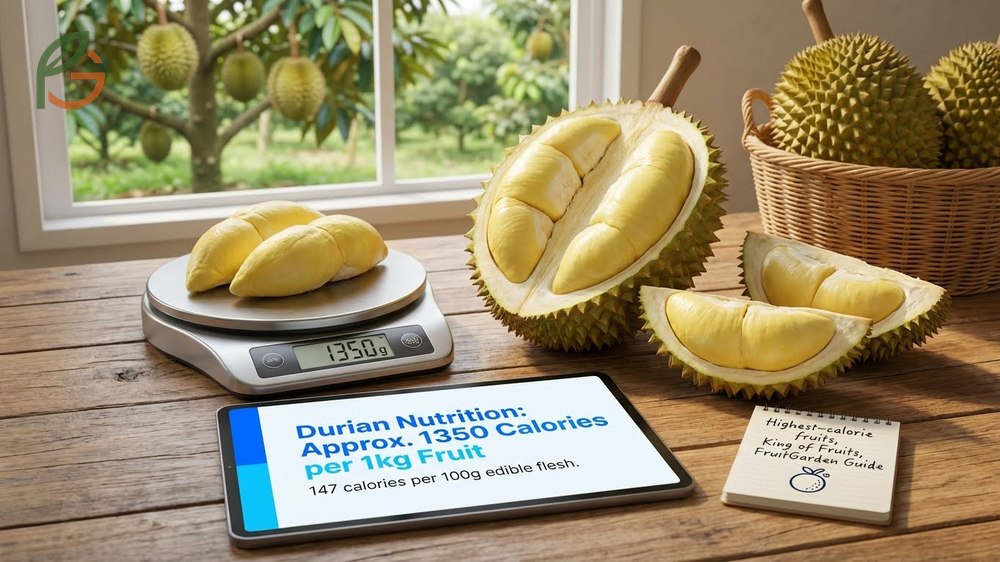
Durian calories per fruit range from 885 to 1500 depending on the fruit’s size, with an average 1kg durian containing approximately 1350 calories[1]. Research shows this makes durian one of the highest-calorie fruits you’ll encounter, with 147 calories per 100g of edible flesh[2]. FruitGarden synthesizes current nutritional research to help you understand how this “king of fruits” fits into your diet, whether you’re growing durians in your garden or just curious about their energy content.
Quick Answer
- Whole durian contains 885-1500 calories[1] depending on size (typically 1-3kg per fruit[3])
- Per 100g: 147 calories, 27g carbs, 5.3g fat, and 3.8g fiber[2]
- One small seed (40-50g) delivers 56 calories[1], while a large seed (80g) provides 113 calories
- Only 20-30% edible portion—the rest is husk and seeds
Durian Calories per Fruit
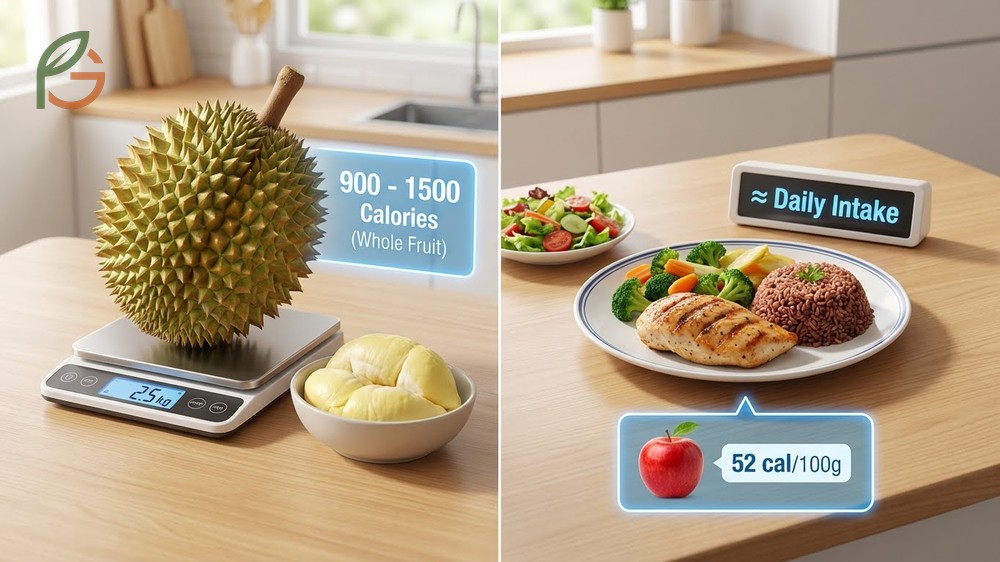
A whole durian’s calorie content varies dramatically based on its size. Studies show that durians typically weigh between 1 to 3 kilograms[3], which translates to roughly 900-1500 calories per fruit[1]. That’s nearly an entire day’s caloric intake for most adults packed into one spiky package.
Current data indicates that per 100g of edible flesh, you’re getting 147 calories[2]. This makes durian significantly more calorie-dense than common fruits like apples (52 cal/100g) or oranges (47 cal/100g). The high calorie count comes from durian’s unique combination of carbohydrates and fats, which most fruits don’t have in such abundance.
Most people don’t realize that timing and ripeness affect both flavor and nutritional density. Riper durians tend to have higher sugar content, which can slightly increase the caloric value compared to less ripe specimens.
How Fruit Size Affects Calorie Count
The relationship between durian size and calories isn’t perfectly linear because edible yield varies. Agricultural data shows that only 20-30% of a durian’s total weight is actually edible flesh—the rest is tough husk and large seeds. A 2kg fruit might only provide 400-600g of flesh you can eat.
For instance, a small 1kg durian delivers approximately 1350 calories[1]. Scale up to a 2.5kg Musang King variety, and you’re looking at well over 2000 calories total. That’s why portion control matters when you’re indulging in this tropical delicacy.
This table compares total weight, edible portion weight, and total calorie content across four durian size categories from small to extra large
| Fruit Size | Total Weight | Edible Portion (25%) | Total Calories |
|---|---|---|---|
| Small | 1.0 kg | 250g | 368 cal |
| Medium | 1.5 kg | 375g | 551 cal |
| Large | 2.0 kg | 500g | 735 cal |
| Extra Large | 3.0 kg | 750g | 1103 cal |
Edible Portion vs Total Weight
When you buy a whole durian, you’re paying for a lot of inedible parts. The spiky husk alone accounts for roughly 50-60% of the total weight. Seeds make up another 15-25%, leaving only that creamy, custard-like flesh as the edible portion.
Evidence suggests that premium varieties like Musang King have slightly better edible yields (26-30%)[4] compared to standard cultivars. This matters when you’re calculating actual calorie intake—don’t assume a 2kg durian gives you 2kg worth of flesh to eat.
Important Note: If you’re tracking calories precisely, weigh only the flesh you’re eating, not the whole fruit. This prevents overestimating your intake by 2-3x.
Whole Durian Calories
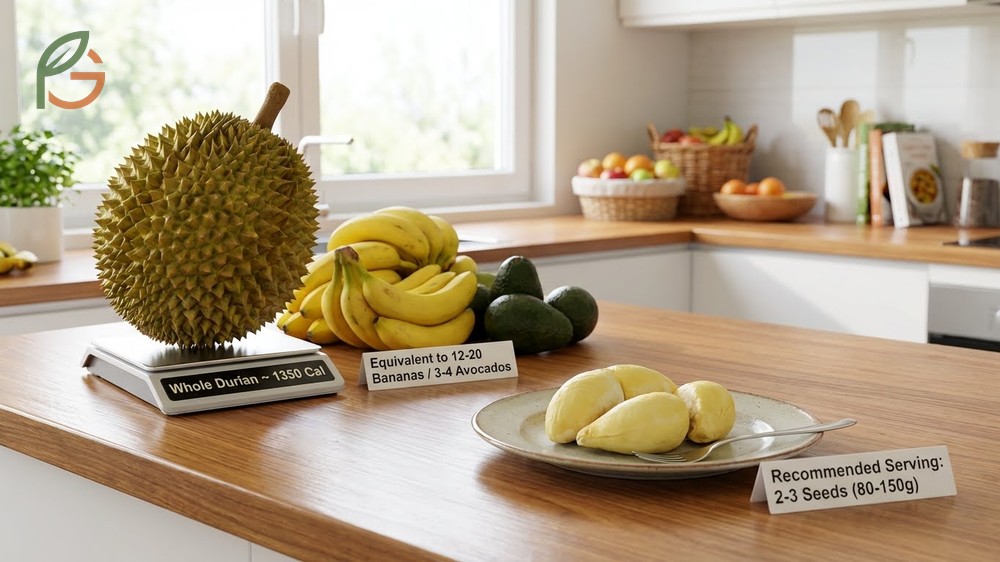
Research shows that consuming an entire durian in one sitting delivers anywhere from 900 to 1500 calories[1]. That’s equivalent to eating 12-20 medium bananas or 3-4 large avocados. Most nutritionists recommend limiting your intake to 2-3 seeds (about 80-150g of flesh) per serving to avoid excessive calorie consumption.
The average 1kg durian contains roughly 1350 calories[1], which represents about 50-70% of a typical adult’s daily caloric needs. If you’re maintaining a 2000-calorie diet, eating a whole durian means you’ve consumed most of your energy budget in one fruit.
What often gets overlooked is that processed durian products like durian chips or jam can contain even more calories per serving due to added sugars and oils during preparation.
Calorie Range by Variety
Different durian varieties show slight variations in calorie content based on their macronutrient composition. Thai raw durian contains approximately 165 kcal per 100g[5], while Malaysian mid-range varieties deliver about 160 kcal per 100g. The difference isn’t huge, but it adds up when you’re eating several hundred grams.
Monthong durians from Thailand typically weigh between 1.8-5.5 kg per fruit, with larger specimens pushing past 2500 calories for the entire fruit. Musang King varieties usually fall in the 1.3-1.8 kg range, translating to 900-1300 calories per whole fruit.
- Musang King (Malaysia): 1.3-1.8 kg fruits, 900-1300 calories total, rich and creamy texture
- Monthong (Thailand): 1.8-5.5 kg fruits, 1300-3000+ calories total, mild sweetness
- D24 (Malaysia): 1.5-2.5 kg fruits, 1100-1800 calories total, bitter-sweet profile
- Red Prawn (Malaysia): 1.2-2.0 kg fruits, 900-1400 calories total, reddish flesh color
- Black Thorn (Malaysia): 1.5-2.5 kg fruits, 1100-1800 calories total, premium quality
Comparing Durian to Other Fruits
Durian stands out as one of the most calorie-dense fresh fruits available. A cup of durian (243g) contains 357 calories[6], whereas a cup of strawberries has only 49 calories and a cup of grapes delivers 104 calories. Even bananas, considered relatively high in calories for a fruit, provide just 134 calories per cup.
The reason behind durian’s high calorie count is its fat content. Unlike most fruits that contain less than 1g of fat per 100g, durian packs 5.3g of fat[2]—primarily healthy monounsaturated fats. This combination of carbs and fats creates the fruit’s distinctive creamy texture and caloric density.
Quick Comparison: One small durian seed (50g) has 56 calories, which is more than an entire 150g apple at 79 calories[1].
Durian Nutritional Facts
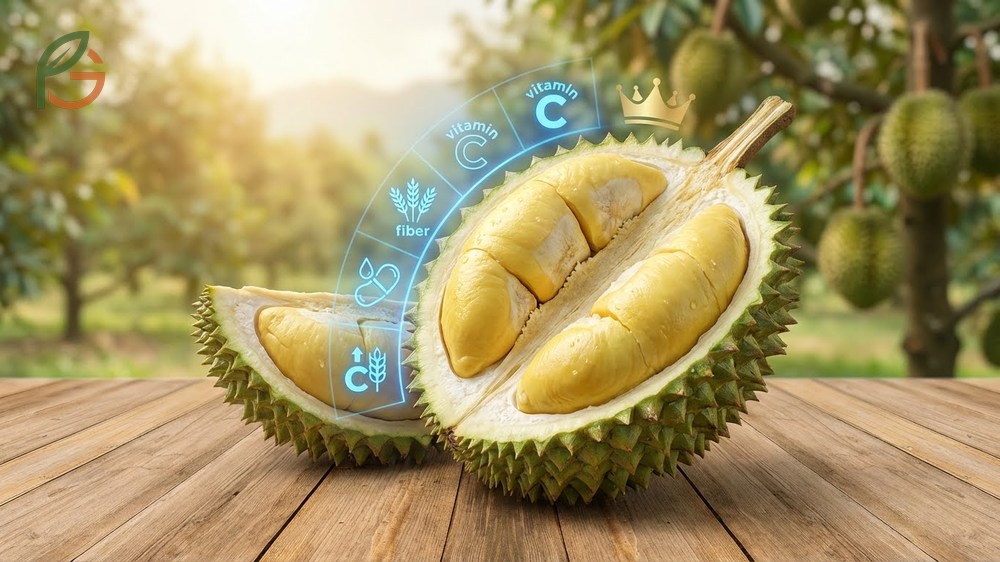
Beyond calories, durian delivers an impressive array of nutrients that justify its “king of fruits” title. Current nutritional analysis shows that 100g of durian provides 1.47g protein, 27.1g carbohydrates, and 5.33g total fat[2]. You’re also getting 3.8g of dietary fiber, which represents about 14% of your daily fiber needs in just 100g of fruit.
The vitamin and mineral profile is where durian really shines. A single cup (243g) delivers 80% of your daily vitamin C requirement, 61% of thiamine (B1), and 23% of potassium[7]. That’s more vitamin C than an orange and more potassium than a medium banana.
Macronutrients Breakdown
The macronutrient distribution in durian is unusual for a fruit. Studies demonstrate that carbohydrates make up about 67% of durian’s caloric content, fats contribute 30%, and protein accounts for just 4%. This 67-30-4 split creates durian’s unique energy profile that’s both quick-burning (from carbs) and satisfying (from fats).
Those 27g of carbohydrates per 100g include natural sugars that provide immediate energy, while the 3.8g of fiber slows down sugar absorption. The 5.33g of fat is predominantly monounsaturated—the same heart-healthy type found in avocados and olive oil. Protein content at 1.47g per 100g is modest but still higher than most fruits.
- Carbohydrates: 27.1g total, including natural sugars and 3.8g fiber for digestive health
- Fats: 5.33g predominantly monounsaturated, supporting cardiovascular health
- Protein: 1.47g, modest but present unlike many tropical fruits
- Fiber: 3.8g insoluble fiber aids digestion and promotes gut health
- No cholesterol: Plant-based fruit with zero dietary cholesterol
Vitamins and Minerals
Durian’s micronutrient content rivals many vegetables. The vitamin C content stands at 19.7mg per 100g, delivering powerful antioxidant protection. B-vitamin levels are particularly impressive—riboflavin at 0.2mg, vitamin B6 at 0.316mg, and folate at 36μg per 100g[2].
Mineral content includes 436mg of potassium, 30mg of magnesium, 39mg of phosphorus, and trace amounts of iron and calcium per 100g[2]. That potassium level helps regulate blood pressure and supports proper muscle function, making durian beneficial for physically active individuals.
- Vitamin C (19.7mg/100g): Boosts immune function and acts as an antioxidant
- Potassium (436mg/100g): Regulates blood pressure and supports heart health
- Folate (36μg/100g): Essential for cell division and red blood cell production
- Vitamin B6 (0.316mg/100g): Aids protein metabolism and brain development
- Magnesium (30mg/100g): Supports bone health and muscle function
- Copper and Manganese: Trace minerals that support various enzymatic processes
High Calorie Fruit Considerations

While durian’s nutritional benefits are impressive, its high calorie content requires mindful consumption. Current dietary guidance emphasizes portion control—nutritionists typically recommend limiting intake to 2-3 seeds (80-120g of flesh) per serving. This provides nutritional benefits without overwhelming your daily calorie budget.
Research shows that eating durian after meals or combining it with starchy foods can lead to excessive calorie intake. The recommended approach is to treat durian as a meal replacement rather than a dessert addition. If you’re having durian, reduce your rice or bread intake by about half to maintain caloric balance.
People following specific diets need to consider durian carefully. Those on ketogenic diets will find durian too high in carbs (27g per 100g) to fit their macros. Individuals with diabetes should limit portions due to the natural sugar content and monitor blood glucose response. Athletes and highly active individuals, however, can leverage durian’s calorie density for quick energy replenishment.
- Portion control: Stick to 2-3 seeds (80-150g flesh) per serving to avoid overconsumption
- Meal timing: Eat durian as a meal component, not as additional dessert
- Reduce starches: Cut back on rice, bread, or pasta by half when eating durian
- Hydrate properly: Drink plenty of water to support fiber digestion
- Monitor frequency: Limit durian consumption to 2-3 times per week maximum
- Consider activity level: More active individuals can handle higher portions
- Watch processed forms: Durian chips and candy have even more calories than fresh fruit
Health Tip: If you have kidney disease, consult your healthcare provider before eating durian regularly. The high potassium content (436mg per 100g) might interfere with kidney function management.
Conclusion
The evidence is clear: durian calories per fruit can reach 900-1500 depending on size, making this tropical delicacy one of the most energy-dense fresh fruits available. With 147 calories per 100g of flesh, durian delivers substantial nutrition alongside those calories—including fiber, potassium, vitamin C, and healthy fats that most fruits lack.
Current nutritional guidance emphasizes enjoying durian mindfully rather than avoiding it entirely. When you limit portions to 2-3 seeds per serving and balance it within your overall diet, you can appreciate durian’s unique nutritional profile without sabotaging your health goals. FruitGarden encourages you to explore durian cultivation and consumption with full awareness of its caloric density, helping you make informed choices whether you’re growing these fascinating fruits or simply enjoying them seasonally.
Frequently Asked Questions
How many calories are in a whole durian fruit?
A whole durian contains approximately 900-1500 calories depending on its size, which typically ranges from 1-3 kilograms. An average 1kg durian delivers about 1350 calories, representing roughly 50-70% of most adults’ daily caloric intake. Only 20-30% of the total weight is edible flesh, so a 2kg fruit yields about 400-600g of flesh you can actually eat.
How many calories are in 100 grams of durian?
100 grams of durian flesh contains 147 calories according to USDA data. This amount also provides 27.1g carbohydrates, 5.33g fat, 1.47g protein, and 3.8g dietary fiber. That’s significantly more calorie-dense than most fruits—about 3 times the calories of an apple or orange per 100g.
Why is durian so high in calories compared to other fruits?
Durian’s high calorie content comes from its unusual combination of both carbohydrates and fats. While most fruits contain less than 1g fat per 100g, durian has 5.33g—primarily healthy monounsaturated fats. Combined with 27g of carbs per 100g, this creates the fruit’s signature creamy texture and caloric density that’s 2-3 times higher than typical fruits.
How many durian seeds should I eat per serving?
Nutritionists recommend limiting your intake to 2-3 durian seeds (about 80-150g of flesh) per serving. This provides the nutritional benefits without excessive calorie consumption. One small seed (40-50g) contains approximately 56 calories, while a large seed (80g) has about 113 calories, so 2-3 seeds deliver 112-339 calories depending on size.
Can I eat durian if I’m trying to lose weight?
You can include durian in a weight loss diet, but strict portion control is essential. Limit yourself to 1-2 small seeds and treat it as a meal replacement rather than an additional snack. The high fiber content (3.8g per 100g) can help with satiety, but the calorie density means you’ll need to reduce other foods accordingly to maintain a caloric deficit.
Is durian suitable for diabetics?
Diabetics should approach durian cautiously due to its high carbohydrate content (27g per 100g). If you choose to eat it, limit portions to 1-2 small seeds maximum, pair it with protein or healthy fats to slow sugar absorption, and monitor your blood glucose response carefully. The fiber content helps somewhat, but the natural sugar load is still significant.
What’s the difference between fresh durian and dried durian calories?
Dried durian and durian chips contain significantly more calories per gram than fresh fruit because water has been removed and oils or sugars are often added during processing. While fresh durian has 147 calories per 100g, dried durian products can exceed 300-400 calories per 100g. Always check labels on processed durian products and account for added ingredients that increase caloric density.





