
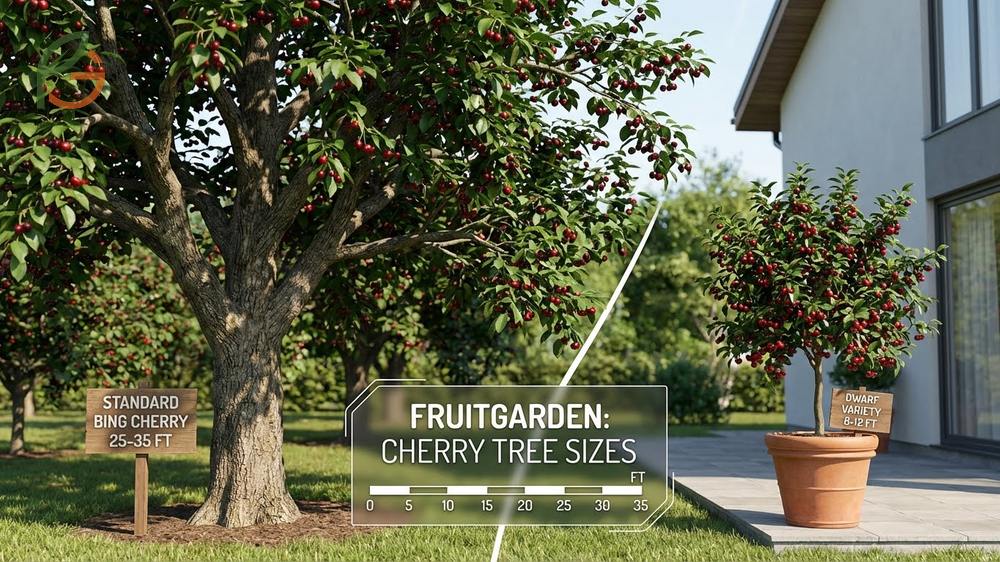
How big do cherry trees get? Cherry trees range from 8 to 35 feet tall depending on variety and rootstock.[1] Standard Bing cherries reach 25-35 feet, while dwarf varieties stay compact at 8-12 feet—perfect for patios and small yards.[2] FruitGarden synthesizes current horticultural research to help you choose the right cherry tree for your space.
Quick Answer
How Big Do Cherry Trees Get
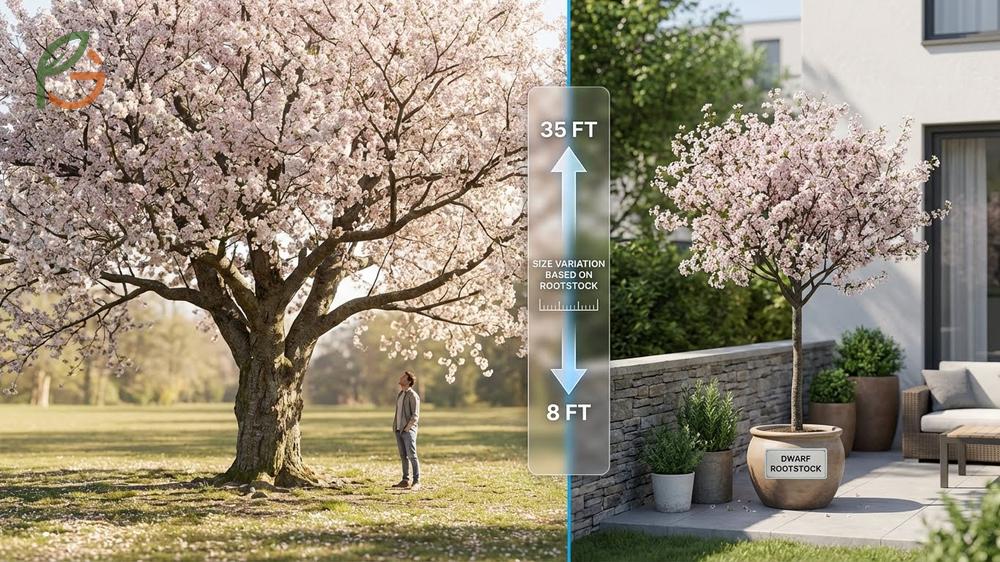
Cherry tree size varies dramatically based on variety and rootstock selection. Research shows that cherry trees can grow anywhere from 8 to 35 feet tall with similar spread.[1] The rootstock controls tree vigor more than any other factor.
Standard cherry trees on vigorous rootstocks typically reach 18-30 feet in height and width at maturity.[6] These full-size trees need considerable space and aren’t practical for small yards or urban gardens. Most gardeners today opt for semi-dwarf or dwarf varieties that deliver full-size fruit on smaller, more manageable trees.
What often gets overlooked is that two identical cherry varieties can reach completely different mature sizes depending solely on the rootstock they’re grafted onto. A Bing cherry on standard rootstock grows to 35 feet, while the same variety on Gisela 5 rootstock stays under 12 feet.[2]
Standard Cherry Tree Size
Standard cherry trees reach impressive dimensions that require careful site planning. These trees grow 18-35 feet tall with spreads of 18-25 feet, creating substantial shade canopies.[6] They’re best suited for properties with ample space and no overhead utility lines.
Standard trees take longer to begin fruiting—typically 4-7 years after planting. Their height makes harvest challenging without ladders, and bird netting becomes nearly impossible to install. Studies demonstrate these trees work well for commercial orchards but present practical challenges for home gardeners.
Dwarf Cherry Tree Varieties
Dwarf cherry trees revolutionize home fruit growing by staying compact at 8-12 feet tall.[3] These varieties produce full-size cherries while occupying minimal space. You can harvest fruit while standing on the ground, and bird netting becomes manageable.
Popular dwarf varieties include Romeo and Juliet bush cherries, which reach just 6-8 feet at maturity.[7] Carmine Jewel grows 6-8 feet tall and produces dark red, almost black cherries perfect for drying and freezing. These compact trees begin fruiting 2-3 years after planting—much faster than standard varieties.
- Fit in small yards, patios, and urban gardens where space is limited
- Allow ground-level harvest without ladders or special equipment
- Easier to cover with bird netting to protect ripening fruit
- Begin producing fruit 2-3 years after planting versus 4-7 years for standards
- Require less pruning and maintenance due to compact growth habit
- Can be grown successfully in large containers on decks or balconies
How Long Do Cherry Trees Live
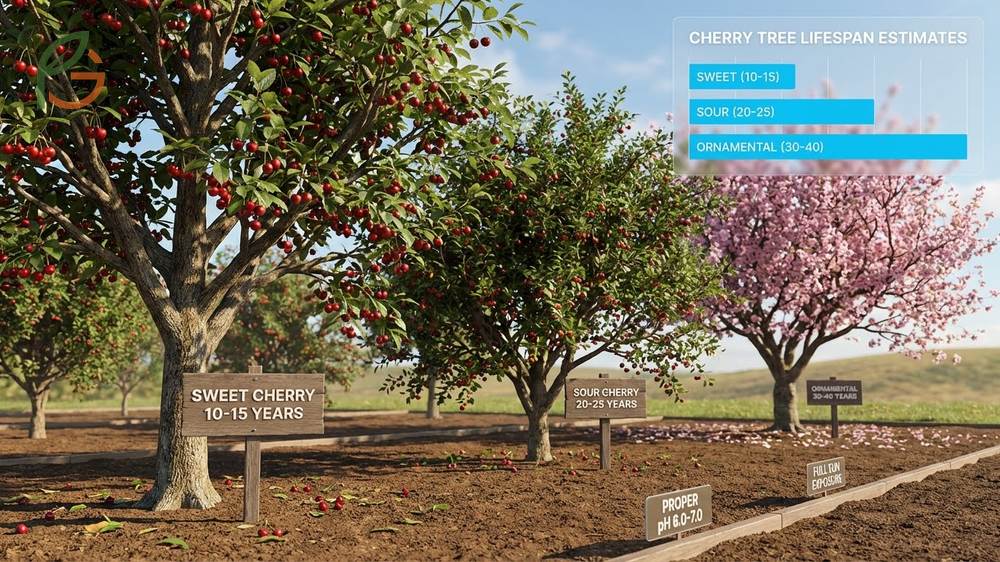
Cherry tree lifespan depends primarily on whether you’re growing fruit-bearing or ornamental varieties. Current data indicates that sweet cherry trees live 10-15 years, while sour cherries survive 20-25 years.[4] Ornamental flowering cherries can thrive for 30-40 years with proper care.
Environmental conditions dramatically affect longevity. Cherry trees growing in well-drained soil with proper pH levels (6.0-7.0) and full sun exposure live longer than those in suboptimal conditions. Overly wet, poorly drained soil proves particularly detrimental and can cut a tree’s life short by years.[4]
Most people don’t realize that regular pruning and disease management can extend a cherry tree’s productive years by 30-50%. Trees that receive consistent care—including proper watering, fertilization, and pest control—consistently outlive neglected specimens.
Fruit-Bearing Cherry Tree Lifespan
Fruit-bearing cherry trees channel significant energy into annual crop production, which shortens their lifespan compared to ornamental varieties. Sweet cherry trees typically live 10-15 years, while sour or tart cherry varieties survive 20-25 years.[4] The difference stems from sour cherries’ greater disease resistance and cold hardiness.
Evidence suggests that trees in commercial orchards often have shorter lifespans than backyard specimens. Commercial growers replace trees after 15-20 years when production declines below profitable levels. Home gardeners who maintain their trees carefully report productive lifespans extending to 25 years for sour cherries.
Important Note: Cherry trees showing declining fruit production, yellowing leaves, or extensive bark damage may be nearing the end of their productive life. These signs typically appear 2-3 years before the tree stops producing fruit entirely.
Ornamental Cherry Tree Longevity
Ornamental cherry trees, prized for their spectacular spring blossoms, generally live 30-40 years.[4] Japanese flowering cherries and weeping varieties fall into this category. These trees direct less energy toward fruit production, allowing them to maintain vigor longer than fruit-bearing types.
Research shows that ornamental cherries in ideal conditions—full sun, well-drained soil, and protection from harsh winds—occasionally survive 50+ years. Proper pruning to remove dead or diseased wood, combined with regular inspections for pests and diseases, maximizes their decorative value across decades.
Rootstock Influence on Size
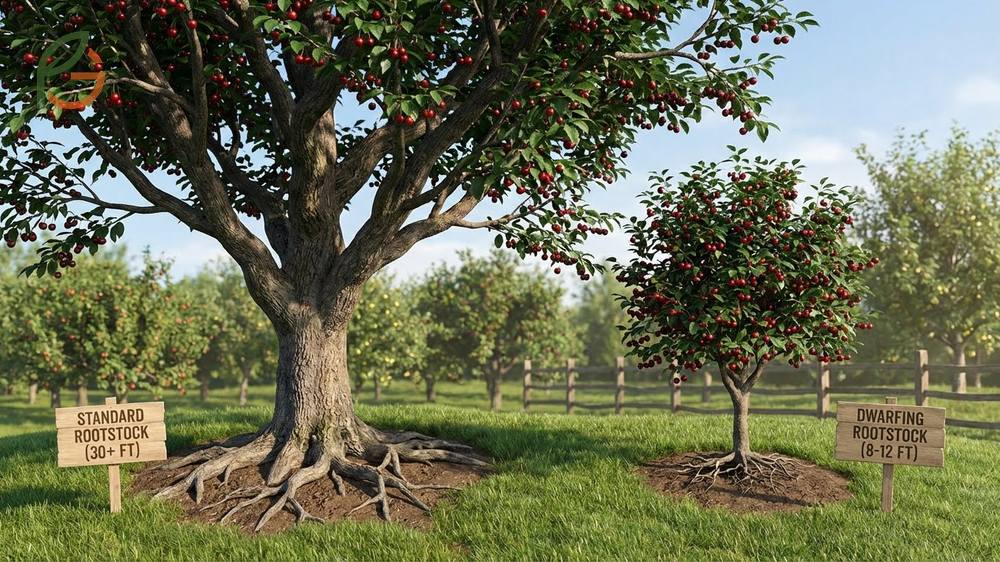
Rootstock selection determines final tree size more than any other factor in cherry cultivation. The rootstock—the root system onto which your desired cherry variety is grafted—controls tree vigor, mature size, and even fruiting precocity. Standard rootstocks produce trees reaching 30+ feet, while dwarfing rootstocks limit growth to 8-12 feet.[1]
This can be confusing because you can buy the same cherry variety—say, Bing or Rainier—with completely different rootstocks. A Bing on Mazzard rootstock grows to 35 feet tall, while a Bing on Gisela 5 rootstock stays under 12 feet. The fruit quality remains identical; only the tree size changes.
Agricultural data shows that dwarfing rootstocks bring trees into production 1-2 years earlier than standard rootstocks. This happens because smaller trees reach maturity faster and channel energy into fruit production rather than vegetative growth.
Gisela Rootstock Series
The Gisela rootstock series represents the most significant advancement in cherry tree size control. Gisela 5 produces trees at 50-60% of standard size, while Gisela 6 and Gisela 12 yield trees at 75% of standard dimensions.[8] These rootstocks work with most sweet cherry varieties including Bing, Rainier, and Lapins.
Research across North American trials demonstrates that Gisela rootstocks produce heavily in early years—sometimes too heavily. Trees on Gisela 5 tend to over-crop in their third and fourth years, which can result in smaller fruit size if not properly thinned. Growers combat this by removing 30-40% of developing fruit in May.
- Gisela 5 limits trees to 10-12 feet tall, ideal for high-density planting and containers
- Gisela 6 produces trees reaching 12-15 feet, offering easier management than standards
- Gisela 12 creates trees of 15-18 feet, suitable for moderate-density orchards
- All Gisela rootstocks bring trees into production within 2-3 years after planting
- Require well-drained soil and consistent irrigation due to smaller root systems
- Demonstrate excellent compatibility with major sweet cherry varieties across USDA Zones 5-8
Choosing the Right Rootstock
Rootstock selection should match your space constraints and management style. For small yards or container growing, choose Gisela 5 rootstock limiting trees to 10-12 feet. For backyard orchards with moderate space, Gisela 6 or semi-dwarf rootstocks producing 12-15 foot trees work well.
Your soil type influences rootstock performance. Gisela rootstocks perform best in well-drained, moderately fertile soils. They struggle in heavy clay or poorly drained locations where standard rootstocks would thrive. Current guidance emphasizes matching rootstock vigor to your specific site conditions rather than choosing the most dwarfing option available.
Cherry Tree in Container
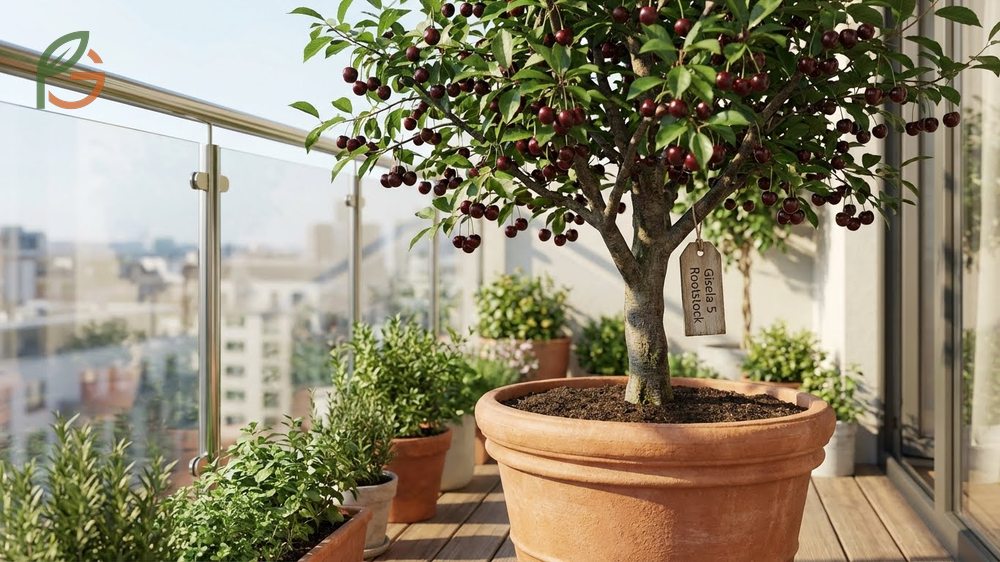
Growing cherry trees in containers opens fruit cultivation to gardeners with limited space, poor soil, or rental properties. Container growing works best with dwarf varieties on Gisela 5 rootstock, which naturally stays compact at 8-10 feet even without root restriction.[9] Sour cherry varieties adapt better to container life than sweet cherries.
Container-grown cherries produce 20-40% less fruit than ground-planted trees, but the fruit quality remains excellent. You can move potted trees to protected locations during harsh weather or relocate them to optimize sun exposure throughout the season. This flexibility proves valuable in regions with unpredictable spring frosts that damage blossoms.
From My Experience: My cousin in Guadalajara, Mexico grew a Stella cherry in a container on their apartment balcony starting in March 2023. The tree reached 6 feet tall by its second season versus the typical 8-10 foot height for ground-planted specimens, but produced 4 pounds of cherries—proving containers work for small-space gardeners.
Best Pot Size for Cherry Trees
Cherry trees need substantial containers to thrive. Research shows that pots should be at least 18-20 inches wide and equally deep for adequate root development.[5] Terracotta pots and half-barrels work well because they provide weight stability and good air circulation to roots.
As trees mature, they’ll need repotting every 2-3 years into containers 2-4 inches larger in diameter. You’ll know it’s time when roots circle the container’s interior or emerge from drainage holes. Use quality loam-based compost like John Innes No. 3 mixed with horticultural grit for improved drainage.
- Minimum container size: 18-20 inches diameter and depth for young trees
- Mature trees require 24-30 inch containers to support adequate root systems
- Drainage holes are essential—standing water kills cherry trees within weeks
- Use loam-based potting mix rather than lightweight potting soil for stability
- Position containers on pot feet or bricks to ensure drainage hole clearance
- Plan to water container cherries 2-3 times weekly during summer versus once weekly for ground-planted trees
Fertilizing Potted Cherry Trees
Container-grown cherry trees need more frequent fertilization than ground-planted specimens because nutrients leach from containers with each watering. Apply balanced 10-10-10 or 5-10-10 fertilizer monthly from March through July. Stop fertilizing after mid-summer to allow trees to harden off before winter.
For a 6-foot potted cherry tree in a 20-inch container, use 2-3 tablespoons of granular fertilizer per application, scratched into the soil surface. Too much nitrogen encourages excessive leafy growth at the expense of fruit production. Cherry trees are light nitrogen feeders, so the phosphorus and potassium numbers in your fertilizer matter more than the nitrogen content.
Fertilization Tip: Container cherries benefit from slow-release fertilizers applied in early spring. These formulations provide steady nutrition for 3-4 months, reducing the risk of over-fertilization while simplifying your maintenance schedule.
Popular Cherry Tree Sizes
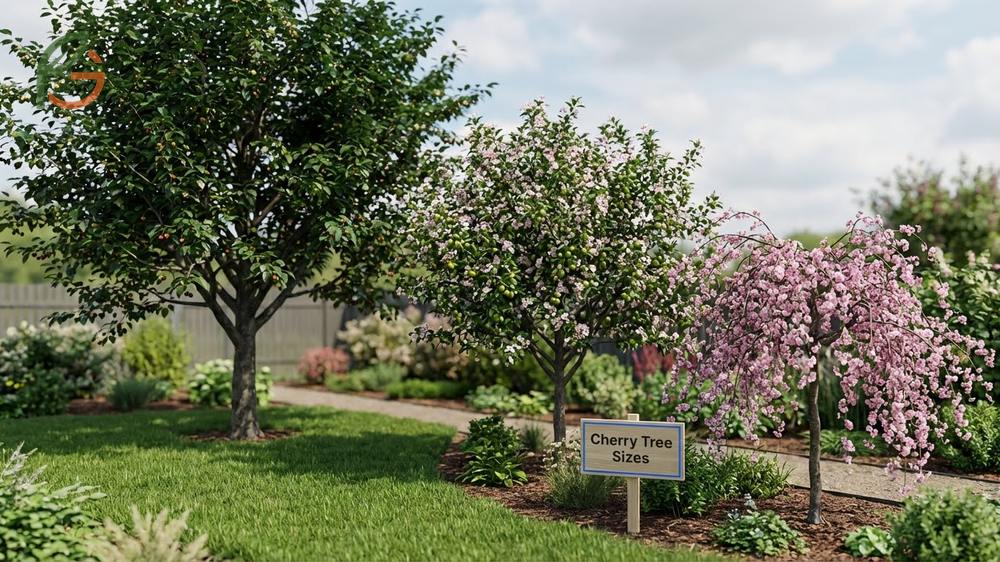
Specific cherry varieties demonstrate predictable growth patterns that help you plan your garden layout. The most popular varieties—Bing, Stella, and weeping ornamentals—each have distinct size characteristics. Understanding these differences ensures you select trees that fit your available space without requiring excessive pruning.
Variety selection impacts more than just size. Sweet cherries like Bing and Rainier typically need cross-pollination from another variety, while self-fertile varieties like Stella produce fruit alone. This affects how many trees you’ll need and consequently how much space your cherry planting requires.
This table compares mature height, spread, and rootstock type for five popular cherry tree varieties including standard and dwarf forms
| Variety | Standard Height | Dwarf Height | Spread | Best Rootstock |
|---|---|---|---|---|
| Bing Cherry | 25-35 feet[2] | 12-15 feet[2] | 20-25 feet | Gisela 5 for dwarf |
| Stella Cherry | 10-15 feet[10] | 8-10 feet | 8-12 feet | Semi-dwarf standard |
| Weeping Cherry | 15-25 feet[11] | 8-12 feet (grafted) | 15 feet | Top-grafted ornamental |
| Romeo Bush Cherry | 6-8 feet[7] | N/A (naturally dwarf) | 6-8 feet | Own roots (not grafted) |
| Carmine Jewel | 6-8 feet[7] | N/A (naturally dwarf) | 6-8 feet | Own roots (not grafted) |
Bing Cherry Tree Size
Bing cherry trees rank as the most popular sweet cherry variety in North America, valued for their large, dark red fruit. Standard Bing trees reach 25-35 feet tall with spreads of 20-25 feet at maturity.[2] These dimensions demand considerable yard space—at least 400-600 square feet per tree.
Dwarf Bing cherries on Gisela 5 rootstock stay compact at 12-15 feet tall with 8-12 foot spreads. They produce the same large, sweet cherries as standard trees but begin fruiting 2-3 years earlier. Most homeowners choose dwarf Bing trees because they fit small yards and allow easier harvest without ladders.
Stella Cherry Tree Size
Stella cherry trees grow naturally smaller than Bing, reaching 10-15 feet tall on semi-dwarf rootstock.[10] Their compact habit makes them ideal for small gardens and container growing. Stella’s self-fertile nature means you need only one tree for fruit production—a significant space advantage over varieties requiring pollinators.
These trees spread 8-12 feet at maturity, creating a manageable canopy that’s easy to net against birds. Stella cherries work exceptionally well for patio gardens and urban lots where space comes at a premium. They produce heavily for trees their size—often yielding 30-50 pounds of fruit annually once established.
Weeping Cherry Tree Size
Weeping cherry trees, grown primarily for ornamental spring blossoms, typically reach 15-25 feet tall with 15-foot spreads.[11] Their graceful, cascading branches create dramatic focal points in landscapes. Top-grafted weeping varieties stay smaller—usually limited to the height of the trunk at grafting time, typically 6-8 feet.
Evidence suggests that weeping cherries live 30-40 years with proper care, making them long-term landscape investments.[4] They require minimal pruning beyond removing dead wood and shaping the canopy. Their size makes them suitable for medium to large yards where their weeping form has room to develop fully.
Pruning for Size Control
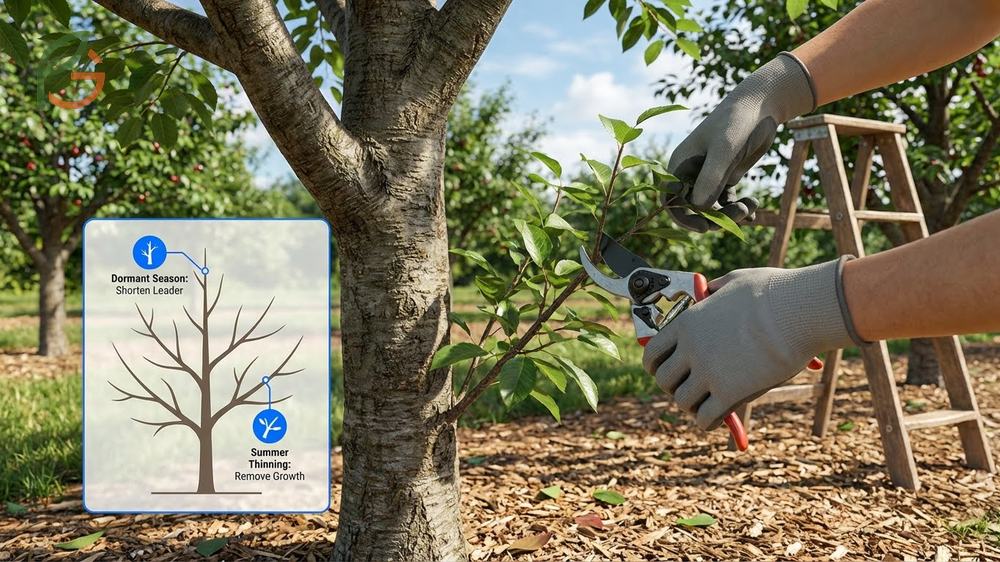
Strategic pruning keeps cherry trees within desired size limits while maintaining fruit production. Summer thinning cuts remove excess vegetative growth and help control tree size without stimulating vigorous regrowth.[12] This approach works better than heavy dormant-season pruning, which often triggers excessive spring growth.
For height control, shorten the leader (main trunk) to your desired tree height during the dormant season. This encourages bushier growth among lower branches rather than upward extension. You can maintain cherry trees at 8-10 feet indefinitely through annual pruning, even if they’d naturally grow to 15-20 feet.
Research shows that removing entire branches (thinning cuts) controls size more effectively than cutting branches back partway (heading cuts). Thinning cuts leave no stubs and don’t stimulate regrowth as aggressively. Focus on removing branches growing toward the tree’s interior or crossing other limbs.
- Prune cherry trees in late summer (July-August) to minimize disease risk and vigor response
- Remove water sprouts (vigorous vertical shoots) as soon as they appear to prevent wasted energy
- Maintain 45-60 degree branch angles by removing upright branches and keeping spreading ones
- Limit annual pruning to 20-30% of the tree’s canopy to avoid stress and reduced fruiting
- Cut branches back to the branch collar—don’t leave stubs that invite disease infection
- Space scaffold branches 8-12 inches apart vertically for optimal light penetration and air circulation
Pruning Caution: Don’t prune cherry trees during wet weather or when temperatures drop below 40°F (4°C). Pruning wounds made in these conditions heal poorly and become entry points for bacterial canker and other diseases that significantly shorten tree lifespan.
Conclusion
The evidence is clear: how big do cherry trees get depends entirely on variety selection and rootstock choice. You can grow cherries in spaces ranging from 6 feet (dwarf bush varieties) to 35 feet (standard trees), making them adaptable to nearly any landscape. Dwarf varieties on Gisela 5 rootstock deliver full-size fruit on compact 8-12 foot trees perfect for small yards and containers.
Current horticultural guidance emphasizes selecting trees that match your space constraints rather than fighting a tree’s natural size through constant pruning. FruitGarden recommends dwarf or semi-dwarf varieties for most home gardeners—they fruit earlier, simplify harvest, and integrate seamlessly into landscape designs. With proper variety selection and basic care, you’ll enjoy fresh cherries for 15-25 years from fruit-bearing trees or admire ornamental blossoms for 30-40 years.
Frequently Asked Questions
How tall do cherry trees grow in 5 years?
Cherry trees on dwarf rootstock reach 6-8 feet tall in 5 years, while semi-dwarf varieties grow 8-12 feet during the same period. Standard cherry trees achieve 10-15 feet of height by year five and continue growing for another 5-10 years before reaching mature size. Growth rate depends on rootstock, soil quality, and pruning practices.
Can you keep cherry trees small with pruning?
Yes, you can maintain cherry trees at 8-10 feet through annual summer pruning. Summer pruning is particularly effective for size control because it removes energy-producing leaves before they store carbohydrates for winter, reducing overall tree vigor. By topping the central leader and shortening branches, you can keep even semi-dwarf trees manageable for backyard harvest.
How much space do cherry trees need?
Standard cherry trees require 35-40 feet of spacing between trees to accommodate their large canopies and root systems. Semi-dwarf varieties need 15-20 feet of space, while dwarf trees on Gisela rootstocks can be planted just 8-10 feet apart. Proper spacing ensures adequate air circulation and sunlight penetration, which are crucial for preventing fungal diseases.
How long does it take for a cherry tree to bear fruit?
Dwarf cherry trees typically begin bearing fruit 2-3 years after planting. Standard cherry trees take significantly longer, often requiring 4-7 years to produce their first substantial harvest. Factors like soil fertility, sunlight exposure, and proper pruning influence how quickly a tree reaches maturity and begins fruiting.
Do I need two cherry trees to get fruit?
It depends on the variety. Most sweet cherries (like Bing and Rainier) are self-sterile and require a second, compatible variety for cross-pollination to produce fruit. However, sour cherries and specific sweet varieties like Stella and Lapins are self-fertile, meaning a single tree will produce fruit without a pollinator partner.
What is the smallest cherry tree variety?
The smallest cherry trees are bush cherries like the Romeo, Juliet, and Carmine Jewel varieties from the University of Saskatchewan. These naturally dwarf shrubs grow only 6-8 feet tall on their own roots. Among grafted trees, varieties on Gisela 5 rootstock are the smallest, keeping trees under 10-12 feet.
Can cherry trees grow in pots permanently?
Yes, dwarf cherry trees can thrive in pots permanently if cared for correctly. Use a container at least 20-24 inches wide and deep, ensure excellent drainage, and use a dwarf variety like Stella or a bush cherry. You will need to refresh the soil every 2-3 years and root-prune the tree to prevent it from becoming root-bound.





