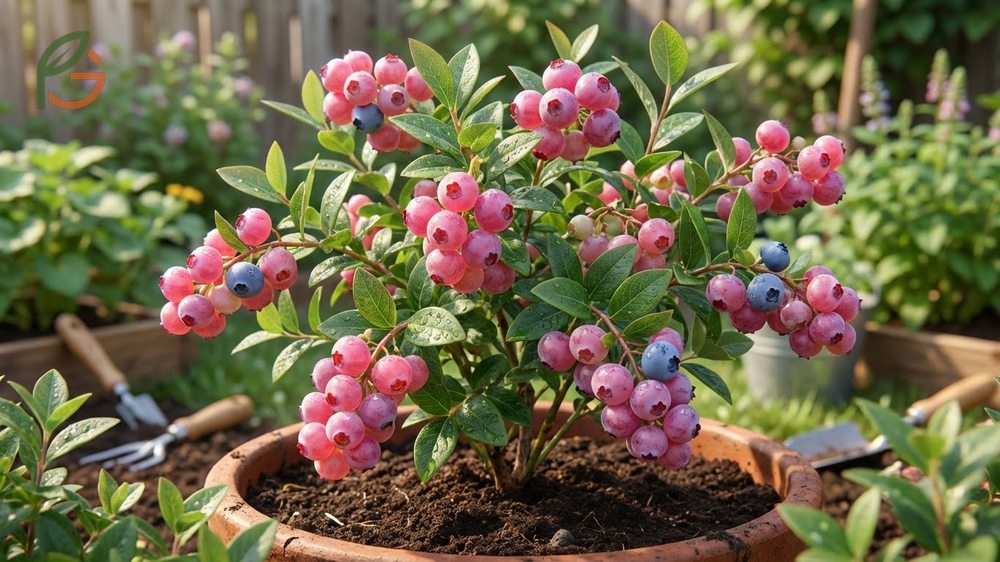
The pink lemonade blueberry plant produces stunning fuschia-pink berries with a sweet, flowery flavor and subtle citrus notes that set it apart from traditional blue varieties.[1] Research shows this unique hybrid thrives in hardiness zones 6-8 and ripens from mid to late summer.[2] FruitGarden synthesizes current agricultural research to help you successfully grow this ornamental and productive berry bush in your backyard or container garden.
Quick Answer
- Pink lemonade blueberries taste sweet with flowery notes and a tart, citrusy undertone unlike blue varieties[1]
- Hardy to -20°F (-29°C) in zones 6-8, reaching 3-5 feet tall at maturity[2]
- Requires pH 4.5-5.5 acidic soil and full sun for best berry production[3]
- Self-fertile but produces larger harvests when cross-pollinated with rabbiteye varieties
Pink Lemonade Blueberry Plant Overview
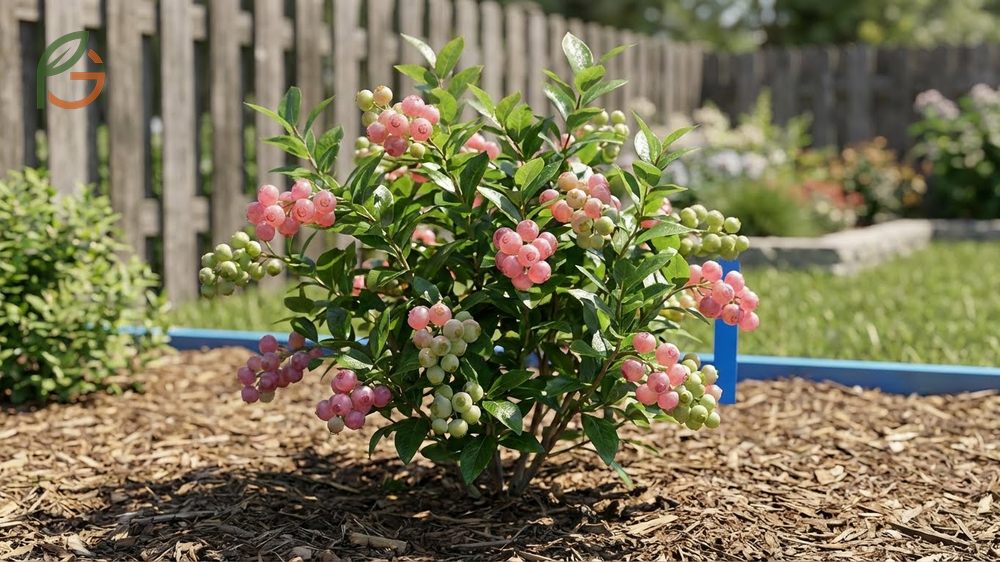
The pink lemonade blueberry is a modern hybrid variety first introduced in 2005 by the USDA Agricultural Research Service.[5] Plant geneticist Mark Ehlenfeldt developed this cross between rabbiteye and highbush blueberries to create what he describes as “the prettiest blueberry around.”[5]
This compact deciduous shrub reaches 3-5 feet in height and width at maturity, making it ideal for smaller gardens and landscape plantings.[2] The plant’s rabbiteye heritage means it only needs 300 chill hours to bloom and fruit reliably, which works well for warmer climates.[4]
From My Experience: My cousin in Guadalajara, Mexico planted a pink lemonade bush in her front yard in spring 2023. By August, neighbors stopped daily to ask about the “pink grape bush”—the unusual color really does turn heads in a landscape.
Unique Pink Berry Characteristics
Unlike traditional blueberries that turn pink before ripening to blue, pink lemonade berries are genuinely pink when fully ripe and ready to harvest. The berries start as yellow-green, then ripen to a glossy dark pink or fuschia tone.[1]
These medium-sized berries have smooth, almost translucent skin similar to red grapes, with light pink flesh inside. Birds often leave them alone because the unusual color doesn’t register as ripe fruit, giving you a better chance at harvesting your crop.[6]
Ornamental Value
Pink lemonade offers three seasons of visual interest in your landscape. Spring brings masses of bell-shaped, pinkish-white blooms that attract pollinators. Summer showcases the striking pink berries against glossy green foliage.
Fall transforms the plant again as leaves turn vibrant orange-red before dropping. This multi-season performance makes pink lemonade an excellent choice for edible landscaping where you want both beauty and function.
- Spring: Bell-shaped pink-white flowers in April-May
- Summer: Glossy dark pink berries against bright green leaves
- Fall: Orange-red foliage before leaf drop
- Winter: Attractive branching structure on deciduous shrub
- Year-round: Compact 3-5 foot form fits small spaces
Pink Lemonade Blueberry Taste

The flavor truly lives up to its name. Research describes the taste as sweet with flowery notes and a slightly tart, citrusy undertone that distinguishes it from blue-colored varieties.[1] Some growers detect hints of lemon, making these berries a refreshing treat on hot summer days.[7]
USDA plant geneticist Mark Ehlenfeldt characterizes the flavor as “sweet and flowery” with moderate yields of firm, glossy berries.[5] The taste is milder and sweeter than many highbush varieties, with a softer, thinner skin that some growers prefer for fresh eating.
Flavor Profile
The sweetness-to-tartness ratio makes pink lemonade berries versatile in the kitchen. You’ll find the sweet fruity aroma noticeable even before tasting. The citrusy notes come through most strongly when berries are fully ripe and slightly warm from the sun.
Most people find these berries best for fresh eating rather than baking, since the delicate flavor and color can fade with heat. They work beautifully in cold preparations like parfaits, smoothie bowls, and fresh fruit salads where the pink color creates visual impact.
- Fresh eating straight from the bush when fully ripe
- Smoothies and smoothie bowls (color creates rosy hue)
- Yogurt parfaits with granola and honey drizzle
- Fresh fruit salads and berry medleys
- Garnishes for desserts and cocktails
- Lightly sweetened compotes (cook briefly to preserve color)
Texture and Appearance
Pink lemonade berries are firm with a slightly dusty texture on the skin, similar to traditional blueberries. The flesh is light pink, translucent, and juicy—it easily releases liquid when bitten. Small seeds are present but barely noticeable when eating.
These berries tend to be slightly smaller than most blue highbush varieties. They bruise easily, so handle them gently during harvest and refrigerate promptly to keep them fresh for up to two weeks.[1]
Harvest Tip: Pick berries in the morning before heat exposure, and look for deep pink color with no green patches. They should come away from the stem easily when gently rolled between your fingers.
Pink Lemonade Blueberry Pollination
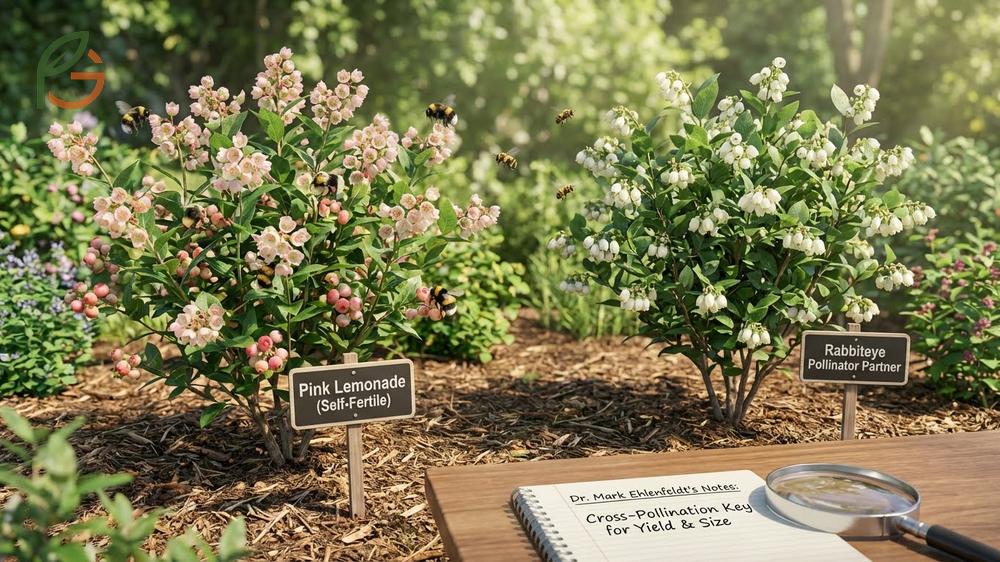
Pink lemonade is self-fertile and will produce fruit when planted alone, but cross-pollination significantly increases both yield and berry size. Current guidance from Dr. Mark Ehlenfeldt, who helped develop this hybrid, emphasizes pairing with rabbiteye varieties that bloom at the same time for best results.[8]
The plant’s rabbiteye heritage means it doesn’t reliably cross-pollinate with northern highbush varieties, though it can work if bloom times overlap.[4] For guaranteed larger harvests, you’ll want to plant it near rabbiteye cultivars rather than relying solely on highbush companions.
Best Pollinator Companions
Research shows rabbiteye varieties make the most effective pollinators for pink lemonade. Powderblue is often recommended as an excellent companion because it blooms during the same mid-season window. Tifblue and Climax also work well if you’re in zones 7-9 where rabbiteyes thrive.
If you’re limited to highbush varieties, choose mid-season bloomers and plant them close together (within 6-10 feet). While not ideal, some growers report decent pollination from Duke, Bluecrop, or other mid-season highbush cultivars that flower in April-May.
- Powderblue (rabbiteye, zones 7-9, mid-season bloom)
- Tifblue (rabbiteye, zones 7-9, mid to late season)
- Climax (rabbiteye, zones 7-9, early to mid-season)
- Brightwell (rabbiteye, zones 7-9, mid-season bloom)
- Duke (highbush, zones 5-7, mid-season if no rabbiteye available)
Bloom Timing
Pink lemonade blooms in April-May depending on your climate, with berries ripening from mid-July through August.[2] Planting pollinator-friendly flowers nearby helps ensure good bee activity during the bloom window. Lavender, sunflowers, asters, and dahlias all attract the pollinators you need for fruit set.
Most growers see fruit production start in the plant’s second or third year after planting. Yields are moderate compared to commercial highbush varieties, but the unique appearance and flavor make it worth growing even with smaller harvests.
Pink Lemonade Blueberry Hardiness Zone
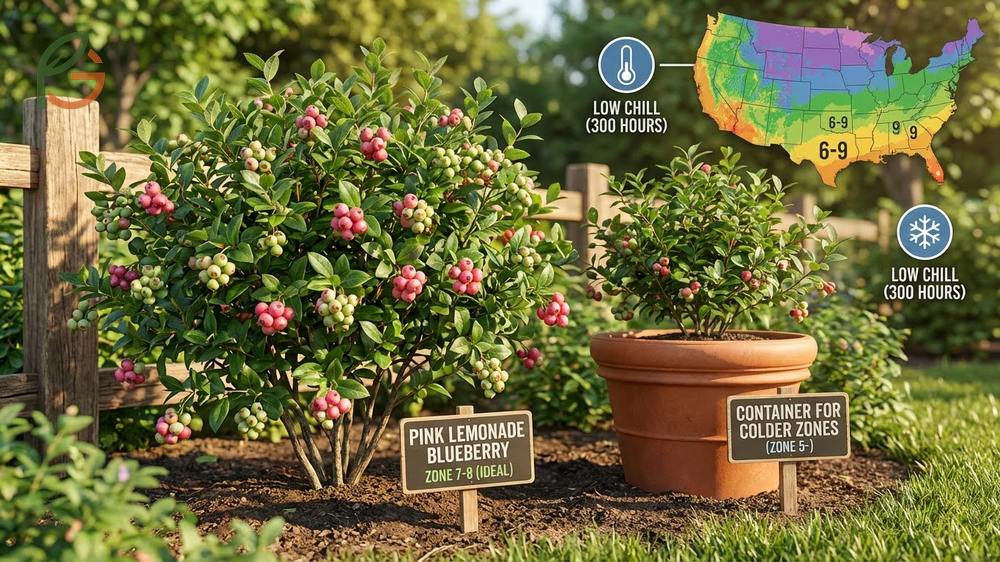
This variety is cold hardy to USDA zone 6, tolerating temperatures down to -20°F (-29°C).[2] It performs well in zones 6-8, with some success in zone 9 where the low chill requirement (300 hours) allows it to fruit reliably despite warmer winters.[4]
If you’re in zone 5 or colder, you’ll need to provide winter protection or grow in containers that can be moved to a sheltered location. Zones 7-8 offer ideal conditions, with enough chill hours to set fruit but without the harsh winters that can damage branches.
This table compares pink lemonade blueberry growing conditions across USDA hardiness zones 5 through 9, including winter low temperatures and chill hour adequacy
| USDA Zone | Winter Low Temp | Chill Hours | Performance |
|---|---|---|---|
| Zone 5 | -20 to -10°F (-29 to -23°C) | 1,000+ | Needs winter protection |
| Zone 6 | -10 to 0°F (-23 to -18°C) | 800-1,000 | Good with mulch |
| Zone 7 | 0 to 10°F (-18 to -12°C) | 600-800 | Excellent |
| Zone 8 | 10 to 20°F (-12 to -7°C) | 400-600 | Excellent |
| Zone 9 | 20 to 30°F (-7 to -1°C) | 200-400 | Good with low chill needs |
The rabbiteye parentage gives pink lemonade better heat tolerance than pure highbush varieties. This makes it a strong choice if you’re in the warmer end of the growing range where traditional blueberries struggle.
Zone Tip: If you’re on the edge of zone 6, plant on the south side of a building or fence for extra winter protection. Mulch heavily around the root zone in late fall to insulate against temperature swings.
Growing Pink Lemonade Blueberries
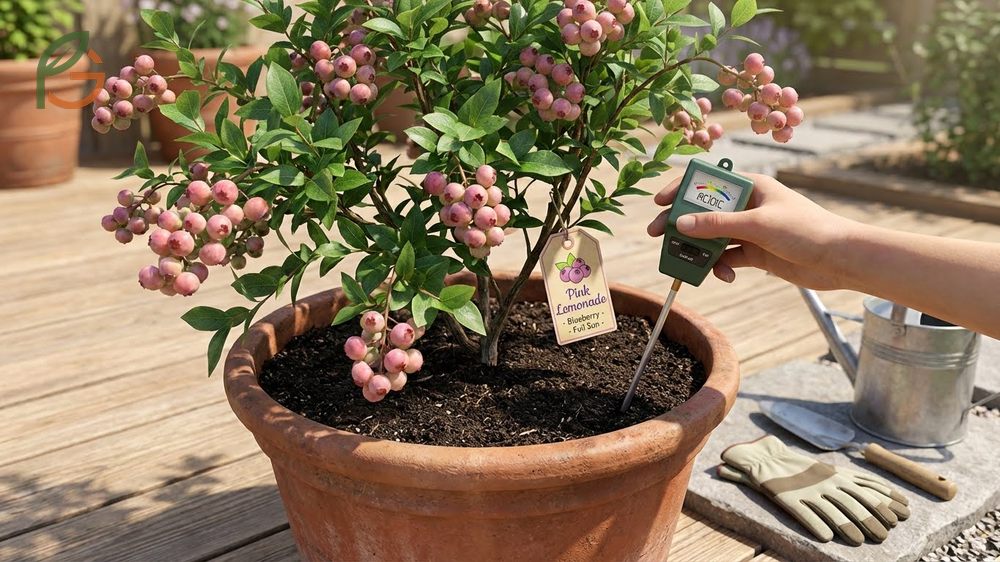
Success with pink lemonade starts with acidic soil and full sun exposure. Studies demonstrate that blueberries need 6-8 hours of direct sunlight daily for optimal berry production and flavor development. Without adequate sun, you’ll get more foliage growth and fewer fruits.
The plant adapts well to both ground planting and container growing, which makes it versatile for different garden situations. Most people find containers easier because you can control the soil pH precisely and move the plant if needed for better sun exposure or winter protection.
My friend in Oaxaca, Mexico grew pink lemonade in a large glazed pot on her sunny patio starting in 2022. She used pine bark and peat moss mix, achieving consistent harvests by mid-summer while keeping the pH at 5.0 with sulfur amendments.
Soil Requirements
Blueberries are acid-loving plants that require soil pH between 4.5 and 5.5 for proper nutrient absorption.[3] Standard garden soil and potting mixes are usually too alkaline (pH 6.5-7.0), so you’ll need to amend heavily or create a custom soil blend.
The best mix consists of equal parts peat moss (acidic), pine bark (for aeration), and perlite or sand (for drainage).[3] Test your soil pH twice yearly and adjust with sulfur if it drifts above 5.5, since deviations hinder nutrient absorption and plant health.
- Test existing soil pH with a reliable kit or meter
- Mix equal parts peat moss, pine bark, and perlite for new plantings
- Add elemental sulfur to lower pH if starting above 6.0
- Incorporate 2-3 inches of compost for organic matter
- Ensure excellent drainage (blueberries won’t tolerate waterlogged roots)
- Retest pH every 6 months and adjust as needed with sulfur or lime
Container Growing
Pink lemonade’s compact 3-5 foot size makes it ideal for large containers. Use a pot at least 18-24 inches in diameter and depth to give roots adequate space to spread. Unglazed terra cotta works but dries out quickly, so glazed ceramic or resin pots often perform better for consistent moisture.
Fill containers with ericaceous (acid-loving plant) potting mix or create your own using the peat-bark-perlite formula. Container-grown plants dry out faster than ground plantings, so you’ll need to water more frequently—check daily during hot summer weather.
Container Tip: Use rainwater for irrigation when possible. Tap water often contains lime that gradually raises soil pH above the ideal range, requiring more frequent sulfur applications to correct.
Watering and Care
During the first growing season, water every two weeks to establish the root system. Keep soil consistently moist but not waterlogged—if puddles remain an hour after watering, you’re giving too much. Once established after year one, you can reduce frequency slightly but never let the soil dry out completely during the growing season.
Fertilize in early spring with a granular or liquid acid fertilizer formulated for blueberries, azaleas, or rhododendrons. Prune in late winter before new growth starts, removing dead or damaged branches and thinning crowded areas. After harvest, prune non-fruiting branches to direct energy into new growth that will fruit the following year.
- Late winter (Feb-March): Prune dead wood and thin crowded branches
- Early spring (March-April): Apply acid fertilizer before bloom
- Spring (April-May): Enjoy pink-white blooms, observe pollinator activity
- Summer (June-Aug): Water consistently, harvest ripe pink berries
- Post-harvest (Aug-Sept): Prune non-fruiting branches for next year
- Fall (Oct-Nov): Enjoy orange-red foliage, apply mulch for winter
Where to Buy Pink Lemonade Blueberry
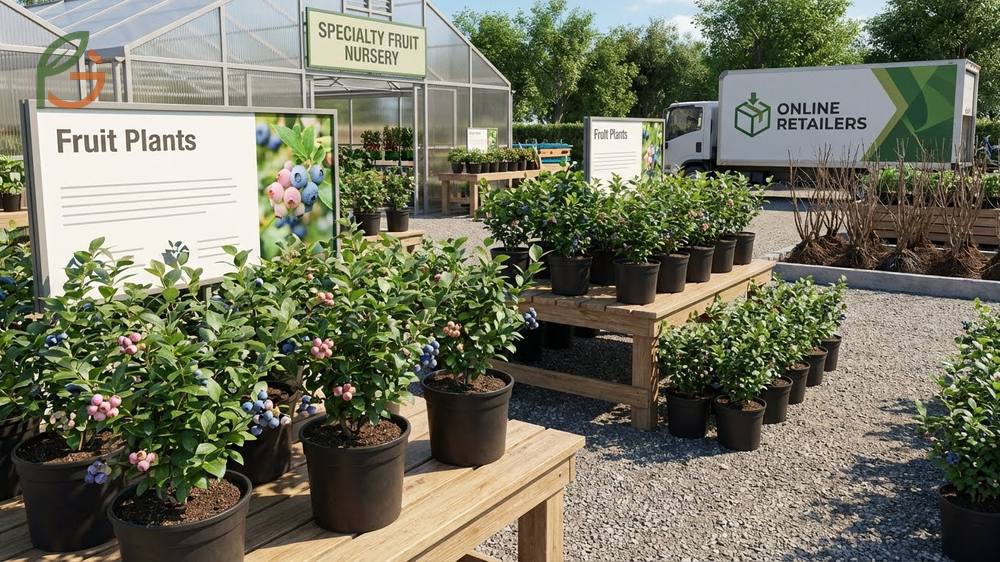
Pink lemonade plants are available from specialty fruit nurseries and online retailers, though they’re rarely found in big-box garden centers. Look for bare-root plants in late winter through early spring, or potted plants available spring through fall for immediate planting.
Reputable sources include Stark Bro’s, Raintree Nursery, One Green World, and Perfect Plants Nursery—all offer 1-2 year plants with guaranteed varietal authenticity. Prices typically range from $18-35 depending on plant size and pot. Order early in the season for best selection, since this unique variety often sells out by mid-spring.
Check your local independent nurseries too, especially those specializing in edible landscaping or rare fruit varieties. Some may special-order pink lemonade if they don’t stock it regularly, and you’ll get the advantage of selecting a specific plant rather than relying on shipped specimens.
Conclusion
The evidence is clear: pink lemonade blueberry plant delivers both ornamental beauty and unique flavor that traditional blue varieties can’t match. Its sweet, citrusy taste, stunning fuschia berries, and compact growth habit make it worth growing whether you’re planting in-ground or in containers.
Current guidance emphasizes proper soil pH management and smart pollinator pairing for maximum yields. FruitGarden helps you apply research-based growing techniques so your pink lemonade bush thrives and produces those eye-catching pink berries year after year.
Frequently Asked Questions
What do pink lemonade blueberries taste like?
Pink lemonade blueberries taste sweet with flowery notes and a slightly tart, citrusy undertone that distinguishes them from traditional blue varieties. The flavor is milder and sweeter than most highbush blueberries, with hints of lemon that make them refreshing for fresh eating.
How do you know when pink lemonade blueberries are ripe?
Pink lemonade blueberries are ripe when they turn a deep pink or purplish-red color with no green patches remaining. They should come away easily from the stem when gently rolled between your fingers. Harvest in the morning before heat exposure for best flavor and shelf life.
Does pink lemonade blueberry need a pollinator?
Pink lemonade is self-fertile and will produce fruit alone, but cross-pollination with rabbiteye varieties like Powderblue or Tifblue significantly increases both yield and berry size. Plant pollinators within 6-10 feet and choose varieties that bloom at the same time in April-May.
Can pink lemonade blueberry grow in containers?
Yes, pink lemonade’s compact 3-5 foot size makes it ideal for container growing. Use a pot at least 18-24 inches in diameter, fill it with acidic potting mix (pH 4.5-5.5), and provide full sun exposure. Container plants need more frequent watering than ground plantings, especially in summer.
What zones can pink lemonade blueberry grow in?
Pink lemonade blueberry grows best in USDA zones 6-8, with cold hardiness down to -20°F (-29°C). It performs well in zone 9 due to its low chill requirement of only 300 hours. Zone 5 gardeners can grow it with winter protection or in containers moved to sheltered locations.
How long does it take for pink lemonade blueberry to produce fruit?
Pink lemonade typically produces fruit 1-3 years after planting, depending on plant age at purchase. Two-year plants often fruit the first season after planting, while bare-root whips take 2-3 years to establish before fruiting. Expect full production by year 4-5.
Where can I buy pink lemonade blueberry plants?
Buy pink lemonade blueberry plants from specialty nurseries like Stark Bro’s, Raintree Nursery, One Green World, and Perfect Plants Nursery. Order in late winter or early spring for best selection, as this unique variety often sells out. Prices range from $18-35 depending on plant size.