
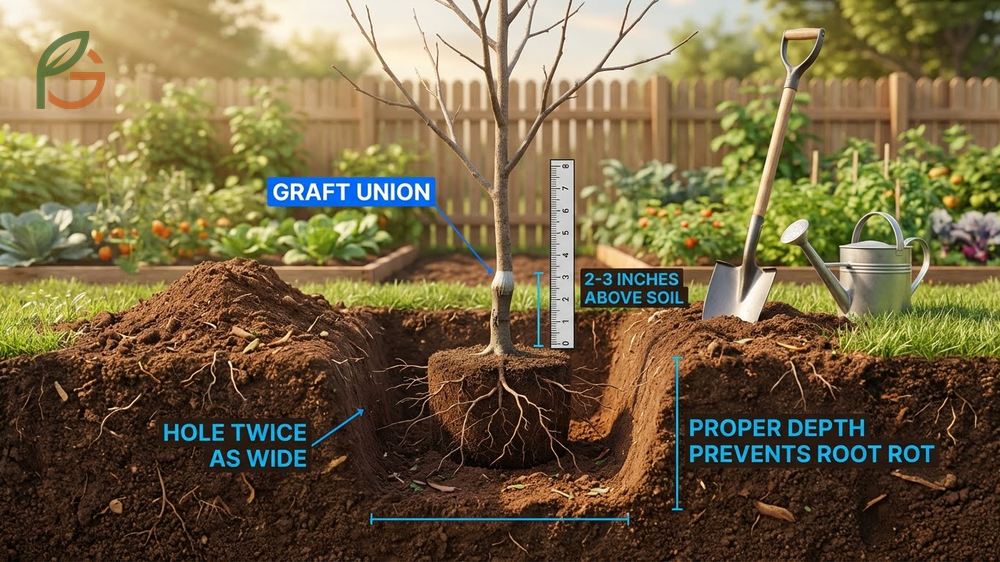
How do you plant a persimmon tree? Dig a hole twice as wide as the root ball but only as deep, position the graft union 2-3 inches above soil level, and backfill with native soil. Research shows proper planting depth prevents root rot and establishes strong growth patterns for decades.[1] FruitGarden synthesizes current horticultural data to help you grow productive persimmon trees in zones 4-10.
Quick Answer
- Space standard persimmon trees 15-20 feet apart, dwarf varieties 8-10 feet apart[2]
- American persimmons grow in zones 4-9, tolerating temperatures to -25°F[3]
- Prune during late winter dormancy, removing 20% of growth annually on mature trees[4]
- American persimmons reach 35-50 feet, Asian varieties 15-20 feet, dwarf types 8-10 feet[5]
How Do You Plant a Persimmon Tree
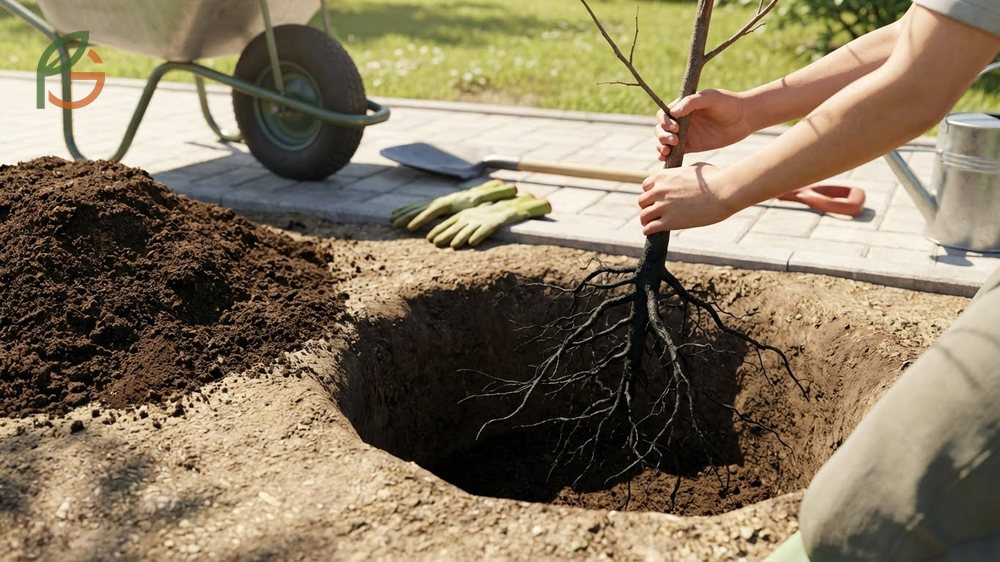
Planting a persimmon tree starts with selecting a sunny, well-drained location and preparing the soil properly. Studies demonstrate that persimmon trees develop strong taproots, requiring deeper planting holes than most fruit trees.[1] The ideal timing is late winter for bare-root trees or spring through early fall for container-grown specimens.
Most people don’t realize that persimmon roots naturally appear black, which doesn’t indicate disease or death. This characteristic can alarm first-time planters who expect white or tan roots. Position your tree so the graft union sits 2-3 inches above the final soil level to prevent rootstock sprouting and graft failure.[2]
From My Experience: My cousin in Guadalajara, Mexico planted three ‘Fuyu’ persimmon trees in February 2024. Two trees positioned in full sun established new growth within 6 weeks, while one in partial shade lagged behind by 3-4 weeks, confirming research about sun requirements.
Choosing the Right Persimmon Tree Location
Persimmon trees need full sun exposure—at least 6-8 hours of direct sunlight daily—for optimal fruit production and tree health. Research shows insufficient sunlight reduces sugar content in fruit and extends ripening time by 2-3 weeks. Choose a location away from buildings, fences, or larger trees that cast afternoon shadows.
Wind protection matters more than most gardeners expect. Strong winds can damage young branches and knock off developing fruit in early summer. Consider planting on the east or south side of your property where structures provide natural windbreaks without blocking sunlight.
Digging and Preparing the Persimmon Planting Hole
Dig a hole twice as wide as the root ball but only as deep as the root mass itself. Agricultural data shows oversized holes cause settling issues that bury the graft union too deep.[1] Create a slight mound in the center for roots to spread over, which improves drainage around the trunk.
Loosen container roots gently or spread bare roots outward before positioning the tree. Trim any circling or damaged roots with clean pruning shears. Backfill with native soil rather than amended mixes, which can create drainage boundaries that trap water and encourage root rot.
- Dig the hole twice as wide as root ball, same depth as root mass
- Create a center mound for root spread and improved drainage
- Position graft union 2-3 inches above final soil level
- Backfill with native soil, eliminating air pockets as you go
- Build a 36-inch water basin and apply 4-6 inches of mulch
Important note: Don’t amend the backfill soil with compost or fertilizer at planting time. This creates a “container effect” where roots circle inside the amended zone instead of spreading into native soil, weakening tree stability over time.
Persimmon Tree Spacing Requirements
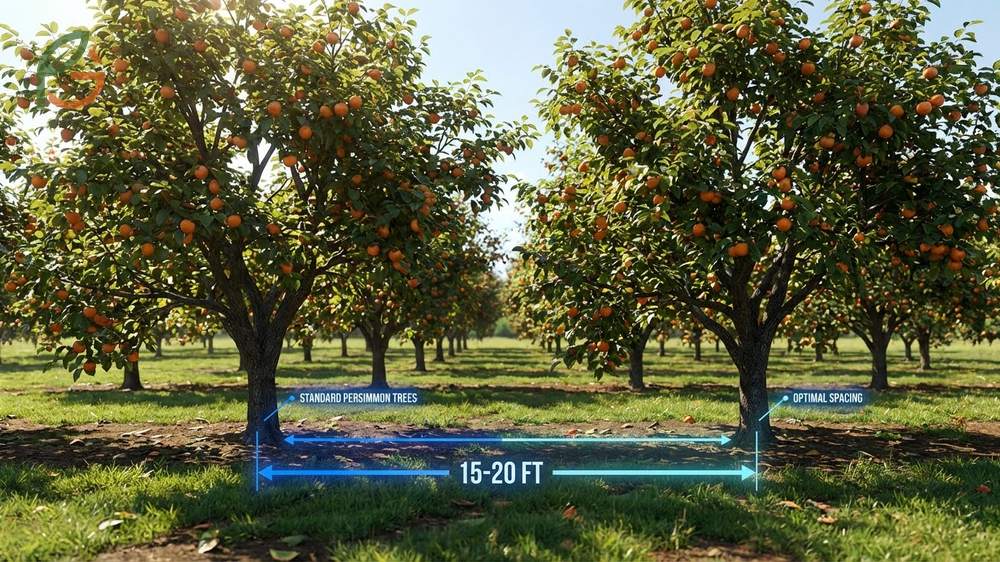
Standard persimmon trees need 15-20 feet of space between each tree to prevent root competition and ensure adequate air circulation.[2] This spacing accommodates the mature canopy spread while allowing enough sunlight to reach lower branches. Closer spacing creates dense canopies that reduce fruit production and increase disease pressure from poor air movement.
Current guidance emphasizes measuring from trunk to trunk rather than from branch tips. Trees spaced 15 feet apart work well for smaller gardens or when you’re mixing persimmons with other fruit trees. The 20-foot spacing better suits commercial orchards or homeowners who want maximum fruit production per tree with easier harvesting access.
Standard vs. Dwarf Persimmon Tree Spacing
Dwarf persimmon varieties need only 8-10 feet between trees, making them ideal for smaller yards or container growing.[2] These compact trees produce full-sized fruit despite their smaller stature. American persimmon trees require the wider 20-foot spacing since they grow larger than Asian varieties.
Commercial persimmon orchards typically plant one male pollinator tree for every eight female American persimmon trees. The male tree should sit within 30-50 feet of female trees, though wind-borne pollen can travel farther in open landscapes. Asian varieties like ‘Fuyu’ and ‘Jiro’ don’t need this pollinator spacing since most cultivars are self-fertile.
This table compares spacing requirements, mature sizes, and pollination needs across three persimmon tree types
| Tree Type | Spacing Required | Mature Height | Pollinator Needed |
|---|---|---|---|
| American Persimmon | 20 feet[6] | 35-50 feet[5] | Yes (male tree) |
| Asian Persimmon | 15-20 feet[6] | 15-20 feet[5] | Most are self-fertile |
| Dwarf Persimmon | 8-10 feet[2] | 8-10 feet[5] | Depends on variety |
Persimmon Tree Growing Zones and Hardiness
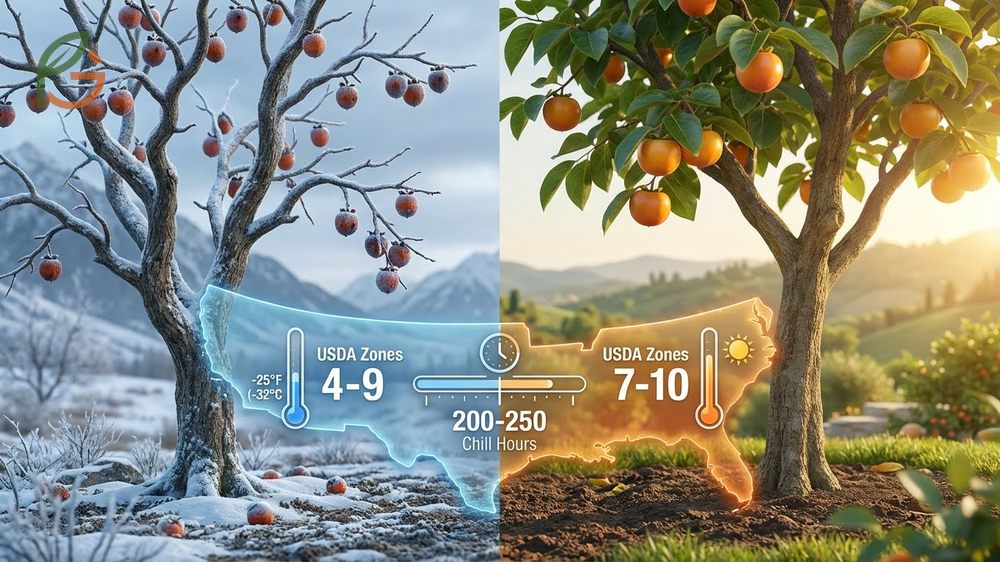
American persimmon trees thrive in USDA hardiness zones 4-9, tolerating winter temperatures as low as -25°F (-32°C).[3] This cold tolerance makes them the best choice for northern gardeners who want reliable fruit production. Asian persimmons perform better in warmer zones 7-10, requiring milder winters and longer growing seasons to ripen their larger fruit properly.
Temperature matters more than just winter survival. American persimmons need 200-250 chill hours below 45°F (7°C) during winter dormancy to set fruit properly in spring. Asian varieties need fewer chill hours—around 100-200—but they’re more sensitive to late spring frosts that damage flower buds and reduce yields.
Some cold-hardy Asian cultivars like ‘Saijo’ bridge the gap between zones 6-7, withstanding light frosts while producing sweeter fruit than American types. If you live in zone 6 or colder, stick with native American persimmons or these hardy Asian selections. Zones 8-10 give you the widest variety choices, including non-astringent ‘Fuyu’ types that don’t need frost to sweeten.
- Zone 4-6: Choose American persimmons or cold-hardy Asian cultivars like ‘Saijo’
- Zone 7-8: Both American and Asian varieties grow successfully
- Zone 9-10: Asian persimmons excel; American types may not get enough chill hours
- Consider microclimates—south-facing slopes add 1 zone of warmth
- Urban heat islands can extend your effective growing zone by half a zone
- Late spring frost dates matter more than winter minimums for flower protection
Climate tip: If your location sits on a zone boundary (like 6b/7a), choose varieties rated for one zone colder than your map designation. This builds in safety margin for unusually harsh winters that occur every 5-10 years.
How to Prune Persimmon Trees
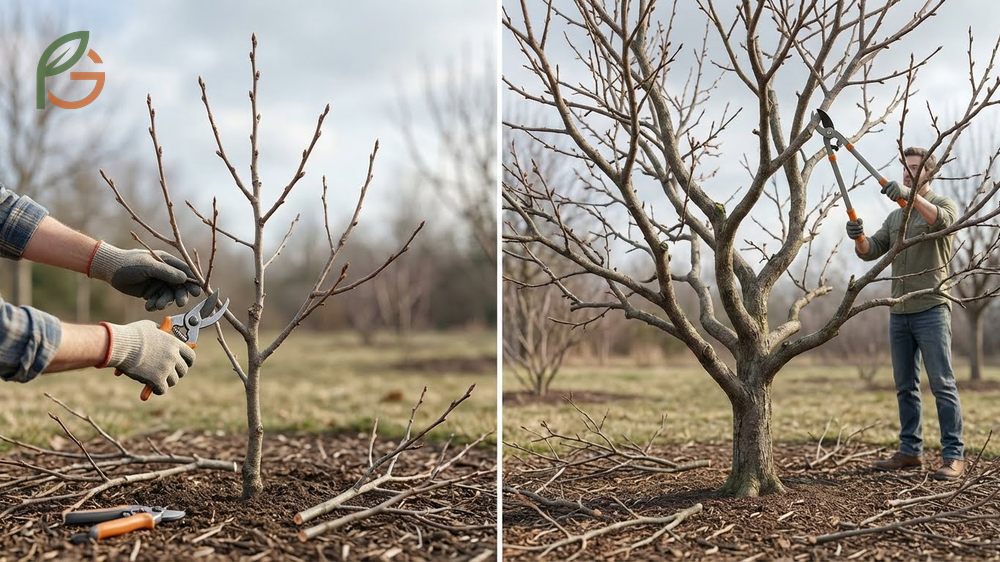
Persimmon tree pruning starts during the dormant season in late winter or early spring before new growth begins. This timing minimizes sap loss and allows the tree to focus energy on spring growth rather than wound healing.[7] Pruning during active growth can stress the tree and reduce fruit set in the current season.
The technique differs dramatically between young and mature trees. Young persimmons need aggressive structural pruning to establish strong scaffold branches, while mature trees need only maintenance pruning to remove dead wood and maintain shape. What often gets overlooked is that persimmons fruit on current-season growth, so proper pruning actually increases yields by stimulating new fruiting wood.
When to Prune Persimmon Trees
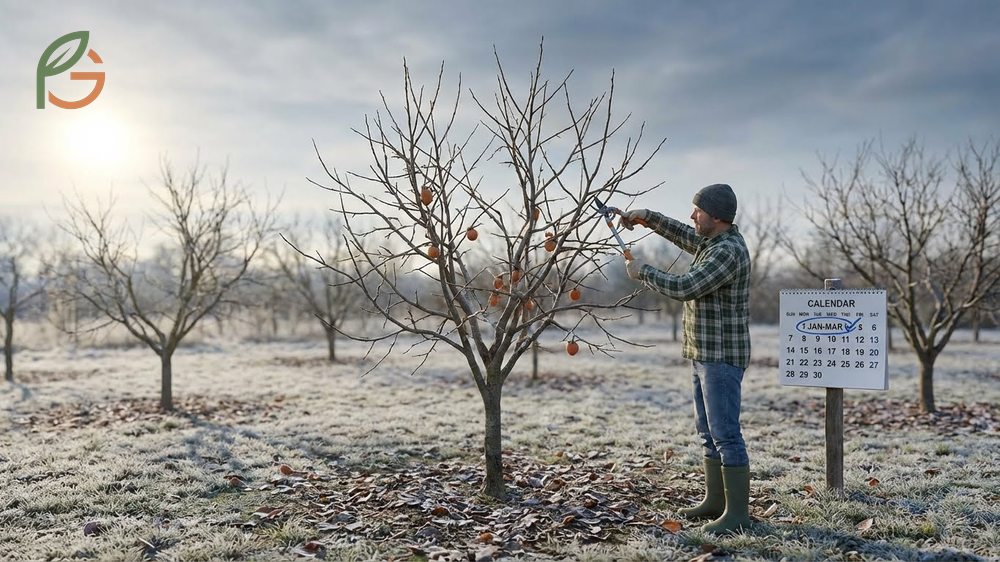
Late winter pruning works best for most gardeners, typically from January through March depending on your location. Watch for swelling buds as your signal to finish pruning—once buds break, you’ve missed the ideal window. The tree is still fully dormant but warming soil temperatures will trigger rapid wound closure when growth resumes.
Light summer pruning can help manage excessive vegetative growth on young trees. Remove water sprouts (vertical shoots from branches) in June or July to redirect energy toward fruit development. Don’t remove more than 10-15% of the canopy during summer pruning, as heavy pruning in hot weather stresses the tree and can sunburn exposed branches.
Pruning Young vs. Mature Persimmon Trees
Young persimmon trees (1-5 years old) need structural pruning to create a strong framework. Select 3-5 scaffold branches spaced evenly around the trunk, growing at wide 45-60 degree angles. Remove competing branches, narrow-angled crotches, and anything growing inward. Keep the tree’s height below 24-30 inches in the first year to build a low, sturdy structure that supports heavy fruit loads later.
Mature persimmon trees need lighter annual maintenance. Remove about 20% of total growth each year by thinning crowded branches and cutting out dead or crossing wood.[4] This opens the canopy for better sunlight penetration and air circulation, which reduces disease pressure while maintaining steady fruit production.
- Hand pruners for branches under ¼ inch diameter
- Loppers for medium branches up to 1½ inches thick
- Pruning saw for larger branches over 1½ inches
- Pole pruners for reaching high branches without ladders
- Disinfectant solution (1 part bleach to 9 parts water) for tool sanitization
- Heavy-duty gloves and safety goggles
- Sturdy ladder with non-slip feet if needed for tall trees
How Tall Do Persimmon Trees Get
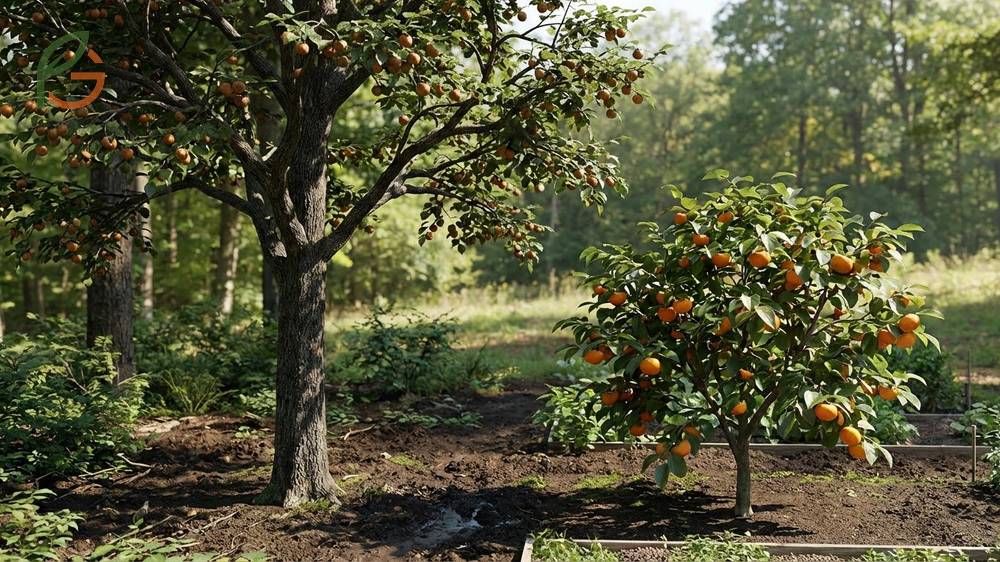
American persimmon trees reach heights of 35-50 feet at maturity, making them the largest of the persimmon types.[5] They’re slow-growing trees that take 10-15 years to reach full size, but they can live for 50-75 years once established. Native American persimmons occasionally reach 60-70 feet in optimal forest conditions with deep, moist soils.
Asian persimmon trees grow to 15-20 feet tall and wide, staying much more compact than their American cousins. This medium size makes them perfect for suburban yards where space is limited. They start fruiting earlier too—often within 3-4 years compared to 7-10 years for American types.
Dwarf persimmon varieties top out at 8-10 feet, small enough for large containers or tight spaces. Don’t worry about fruit size—dwarf trees produce the same full-sized fruit as standard trees, just on a smaller frame. You can keep them even shorter with regular pruning, maintaining heights of 6-7 feet while still getting abundant harvests.
Do You Need Two Persimmon Trees to Produce Fruit
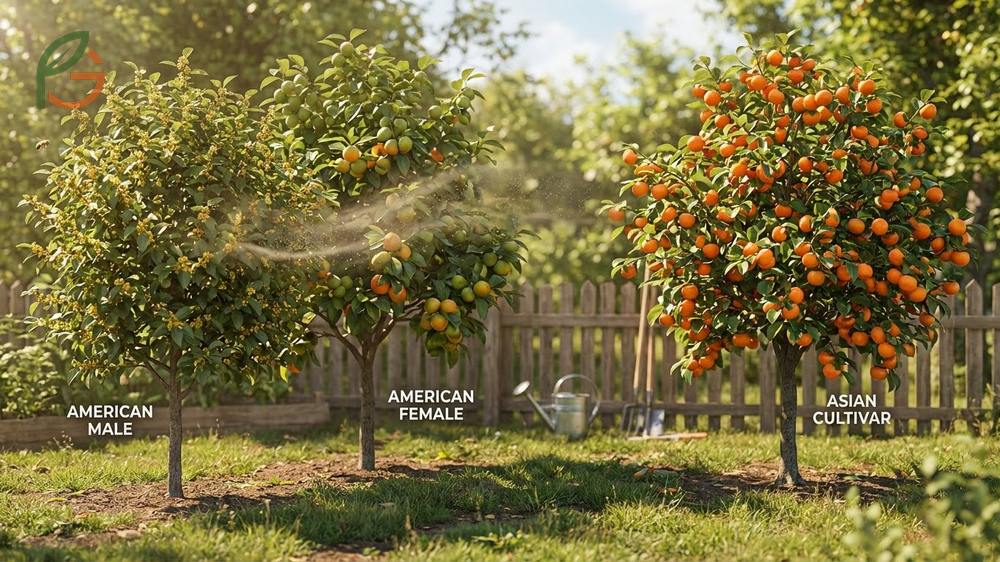
American persimmon trees are dioecious, meaning you need both a male and female tree for fruit production.[6] The female tree bears the fruit, but it can’t set fruit without pollen from a male tree nearby. Most garden centers don’t label persimmon trees by gender, so you’ll need to ask specifically for one male and one female, or buy a female tree if you have wild males in your area.
Asian persimmon cultivars typically don’t need a pollinator tree. Popular varieties like ‘Fuyu’, ‘Jiro’, and ‘Hachiya’ are self-fertile and will produce fruit when planted alone. Some Asian varieties actually produce better quality fruit without pollination—pollinated ‘Hachiya’ fruit develops dark flesh spots, while unpollinated fruit stays bright orange throughout.
If you live in the eastern United States where American persimmons grow wild, you might get lucky with a single female tree. Native male trees in nearby forests can pollinate your cultivated female from distances up to half a mile. Check with neighbors or take a late-fall walk to look for persimmon fruit on existing trees—if you find fruit, there’s a male tree somewhere in pollination range.
Persimmon Tree Care Essentials
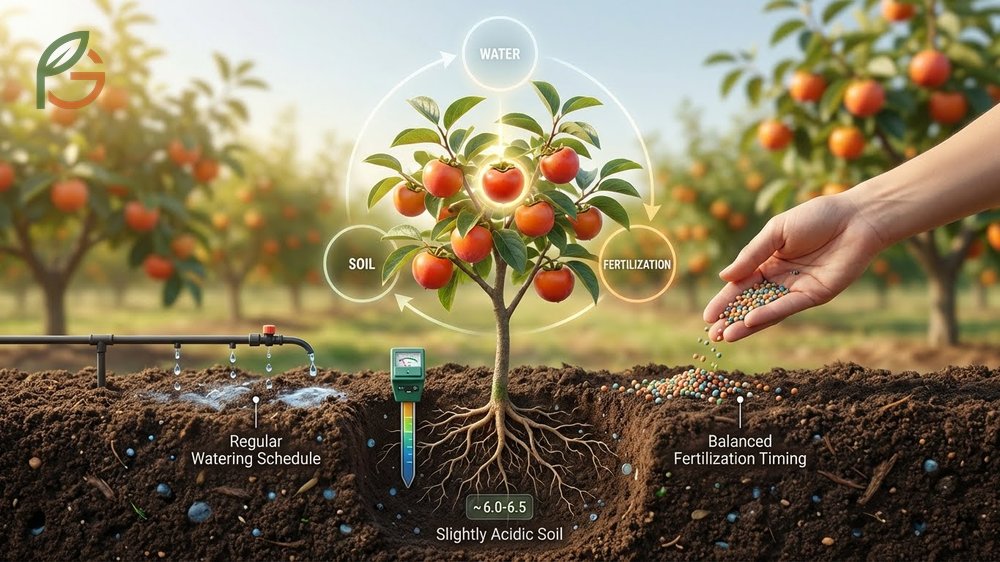
Proper persimmon tree care balances soil conditions, watering schedules, and fertilization timing to maximize fruit quality and tree health. These three factors work together—great soil can’t compensate for irregular watering, and perfect irrigation won’t fix nutrient deficiencies. Research shows consistent care routines produce better results than intensive interventions.
Soil for Persimmon Trees
Persimmon trees thrive in well-drained, slightly acidic soil with a pH between 6.0-6.5. Sandy loam provides the ideal texture, though they adapt to clay soils if drainage is improved.[3] Heavy clay soils trap water around roots, causing root rot that kills trees within 2-3 years if not corrected.
Test your soil before planting to identify pH and nutrient levels. If pH exceeds 7.0 (alkaline), add elemental sulfur at 1-2 pounds per 100 square feet to gradually lower it. For clay soil improvement, work in 3-4 inches of aged compost to the top 12 inches without creating an amended “bowl” that holds water.
Watering Persimmon Trees
Young persimmon trees need 1-2 inches of water weekly during their first growing season to establish deep roots. Water deeply but infrequently rather than giving shallow daily drinks—this encourages roots to grow downward for drought resistance. Construct a 36-inch diameter water basin around the trunk to direct water to the root zone.
Mature persimmon trees tolerate drought once established but produce better fruit with consistent moisture during fruit development from May through September. Cut back watering in late fall to harden off the tree before winter. Overwatering causes fruit to split and dilutes flavor, so aim for moist but not soggy soil.
Fertilizing Persimmon Trees
Fertilize young persimmon trees lightly in early spring with a balanced 10-10-10 fertilizer at ½ pound per year of tree age, maxing out at 2 pounds for trees under 5 years old. Spread fertilizer in a circle from the trunk to 1 foot beyond the canopy drip line. Avoid fertilizing after July, which pushes late-season growth that won’t harden off before winter.
Mature fruiting trees benefit from a split application: half in early March before bud break, and half in early June after fruit set. If trees show vigorous growth with 12-24 inches of new shoot growth annually, reduce or skip fertilization—excess nitrogen reduces fruit production and increases disease susceptibility.
- Yellowing leaves with green veins indicate iron deficiency (lower soil pH)
- Pale overall leaf color suggests nitrogen deficiency (increase fertilizer)
- Excessive vertical shoot growth means too much nitrogen (reduce fertilizer)
- Small fruit size indicates potassium deficiency (switch to higher-potassium formula)
- Poor fruit set despite good flowering suggests phosphorus need (add bone meal)
- Leaf tip burn shows over-fertilization or salt buildup (flush with deep watering)
Conclusion
The evidence is clear: successful persimmon growing hinges on proper initial planting, adequate spacing, and strategic pruning practices. How do you plant a persimmon tree correctly? Choose a sunny location with well-drained soil, space trees 15-20 feet apart (8-10 feet for dwarfs), and position the graft union 2-3 inches above soil level to prevent future problems.
Current horticultural guidance emphasizes matching tree type to your hardiness zone—American persimmons for zones 4-9, Asian varieties for zones 7-10. Prune during late winter dormancy, removing 20% of growth annually on mature trees to maintain productivity. FruitGarden combines research-based recommendations with practical growing experience to help you produce abundant persimmon harvests for decades.
Frequently Asked Questions
When is the best time to plant persimmon trees?
Plant bare-root persimmon trees in late winter during dormancy, typically January through March. Container-grown trees can go in the ground from spring through early fall, but avoid planting during extreme summer heat above 90°F (32°C). Early planting gives roots time to establish before fruit production begins.
How long does it take for persimmon trees to produce fruit?
Asian persimmon trees typically start fruiting within 3-4 years after planting, while American persimmons take 7-10 years to produce their first harvest. Grafted trees fruit earlier than seedling trees. Dwarf varieties often produce fruit 1-2 years sooner than standard-sized trees.
What are common persimmon tree pests and diseases?
Persimmon trees face few serious pests, but ambrosia beetles can attack stressed trees by drilling through bark and introducing pathogenic fungi. Angular leaf spot caused by Pseudocercospora species affects foliage in humid climates. Good air circulation from proper spacing and drainage reduces most disease problems naturally.
Do persimmon trees need full sun?
Yes, persimmon trees require at least 6-8 hours of direct sunlight daily for optimal fruit production and quality. Insufficient sunlight reduces sugar content in fruit, extends ripening time by 2-3 weeks, and decreases overall yields. Plant in the sunniest spot available for best results.
Can you grow persimmon trees in containers?
Dwarf persimmon varieties thrive in 15-20 gallon containers with well-draining potting mix. Container trees need more frequent watering than in-ground trees and benefit from regular feeding during the growing season. Choose self-fertile Asian varieties like ‘Ichi-Ki-Kei-Jiro’ for container growing.
How deep should you plant a persimmon tree?
Plant persimmon trees so the graft union sits 2-3 inches above the final soil level. Dig the hole only as deep as the root ball—not deeper—to prevent settling that buries the graft union. Planting too deep encourages rootstock sprouting and increases root rot risk significantly.
What’s the difference between American and Asian persimmons?
American persimmons grow larger (35-50 feet), tolerate colder zones (4-9), and need separate male and female trees for pollination. Asian persimmons stay smaller (15-20 feet), prefer warmer zones (7-10), and most varieties are self-fertile. Asian types typically have larger individual fruits.





