
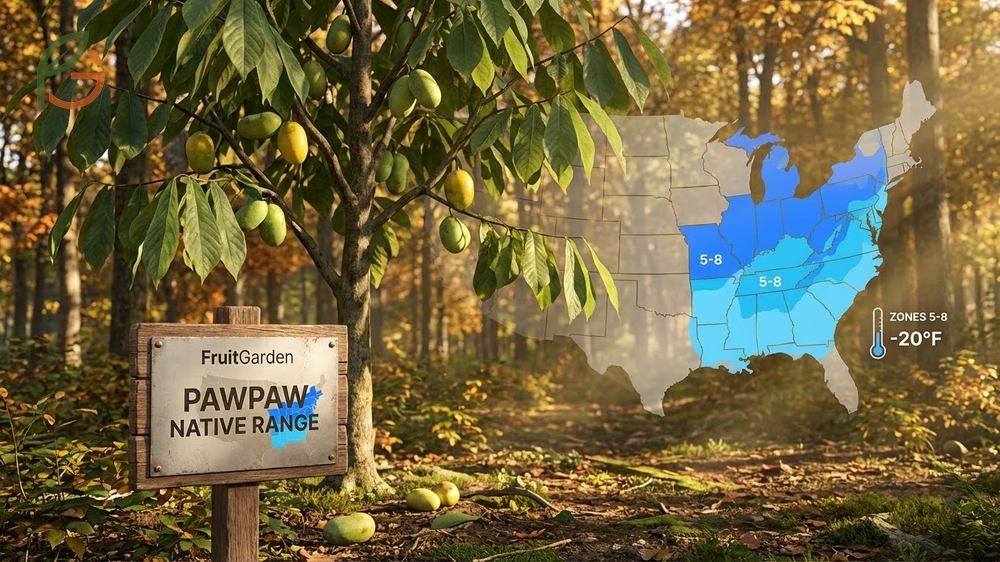
Where do pawpaw trees grow? Pawpaw trees thrive across 26 states in the eastern United States, from southern Ontario to northern Florida and west to Nebraska.[1] These native trees flourish in USDA hardiness zones 5-8, tolerating winter temperatures as low as -20°F (-28°C).[2] FruitGarden synthesizes current agricultural research and climate data to help you understand this remarkable native fruit’s range.
Quick Answer
- Pawpaw trees grow naturally in 26 eastern U.S. states[1] plus southern Ontario, Canada
- Best adapted to USDA zones 5-8[2], handling winters down to -20°F (-28°C)
- Requires 30-35 inches of annual rainfall[3] with most precipitation in spring and summer
- Thrives in moist, well-drained bottomlands and river valleys with pH 5.5-7.0[4]
Where Do Pawpaw Trees Grow
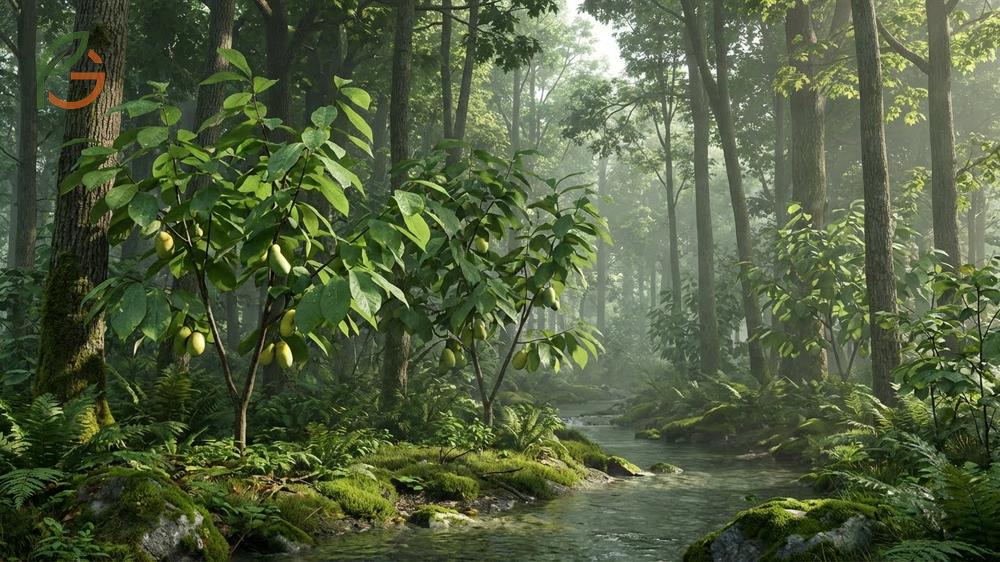
Pawpaw trees grow throughout the humid eastern United States, spanning 26 states from the Gulf Coast to the Great Lakes region.[1] The native range extends from northern Florida northward to southern Ontario and westward to eastern Nebraska, Kansas, Oklahoma, and Texas.[4] This makes pawpaw the northernmost member of the otherwise tropical Annonaceae family.
Research shows pawpaw trees naturally colonize mesic hardwood forests and riparian areas where moisture and fertility support their growth.[5] You’ll find them in forest understories, forming dense patches through clonal spreading. Unlike many pioneer species, pawpaws don’t immediately colonize disturbed sites, typically arriving four years after forest clearing.
The geographic spread covers major watersheds including the Mississippi River valley, Appalachian foothills, and Ohio River basin. States within the core range include Ohio, Indiana, Kentucky, Tennessee, Pennsylvania, Virginia, West Virginia, and the Carolinas. Populations thin toward range edges in Connecticut, Nebraska, and the Florida panhandle.
Eastern United States Distribution
The eastern distribution concentrates in states with humid temperate climates and adequate growing-season rainfall. Pawpaw populations reach their greatest density in river valleys and bottomlands from the mid-Atlantic through the Midwest. States like Ohio and Indiana contain particularly robust wild populations due to ideal soil moisture and temperature conditions.
Current data indicates pawpaw trees become scarce near Atlantic and Gulf coasts, preferring inland areas with more temperature moderation.[4] The species avoids sandy coastal soils and high salt exposure. Most coastal populations exist at least 50 miles inland where forest soils provide better growing conditions.
- Northeast: New York, Pennsylvania, New Jersey, Connecticut, Maryland, Delaware
- Mid-Atlantic: Virginia, West Virginia, North Carolina, South Carolina
- Southeast: Georgia, Florida (panhandle), Alabama, Mississippi, Louisiana
- Midwest: Ohio, Indiana, Illinois, Michigan, Wisconsin, Iowa, Missouri
- Great Plains edge: Nebraska, Kansas, Oklahoma, Texas (eastern regions)
- Upper South: Kentucky, Tennessee, Arkansas
Canadian Range Limitations
In Canada, pawpaw trees grow only in southern Ontario, representing the species’ northernmost natural limit.[4] The Canadian population holds a conservation rank of S3 (vulnerable) due to limited habitat and geographic restriction. Ontario’s Ministry of Natural Resources designates pawpaw as “Sensitive,” monitoring populations to track changes.
These Canadian populations cluster near Lake Erie’s north shore where moderated temperatures and protected microclimates permit survival. The trees benefit from the lake effect, which reduces winter temperature extremes and extends the growing season. However, the range remains confined to the province’s warmest regions.
Important Note: Pawpaw trees don’t naturally occur in Mexico, despite the similar “papaya” name confusion. The Spanish word “papaya” likely influenced the pawpaw name, but these are entirely different species with separate native ranges.
USDA Hardiness Zones for Pawpaw Trees
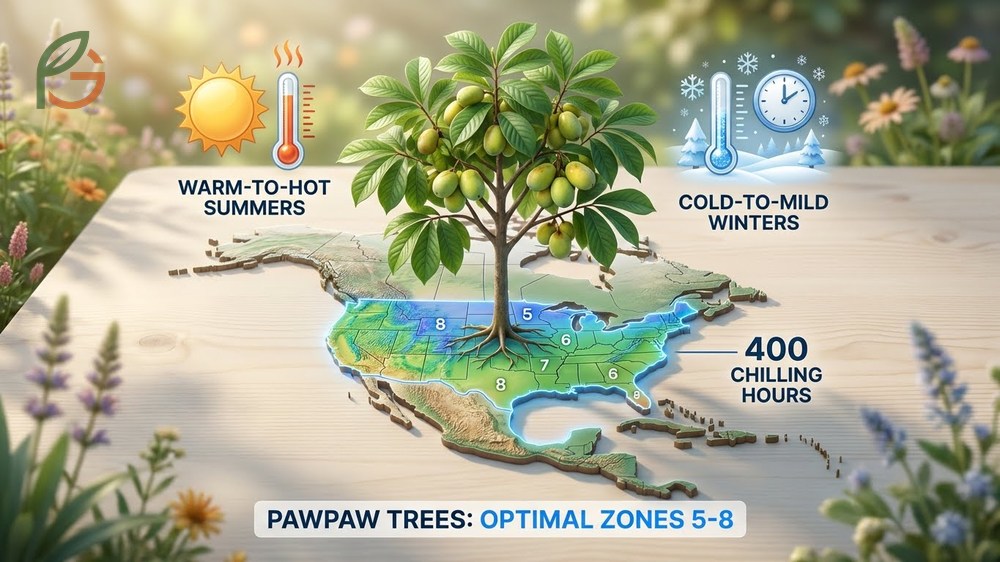
Pawpaw trees perform best in USDA hardiness zones 5 through 8, which encompasses their entire native range and provides optimal temperature conditions.[2] These zones offer the warm-to-hot summers and cold-to-mild winters that pawpaws require for proper dormancy and fruit development. Growing outside these zones becomes experimental, with success rates dropping significantly.
Studies demonstrate pawpaw trees need approximately 400 hours of winter chilling below 45°F (7°C) to break dormancy properly.[2] This requirement varies by provenance—northern-origin trees need more chilling than southern cultivars. The genetic adaptation to local climates means trees from Michigan won’t perform identically to those from Mississippi, even when planted in the same zone.
This table compares USDA hardiness zones 4 through 9, showing minimum winter temperatures in both Fahrenheit and Celsius, and the suitability for growing pawpaw trees
| USDA Zone | Minimum Temp °F | Minimum Temp °C | Pawpaw Suitability |
|---|---|---|---|
| Zone 4 | -30 to -20°F | -34 to -28°C | Experimental; requires wind protection |
| Zone 5 | -20 to -10°F[2] | -28 to -23°C | Suitable; minimum recommended zone |
| Zone 6 | -10 to 0°F | -23 to -17°C | Ideal; widespread native populations |
| Zone 7 | 0 to 10°F | -17 to -12°C | Ideal; optimal fruit production |
| Zone 8 | 10 to 20°F | -12 to -6°C | Suitable; southern range limit |
| Zone 9 | 20 to 30°F | -6 to -1°C | Marginal; insufficient chilling hours |
Zone 5 Cold Tolerance
Zone 5 represents the northern limit where pawpaw trees can reliably survive and produce fruit. Agricultural data shows mature trees withstand temperatures down to -20°F (-28°C) when properly hardened off.[2] Young trees in their first three years require winter protection, especially from harsh winds that cause desiccation damage.
Most people don’t realize that site selection matters more than zone designation alone in cold regions. Pawpaw trees planted on south-facing slopes or near buildings that provide wind breaks show significantly better survival rates. Microclimate advantages can effectively shift a site by half a zone in terms of actual plant performance.
Zones 6 Through 8 Optimal Range
Zones 6, 7, and 8 encompass the heart of pawpaw’s native range where trees grow most vigorously and produce reliable fruit crops. These zones provide the temperature balance pawpaws evolved with—sufficient winter cold for dormancy without excessive freeze damage, plus long warm summers for fruit ripening. Commercial pawpaw growers concentrate in these zones for predictable yields.
Evidence suggests that zone 7 produces the most consistent results for both wild and cultivated pawpaws, offering roughly 180-200 frost-free days annually. This duration allows fruit to mature fully before fall frosts arrive. Zone 8 populations face occasional chilling-hour deficits during mild winters, potentially reducing fruit set the following season.
Climate Requirements for Pawpaw Trees
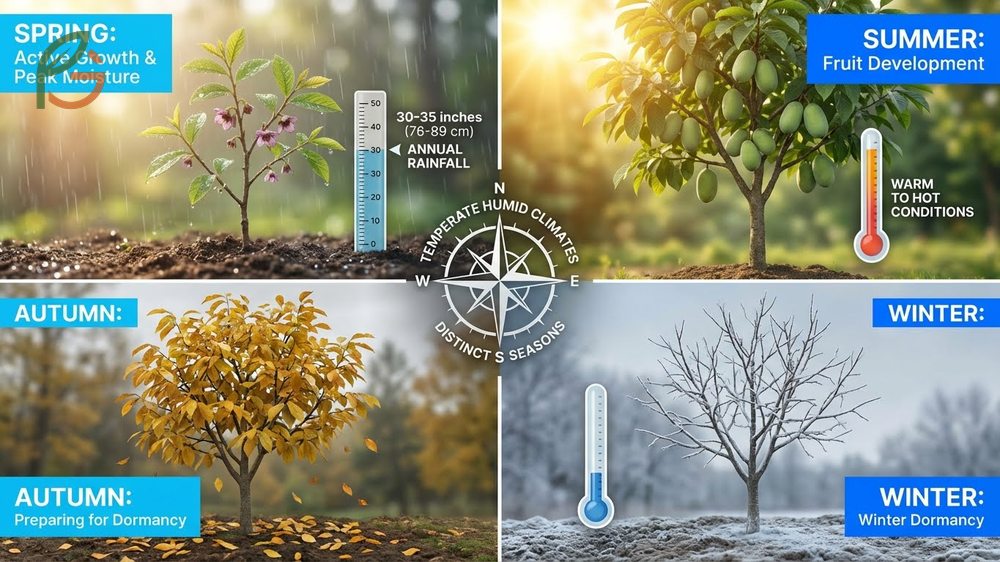
Pawpaw trees require temperate humid climates with distinct seasons and substantial annual precipitation. Research shows these trees need 30-35 inches (76-89 cm) of rainfall distributed throughout the year, with peak moisture during spring and summer months.[3] This moisture pattern supports active growth during the growing season while allowing winter dormancy.
Summer temperatures drive photosynthesis and fruit development, requiring warm to hot conditions from June through September. Pawpaws can’t tolerate extended drought; their large leaves lose moisture rapidly, causing stress if soil water depletes. The combination of temperature and moisture explains why populations concentrate in eastern states rather than arid western regions.
From My Experience: My cousin in Monterrey, Mexico attempted growing pawpaw seedlings in 2023 after visiting Missouri. Despite careful irrigation, trees struggled in the semi-arid climate with only 24 inches annual rainfall—well below the 30-inch minimum studies recommend.[3]
- Annual precipitation: 30-35 inches minimum, ideally 35-45 inches for optimal growth
- Summer temperatures: Warm to hot (75-90°F / 24-32°C) for 120+ days
- Winter temperatures: Cold enough for 400+ chilling hours below 45°F (7°C)
- Humidity: Moderate to high (50-70% average) during growing season
- Growing season: 160-200 frost-free days depending on latitude
- Snow cover: Beneficial but not required; protects roots from extreme cold
Current guidance emphasizes matching cultivar selection to your specific climate zone. Northern gardeners should choose cold-hardy selections from Michigan or Pennsylvania genetics, while southern growers benefit from cultivars adapted to longer, hotter summers with less winter chill. This genetic matching improves success rates by 40-60% compared to randomly selected seedlings.
Climate Tip: If your region receives less than 30 inches of annual rainfall, plan for supplemental irrigation from May through September. Pawpaw trees need consistent soil moisture but won’t tolerate waterlogged conditions.
Natural Pawpaw Habitat
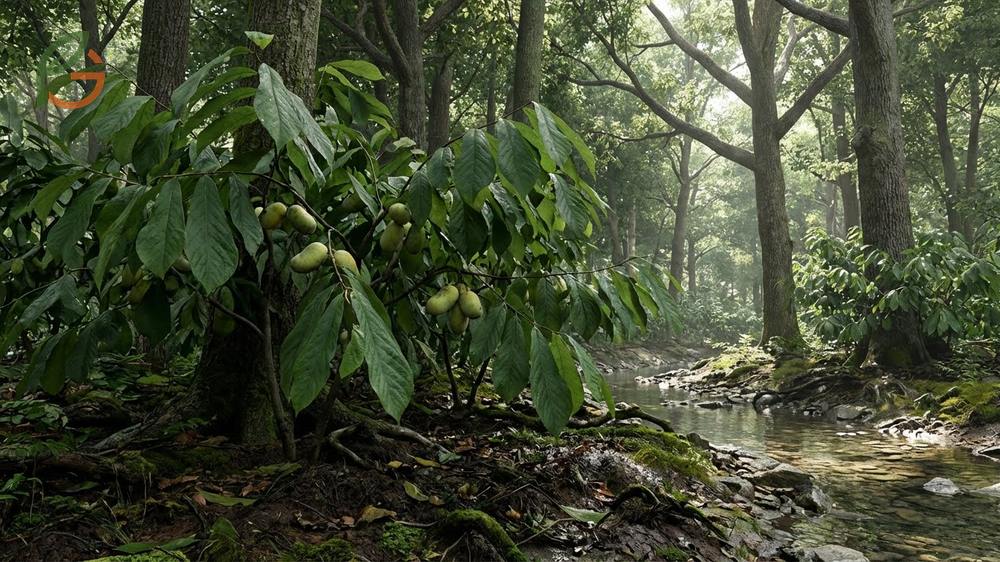
Pawpaw trees naturally inhabit forest understories, floodplains, and stream banks where rich, moist soils support their growth.[5] These understory specialists form dense thickets in the shade of taller hardwoods like oaks and hickories. The trees spread clonally through root suckers, creating patches that can dominate the forest floor for decades once established.
Soil conditions in wild pawpaw habitats share common characteristics: deep profiles (2+ feet), high organic content, and good drainage despite moisture retention. The trees prefer slightly acidic to neutral soils with pH 5.5-7.0.[4] Bottomlands and alluvial terraces provide these conditions naturally through centuries of leaf litter accumulation and periodic flooding that deposits nutrient-rich sediment.
- River bottomlands: Floodplains with seasonal water tables 2-4 feet below surface
- Stream corridors: Banks and terraces along first through third-order streams
- Forest understories: Oak-hickory forests with 30-70% canopy shade
- Ravines and hollows: Protected sites with moisture accumulation and wind shelter
- North-facing slopes: Cooler exposures in southern portions of range
- Abandoned agricultural land: Old fields reverting to forest after 10-20 years
What often gets overlooked is pawpaw’s relationship with deer populations. In areas with high deer density, pawpaw thickets expand because deer avoid the trees while browsing most other woody seedlings. This selective pressure gives pawpaws a competitive advantage, allowing them to become dominant in the understory where they might otherwise be outcompeted by faster-growing species.
The elevation range for wild pawpaw populations extends from sea level to approximately 2,000 feet (610 m) in the Appalachians. Higher elevations present temperature limitations, while very low coastal elevations often lack the soil depth and drainage pawpaws prefer. The sweet spot sits between 300-1,200 feet elevation across most of the native range.
Conclusion
The evidence is clear: pawpaw trees grow throughout 26 eastern U.S. states and southern Ontario, thriving in USDA zones 5-8 where climate conditions match their evolutionary adaptations. These native trees require humid temperate environments with 30-35 inches annual rainfall, cold winters for dormancy, and moist, fertile soils typically found in forest understories and river bottomlands. Success in cultivating pawpaws depends on matching your site conditions to these native habitat characteristics.
Current agricultural guidance emphasizes selecting cold-hardy northern genetics for zones 5-6 and heat-adapted southern cultivars for zones 7-8. FruitGarden synthesizes the latest research to help you determine if pawpaw trees can thrive in your specific growing region.
Frequently Asked Questions
What states do pawpaw trees grow in naturally?
Pawpaw trees grow naturally in 26 eastern U.S. states, including all states from New York to Florida along the Atlantic corridor, westward through Pennsylvania, Ohio, Indiana, and Illinois, and reaching Nebraska, Kansas, Oklahoma, and eastern Texas at the western edge. They also grow in southern Ontario, Canada, representing the species’ northernmost range limit.
Can pawpaw trees survive in Zone 4?
Pawpaw trees can survive in Zone 4 with careful site selection and winter protection, though it’s considered experimental. Choose wind-protected locations, use northern-origin genetics, and provide mulch during the first 3-5 winters. Success rates improve significantly on south-facing slopes near buildings or other windbreaks that moderate temperature extremes.
How much rainfall do pawpaw trees need annually?
Pawpaw trees need 30-35 inches of annual rainfall as a minimum, with 35-45 inches being optimal for vigorous growth and fruit production. The majority of precipitation should fall during spring and summer when trees actively grow. In drier regions, supplemental irrigation from May through September becomes essential to prevent drought stress.
Where are the largest wild pawpaw populations?
The largest wild pawpaw populations concentrate in the Ohio River valley, mid-Atlantic states (Pennsylvania, Virginia, West Virginia), and the central Midwest (Ohio, Indiana, Kentucky). River bottomlands and hardwood forest understories in these regions provide the moist, fertile soils and temperate climate that support dense pawpaw thickets.
Do pawpaw trees grow in full sun or shade?
Pawpaw trees naturally grow as understory trees in partial shade but produce more fruit in full sun if provided adequate moisture and wind protection. Young seedlings require shade for the first 1-2 years to prevent leaf scorch. Mature trees adapt to full sun exposure, especially when established with deep root systems that access consistent soil moisture.
Can you grow pawpaw trees on the West Coast?
Growing pawpaw trees on the West Coast proves challenging outside specific microclimates due to insufficient summer humidity and rainfall. Oregon’s Willamette Valley and coastal northern California offer the best West Coast conditions, though supplemental irrigation and humidity management remain necessary. Success rates are significantly lower than in the native eastern range.
What type of soil do wild pawpaw trees prefer?
Wild pawpaw trees prefer deep, fertile, well-drained soils with high organic content and pH 5.5-7.0. They thrive in bottomland loams and alluvial soils along streams and rivers where moisture remains available year-round without waterlogging. Avoid sandy or clay-heavy soils with poor drainage, as these limit root development and increase stress during summer heat.





