
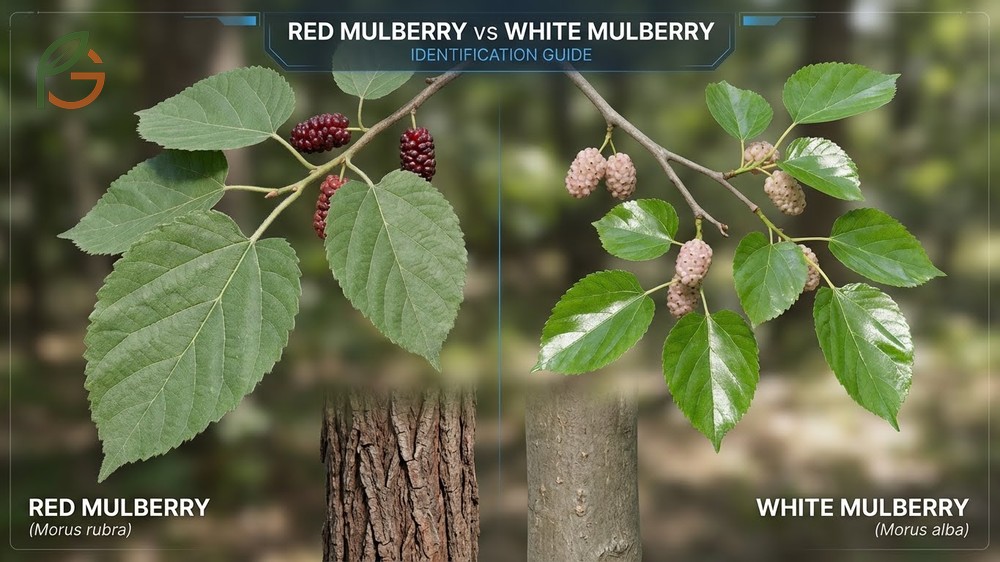
Red mulberry vs white mulberry identification hinges on leaf texture, bark patterns, and fruit characteristics. The native red mulberry (Morus rubra) features rough, matte leaves measuring 4-7 inches with dense underside hairs, while the invasive white mulberry (Morus alba) displays glossy, smooth leaves only 3-4 inches long[1]. Research shows these two species readily hybridize in overlapping habitats, making accurate identification crucial for conservation efforts[2]. FruitGarden synthesizes current botanical research to help you distinguish these mulberry species with confidence.
Quick Answer
- Red mulberry leaves are 4-7 inches long with rough, sandpaper-like texture[1]
- White mulberry leaves measure 3-4 inches with glossy, plastic-like smoothness[1]
- Red mulberry thrives in zones 5-9 preferring shade; white mulberry in zones 5-8 preferring sun[3]
- Red mulberry fruit turns nearly black; white mulberry stays red when ripe[4]
Red Mulberry vs White Mulberry
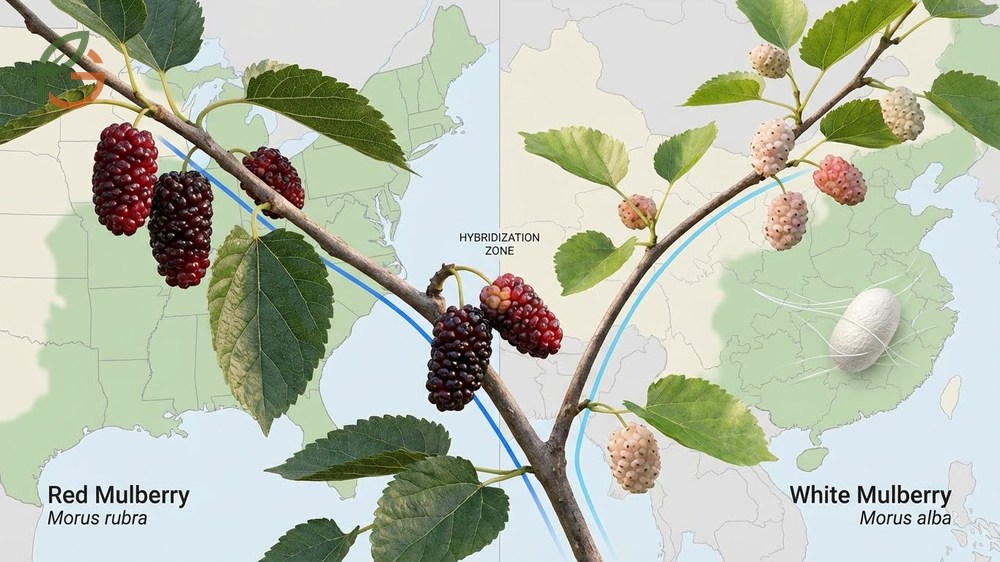
Studies demonstrate that red mulberry (Morus rubra) and white mulberry (Morus alba) belong to the same genus but evolved in completely different regions. Red mulberry is native to eastern United States from Massachusetts to Kansas and the Gulf Coast[5]. White mulberry originated in eastern and central China, introduced to America during colonial times for silkworm cultivation[5].
Current data indicates these species readily hybridize where their ranges overlap, creating intermediate forms that challenge identification. What often gets overlooked is that hybrid individuals may display a jumbled mix of characteristics from both parent species[2]. The native red mulberry now appears uncommon to rare across much of its historical range, including Pennsylvania, though reasons for this decline remain uncertain.
Native vs Invasive Origins
Red mulberry evolved as part of eastern North American forest ecosystems over millions of years. The species plays an important role in mature bottomland forests, where it provides food for over 40 bird species[6]. Its extensive root system includes lateral horizontal roots in the upper 24 inches of soil and smaller vertical roots branching downward[7].
White mulberry naturalized throughout most of the United States except Alaska, Arizona, and Nevada. Agricultural data shows it functions as a pioneer species in disturbed habitats, thriving in areas where native vegetation struggles. The invasive white mulberry threatens native red mulberry survival through competitive displacement and genetic contamination via hybridization.
From My Experience: My cousin in Guadalajara, Mexico grows both mulberry species in his urban garden. He noticed the white mulberry spread 15 feet in two years—matching the aggressive growth documented in invasive species reports—while his red mulberry barely expanded 5 feet in the same period.
Habitat Preferences
Research shows red mulberry typically thrives in shaded areas within mature forests. The species tolerates less sunlight than white mulberry, though fruit yield decreases proportionally with shade. Red mulberry performs best with some canopy protection, adapting to the dappled light conditions common in bottomland hardwood forests.
White mulberry and hybrid varieties prefer full sunlight exposure. Evidence suggests these trees colonize open, disturbed sites more aggressively than red mulberry. White mulberry’s sun preference gives it a competitive advantage in agricultural edges, roadsides, and cleared land where native species struggle to establish.
Mulberry Leaf Identification
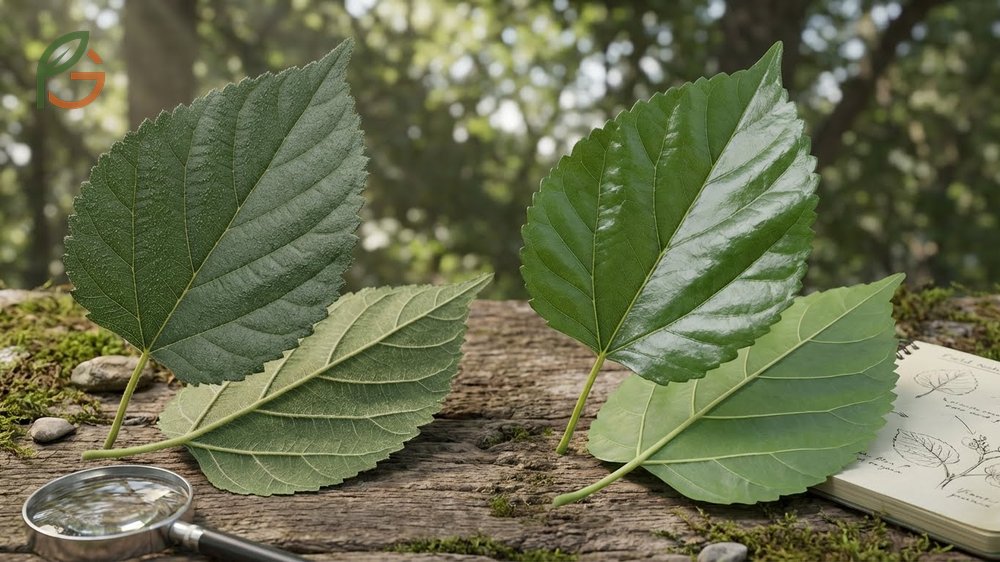
The single most reliable feature for distinguishing red from white mulberry is leaf surface texture and pubescence. Red mulberry leaves have a dull, dark green upper surface with rough texture similar to fine sandpaper[7]. White mulberry leaves display a glossy, medium green upper surface that feels smooth like plastic[4].
Current botanical guidance emphasizes examining both upper and lower leaf surfaces for accurate identification. Red mulberry shows more visible veins on the upper surface, creating a textured appearance throughout the leaf blade. White mulberry leaves reveal only main veins against a smoother background, with secondary veins barely perceptible to touch.
Leaf Size and Shape
Red mulberry leaves consistently measure longer at 4-7 inches (10-18 cm) and always taper to a conspicuous, long point at their tip called an acuminate apex[1]. When side lobes appear on red mulberry leaves, these lobes also terminate in pointed tips. The overall leaf shape ranges from ovate to nearly round (suborbicular) with a rounded to heart-shaped (cordate) base.
White mulberry leaves are noticeably shorter at 3-4 inches (8-10 cm). Many white mulberry leaves look blunt-tipped rather than tapering to long points. The leaf base typically ranges from wedge-shaped (cuneate) to slightly heart-shaped (subcordate), and the petiole shows a distinctive groove not found on red mulberry[8].
Identification Tip: Don’t rely solely on leaf lobing for identification. Both species produce highly variable leaf shapes, with deeply lobed leaves common on young shoots and unlobed leaves on mature growth. Focus instead on length, tip shape, and surface texture.
Leaf Texture and Pubescence
Examining the leaf underside provides the most definitive identification marker. Red mulberry leaves are densely covered with soft, erect hairs spread over the entire lower surface[8]. These hairs (pubescence) cover all veins, including smaller side veins, creating a soft, fuzzy feel when you rub the underside gently.
White mulberry shows minimal pubescence with sparse, flat-lying (appressed) hairs concentrated only along major veins. The underside feels bumpier rather than fuzzy due to pronounced vein structure. This difference in pubescence density remains consistent across the growing season, making it useful for identification from spring through fall.
- Red mulberry upper surface: Dull matte finish, rough like sandpaper, dark green color
- White mulberry upper surface: Glossy plastic-like finish, smooth texture, medium green color
- Red mulberry underside: Densely hairy all over, soft fuzzy feel, hairs on all veins
- White mulberry underside: Minimally hairy, bumpy feel, hairs only on major veins
- Red mulberry length: 4-7 inches (10-18 cm) with long tapering tips
- White mulberry length: 3-4 inches (8-10 cm) with blunt or short-pointed tips
Bark and Trunk Differences
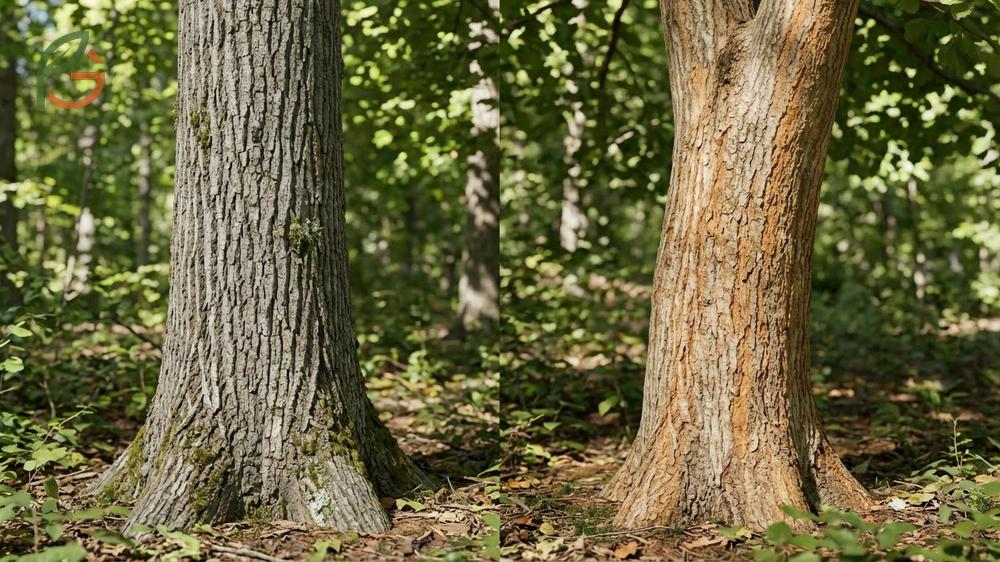
Bark characteristics provide reliable identification when leaves aren’t accessible. Red mulberry bark averages grayer in color with a scaly texture featuring straight vertical ridges[1]. The trunk typically grows straighter, especially toward the base, and the tree usually develops a single-trunk habit. This growth pattern reflects the species’ adaptation to competing for light in mature forest understories.
White mulberry bark displays a warmer color palette, ranging from tan to orangish-brown. Studies show the texture appears almost braided, with ridges that twist back and forth rather than running straight up the trunk[1]. White mulberry trunks frequently grow crooked or leaning, and individual trees commonly develop multiple trunks. The orange-brown bark and twisted growth form persist in hybrid offspring.
Bud characteristics offer another identification tool available for at least six months annually. Red mulberry produces larger, more flattened buds that often sit off-center on the twig. Each bud scale displays a distinctive black band along its margin. White mulberry buds appear smaller, orange-colored, and pressed tightly against the twig[2].
Winter Identification: You can distinguish these species even in winter. Red mulberry’s shiny buds point away from the twig with visible black-margined scales, while white mulberry’s orange buds hug the twig closely. This difference works from November through March when leaves are absent.
- Red mulberry bark color: Gray with cooler tones throughout growing season
- White mulberry bark color: Tan to orange-brown with warm undertones
- Red mulberry bark texture: Scaly with straight vertical ridges running parallel
- White mulberry bark texture: Braided appearance with ridges twisting back and forth
- Red mulberry trunk: Straighter growth, single-trunk habit, upright form
- White mulberry trunk: Crooked or leaning growth, multi-trunk habit, irregular form
- Red mulberry buds: Larger, flattened, off-center, black-margined scales, point outward
- White mulberry buds: Smaller, orange-colored, centered, pressed against twig
Mulberry Fruit Taste and Nutrition
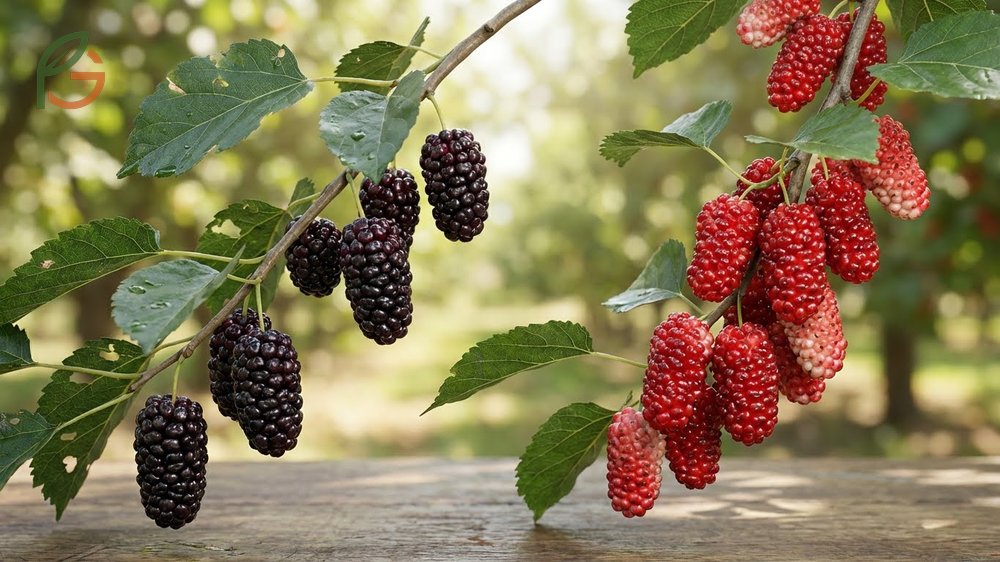
Fruit characteristics separate these species clearly once berries mature. Red mulberry fruit turns nearly black when fully ripe and grows individually on the branch[4]. White mulberry fruit remains red even at peak ripeness and tends to cluster together. This color difference proves especially useful since the common name “white mulberry” misleadingly suggests white fruit, when berries actually range from white to pink to red.
Research across multiple cultivated varieties shows significant differences in sugar content and flavor chemistry between species. Agricultural data indicates white mulberry contains higher total sugars at 16.03% compared to red mulberry’s 15.25%[9]. However, taste preferences vary among consumers based on individual tolerance for acidity and sweetness balance.
Flavor Profiles
Red mulberry delivers a complex flavor profile. Current guidance from culinary experts describes red mulberry fruit as flavorful with a distinct acidic undertone that balances the sweetness[10]. The berries taste deep red, sweet, and juicy when fully ripe with the nearly-black color indicating optimal harvest time. Most people find the tartness appealing, comparing it favorably to blackberries.
White mulberry fruit tastes typically sweet but lacks tartness. Studies demonstrate white mulberry has a refreshing quality with a little tart note, some gumminess, and a subtle vanilla hint[11]. The milder flavor makes white mulberry berries less distinctive but more universally acceptable to people who dislike acidic fruits. White mulberries don’t stain fingers as readily as the darker red mulberry fruit.
Nutritional Comparison
Nutritional analysis reveals both similarities and differences between these species. Red mulberry contains 1.24% protein and 2.17% crude fiber[9]. White mulberry shows slightly lower protein at 1.15% but higher fiber at 2.28%. Red mulberry demonstrates higher antioxidant activity at 60.35% compared to white mulberry’s 55.31% in fresh fruit testing.
Mineral content shows notable variations. Evidence indicates red mulberry fruit contains the highest levels of iron and zinc among the three common mulberry species (red, white, and black). Both red and white mulberries provide substantial potassium, the most abundant mineral in all mulberry species. Red mulberry offers higher calcium content than white mulberry, along with moderate amounts of sodium and magnesium[9].
This table compares protein, sugar, fiber content and antioxidant activity between red and white mulberry species
| Component | Red Mulberry | White Mulberry | Advantage |
|---|---|---|---|
| Protein Content | 1.24%[9] | 1.15%[9] | Red mulberry |
| Total Sugars | 15.25%[9] | 16.03%[9] | White mulberry |
| Crude Fiber | 2.17%[9] | 2.28%[9] | White mulberry |
| Antioxidant Activity | 60.35%[9] | 55.31%[9] | Red mulberry |
| Iron & Zinc | Highest[9] | Moderate[9] | Red mulberry |
- Red mulberry flavor: Sweet with acidic undertone, complex taste, balanced tartness
- White mulberry flavor: Sweet without tartness, refreshing with vanilla hints, milder taste
- Red mulberry ripeness: Nearly black color when ready to harvest, grows individually
- White mulberry ripeness: Stays red even when ripe, tends to cluster together
- Red mulberry nutrition edge: Higher protein, antioxidants, iron, zinc, and calcium
- White mulberry nutrition edge: Higher total sugars, slightly more fiber, milder acids
Growing Conditions and Hardiness
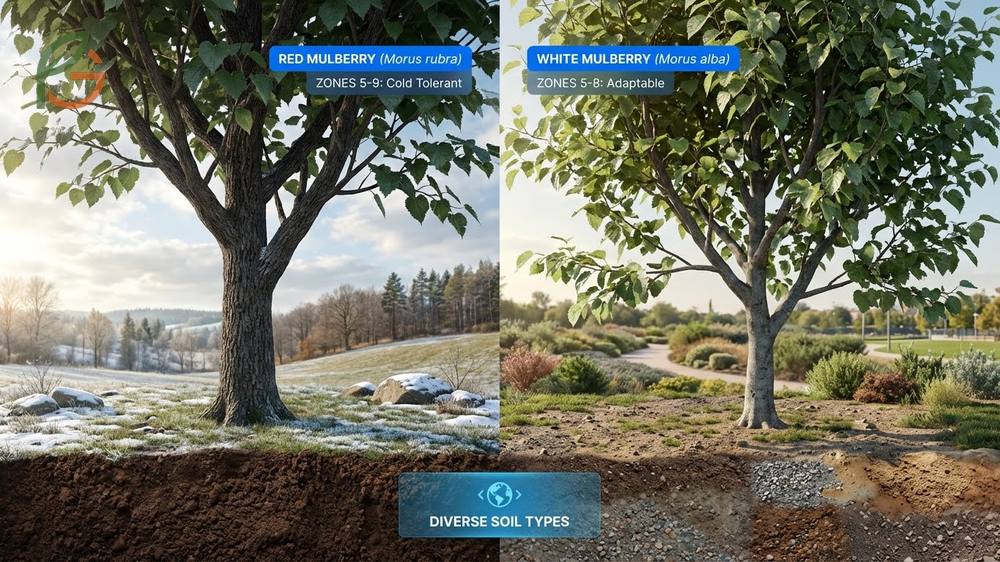
Climate adaptability differs between these species in important ways for gardeners and landscapers. Red mulberry proves hardy in USDA zones 5 to 9, tolerating cold winters across most of the eastern United States[3]. White mulberry shows slightly less cold tolerance, rated for zones 5 to 8. Despite this narrower range, white mulberry’s invasive success demonstrates superior adaptability to varied conditions.
Both species tolerate diverse soil types including rich, poor, deep, thin, rocky, clay, or sandy substrates. Evidence suggests they adapt to acidic, neutral, or alkaline pH levels with equal success. The mulberries handle moist or dry conditions, though they’ll tolerate wet soils only for short periods. Both species show pollution tolerance, including resistance to salt deposition and salt spray[3].
Red mulberry handles subzero temperatures better than expected for a southern species. Research demonstrates the species shows relative hardiness to drought, pollution, and poor soil, though white mulberry consistently outperforms it in extreme conditions[7]. This difference in stress tolerance partly explains white mulberry’s invasive spread beyond red mulberry’s native range.
Light requirements create the most dramatic performance difference between species. Red mulberry performs better in partial shade or understory conditions, producing fewer fruits in deep shade but surviving where white mulberry cannot. White mulberry demands full sun for optimal growth and fruit production. Most people notice white mulberry grows faster, spreads more aggressively, and colonizes disturbed sites more readily than the native species.
Conservation Note: If you’re planting mulberries in eastern North America, choose red mulberry to support native ecosystems. White mulberry’s invasive nature threatens native red mulberry through habitat competition and genetic contamination via hybridization. Check with local native plant societies before introducing any mulberry species.
- Red mulberry zones: USDA hardiness zones 5-9, broader southern range
- White mulberry zones: USDA hardiness zones 5-8, slightly less cold-tolerant
- Red mulberry light: Prefers shade to partial sun, tolerates understory conditions
- White mulberry light: Requires full sun for optimal growth and fruiting
- Red mulberry habitat: Mature bottomland forests, shaded moist areas, native ecosystems
- White mulberry habitat: Disturbed sites, roadsides, edges, open sunny locations
- Both species soil: Adaptable to poor or rich, acidic or alkaline, varied textures
Conclusion
The evidence is clear: red mulberry vs white mulberry identification depends primarily on leaf texture, size, and pubescence patterns. Red mulberry’s 4-7 inch rough, matte leaves with dense underside hairs contrast sharply with white mulberry’s 3-4 inch glossy, smooth leaves showing minimal pubescence. Bark color, trunk form, fruit ripeness color, and habitat preference provide supporting identification markers that work year-round.
Current botanical guidance emphasizes protecting native red mulberry populations by correctly identifying and removing invasive white mulberry where possible. Understanding these differences helps gardeners make informed planting decisions, supports conservation efforts, and preserves native biodiversity. FruitGarden encourages readers to examine local mulberry trees using these identification features and report red mulberry sightings to state natural heritage programs.
Frequently Asked Questions
What’s the easiest way to tell red mulberry from white mulberry?
The easiest method is checking leaf texture—red mulberry leaves feel rough like sandpaper with a matte finish, while white mulberry leaves feel smooth and glossy like plastic[4]. Leaf length also helps: red mulberry measures 4-7 inches versus white mulberry’s 3-4 inches.
Can you eat both red and white mulberry fruits?
Yes, both species produce edible fruits that people have consumed for centuries. Red mulberry offers more complex flavor with balanced sweetness and tartness, while white mulberry tastes sweeter with less acidity[11]. Red mulberry fruit also contains higher antioxidant levels and more minerals like iron and zinc.
Why is white mulberry considered invasive?
White mulberry spreads aggressively throughout North America after introduction during colonial times for silkworm cultivation[5]. It outcompetes native red mulberry by tolerating harsher conditions, growing faster in disturbed habitats, and hybridizing with native populations. White mulberry now threatens native red mulberry conservation across eastern United States.
Do red and white mulberries grow in the same areas?
Their ranges overlap extensively in eastern North America, where they readily hybridize. Red mulberry prefers mature bottomland forests with shade, while invasive white mulberry colonizes disturbed sites, roadsides, and sunny edges[1]. White mulberry ranges farther north and west than the native red species.
How can I tell if my mulberry is a hybrid?
Hybrids display mixed characteristics from both parent species—you might see medium-length leaves (around 4-5 inches) with intermediate glossiness, or orangish bark on a relatively straight trunk[2]. Genetic testing is often required for 100% certainty due to the complexity of hybrid traits.
Which mulberry tree is better for wildlife?
Native red mulberry provides superior ecological value, supporting over 40 bird species and serving as a specific host plant for native butterfly larvae like the Mourning Cloak[6]. While white mulberry offers food, its displacement of native flora disrupts established food webs and forest biodiversity.
How fast do mulberry trees grow?
White mulberry grows extremely fast, often exceeding 10-15 feet in just a few years, a trait that aids its invasive spread in disturbed soils. Red mulberry grows at a moderate rate, focusing energy on developing a strong root system and structure adapted for longevity in forest environments rather than rapid colonization.





