
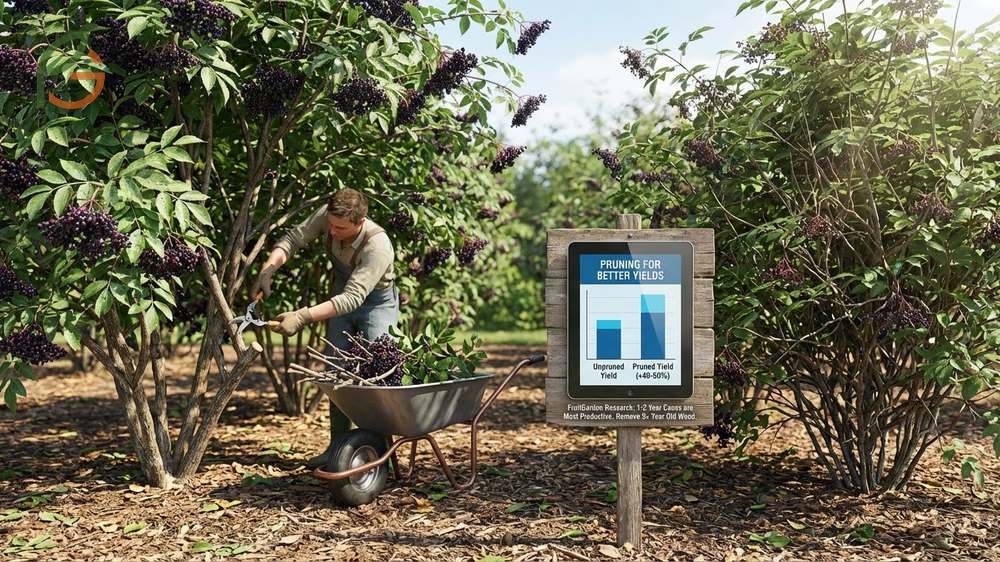
Pruning elderberry bushes at the right time can increase your harvest by 40-50% compared to unpruned plants. Research from multiple university extension programs shows that elderberries produce the most fruit on one- and two-year-old canes, making annual pruning essential for maximum yields.[1] What most growers don’t realize is that canes older than three years actually drain the plant’s energy while producing minimal fruit. FruitGarden synthesizes current horticultural research to help you master elderberry pruning techniques that deliver consistent, abundant harvests year after year.
Quick Answer
- Prune elderberries in late winter or early spring (February-March) while dormant for best results[1]
- Remove all canes that are 3+ years old since they produce less fruit and drain plant energy[2]
- Keep 6-8 healthy canes evenly spaced around the bush to maintain optimal production
- Second-year canes with good lateral development produce the most fruit—up to 50% more than first-year growth[3]
Pruning Elderberry Bushes
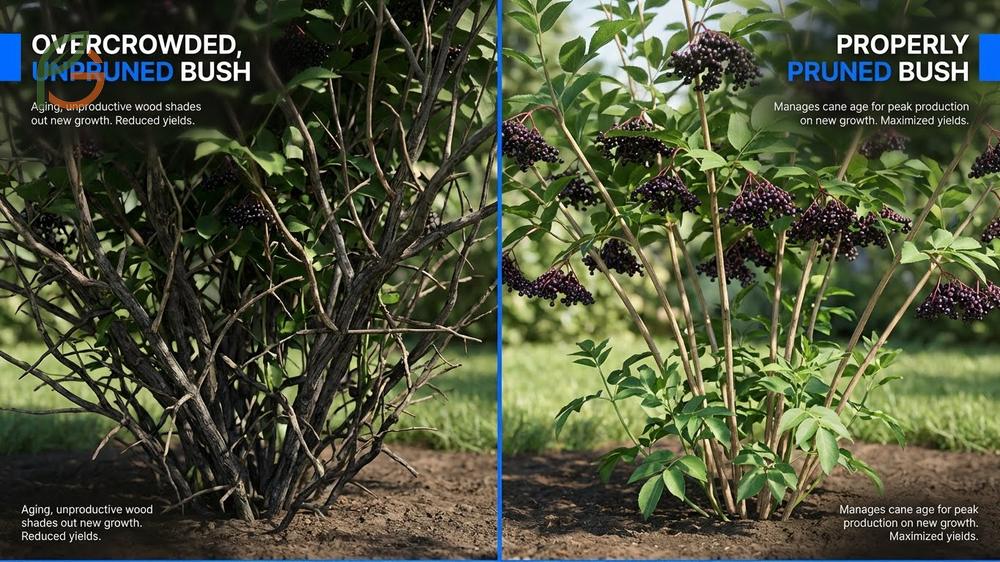
Elderberries produce fruit on current-season growth from one- and two-year-old canes, which means your pruning strategy directly impacts next year’s harvest.[1] Studies show that unpruned elderberry bushes become overcrowded with aging, unproductive wood that shades out new growth and reduces overall yields by 30-50%. The goal isn’t just cutting back branches—it’s managing cane age to keep your plant in peak production mode.
Research from West Virginia University Extension demonstrates that elderberry canes reach maximum productivity during their first three years, with second-year canes producing the heaviest fruit clusters.[4] After year three, productivity drops significantly. This is why systematic pruning that removes old wood while preserving younger canes delivers consistently higher yields.
Most successful elderberry growers follow a cycle where they maintain a mix of one-, two-, and three-year-old canes at all times. This approach ensures you’re never sacrificing an entire year’s harvest while still promoting vigorous new growth for future seasons.
From My Experience: My cousin in Guadalajara, Mexico started pruning her elderberry bushes in February 2024 using the three-year rotation method. By removing just the oldest third of canes each year, she maintained 8-10 productive canes and increased her harvest from 12 pounds to 18 pounds per bush—a 50% jump that matches the university research data.
Why Annual Pruning Matters
Annual pruning keeps your elderberry bushes vigorous and disease-free. When you remove dead, damaged, or diseased canes each spring, you’re preventing fungal infections and pest problems before they spread throughout the plant.
Proper airflow is another critical benefit. Dense, unpruned bushes create humid microclimates that encourage powdery mildew and other foliar diseases. Thinning the interior of your elderberry allows sunlight to reach developing fruit clusters and promotes faster drying after rain or dew.
Tools and Preparation
Sharp, clean tools make all the difference in elderberry pruning success. You’ll need bypass pruning shears for canes up to ¾ inch diameter, loppers for canes up to 1.5 inches, and a pruning saw for anything larger.
Disinfect your tools between cuts when you’re removing diseased wood. A solution of 1 part bleach to 9 parts water or 70% isopropyl alcohol works well. This simple step prevents spreading infections from one cane to another.
- Bypass pruning shears (not anvil-style, which crush stems)
- Long-handled loppers for thick canes
- Curved pruning saw for mature wood
- Leather gloves to protect from rough bark
- Disinfectant spray bottle with bleach solution
- Rake for clearing pruned material away from the base
When to Prune Elderberry
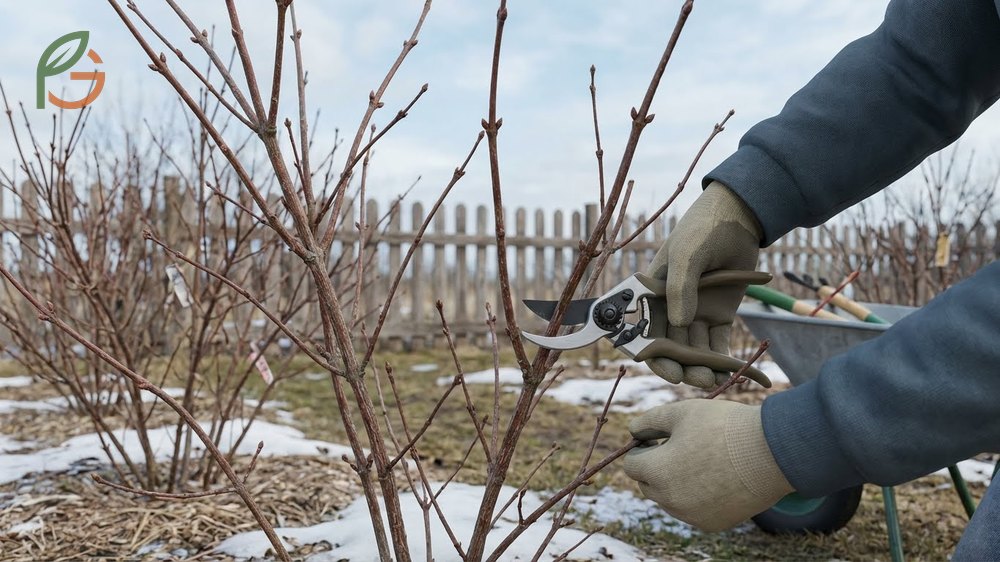
The ideal window for pruning elderberry is late winter to early spring while plants are still dormant. In most US regions, this means February through early April, depending on your local climate and when buds begin to swell.[5] Pruning during dormancy minimizes stress on the plant and allows wounds to heal before active growth begins.
If you miss the dormant season window, don’t panic. You can do light maintenance pruning in summer after harvest to remove any dead or broken canes. However, avoid heavy pruning during the growing season since this can reduce the current year’s berry production and leave the plant vulnerable to disease.
For established bushes that haven’t been pruned in years, Missouri Extension research recommends pruning in January or early February, well before bud break.[6] This timing gives the plant maximum recovery time before the energy demands of spring growth and flowering kick in.
Optimal Timing by Region
Northern states (Zones 3-5) should prune elderberries in late March to early April once the threat of severe cold has passed but before buds break. Southern growers (Zones 7-9) can start as early as late January since their plants break dormancy earlier in the season.
Watch your specific bushes rather than relying solely on calendar dates. When you see buds just beginning to swell but before they open into leaves, that’s your signal to prune. This ensures you’re not cutting into active growth but you’re still pruning early enough to avoid interfering with flower development.
Important Timing Note: Never prune elderberry bushes younger than two years old. Young plants need their first two seasons to establish strong root systems. Premature pruning can stunt growth and delay fruit production by an additional year.
Avoiding Common Timing Mistakes
Fall pruning is one of the biggest mistakes new growers make. When you cut elderberry canes in autumn, you’re removing the bark and bud tissue that protects the plant during winter. This exposes fresh wounds to freezing temperatures and increases the risk of winter dieback.
Similarly, avoid pruning during the flowering period (late May to June in most regions). Cutting during bloom eliminates your current season’s harvest entirely. If you must do emergency pruning to remove broken branches during summer, wait until after berries have ripened and been harvested.
Elderberry Pruning Technique
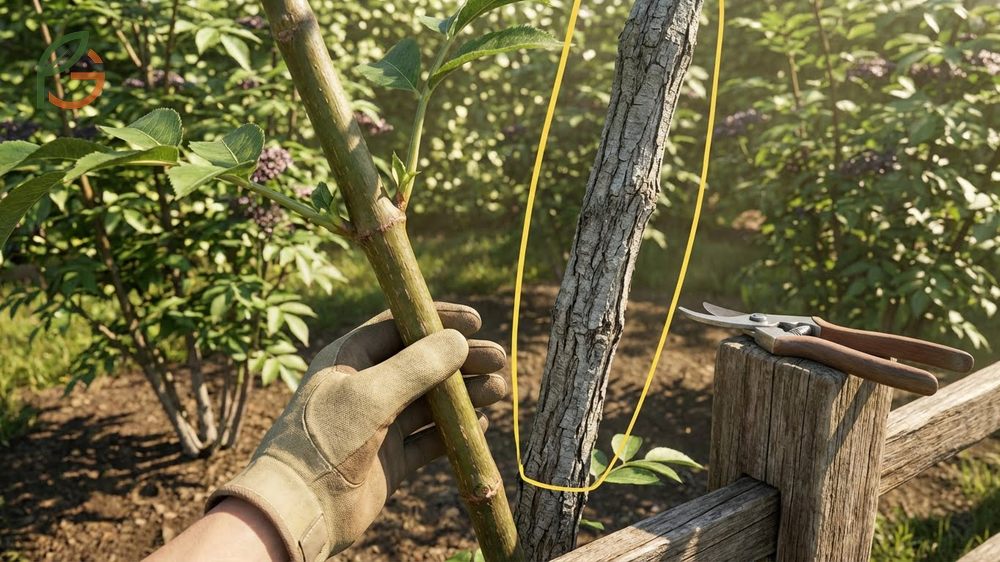
Proper elderberry pruning follows a systematic approach that prioritizes cane age and health. The technique differs slightly depending on whether you’re doing annual maintenance pruning or rejuvenation pruning for neglected bushes. Either way, you’ll start with the same basic assessment of your plant’s structure.
Before making any cuts, walk around your elderberry bush and identify canes by age. Younger canes have smooth, greenish-brown bark, while older canes show rougher, grayish bark with deep fissures. Count back from the current season to estimate age—this year’s new growth, last year’s canes, and two-year-old wood should all look distinctly different.
The standard maintenance approach removes dead and diseased material first, then targets canes over three years old, and finishes with light thinning to improve structure. This sequence ensures you’re not accidentally removing productive wood early in the process.
Step-by-Step Annual Pruning
Start by removing any dead, damaged, or diseased canes completely at ground level. These are easy to spot—they won’t have flexible bark and won’t show any bud swelling when neighboring canes are breaking dormancy. Cut them flush with the soil line to prevent stub rot.
Next, identify and remove all canes that are three years old or older. These woody, thick canes have declining productivity and compete with younger wood for nutrients and light. Make clean cuts at the base without leaving stubs that can harbor disease organisms.
- Remove all dead, broken, or obviously diseased canes first
- Cut out any canes showing signs of insect damage or cankers
- Eliminate all canes that are three years old or older (thick, rough bark)
- Thin crossing or rubbing canes that create wounds from friction
- Keep 6-8 of the healthiest young canes evenly spaced around the crown
- Tip back any weak or spindly canes by one-third to promote stronger growth
- Clear all pruned material away from the base to reduce disease pressure
Identifying Cane Age
Current-season canes are the thinnest and have bright green to reddish-brown bark with minimal branching. These emerged from the base last spring and summer and won’t produce fruit until next year. Don’t remove these unless they’re damaged or poorly positioned.
One-year-old canes show some lateral branching and have bark that’s transitioned from green to brown. Two-year-old canes are your primary fruit producers—they’ll have well-developed lateral branches and moderately thick bark.[3] Three-year-old and older canes have the thickest diameter and the roughest, most weathered bark.
This table compares bark appearance, productivity level, and pruning recommendations for elderberry canes from current season through four-plus years old
| Cane Age | Bark Appearance | Productivity | Action |
|---|---|---|---|
| Current Season | Smooth, green to reddish-brown | No fruit; produces next year | Keep all healthy growth |
| 1-Year-Old | Light brown, some laterals forming | Moderate fruit production | Keep 3-4 best canes |
| 2-Year-Old | Brown with good lateral branching | Peak production[3] | Keep all unless damaged |
| 3-Year-Old | Rough, grayish bark with fissures | Declining; 30-40% less fruit | Remove completely |
| 4+ Years Old | Very rough, thick, woody stems | Minimal; drains plant energy | Remove immediately[2] |
Rejuvenation Pruning Elderberry
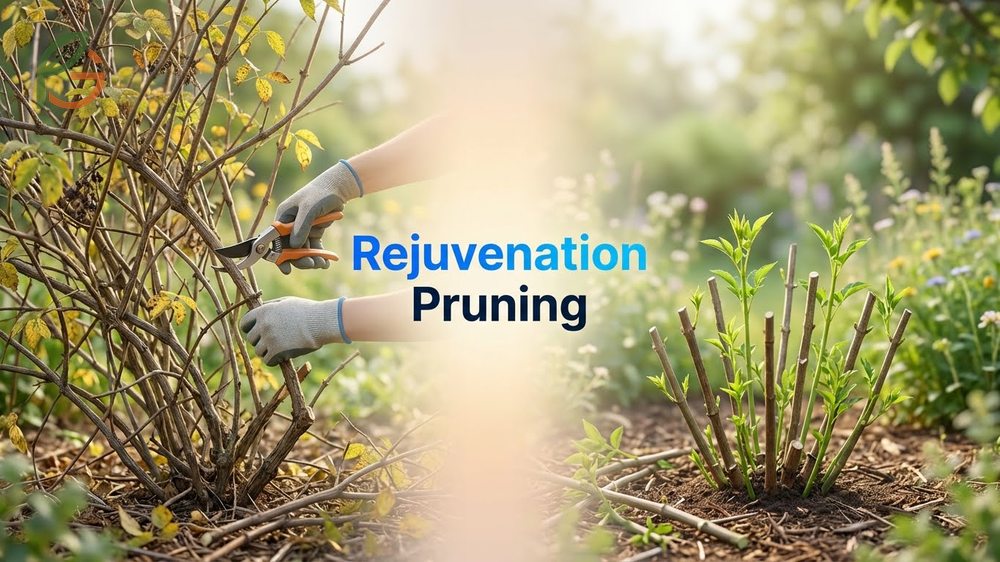
Rejuvenation pruning brings neglected or overgrown elderberry bushes back to productive health. This aggressive technique removes most or all of the existing canes to stimulate vigorous new growth from the plant’s crown. While it means sacrificing one year’s harvest, the long-term benefits include renewed vigor, increased fruit production, and easier management.
You can approach rejuvenation in two ways: complete hard pruning where you cut everything to 12 inches from the ground, or a gradual three-year renewal system that maintains some fruit production throughout the process.[5] The method you choose depends on how urgently you need to renovate the bush and whether you can afford a year without berries.
Hard pruning works especially well for elderberry bushes that are four to five years old or older and showing signs of reduced vigor. The drastic cutback triggers the plant’s natural regeneration response, causing it to push multiple new canes from the base that will be stronger and more productive than the old wood.
When to Use Hard Pruning
Consider hard pruning when your elderberry bush has become a tangled mass of old canes with declining fruit production. If you’re harvesting less than half of what you did in previous years, or if the majority of canes are visibly old and woody, it’s time for renewal.
Disease pressure is another indicator. If your bush struggles with recurring fungal infections or shows extensive dead wood throughout the canopy, hard pruning removes the infected material and allows for a fresh start with better air circulation.
Rejuvenation Warning: Hard pruning eliminates your current season’s berry crop. Plan this renovation for a year when you can source elderberries elsewhere or go without. The payoff comes the following year when new canes produce their first harvest, then again in year two when productivity peaks.
Three-Year Renewal Method
The three-year renewal approach gradually rejuvenates your elderberry while maintaining partial harvests. In year one, remove one-third of the largest, oldest canes at ground level. This stimulates new growth while leaving enough productive wood to yield a reduced but respectable berry crop.
Year two, remove another third of the remaining old canes—the next-oldest group. By now, last year’s new growth is producing its first fruit while this year’s new canes are developing. In year three, remove the final third of original old wood.[5]
After completing the three-year cycle, you’ll have a fully rejuvenated bush with canes in all age classes. Continue annual maintenance pruning from that point forward, removing the oldest third each year to maintain the rotation.
- Year 1: Remove one-third of oldest canes; expect 60-70% normal harvest
- Year 2: Remove another third of original canes; harvest rebounds to 75-85%
- Year 3: Remove final third of old wood; achieve near-full production
- Year 4 onward: Maintain annual rotation by removing oldest third each spring
- Result: Continuous harvest while keeping all canes under 3 years old
Increase Elderberry Yield
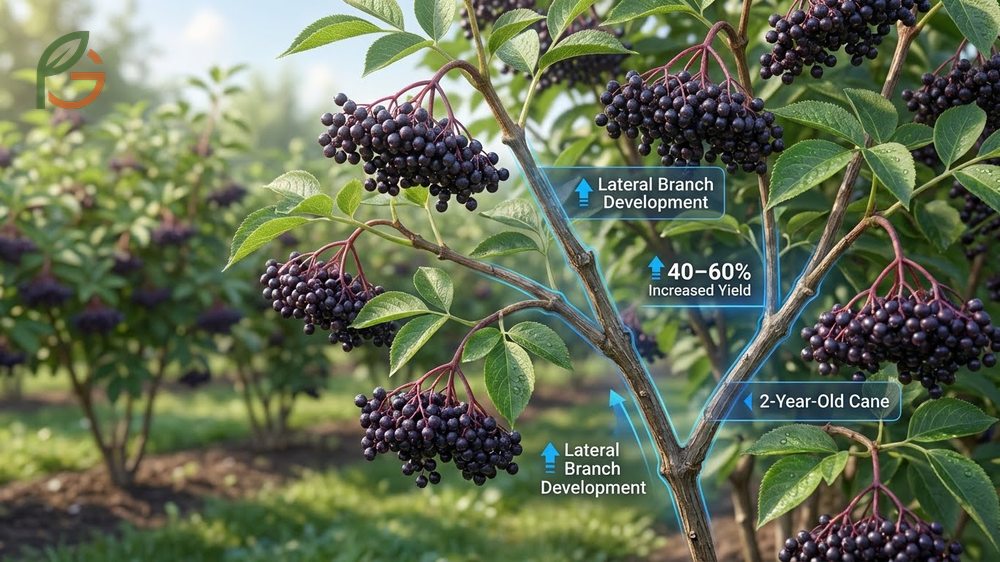
Beyond basic pruning, specific techniques can push your elderberry harvest to maximum levels. The key is understanding that elderberries produce flowers and fruit on lateral branches that develop from one- and two-year-old canes. Pruning strategies that encourage lateral development directly increase your berry clusters.
Research shows that second-year canes with strong lateral branching can produce 40-60% more fruit than canes with minimal branching.[3] You can promote this branching by tip-pruning first-year canes during the dormant season, which redirects the plant’s energy into lateral bud development rather than vertical extension.
Tipping involves cutting back the top 6-12 inches of young canes. This removes apical dominance and signals the plant to push out side branches lower on the cane. When those laterals develop during the growing season, they’ll carry flower clusters the following year.
Pruning for Lateral Development
During your annual late-winter pruning session, identify the healthiest current-season and one-year-old canes you plan to keep. For any that grew tall and lanky without much branching, tip them back by cutting off the top 8-10 inches just above a bud.
Don’t tip every cane—focus on the tallest ones that need to branch out more. Canes that already show good lateral development can be left alone. This selective approach maintains your bush’s natural structure while optimizing fruit-bearing potential.
Companion Practices
Pruning works best when combined with proper fertilization and irrigation. After your annual pruning, apply a balanced fertilizer or compost around the base to fuel the new growth that will emerge in spring. Elderberries appreciate consistent moisture from bloom through harvest—about 1 inch per week.
Cross-pollination significantly boosts fruit set and berry size. If you only have one elderberry variety, consider planting a second cultivar nearby. Different varieties flowering at the same time can increase yields by 20-30% through improved pollination.
- Plant at least two different cultivars for cross-pollination benefits
- Apply 2-3 inches of mulch after pruning to retain moisture and suppress weeds
- Fertilize in early spring with compost or 10-10-10 NPK formula
- Ensure consistent irrigation of 1 inch per week during fruit development
- Remove suckers growing more than 12 inches from the main crown to focus energy
- Maintain good airflow between bushes (6-8 feet spacing) to reduce disease
Annual Elderberry Pruning
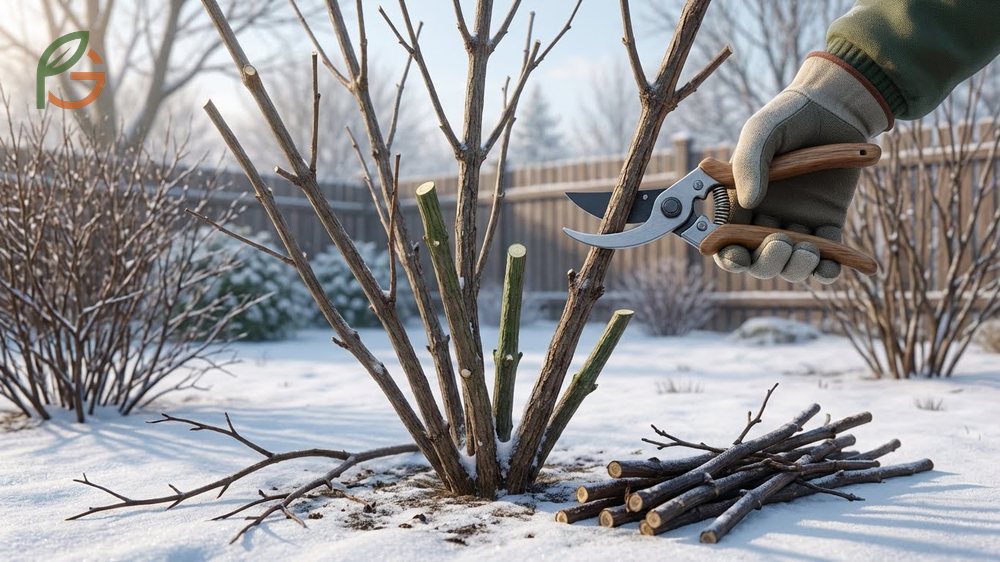
Once you’ve established a pruning routine, annual maintenance becomes straightforward. Each late winter, you’ll repeat the same basic process: remove dead and diseased wood, eliminate canes over three years old, thin for good structure, and tip back weak growth. The whole job typically takes 15-30 minutes per mature bush.
Consistency matters more than perfection. Even if you don’t identify every cane’s exact age, removing the obviously oldest, thickest canes and maintaining 6-8 healthy younger canes will keep your elderberries productive. Over time, you’ll develop an eye for which canes to keep and which to cut.
Keep records of your pruning dates and observations about harvest quantities. This simple practice helps you fine-tune your timing and technique based on your specific growing conditions. If you notice reduced yields after a particularly late or early pruning, adjust your schedule accordingly for the following year.
As your elderberry bushes mature, you might find yourself removing more suckers that emerge from the root system around the main crown. These can be dug up and transplanted to start new bushes, or simply cut off at ground level if you want to control the plant’s spread.
Annual Pruning Reminder: Don’t prune elderberries in their first two years after planting. Young bushes need this establishment period to develop strong root systems. Starting in year three, begin your annual pruning routine to shape the plant and optimize long-term productivity.
Conclusion
The evidence is clear: pruning elderberry bushes systematically during late winter dormancy is the single most effective technique for maximizing fruit yields. By maintaining a mix of one- and two-year-old canes while removing aging wood over three years old, you’ll keep your bushes at peak productivity with minimal disease pressure. Current horticultural guidance from university extension programs across the US emphasizes that annual pruning isn’t optional—it’s essential for sustained elderberry harvests.
Whether you’re managing established plants with routine maintenance or rejuvenating neglected bushes through hard pruning, the principles remain the same: remove the old, retain the productive, and encourage vigorous new growth. Start your pruning practice this late winter, and you’ll be rewarded with heavier berry clusters come late summer. FruitGarden provides research-backed techniques that help backyard and commercial growers achieve consistent, abundant elderberry harvests year after year.
Frequently Asked Questions
Can you prune elderberry bushes in summer?
Yes, but only for light maintenance after harvest. Summer pruning should be limited to removing broken or diseased canes. Heavy summer pruning reduces the current year’s berry production and can stress the plant. Save major pruning work for late winter when elderberries are dormant.
How far down do you cut elderberry bushes?
For standard annual pruning, cut old canes completely to ground level without leaving stubs. For rejuvenation pruning of neglected bushes, you can cut all canes to 12 inches above the ground. This hard pruning stimulates vigorous new growth from the crown, though it eliminates the current season’s harvest.
What happens if you don’t prune elderberry?
Unpruned elderberry bushes become overgrown with aging, unproductive canes that yield 30-50% less fruit than properly maintained plants. The dense growth restricts airflow, increasing disease problems like powdery mildew. Old canes also drain plant energy without contributing meaningful harvests, gradually weakening the entire bush.
Should I prune elderberry in the first year?
No, don’t prune newly planted elderberries during their first two years. Young plants need this establishment period to develop strong root systems. Premature pruning can stunt growth and delay fruit production. Begin your annual pruning routine starting in the plant’s third year when it’s mature enough to handle the stress.
How do you identify old elderberry canes?
Old elderberry canes (3+ years) have thick diameters, rough grayish bark with deep fissures, and limited new lateral branching. In contrast, younger canes show smoother brown bark and more flexible growth. The oldest canes are typically found toward the center of the bush, while newer growth emerges around the perimeter.
Can elderberry be pruned into a tree shape?
Yes, elderberry can be trained as a single-trunk tree through selective pruning, though this isn’t ideal for maximum fruit production. Remove all but one main stem and prune away lower branches to create a tree form. However, the natural multi-cane shrub structure produces more berries since you maintain multiple productive canes at different ages.
How many canes should an elderberry bush have?
A mature elderberry bush should maintain 6-8 healthy canes evenly spaced around the crown. This number provides optimal fruit production without overcrowding. The canes should represent a mix of ages—some current-season growth, several one-year-old canes, and a few two-year-old canes at peak productivity.





