
What does breadfruit taste like? The flavor depends on ripeness—unripe breadfruit tastes starchy and potato-like with artichoke notes, while ripe breadfruit becomes sweet with tropical banana and mango flavors.[1] Research shows this versatile tropical fruit transforms completely as it matures, making it suitable for both savory dishes and desserts. FruitGarden synthesizes current agricultural research to help you understand how to select, prepare, and enjoy breadfruit at every stage.
Quick Answer
- Unripe breadfruit has a starchy, neutral flavor similar to potatoes or artichoke hearts—perfect for savory cooking[1]
- Ripe breadfruit delivers sweet tropical notes reminiscent of banana, mango, and pineapple with a custard-like texture[2]
- One cup provides 227 calories, 11g fiber, and 64mg vitamin C (71% daily value)[3]
- You can roast, fry, boil, or bake it just like potatoes—it’s incredibly versatile in both sweet and savory recipes
What Does Breadfruit Taste Like
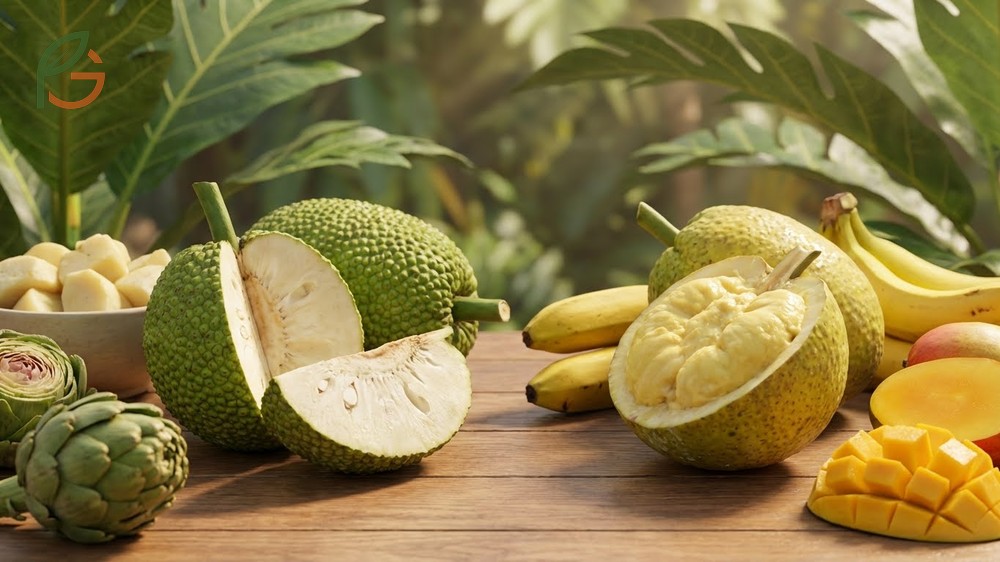
Breadfruit’s flavor profile shifts dramatically depending on when you harvest it. Young, unripe breadfruit has a firm texture with a grassy, artichoke-like flavor that’s neutral and starchy—similar to raw potato or yuca.[1] Most people don’t realize that this stage is actually ideal for savory cooking.
As breadfruit ripens, its yellowish color signals a taste transformation. The flesh takes on a clean, nutty flavor reminiscent of Yukon gold potato infused with unsalted cashews.[1] When you cook it at this stage, it lives up to its name—the texture and aroma genuinely resemble freshly baked bread.
Fully ripe breadfruit becomes sweet with distinct tropical notes. The flavor profile shifts to include banana, mango, and pineapple characteristics with a custard-like consistency.[2] At this point, you can eat it raw or incorporate it into desserts and smoothies.
Texture of Cooked Breadfruit
Cooking method significantly impacts breadfruit’s final texture. Raw unripe breadfruit is crunchy with dense, starchy flesh that’s not typically eaten without cooking. Once you apply heat, the transformation begins.
Cooked unripe breadfruit becomes tender yet firm—very similar to boiled or roasted potato. The ivory flesh softens while maintaining enough structure for slicing, cubing, or mashing. When you roast it, the outside develops a slightly crispy edge while the inside turns creamy and smooth.[4]
Flavor Changes by Ripeness
Understanding the three ripeness stages helps you choose the right breadfruit for your recipe. Here’s what to look for and expect from each stage.
This table compares appearance, flavor profile, and best cooking methods across three breadfruit ripeness stages from unripe to fully ripe
| Ripeness Stage | Appearance | Flavor Profile | Best Uses |
|---|---|---|---|
| Unripe (Green) | Firm, bright green skin | Starchy, neutral, mild artichoke/potato notes[2] | Boiled, roasted, or fried for savory dishes |
| Semi-Ripe (Yellowing) | Yellowing skin, slightly soft | Nutty, mild sweetness, subtle tropical hints[2] | Grilled, baked, or added to stews |
| Ripe (Yellow/Brown) | Yellow to brown skin, soft | Sweet tropical (banana/mango/pineapple), custardy[2] | Eaten raw, baked into desserts, or made into smoothies |
Important Note: Don’t store unripe breadfruit in the refrigerator—it won’t ripen properly. Keep it at room temperature until it reaches your desired ripeness, then refrigerate to slow further ripening.
How to Eat Breadfruit
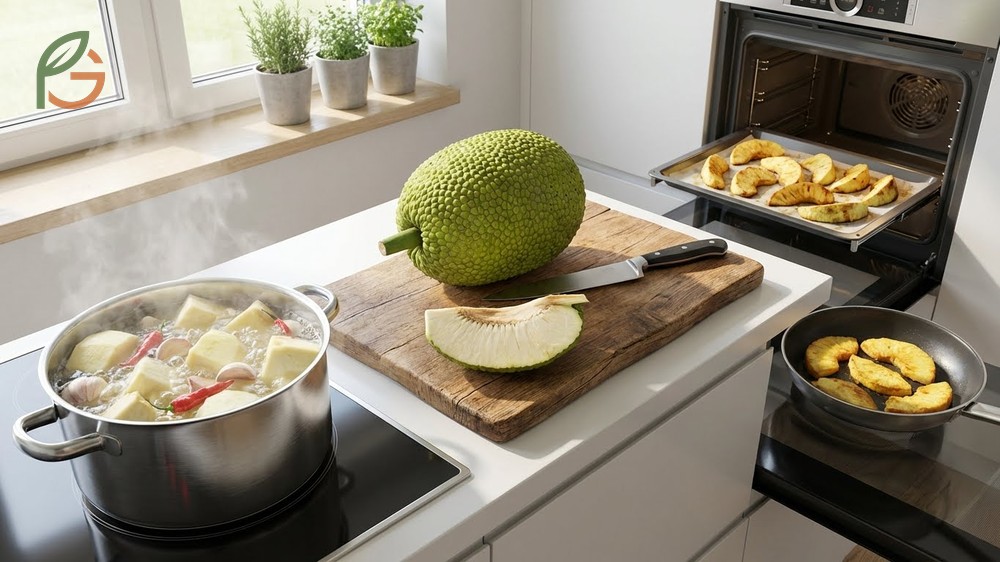
You can prepare breadfruit using the same methods you’d use for potatoes or squash. The simplest approach is to peel it, remove the fibrous core, then boil, steam, fry, or bake until tender.[5] The versatility is remarkable—it works in everything from breakfast hash to dinner sides.
Boiling takes about 40 minutes in enough water to cover the fruit. You’ll know it’s done when a fork slides through easily. For extra flavor, add hot peppers and garlic to the boiling water.[6]
My cousin in Veracruz, Mexico grows several tropical fruits including mamey and tried cooking breadfruit for the first time in spring 2024. She boiled it with garlic like the traditional method—the texture was creamy after 35 minutes versus the typical 40-minute range, and the mild flavor paired perfectly with grilled fish.
Roasting Breadfruit
Roasting brings out breadfruit’s natural sweetness and creates a tender, creamy interior with slightly caramelized edges. When roasted, the starchy flesh develops a subtly nutty flavor that’s incredibly satisfying.[4]
You can roast breadfruit whole or cut it into wedges. For whole roasting, place it directly on oven racks at 400°F (204°C) and turn every 15 minutes until the skin blackens and the flesh softens completely—usually 60-75 minutes total. The charred skin peels away easily to reveal the cooked interior.
Fried Breadfruit Recipes
Fried breadfruit rivals the best french fries you’ve ever had. The key is slicing it thin—about 1/4 inch thick—and soaking the slices in salt water for 15 minutes before frying.[5] This step removes excess starch and helps achieve crispier results.
After drying the slices thoroughly, drop them into hot oil (around 350°F or 177°C). They’ll brown quickly—typically 3-4 minutes per side. Remove to paper towels and sprinkle with salt immediately while they’re hot.
- Boiling: 40 minutes in water with optional garlic and peppers for extra flavor
- Roasting whole: 60-75 minutes at 400°F (204°C), turning every 15 minutes until skin blackens
- Frying as chips: Slice 1/4 inch thick, soak 15 minutes, fry 3-4 minutes per side at 350°F (177°C)
- Baking wedges: 30-35 minutes at 375°F (191°C) with olive oil and seasonings
- Steaming: 35-40 minutes in a steamer basket for the most delicate texture
Nutritional Content of Breadfruit
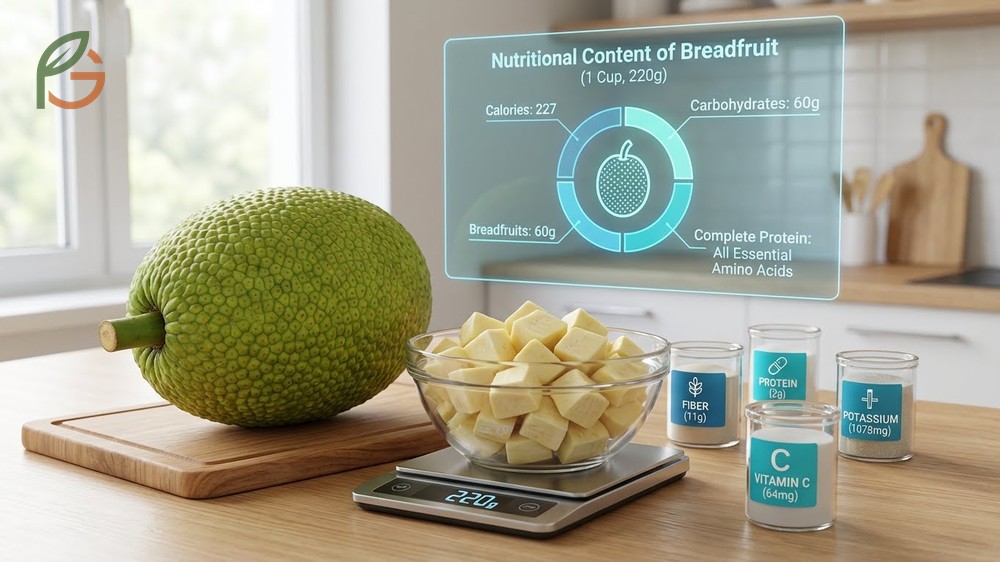
Breadfruit packs impressive nutritional value for a starchy fruit. One cup (220g) of raw breadfruit contains 227 calories, 60g carbohydrates, 11g fiber (39% daily value), and 2g protein.[3] What often gets overlooked is that breadfruit delivers a complete protein containing all essential amino acids—unlike most plant foods.[7]
The mineral content is particularly notable. That same one-cup serving provides 1,078mg potassium (23% daily value), 64mg vitamin C (71% daily value), and significant amounts of iron, manganese, and phosphorus.[3] The vitamin C content exceeds what you’ll find in most citrus fruits.
| Nutrient | Amount | % Daily Value |
|---|---|---|
| Calories | 227[3] | 11% |
| Carbohydrates | 60g[3] | 22% |
| Fiber | 11g[3] | 39% |
| Protein | 2g[3] | 4% |
| Vitamin C | 64mg[3] | 71% |
| Potassium | 1,078mg[3] | 23% |
Breadfruit Health Benefits
The high fiber content—nearly 40% of your daily needs in one cup—supports digestive health and helps maintain steady blood sugar levels. Research shows that fiber-rich foods like breadfruit can improve cholesterol profiles and reduce cardiovascular disease risk.
Breadfruit’s complete protein status sets it apart from other starchy staples like potatoes, rice, or cassava. This makes it particularly valuable for plant-based diets where getting all essential amino acids from a single food source is rare.[7]
- High fiber content (11g per cup) promotes digestive health and blood sugar stability
- Complete protein containing all essential amino acids—rare for plant foods
- Excellent vitamin C source (71% daily value) supporting immune function
- Rich in potassium (23% daily value) for heart health and blood pressure regulation
- Low fat content (less than 1g per cup) makes it suitable for weight management
- Good source of B vitamins including thiamine (20% DV) and pantothenic acid (20% DV)
- Contains copper (21% DV) and manganese supporting bone health and metabolism
Tip: Breadfruit’s carbohydrate content is similar to potatoes, but with significantly more fiber and vitamin C. If you’re watching carb intake, a half-cup serving provides the satisfaction of a full serving of potatoes with better nutritional density.
What is a Breadfruit Plant
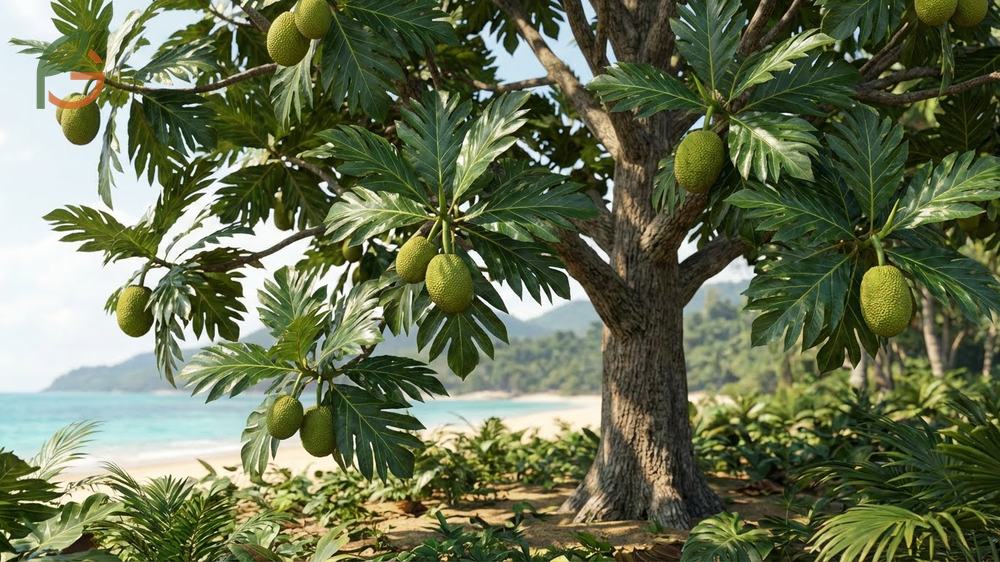
Breadfruit (Artocarpus altilis) is a large tropical tree in the mulberry family that can reach 65-85 feet tall at maturity. The tree produces large, showy leaves and develops fruit at the ends of branches rather than on the trunk.[8] It’s been a staple food crop across Pacific islands, Africa, the Caribbean, and Central America for centuries.
The tree thrives in warm climates—specifically USDA hardiness zones 9b to 11. It performs best when temperatures stay between 70-90°F (21-32°C) and doesn’t yield well if temperatures exceed 104°F (40°C) or drop below 41°F (5°C).[8] In the United States, this limits outdoor cultivation primarily to southern Florida, Hawaii, and protected areas of southern California and Texas.
Breadfruit trees need full sun exposure—at least 6-8 hours of direct sunlight daily. They prefer fertile, deep, well-draining soil with some sand content and a pH between 6.0-7.4. With proper care, trees begin producing fruit 3-5 years after planting and can continue bearing for 50-60 years.
Breadfruit vs Jackfruit
People often confuse breadfruit and jackfruit since they’re both large tropical fruits in the same plant family. However, they’re quite different in taste, nutrition, and how they grow.
Breadfruit delivers higher fiber content—4.9g per serving compared to jackfruit’s 1.5g—and contains more vitamin C, iron, manganese, and phosphorus.[7] The complete protein in breadfruit also sets it apart, while jackfruit lacks several essential amino acids.
Texture-wise, ripe jackfruit has a rubbery, stringy texture with individual seed pods covered in fruit flesh. Ripe breadfruit is soft and uniformly creamy throughout. Jackfruit typically weighs much more—it’s the largest tree-borne fruit in the world, with some specimens exceeding 80 pounds. Breadfruit rarely exceeds 10-12 pounds per fruit.
- Breadfruit has 3x more fiber per serving (4.9g vs 1.5g) than jackfruit
- Breadfruit provides complete protein; jackfruit doesn’t contain all essential amino acids
- Ripe breadfruit is creamy and uniform; ripe jackfruit is rubbery and stringy
- Breadfruit develops at branch ends; jackfruit grows directly from the trunk
- Jackfruit has higher sugar content (19g vs 11g) making it sweeter when ripe
- Breadfruit typically weighs 7-12 pounds; jackfruit can exceed 80 pounds
Where to Buy Breadfruit
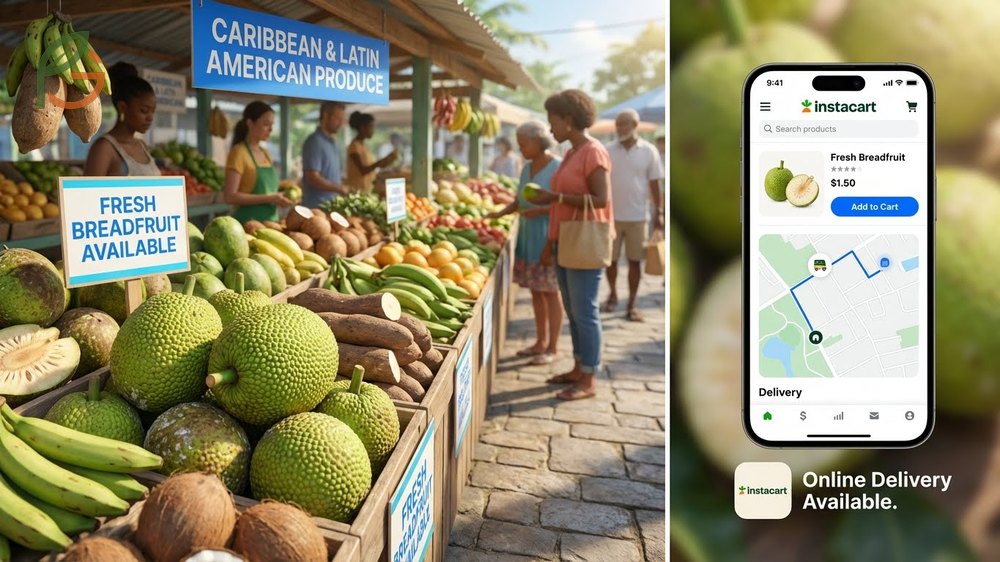
Finding fresh breadfruit in the United States can be challenging outside of Florida, Hawaii, and major metropolitan areas with Caribbean or Pacific Islander communities. Your best bet is Caribbean specialty stores, Latin American markets, or Asian grocery stores that carry tropical produce.
Several online retailers now offer breadfruit delivery through services like Instacart, which partners with stores that stock tropical fruits. You can also find frozen breadfruit—both whole and pre-sliced—at Caribbean markets and some natural food stores. Frozen breadfruit works well for most cooking applications and is often more convenient than fresh.
If you live in USDA zones 9b-11, consider growing your own breadfruit tree. Specialty tropical plant nurseries sell young breadfruit trees that can be planted in late spring when temperatures consistently stay above 60°F (16°C). The trees need space—plant them 26-33 feet apart and expect your first harvest 3-5 years after planting with good care.
Conclusion
The evidence is clear: what does breadfruit taste like depends entirely on ripeness—from starchy and potato-like when green to sweet and tropical when fully ripe. This versatility makes it one of the most adaptable fruits you can grow or cook with, suitable for everything from french fries to desserts. Current agricultural research emphasizes breadfruit’s potential as a sustainable, nutritious staple crop that can help address food security while providing complete protein and exceptional fiber content. Whether you’re roasting it whole, frying it into chips, or mashing it as a side dish, breadfruit delivers remarkable nutrition wrapped in surprisingly bread-like flavor and texture.
Frequently Asked Questions
How do you know when breadfruit is ripe enough to eat?
Breadfruit is ready when the skin changes from bright green to yellowish-green or yellow, and it gives slightly when pressed. For savory cooking, harvest it when still firm and green. For sweet applications, wait until it’s completely yellow with brown spots and feels soft—similar to a ripe avocado.
Can you eat breadfruit raw?
You can eat fully ripe breadfruit raw when it’s soft and yellow with a sweet tropical flavor. However, unripe and semi-ripe breadfruit should be cooked—the raw starchy flesh is tough and not particularly palatable. Most people prefer cooking breadfruit at all ripeness stages to enhance its natural flavors and improve digestibility.
Does breadfruit taste better roasted or boiled?
Roasting develops more complex flavors with nutty, caramelized notes and creates a creamier texture with slightly crispy edges. Boiling produces a milder taste and softer, more uniform texture similar to boiled potatoes. For maximum flavor, roasting wins—but boiling is faster and easier if you’re mashing it or adding it to soups and stews.
What’s the best substitute for breadfruit in recipes?
Potatoes make the closest substitute for unripe breadfruit in savory dishes—especially Yukon gold varieties. For ripe breadfruit’s sweeter applications, try plantains or even sweet potatoes. The texture won’t be identical, but these substitutes work well in most recipes calling for breadfruit.
How long does breadfruit last after you buy it?
Unripe breadfruit keeps at room temperature for 5-7 days while it ripens. Once ripe, refrigerate it for 2-3 days maximum before the quality declines. Cooked breadfruit lasts 3-4 days refrigerated in an airtight container. For longer storage, freeze cooked breadfruit for up to 6 months.
Is breadfruit good for weight loss?
Breadfruit can support weight loss when eaten in reasonable portions due to its high fiber content (11g per cup) which promotes fullness. However, at 227 calories and 60g carbs per cup, it’s similar to other starchy foods—portion control matters. The key advantage is that breadfruit’s fiber and complete protein keep you satisfied longer than simple carbohydrates.
Why is it called breadfruit if it’s not bread?
The name comes from the texture and aroma of cooked breadfruit, which remarkably resembles freshly baked bread—especially when roasted. As it ripens, breadfruit gives off a sweet, bread-like odor. Early European explorers who encountered it in the Pacific islands noted this similarity and the name stuck.





