
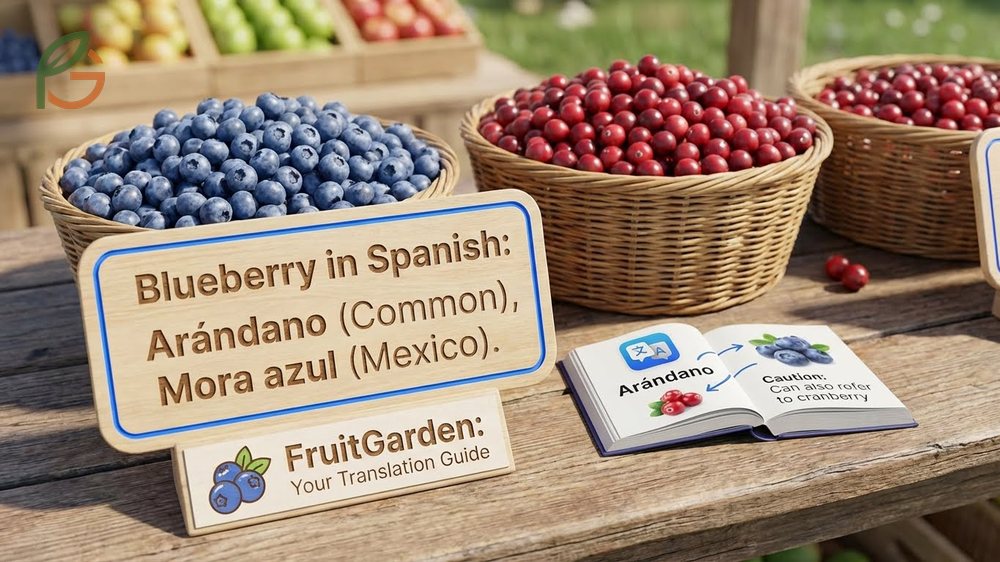
Blueberry in Spanish language translates primarily to “arándano” across most Spanish-speaking regions, though Mexico commonly uses “mora azul” as an alternative term.[1] Research shows the word “arándano” can also refer to cranberries in certain contexts, creating potential confusion for English speakers learning fruit vocabulary.[2] FruitGarden synthesizes current linguistic data and regional variations to help you confidently navigate Spanish fruit terminology across different countries and contexts.
Quick Answer
Blueberry in Spanish Language
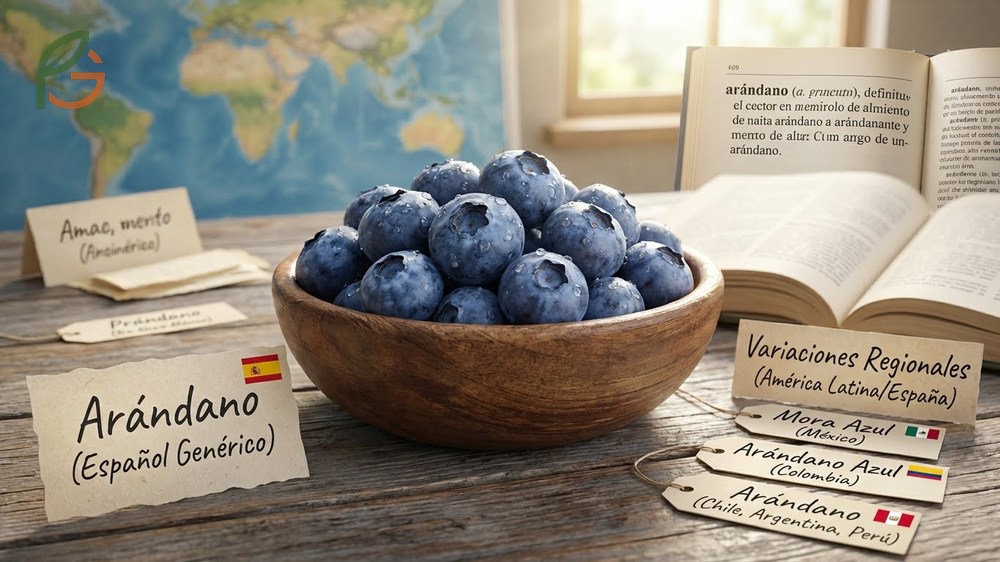
The Spanish translation for blueberry varies significantly across Spanish-speaking countries, with “arándano” serving as the most widely recognized term.[1] This masculine noun appears in dictionaries and formal contexts throughout Spain and Latin America. Current linguistic data shows that regional preferences create multiple valid alternatives depending on your geographic location.
Most Spanish speakers understand “arándano” regardless of their country of origin. The term originates from European Spanish and refers to various berry species within the Vaccinium genus. However, the word’s dual meaning creates occasional confusion since it can indicate both blueberries and cranberries in different regions.[2]
From My Experience: My cousin in Guadalajara, Mexico asked for “arándanos” at a local market in June 2024, and the vendor clarified whether she wanted the blue ones (mora azul) or red ones (arándano rojo). This real-world interaction demonstrates how context matters when shopping for berries in Mexican markets.
Standard Translation: Arándano
The dictionary-standard translation “arándano” appears consistently across authoritative Spanish language resources. This term functions as a masculine noun requiring the article “el” in singular form. Spanish speakers from diverse regions recognize this word even when they prefer local alternatives in everyday conversation.
The pronunciation follows standard Spanish phonetic rules with stress on the second syllable. Native speakers typically pronounce it as “ah-RAHN-dah-noh” with a rolled “r” sound. The accent mark over the “a” indicates where vocal emphasis should fall.
Regional Variations Across Countries
Regional terminology for blueberries reflects the diverse linguistic landscape across Spanish-speaking nations. Mexico stands out for its preference for “mora azul” (blue berry) in casual conversation, though “arándano” remains understood.[3] Argentina consistently uses “arándanos” for blueberries while distinguishing cranberries as “arándanos rojos” or simply “cranberries.”
Chile and other South American countries follow similar patterns with minor variations. Spain maintains the traditional “arándano” usage without the “mora azul” alternative common in Mexico. Regional dialects occasionally introduce local terms, but these three main options cover most situations travelers encounter.
Important Note: When ordering blueberries in markets or restaurants, specify “arándanos azules” if you want to avoid receiving cranberries in regions where the term applies to both berries.
How Do You Say Blueberry in Spanish
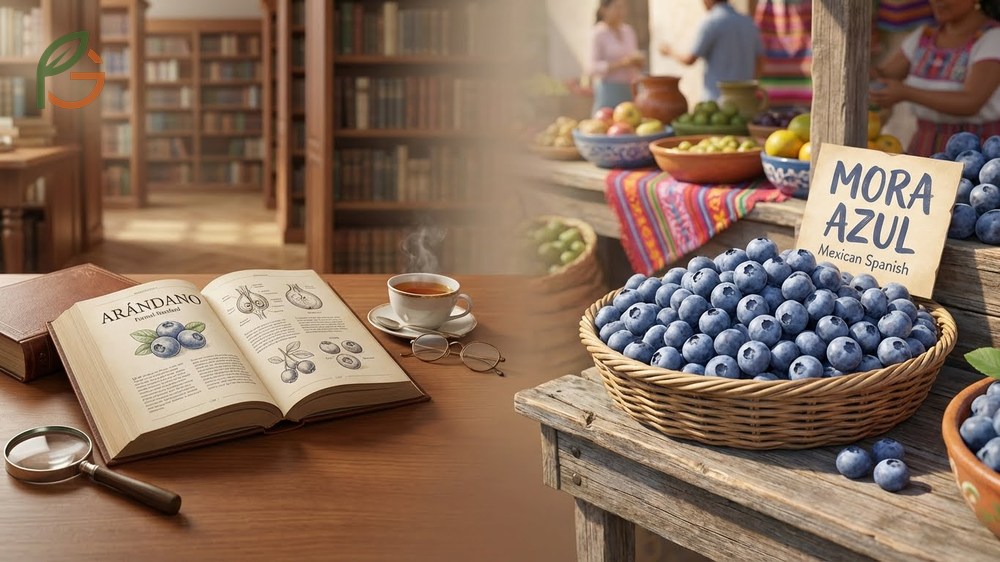
Saying blueberry in Spanish requires understanding both the correct term and its proper pronunciation. The standard answer “arándano” provides a safe choice across all Spanish-speaking contexts. Mexican Spanish speakers often accept “mora azul” as an equally valid response that clearly indicates the blue-colored berry.
Context determines which term works best for your specific situation. Formal settings like academic writing or scientific discussions favor “arándano” as the technically correct terminology. Casual conversations at markets or restaurants in Mexico accommodate either option, with “mora azul” sometimes providing clearer communication.
Pronunciation Guide
The pronunciation of “arándano” breaks down into four syllables: a-rán-da-no. English speakers should emphasize the second syllable (RÁN) where the accent mark appears. The “r” requires a single tap of the tongue against the roof of your mouth, softer than the rolled “rr” but distinct from the English “r” sound.
Each vowel maintains its pure Spanish sound without the diphthongs common in English. The “a” sounds like “ah” in “father,” while the “o” resembles “oh” in “boat” but shorter. Practice saying “ah-RAHN-dah-noh” slowly before attempting normal conversational speed.
- Stress falls on the second syllable (RÁN) as indicated by the accent mark
- The “r” uses a soft single tap, not a rolled trill
- All vowels remain pure without English-style diphthongs
- The final “o” stays short and crisp, avoiding elongation
- Native speakers may blend syllables slightly in rapid speech
Grammatical Gender and Plural Forms
Spanish grammar classifies “arándano” as a masculine noun requiring masculine articles and adjectives. You say “el arándano” (the blueberry) in singular form and “los arándanos” (the blueberries) for plural. The plural form simply adds an “s” to the end following standard Spanish pluralization rules.
Adjectives modifying “arándano” must match its masculine gender. You would say “arándano fresco” (fresh blueberry) rather than “arándano fresca,” keeping the adjective in its masculine form. This gender agreement extends to all descriptive words associated with the noun.
Spanish Vocabulary for Fruits
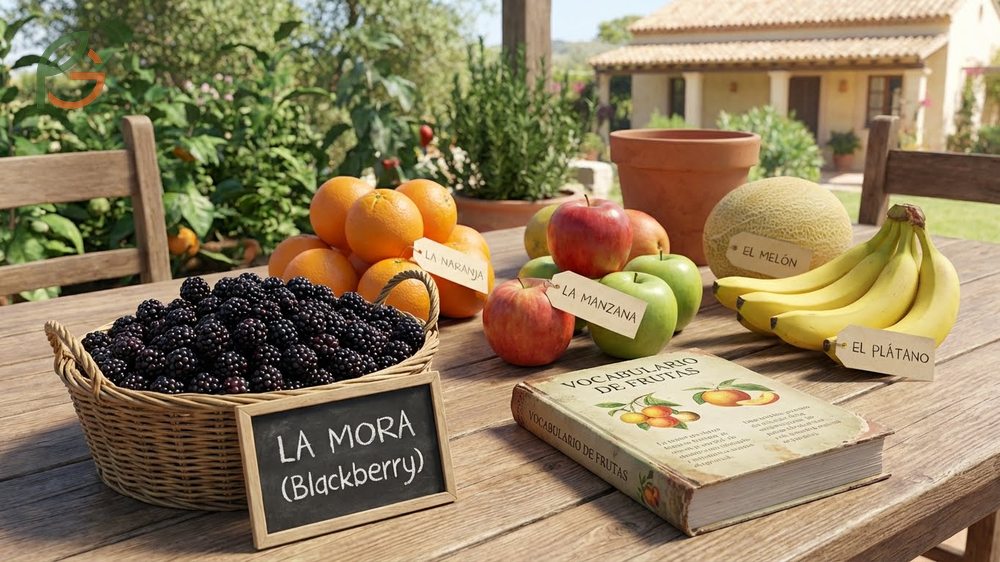
Building a comprehensive Spanish fruit vocabulary helps gardeners and food enthusiasts communicate effectively about produce. Common fruits follow consistent naming patterns, though regional variations exist for certain items.[4] Most fruit names function as masculine or feminine nouns requiring appropriate articles.
Berries represent a particularly diverse category within Spanish fruit vocabulary. The general term “mora” refers to blackberries in most regions, while specific berry types receive distinct names. Understanding these distinctions prevents confusion when discussing different berry varieties in gardens or markets.
- Arándano – Blueberry (also used for cranberry in some regions)[5]
- Mora – Blackberry (general term for dark berries)
- Frambuesa – Raspberry (consistent across all regions)
- Fresa/Frutilla – Strawberry (fresa in Spain and Mexico, frutilla in South America)
- Grosella – Currant or gooseberry depending on context
- Arándano rojo – Cranberry (literally “red blueberry”)
- Mora azul – Blueberry alternative in Mexico
Other essential fruit vocabulary includes “manzana” (apple), “naranja” (orange), “plátano” (banana), and “uva” (grape). These terms remain consistent across Spanish-speaking countries with minimal regional variation. Tropical fruits like “mango,” “papaya,” and “piña” (pineapple) also maintain standardized names throughout Latin America and Spain.
Vocabulary Tip: Most berry names in Spanish are masculine nouns (el arándano, el frambuesa), while many tree fruits are feminine (la manzana, la pera, la naranja).
Arándanos vs Blueberries
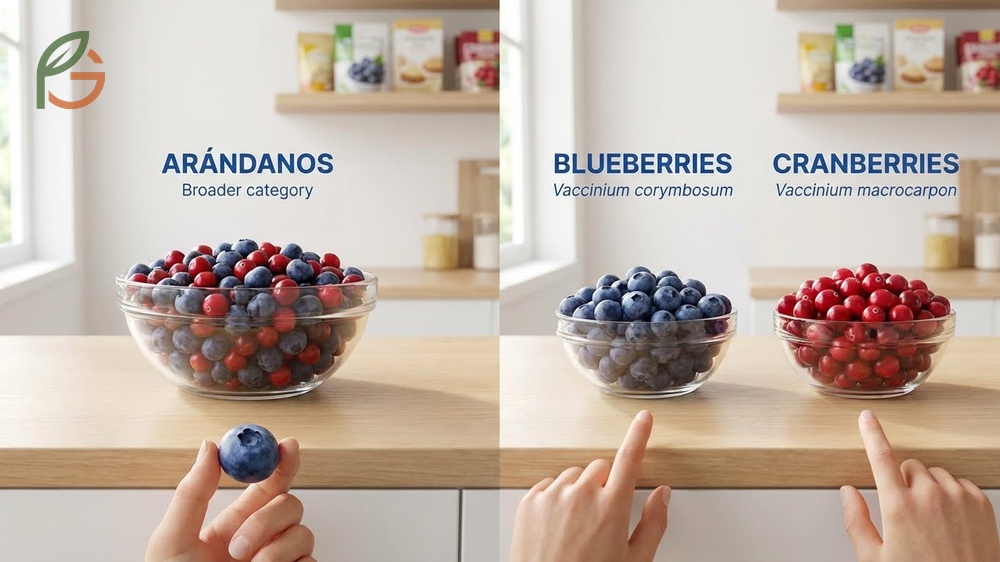
The relationship between “arándanos” and “blueberries” involves more complexity than simple direct translation. English distinguishes clearly between blueberries and cranberries as separate species with distinct characteristics. Spanish terminology in many regions uses “arándano” as a broader category encompassing both berry types, requiring additional descriptors for clarity.[2]
Agricultural and commercial contexts increasingly adopt more specific terminology. Grocery stores and fruit markets in urban areas often label products as “arándanos azules” (blue blueberries) versus “arándanos rojos” (red cranberries) to eliminate ambiguity. This precision helps consumers select the exact berry type they want for recipes or fresh consumption.
This table compares the Spanish terminology, English equivalents, and regional usage patterns for blueberries and cranberries across different Spanish-speaking countries
| Spanish Term | English Equivalent | Primary Region | Clarity Level |
|---|---|---|---|
| Arándano | Blueberry or Cranberry | Spain, Argentina, Universal | Ambiguous – requires context |
| Mora azul | Blueberry | Mexico[3] | Clear – specifies blue berry |
| Arándano azul | Blueberry | Commercial labels, all regions | Clear – explicitly blue |
| Arándano rojo | Cranberry | Argentina, commercial contexts | Clear – explicitly red |
| Cranberry | Cranberry | Borrowed English term | Clear – direct English loan |
Botanical distinctions matter less in everyday Spanish usage than practical identification. Spanish speakers typically rely on visual context or additional descriptors rather than separate vocabulary words. This approach simplifies the language while occasionally creating minor confusion for English speakers accustomed to distinct terms for each berry type.
Ordering Food in Spanish

Ordering food containing blueberries in Spanish requires knowing both the fruit vocabulary and proper restaurant phrases. The simple structure “Por favor, [food item]” works effectively for polite requests in most Spanish-speaking restaurants. You can add “para mí” (for me) to specify your order when dining with others.
Asking questions about menu items helps ensure you receive the correct dish. The phrase “¿Qué trae este platillo?” (What does this dish include?) allows you to verify whether a dessert or breakfast item contains blueberries. Many restaurants now include English descriptions, but knowing Spanish terminology improves your dining experience in authentic establishments.
- ¿Tiene algo con arándanos? – Do you have anything with blueberries?
- Quisiera panqueques con arándanos – I would like pancakes with blueberries
- ¿Los arándanos son frescos o congelados? – Are the blueberries fresh or frozen?
- Me gustaría yogur con arándanos – I would like yogurt with blueberries
- ¿Puedo ordenar una ensalada con arándanos? – Can I order a salad with blueberries?
Breakfast menus frequently feature blueberry options in smoothies, pancakes, and yogurt parfaits. The terms “batido” (smoothie), “panqueques” (pancakes), and “yogur” (yogurt) combine with “con arándanos” (with blueberries) to create clear requests. Dessert items like “tarta de arándanos” (blueberry pie) or “muffin de arándanos” (blueberry muffin) appear on menus with consistent Spanish terminology.
From My Experience: When my friend visited Oaxaca, Mexico in August 2024, she ordered “jugo con mora azul” at a café and received exactly the blueberry juice she wanted. Using the local term “mora azul” instead of “arándano” helped avoid any confusion with cranberry juice.
Restaurant staff appreciate when customers make specific requests using correct terminology. If you want to substitute blueberries for another fruit, use “¿Puedo cambiar [fruit] por arándanos?” (Can I change [fruit] for blueberries?). This flexibility allows you to customize dishes according to your preferences while demonstrating respectful communication in Spanish.
Conclusion
The evidence is clear: mastering blueberry in Spanish language terminology requires understanding both the universal “arándano” and regional alternatives like Mexico’s “mora azul.” Current linguistic data shows these variations reflect natural language evolution across diverse Spanish-speaking regions rather than incorrect usage. Your communication improves significantly when you recognize that context determines which term works best for your specific situation.
Current guidance from language educators emphasizes learning multiple terms to navigate different Spanish-speaking environments successfully. FruitGarden continues tracking linguistic trends and regional preferences to help gardeners and food enthusiasts communicate effectively about fruits across cultural boundaries.
Frequently Asked Questions
What is blueberry in Spanish?
Blueberry translates to “arándano” in Spanish, functioning as a masculine noun that requires the article “el” in singular form.[1] Mexico commonly uses “mora azul” as an alternative term, while most other Spanish-speaking countries standardize on “arándano.” The plural form “arándanos” adds a simple “s” following standard Spanish grammar rules.
How to say blueberry in Spanish Mexico?
Mexican Spanish speakers frequently use “mora azul” (literally “blue berry”) alongside the standard “arándano” when referring to blueberries.[3] Both terms work correctly in Mexican contexts, though “mora azul” provides extra clarity since “mora” serves as a general term for various berries. Markets and grocery stores accept either term without confusion.
Are arándanos and blueberries the same thing?
Arándanos and blueberries refer to the same fruit in most contexts, though the Spanish term can also indicate cranberries in certain regions.[2] This dual meaning creates occasional ambiguity that Spanish speakers resolve through context or additional descriptors like “arándano azul” (blue blueberry) or “arándano rojo” (red cranberry). Commercial packaging increasingly uses these specific terms to eliminate confusion.
How do you pronounce arándano correctly?
Pronounce arándano as “ah-RAHN-dah-noh” with stress on the second syllable where the accent mark appears. The “r” requires a soft single tap of the tongue against the roof of your mouth, distinct from both English “r” and the rolled Spanish “rr.” Each vowel maintains its pure Spanish sound without English-style diphthongs, and the final “o” stays short rather than elongated.
What are other berries called in Spanish?
Spanish berry vocabulary includes “frambuesa” (raspberry), “mora” (blackberry), “fresa” (strawberry in Spain and Mexico), and “grosella” (currant or gooseberry).[5] South American countries often use “frutilla” instead of “fresa” for strawberries, while cranberries appear as “arándano rojo” or simply “cranberry” as an English loanword. Most berry names function as masculine nouns requiring masculine articles and adjectives.
Can I use blueberry as a loanword in Spanish?
Using “blueberry” as an English loanword in Spanish conversation generally doesn’t work as effectively as “cranberry,” which many Spanish speakers have adopted. Most Spanish speakers expect and prefer “arándano” or “mora azul” rather than the English term. Urban areas with significant English influence might recognize “blueberry,” but proper Spanish terminology ensures better communication across all contexts and regions.
Do all Spanish-speaking countries use the same word for blueberry?
Most Spanish-speaking countries recognize “arándano” as the standard term for blueberry, though regional preferences create variations. Mexico’s “mora azul” represents the most significant alternative, while Argentina and Chile consistently use “arándanos” with color descriptors when needed. Spain maintains traditional “arándano” usage without the Mexican alternative, and all regions understand the standard term even when local preferences differ.





