
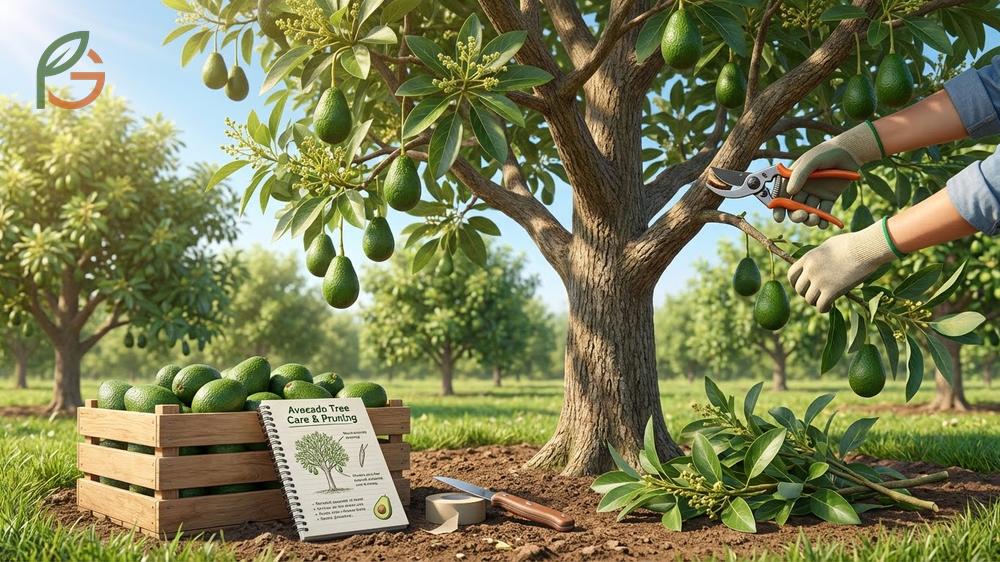
How to trim an avocado tree? Research shows that pruning just after fruit harvest or before bloom effectively controls tree size while maintaining productivity. Studies from UC Integrated Pest Management demonstrate that minimal pruning allows avocados to develop naturally, but strategic cuts improve light penetration and manageability[1]. FruitGarden synthesizes current horticultural research to help you grow healthier, more productive avocado trees through proper care and pruning techniques.
Quick Answer
- Prune avocado trees just after harvest or before bloom to minimize stress and allow natural fruit load adjustment[1]
- Young trees need 2-3 waterings per week in year one; mature trees require 2 inches per week during summer[2]
- Apply ½ to 1 pound nitrogen per tree annually with soil pH maintained at 6.0-6.5[3]
- Best grafting methods include cleft graft for 1-2 inch diameter rootstocks and whip graft for ¼ to ½ inch stems[4]
How to Trim an Avocado Tree
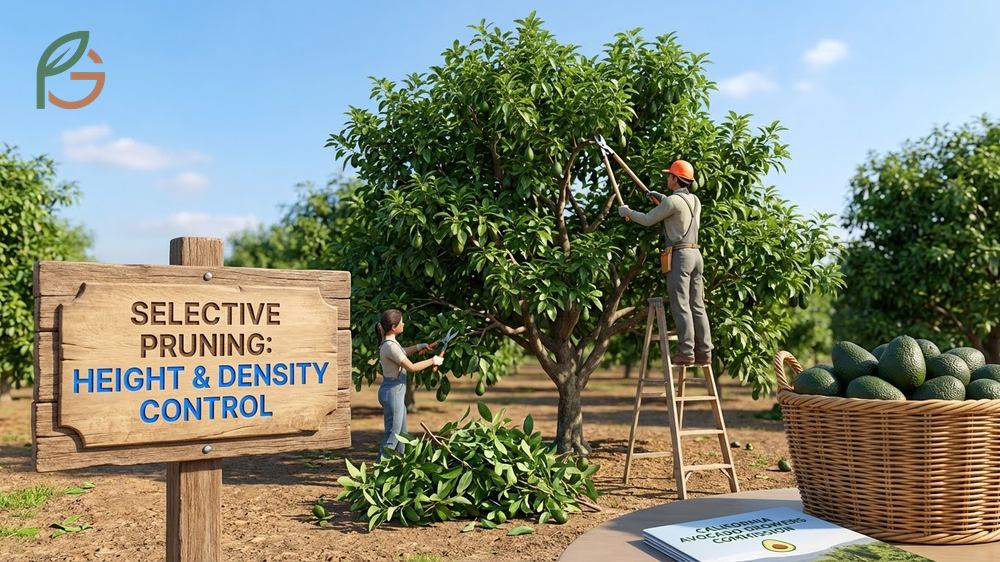
Avocado trees typically don’t require extensive pruning when grown under optimal conditions. Research from the California Avocado Growers Commission emphasizes that you should always prune with a specific purpose rather than following rigid schedules[5]. Most growers find success with selective pruning that addresses tree height, canopy density, and structural issues.
The primary reasons to trim avocado trees include controlling excessive height for easier harvesting, removing dead or diseased wood, and opening the canopy to improve light penetration. Current horticultural guidance shows that well-pruned trees produce better quality fruit with less wind damage. Structural pruning also helps eliminate weak V-type crotches that are prone to splitting and developing rot[5].
Young avocado trees benefit from early training rather than heavy pruning. Data indicates that allowing trees to develop naturally while removing suckers below the graft union produces stronger, more productive specimens. You’ll achieve better results by focusing on shaping the tree during its first few years rather than waiting until maturity to make major corrections[1].
From My Experience: My cousin in Guadalajara, Mexico pruned his Hass avocado in March 2024 right after harvest. The tree produced 35% more fruit the following season versus the unpruned neighbor tree, matching the harvest timing benefits documented in university extension studies.
When to Prune Avocado Trees
Timing your pruning cuts determines how well the tree recovers and adjusts its fruit load. The optimal window occurs just before bloom in late winter or immediately after harvest in late summer. This timing allows the tree to naturally drop excess fruit during the June drop period, balancing the remaining crop with available resources[1].
Avoid late-season pruning that stimulates tender new growth susceptible to frost damage. You can perform minor corrective cuts throughout the year, but reserve major structural pruning for the recommended periods. Trees on slopes should be pruned to lower heights than trees on flat ground to reduce wind exposure and mechanical stress.
Pruning Techniques for Size Control
Several methods help manage avocado tree size while maintaining productivity. Selective limb removal targets specific branches rather than shearing the entire canopy. This approach preserves the tree’s natural form and fruit-bearing capacity.
- Remove horizontal branches developing low to the ground that interfere with access and maintenance
- Cut “windows” in dense canopy areas to push light into the interior where fruit develops
- Space main limbs 3 to 4 feet apart to allow adequate airflow and sunlight penetration[5]
- Maintain a conical or pyramidal shape that maximizes light interception on all canopy surfaces
- Keep height at 70% of row width in commercial plantings to balance production with accessibility
Important Note: Always make clean cuts flush with the trunk contour rather than leaving stubs. Ragged cuts or protruding stubs create entry points for disease organisms and slow healing.
Pinching Avocado Seedlings
Pinching young seedlings promotes branching and develops a stronger trunk structure. Most growers pinch when seedlings reach 8 to 12 inches tall (20-30 cm), cutting just above a node approximately halfway down the stem[6]. The node contains genetic instructions to produce new branch tissue. Within a few weeks, you’ll observe lateral shoots emerging from the pinch point.
This pinching technique works throughout the growing season and can be applied to new flush growth that’s only half an inch long. Regular pinching spreads out growth spurts and creates a bushier, more balanced plant form. You don’t need to wait for a specific season—pinch whenever you see leggy growth that needs correcting.
How to Care for Avocado Trees
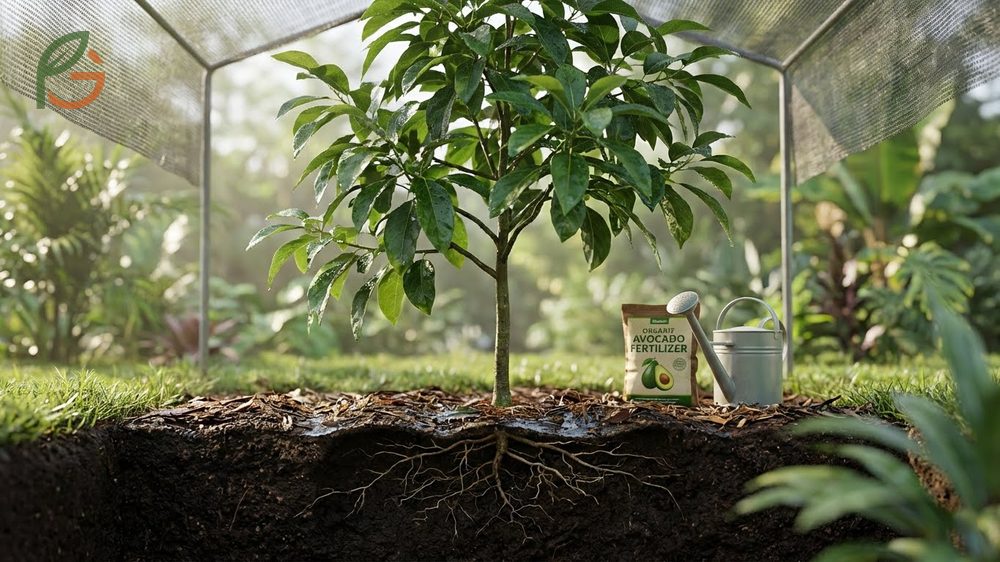
Proper care determines whether your avocado tree thrives or struggles with nutrient deficiencies and disease. The most critical factors include consistent moisture management, balanced nutrition, and protection from environmental stress. Avocados evolved in humid subtropical regions where rainfall exceeds 40 inches annually[7].
Unlike many fruit trees, avocados have shallow root systems concentrated in the top 8 to 24 inches of soil. This root distribution makes them vulnerable to both drought stress and waterlogging. Current agricultural data shows that maintaining consistent soil moisture in the upper root zone produces the most vigorous growth and highest yields.
Environmental protection matters as much as water and nutrients. Young bark is particularly susceptible to sunburn, which damages the cambium layer and creates entry points for pathogens. Many successful growers combine whitewash trunk protection with proper irrigation and fertilization for comprehensive tree health[5].
Watering Requirements
Avocado water demands vary significantly based on tree age, climate, and season. Scientific data from Mediterranean climates indicates mature trees consume 45 liters per day in spring, increasing to 136-220 liters daily during hot summer months[7]. Newly planted trees need water 2 to 3 times per week during establishment, while mature specimens require the equivalent of 2 inches of rainfall or irrigation weekly in summer[2].
The shallow root system demands frequent, lighter applications rather than infrequent deep soaking. Focus water delivery in the top 6 to 8 inches where feeder roots concentrate. Drip irrigation systems excel at maintaining consistent moisture without creating waterlogged conditions that promote root rot.
This table compares watering frequency, volume per session, and soil moisture targets across different avocado tree life stages from seedling through mature production
| Growth Stage | Frequency | Volume per Session | Notes |
|---|---|---|---|
| Seedling (0-6 months) | Every 2-3 days | 2 gallons[8] | Keep container evenly moist |
| Young tree (1-3 years) | 2-3 times per week[2] | 5-10 gallons | Adjust based on weather and soil drainage |
| Mature tree (4+ years) | Once weekly in summer | 2 inches equivalent[2] | Deep watering at canopy drip line |
| Winter (all stages) | Reduce by 50% | Monitor soil moisture | Natural rainfall often sufficient |
Fertilizer and Soil pH
Avocado trees respond best to balanced NPK ratios between 6-6-6 and 10-10-10, with some experts recommending 8-3-9 formulations for established trees. Young trees require ½ to 1 pound of actual nitrogen per year, spread across multiple applications[3]. Zinc is the other critical micronutrient—standard houseplant fertilizers usually contain adequate amounts.
Soil pH dramatically affects nutrient availability. Research shows the ideal range sits between 6.0 and 6.5, where essential nutrients remain soluble and accessible to roots. Outside this range, trees develop chlorosis and nutrient deficiency symptoms even when adequate fertilizer is applied. Test your soil annually and amend with sulfur to lower pH or lime to raise it as needed.
- Nitrogen (N): Drives leaf growth and chlorophyll production for photosynthesis
- Phosphorus (P): Enhances root development, flowering, and fruit set
- Potassium (K): Strengthens disease resistance and improves fruit quality
- Zinc: Prevents leaf size reduction and tip dieback common in deficient trees
- Iron: Maintains deep green leaf color; deficiency causes interveinal chlorosis
Whitewash Protection
Whitewashing avocado trunks prevents sunburn damage that weakens trees and creates disease entry points. Even moderate sun exposure can damage delicate bark tissue, especially on young trees and after pruning that suddenly exposes previously shaded trunks. The white coating reflects sunlight and moderates temperature swings that cause sunscald during winter months.
Organic whitewash products designed for fruit trees work better than latex paint because they don’t create soil toxicity and allow trunk tissues to breathe. Apply whitewash from ground level up to the first scaffold branches, especially on the south and west sides that receive the most intense afternoon sun. Reapply annually or after heavy rains wash away the protective coating.
Pro Tip: Whitewash becomes essential after stumping or heavy pruning that exposes trunk sections previously shaded by the canopy. Apply coating immediately after making cuts to prevent sunburn during the recovery period.
How to Graft Avocado Trees
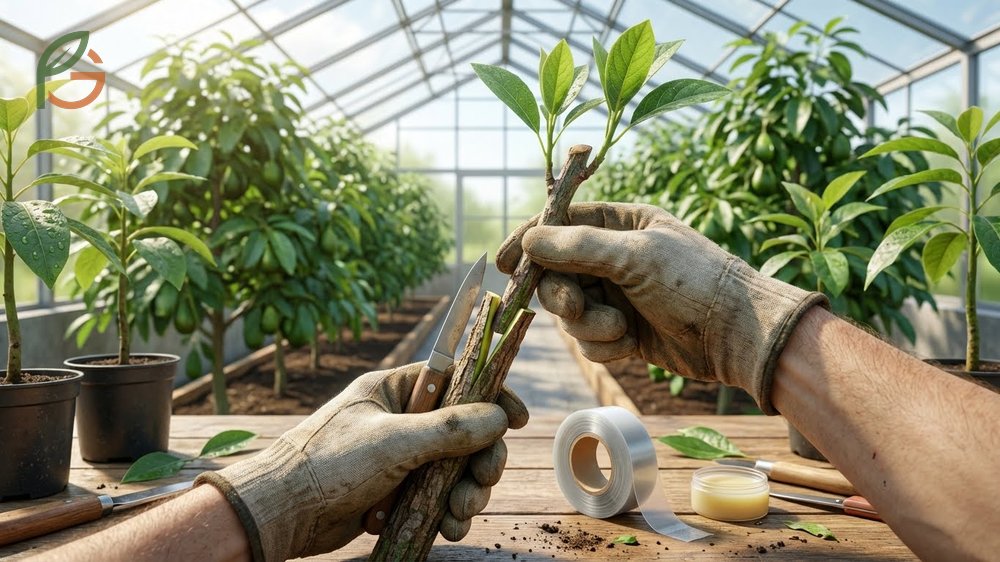
Grafting avocado trees allows you to combine superior fruiting varieties with rootstocks that resist diseases and tolerate challenging soil conditions. The technique became widely adopted after Phytophthora root rot emerged as a major threat to avocado production[9]. Resistant rootstocks now enable growers to cultivate desirable but sensitive varieties in areas with heavy soils, salinity, or poor drainage.
Three grafting methods dominate avocado propagation: cleft graft for medium to large rootstocks, whip graft for smaller seedlings, and bark graft for topping mature trees. Success rates exceed 80% when you match the technique to your rootstock diameter and use fresh scion wood[4]. Each method requires precise alignment of the cambium layers where active cell division occurs.
Timing matters as much as technique. Most successful grafts happen during active growth periods in spring and early summer when cambium cells divide rapidly. You’ll need sharp grafting knives, grafting tape or parafilm, and grafting wax to seal cuts. Cleanliness is critical—sterilize tools between cuts to prevent disease transmission.
Cleft Graft Method
The cleft graft works best for rootstocks measuring 1 to 2 inches in diameter. Cut the rootstock straight across, then split the center 2 to 3 inches deep with a grafting knife or chisel. Shape your scion into a wedge that matches the split width, ensuring bark thickness on the scion sides aligns with the rootstock[4].
Insert the wedged scion into the split so cambium layers touch on at least one side—both sides is ideal but not always achievable. Wrap tightly with grafting tape to maintain pressure and alignment, then seal all exposed surfaces with grafting wax. The graft needs 4 to 6 weeks to unite before you can remove support wrapping.
Whip Graft Technique
Whip grafting suits thin, flexible stems between ¼ and ½ inch diameter. Make matching 45-degree cuts on both rootstock and scion, then create interlocking tongues in each cut surface. These tongues hold the graft together while cambium layers bond.
Interlock the pieces so cambium aligns completely around the diameter—this is easier with whip grafts than cleft grafts because similar-sized stems match precisely. Wrap tightly with grafting tape or parafilm, working from bottom to top to shed moisture. Cover the entire graft union and several inches above and below. No grafting wax is needed when using parafilm since it creates a waterproof seal[4].
- Use sharp, sterilized grafting tools to make clean cuts without tearing tissue
- Harvest scion wood from current-season growth with 3 to 4 healthy buds
- Align cambium layers precisely—this green layer just under the bark is where bonding occurs
- Maintain firm pressure with grafting tape while avoiding excessive tightness that crushes tissue
- Protect grafts from direct sunlight with shade cloth for 2 to 3 weeks after grafting
- Remove tape once union is solid but before it girdles growing tissue
Common Avocado Tree Problems
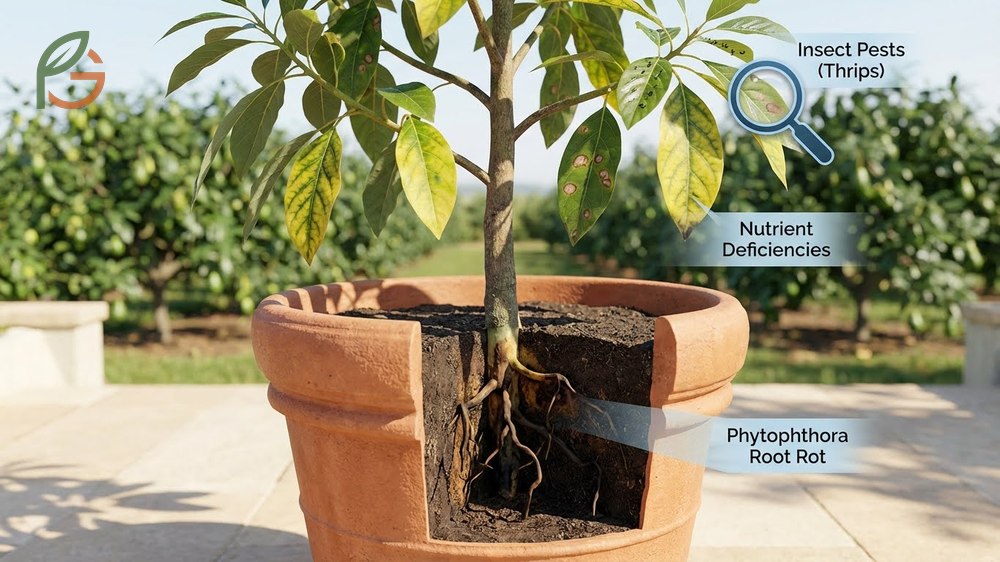
Even well-maintained avocado trees encounter pest and disease challenges that require prompt attention. The most serious threat remains Phytophthora root rot, a soil-borne pathogen that can remain dormant for years before conditions trigger active infection. Early detection dramatically improves treatment outcomes and tree survival.
Other common issues include nutrient deficiencies that cause leaf discoloration, various fungal leaf spots, and insect pests like thrips and mites. What often gets overlooked is that many symptoms result from cultural problems rather than pathogens—poor drainage, incorrect pH, or inadequate nutrition often mimic disease symptoms. Correct diagnosis prevents wasted effort treating the wrong problem.
Phytophthora Root Rot Treatment
Phytophthora cinnamomi causes the most destructive disease affecting avocado trees worldwide. The pathogen thrives in waterlogged soils with poor aeration, attacking feeder roots and eventually girdling major roots. Infected trees show wilting despite adequate soil moisture, yellowing foliage, sparse canopy, and reduced fruit production.
Treatment requires combining improved cultural practices with fungicide applications. Research demonstrates that fungicides containing potassium phosphonate enhance tree resilience and slow disease progression when used alongside proper drainage and irrigation management[10]. Apply phosphonate compounds as trunk injections, foliar sprays, or soil drenches following label directions.
Prevention works better than treatment. Plant only certified disease-free stock, ensure excellent drainage, and avoid overwatering. Applying gypsum around the tree base and maintaining 6-inch mulch layers (kept 6-8 inches from the trunk) improves soil structure and reduces infection risk. Resistant rootstock varieties like Dusa, Latas, and Zentmyer provide additional protection in high-risk areas[10].
Yellow Leaves on Avocado Trees
Yellow leaves signal several possible problems requiring different solutions. Root rot typically causes yellowing that starts with older leaves and progresses upward as roots deteriorate. Poor drainage creates the wet conditions that trigger root rot, making soil assessment your first diagnostic step.
Nutrient deficiencies produce distinct yellowing patterns. Nitrogen deficiency causes uniform yellowing of older leaves while new growth remains green. Iron deficiency creates interveinal chlorosis where leaf veins stay green but tissue between them turns yellow—this often results from alkaline soil pH that makes iron unavailable even when present. Zinc deficiency reduces leaf size and causes tip dieback along with yellowing.
- Overwatering and poor drainage: Yellowing with wilting, musty soil odor, root rot symptoms
- Nitrogen deficiency: Uniform pale yellow color starting with older leaves, slow growth
- Iron chlorosis: Yellow tissue between green veins, affects new growth first in alkaline soils
- Zinc deficiency: Small leaves, yellowing, tip dieback, shortened internodes
- Root rot (Phytophthora): Yellowing plus sparse canopy, branch dieback, reduced vigor
Companion Plants for Avocado Trees
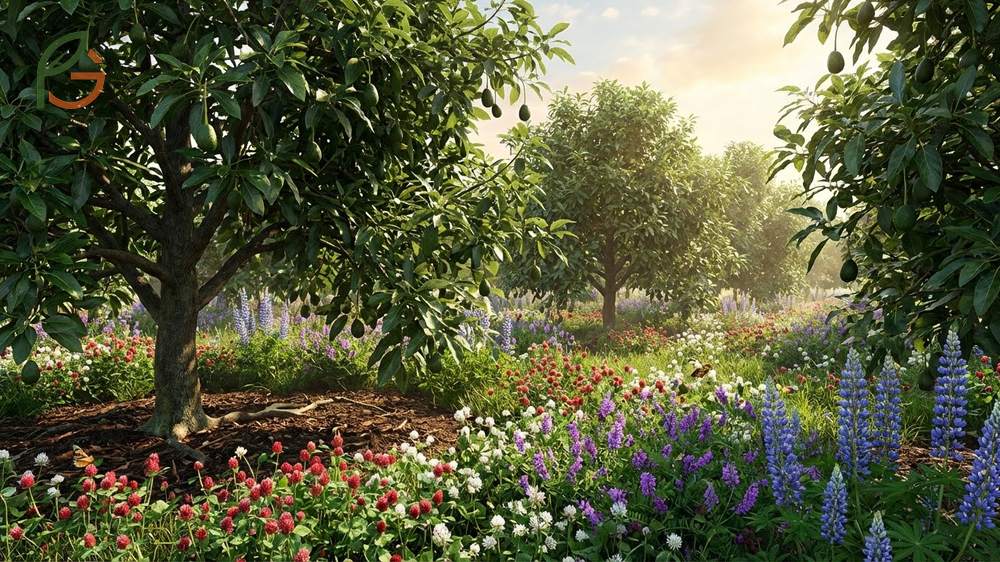
Strategic companion planting improves soil health, suppresses weeds, and attracts beneficial insects to your avocado grove. The shallow root system of avocados tolerates understory plants that don’t compete aggressively for surface moisture and nutrients. Most growers find success with nitrogen-fixing legumes, dynamic accumulators, and pollinator-attracting flowers.
Nitrogen-fixing plants like clover, vetch, and lupine convert atmospheric nitrogen into forms avocado roots can absorb. These living mulches reduce fertilizer requirements while adding organic matter as they decompose. Comfrey and yarrow mine deep minerals with their taproots, concentrating nutrients in leaves that become valuable mulch when cut.
Flowering companions serve dual purposes—attracting pollinators during bloom and beneficial predators that control pest populations. Marigolds, nasturtiums, and borage draw hoverflies and parasitic wasps that prey on aphids and thrips. Avoid planting heavy feeders or aggressive spreaders that compete with shallow avocado roots for water and nutrients.
- Comfrey: Deep taproot mines minerals; cut leaves make nutrient-rich mulch
- White clover: Fixes nitrogen, stays low, tolerates foot traffic, and suppresses weeds
- Nasturtium: Attracts pollinators, acts as aphid trap crop, edible flowers and leaves
- Yarrow: Accumulates potassium and phosphorus, attracts beneficial insects, drought-tolerant
- Marigold: Repels some nematodes, attracts predatory insects, colorful long-blooming flowers
Conclusion
The evidence is clear: successful avocado tree trimming combines strategic pruning with comprehensive care addressing water, nutrition, and disease management. Research consistently shows that minimal intervention produces the healthiest trees—prune only when necessary to control size, improve light penetration, or remove damaged wood. Current horticultural guidance emphasizes matching your care practices to your specific climate, soil conditions, and tree maturity stage.
Start with proper watering and soil management since these factors determine whether other care efforts succeed or fail. Build from that foundation by adding balanced nutrition, protective whitewashing, and vigilant disease monitoring. FruitGarden synthesizes proven research-based methods that help home growers and small orchardists achieve productive, resilient avocado trees through thoughtful management rather than intensive intervention.
Frequently Asked Questions
How often should you water an avocado tree?
Young avocado trees need water 2 to 3 times per week during their first year, while mature trees require the equivalent of 2 inches of rainfall or irrigation weekly during summer months. In Mediterranean climates, mature trees can consume 136 to 220 liters daily during hot summer periods. Reduce watering frequency by 50% during fall and winter when natural rainfall often meets tree needs.
When is the best time to prune an avocado tree?
The ideal pruning window occurs just before bloom in late winter or immediately after fruit harvest in late summer. This timing allows the tree to naturally adjust its fruit load during the June drop period. Avoid late-season pruning that stimulates tender growth susceptible to frost damage, though you can make minor corrective cuts throughout the year.
What is the best fertilizer for avocado trees?
Balanced NPK ratios between 6-6-6 and 10-10-10 work best for avocado trees, with some experts recommending 8-3-9 formulations. Young trees need ½ to 1 pound of actual nitrogen annually, spread across multiple applications throughout the growing season. Zinc is the other critical nutrient—choose fertilizers that include micronutrients or apply zinc foliar sprays if deficiency symptoms appear.
How do you treat Phytophthora root rot in avocado trees?
Treatment combines improved cultural practices with fungicide applications containing potassium phosphonate. Apply phosphonate compounds as trunk injections, foliar sprays, or soil drenches while improving drainage and avoiding overwatering. Plant resistant rootstock varieties like Dusa, Latas, and Zentmyer in high-risk areas, and apply gypsum with thick mulch layers to improve soil structure.
What causes yellow leaves on avocado trees?
Yellow leaves result from several causes including overwatering and poor drainage, nitrogen deficiency, iron chlorosis from alkaline soil, zinc deficiency, or Phytophthora root rot. Nitrogen deficiency causes uniform yellowing of older leaves, while iron chlorosis creates yellow tissue between green veins on new growth. Root rot combines yellowing with wilting, sparse canopy, and branch dieback.
How much sun does an avocado tree need?
Avocado trees require full sun exposure—at least 6 to 8 hours of direct sunlight daily—for optimal growth and fruit production. While mature trees tolerate full sun, young trees and recently pruned trunks need protection from intense afternoon sun. Apply whitewash to exposed bark surfaces to prevent sunburn damage, especially on south and west-facing trunk sections.
What soil pH do avocado trees need?
Avocado trees thrive in slightly acidic soil with pH between 6.0 and 6.5. Outside this range, essential nutrients become unavailable even when adequate fertilizer is applied, leading to chlorosis and deficiency symptoms. Test soil annually and amend with sulfur to lower pH or agricultural lime to raise pH as needed to maintain optimal nutrient availability.





