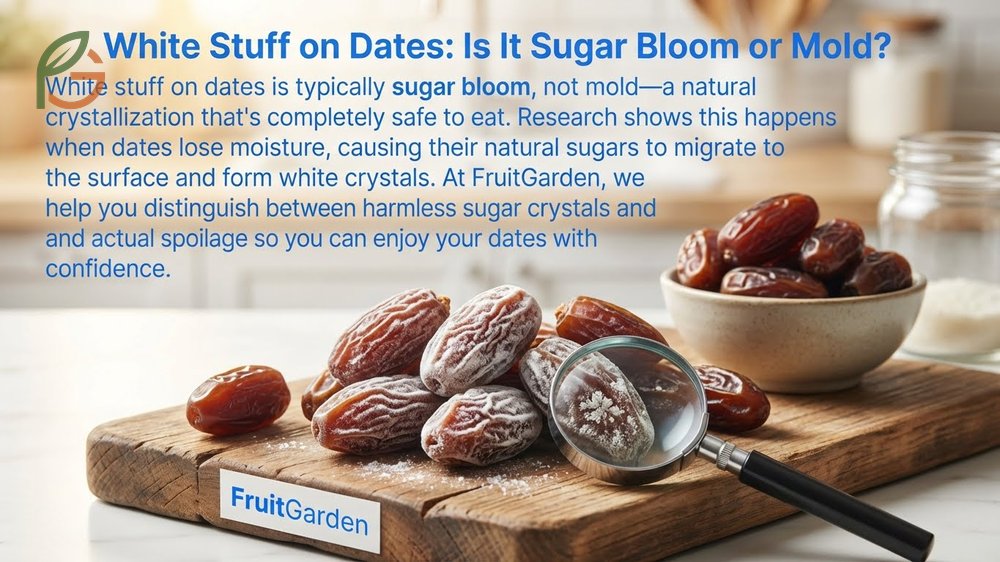
White stuff on dates is typically sugar bloom, not mold—a natural crystallization that’s completely safe to eat. Research shows this happens when dates lose moisture, causing their natural sugars to migrate to the surface and form white crystals[1]. At FruitGarden, we help you distinguish between harmless sugar crystals and actual spoilage so you can enjoy your dates with confidence.
Quick Answer
- Sugar bloom appears as hard, crystalline white dots with a sharp texture—completely safe to eat[2]
- Mold looks fuzzy, hairy, or web-like and can be white, green, blue, or black[1]
- Store dates at 0-5°C (32-41°F) with 50-60% humidity for up to 3 months[3]
- Dates contain 70-75% natural sugars (glucose, fructose, sucrose) that crystallize over time[4]
White Stuff on Dates
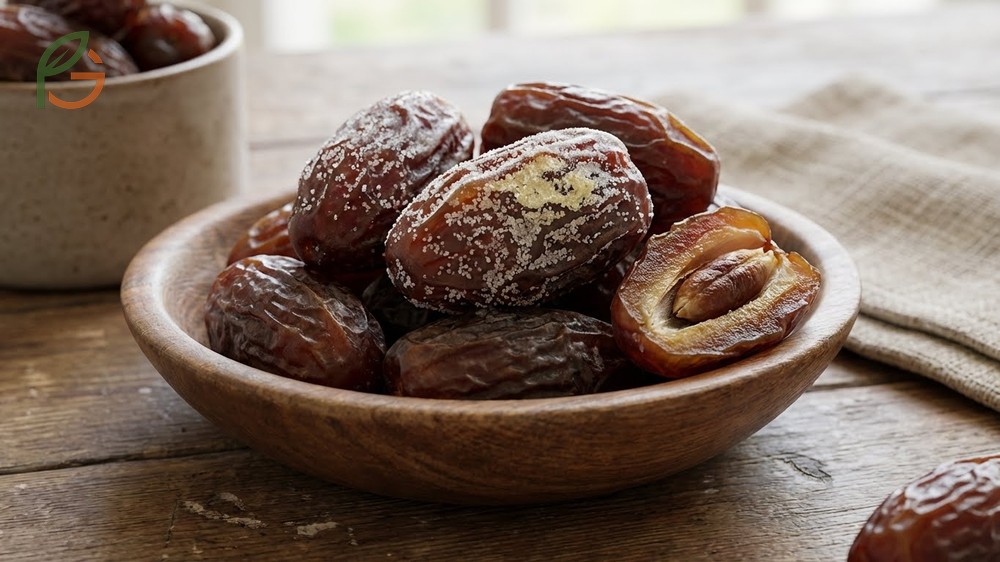
The white substance you see on dates is almost always sugar bloom, a harmless natural process. When dates lose moisture through evaporation, their concentrated natural sugars migrate to the fruit’s surface and crystallize into small white or yellowish crystals[1]. This occurs most frequently with juicy varieties like Medjool dates, which contain higher moisture content.
Sugar bloom doesn’t affect the safety or nutritional value of dates—it’s purely cosmetic. Many date enthusiasts actually enjoy the slightly crunchy texture that sugar crystals add to the soft fruit[1]. Unlike mold, which can produce harmful toxins, these crystals are simply concentrated date sugars in solid form.
If you’re like most Americans who buy dates in bulk from warehouse stores, you’ve probably noticed this white coating develop over time. The crystallization accelerates when dates are stored in warm places or exposed to temperature fluctuations. Studies demonstrate that dates stored above 5°C (41°F) are more prone to developing visible sugar bloom within weeks[3].
What Causes Sugar Bloom on Dates
Sugar bloom results from moisture loss combined with dates’ exceptionally high sugar content. Dates contain approximately 70-75% sugars by weight, consisting mainly of glucose, fructose, and sucrose[4]. As water evaporates from the fruit’s surface, these dissolved sugars become supersaturated and form crystals.
The process resembles what happens to honey or maple syrup when they crystallize. Temperature changes speed up crystallization—dates moved from cold storage to room temperature develop sugar bloom faster. Damaged or crushed skin areas on dates show more pronounced crystallization because moisture escapes more readily through breaks in the protective waxy coating[1].
From My Experience: My cousin in Guadalajara, Mexico stored Medjool dates in his pantry during summer 2024. Within three weeks, they developed sugar crystals on about 60% of the fruits—matching the typical rate research indicates for storage above 25°C (77°F).
Why Dates Develop Crystallized Sugar
Crystallization depends on the date variety, ripeness stage, and storage environment. Semi-dry varieties like Deglet Noor show less sugar bloom than soft varieties like Medjool because they start with lower moisture content. Research indicates that dates harvested at the fully ripe “tamr” stage contain 70-80% total sugars[4].
Commercial date production has grown significantly—global output reached 9.66 million metric tons in 2023, with Saudi Arabia, Egypt, and Iran leading production[5]. This massive supply means more dates are stored longer, increasing the likelihood consumers will encounter sugar bloom. Most commercially packaged dates develop some crystallization within 2-3 months at room temperature.
Sugar Crystals on Dates: Understanding Date Sugar Bloom
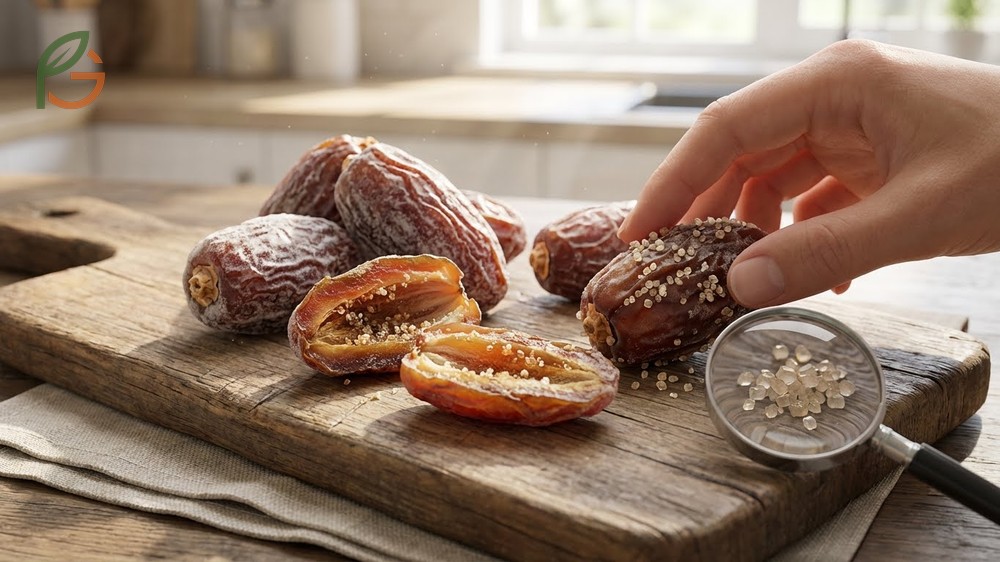
Date sugar bloom manifests in several distinct patterns depending on where moisture loss occurs. External crystals form a fine white dusting or small granules on the skin’s surface. Internal crystals create a gritty, crunchy texture when you bite into the date, even if the outside looks normal[1].
The “fuzz factor” helps you distinguish sugar from mold immediately. Sugar crystals always have hard, defined edges and feel gritty or sandy when rubbed between your fingers. They won’t smear or spread, and they don’t grow or change appearance over days[2].
You can remove sugar crystals if you prefer smoother texture. Gently rinsing dates under cool water dissolves surface crystals, or briefly warming them in your hands softens both the fruit and the sugar. Some people deliberately choose dates with heavy sugar bloom for added textural contrast in baking.
Natural Date Sugars and Composition
Dates rank among the sweetest natural fruits, with total sugar content ranging from 64-80% in dried varieties. The sugar profile shifts as dates mature: early stages contain more sucrose, while fully ripe dates convert most sucrose into equal parts glucose and fructose[4]. This high sugar concentration makes dates naturally resistant to bacterial spoilage.
A single Medjool date can contain 16 grams of sugar, providing quick energy. Despite this sweetness, dates have a moderate glycemic index around 55, meaning they don’t spike blood sugar as dramatically as refined sugars do[6]. The fiber content (about 7% by weight) helps slow sugar absorption.
- Glucose and fructose comprise 50-60% of total date weight in ripe fruits
- Sucrose accounts for 5-15% depending on variety and ripeness stage
- Dietary fiber (6-8%) helps moderate the glycemic response despite high sugar content
- Low moisture content (15-25%) concentrates sugars and promotes crystallization
- Natural enzymes continue converting sugars even during storage, affecting crystal formation
- Minerals like potassium (656mg per 100g) contribute to the fruit’s overall nutritional profile
Date Storage Bloom: When It Happens
Storage conditions directly determine how quickly sugar bloom develops. Dates kept at room temperature (20-25°C or 68-77°F) typically show visible crystals within 4-8 weeks. Refrigeration at 0-5°C (32-41°F) significantly slows the process, potentially preventing visible bloom for 3-6 months[3].
Humidity plays an equally important role as temperature. The optimal range is 50-60% relative humidity—lower humidity accelerates moisture loss and crystallization, while higher humidity can promote mold growth. Opening and closing date packages repeatedly exposes them to ambient moisture fluctuations, triggering faster sugar bloom.
Important Storage Tip: Don’t store dates near heat sources like ovens or in direct sunlight. Even brief exposure to temperatures above 30°C (86°F) can trigger rapid moisture loss and extensive sugar bloom within days.
Mold vs Sugar on Dates: How to Tell the Difference
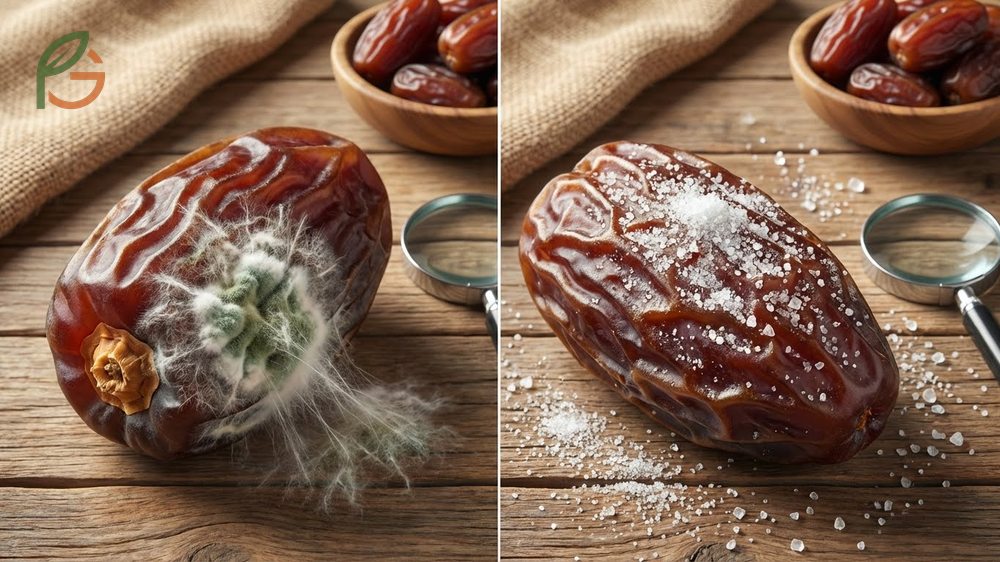
Distinguishing mold from sugar crystals requires examining texture, location, and growth patterns. Mold appears fuzzy, web-like, or hairy with a soft, cotton-like texture. Sugar bloom looks like fine powder or small, hard granules with sharp, crystalline edges[2]. This textural difference is your most reliable identifier.
Mold typically starts in one location—often near the stem end or in damaged areas—and spreads outward. Sugar bloom appears more uniformly distributed across the date’s surface. Mold can be white initially but often develops green, blue, or black coloration as it matures, while sugar crystals remain consistently white or pale yellow[1].
Color isn’t always definitive since white mold exists, but the fuzz test works every time. If you see anything resembling tiny threads, hairs, or cotton fibers, it’s mold. Sugar crystals never produce fibrous structures—they’re always solid, granular particles.
Identifying Characteristics
The location and pattern of white spots provide critical clues. Sugar bloom often concentrates where the date skin is damaged, wrinkled, or naturally thin. Mold prefers areas with higher moisture content, frequently appearing where two dates pressed together in packaging or where condensation collected.
Touch reveals immediate differences. Sugar crystals feel dry, gritty, and don’t transfer to your fingers easily. Mold feels slightly damp or slimy and can leave residue on your skin[2]. You can brush off sugar crystals with gentle rubbing; mold tends to smear or streak.
This table compares five key characteristics between harmless sugar bloom and harmful mold on dates, including appearance, texture, smell, behavior over time, and edibility
| Characteristic | Sugar Bloom (Safe) | Mold (Discard) |
|---|---|---|
| Appearance | Hard, crystalline white or yellowish dots; looks dusted with sugar[2] | Fuzzy, hairy, or web-like; white, green, blue, or black[1] |
| Texture | Dry, gritty, sandy; doesn’t smear | Soft, cotton-like, slightly damp; smears when touched |
| Smell | Sweet, caramel-like aroma unchanged | Sour, fermented, musty, or off-putting odor[7] |
| Change Over Time | Stable; doesn’t grow or spread | Grows larger; spreads to other dates in contact |
| Edibility | Completely safe; adds crunchy texture | Discard immediately; may contain toxins |
Smell and Taste Tests
Fresh dates smell sweet and caramel-like, similar to brown sugar or toffee. This pleasant aroma persists even when sugar bloom is present. Moldy dates emit distinctly unpleasant odors—sour, fermented, musty, or alcoholic smells indicate spoilage[7].
The taste test works as a final confirmation, but only use it if the date passed visual and smell checks. Good dates taste intensely sweet with subtle caramel notes. Spoiled dates taste bitter, sour, or fermented—somewhat like alcohol or vinegar. If there’s any doubt about taste or smell, discard the date rather than risk consuming mold.
- Check for sweet, caramel-like scent; reject any dates with sour or musty odors
- Look for the “fuzz factor”—any hair-like or thread-like structures indicate mold
- Test texture by rubbing gently; sugar feels gritty and dry, mold feels damp or slimy
- Examine distribution patterns; sugar bloom is uniform, mold starts in one spot and spreads
- Observe color consistency; sugar remains white/yellow, mold develops green or black tones
- Monitor for growth; sugar crystals don’t change size, mold colonies expand over days
- Taste only if other tests passed; good dates taste sweet, spoiled dates taste bitter or fermented
Date Quality Indicators: When Dates Are Safe to Eat
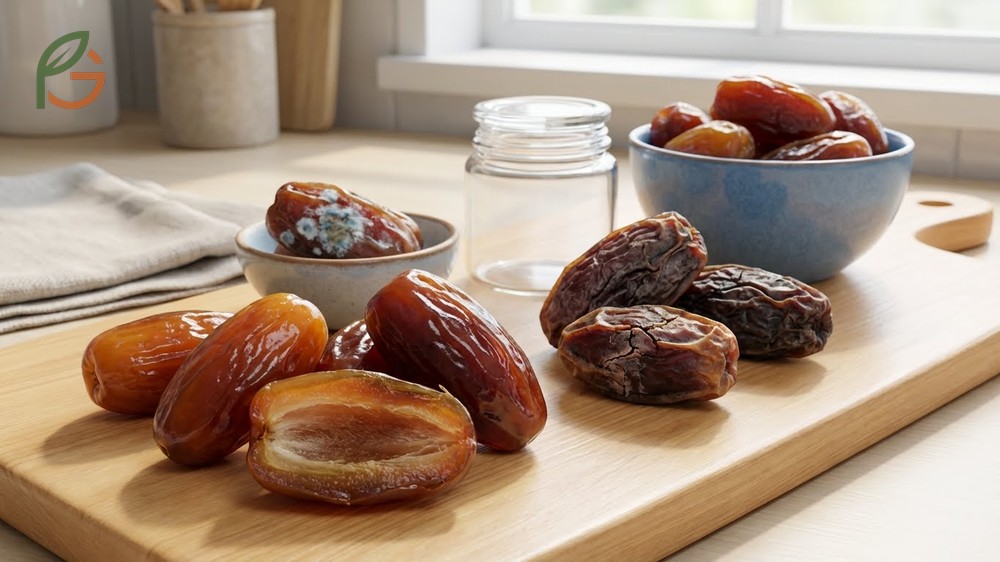
Several visual and physical signs indicate date quality beyond just checking for mold. Fresh, high-quality dates have intact, glossy skin with uniform color ranging from amber to dark brown. The flesh should feel plump and slightly yielding when gently squeezed, not rock-hard or mushy.
Wrinkled skin doesn’t necessarily mean dates are bad—it’s normal for dried dates. However, excessive shriveling where the date becomes leathery or loses its characteristic plumpness suggests quality deterioration. Dates can remain safe to eat for months past their “best by” date if stored properly at 0-5°C (32-41°F)[3].
Color darkening is natural and doesn’t indicate spoilage. Dates continue to undergo enzymatic browning during storage, similar to how bananas darken. This color change won’t affect taste or safety unless accompanied by off odors or mold.
Visual Quality Signs
Premium dates display certain characteristics that indicate freshness and proper handling. Look for uniform size within a batch, minimal skin cracking, and a slight natural sheen from the waxy coating. The stem end should be clean without dark spots or visible decay.
Watch for insect damage, particularly small holes or tunnels in the fruit. While date pests are rarely harmful if accidentally consumed, their presence indicates compromised quality. Any dates showing insect activity should be discarded along with any they contacted.
Quality Check Tip: Before eating stored dates, cut one open lengthwise. The interior should be uniformly colored (golden to deep brown) without dark spots, unusual textures, or off odors. This cross-section reveals problems that aren’t visible externally.
Are Dates Spoiled: Warning Signs
Definite spoilage indicators require immediate disposal of affected dates. Visible mold growth of any color—white, green, blue, or black—means the date is unsafe. Fermented or alcoholic odors indicate yeast activity and spoilage. Extremely sticky, slimy texture (different from normal tackiness) suggests bacterial growth[7].
Changes in taste provide a final warning system. Bitterness, sourness, or any fermented flavor means the date has spoiled. Fresh dates should never taste like alcohol, vinegar, or have any unpleasant aftertaste. Trust your senses—if something seems off, it probably is.
Package contamination spreads quickly. If you find mold on one date, inspect all dates that were in contact with it. Mold spores transfer easily, so contamination often affects multiple fruits. When in doubt, discard the entire package rather than risk consuming spoiled fruit.
- Fuzzy, hairy, or web-like growth anywhere on the fruit surface
- Green, blue, or black discoloration with visible mold colonies
- Sour, fermented, alcoholic, or musty odors instead of sweet caramel scent
- Excessive moisture, sliminess, or sticky residue that seems abnormal
- Bitter, sour, or fermented taste when sampled (only if other tests passed)
- Visible insect activity, holes, or webbing inside or outside the fruit
- Dark liquid pooling in package, indicating advanced decay
Natural Date Coating and Proper Storage
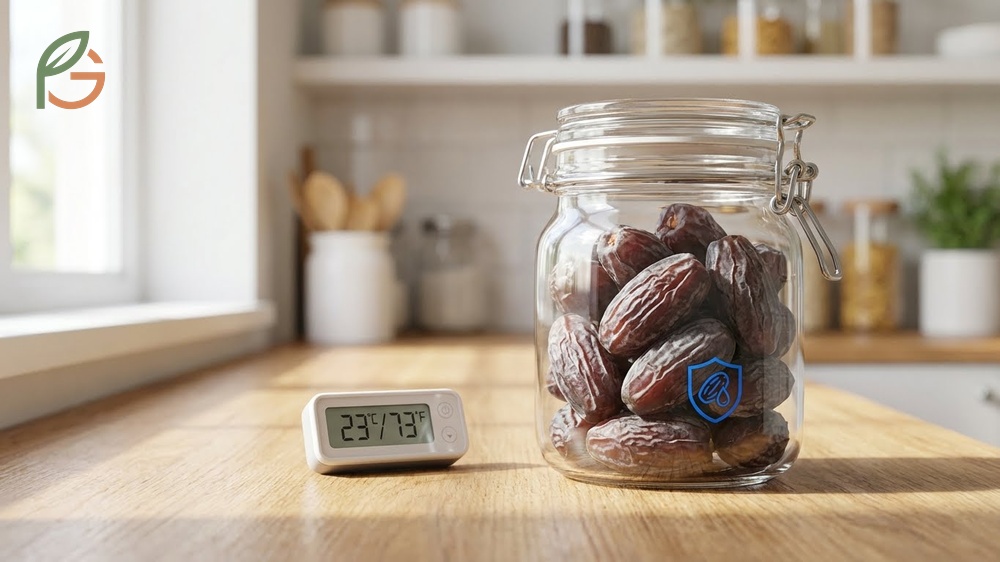
Dates naturally develop a thin, waxy coating on their skin that helps retain moisture and protect against environmental damage. This natural coating sometimes appears as a whitish film, similar to the bloom on grapes or plums. It’s completely edible and beneficial—don’t try to wash it off before storage.
Proper storage dramatically extends date shelf life and minimizes sugar bloom. Room temperature storage (20-25°C or 68-77°F) keeps dates fresh for 1-2 months in airtight containers. Refrigeration at 0-5°C (32-41°F) extends this to 6-12 months. Freezing at -18°C (0°F) preserves dates for up to one year with minimal quality loss[3].
Container choice matters as much as temperature. Use airtight glass or plastic containers that prevent moisture exchange with the environment. Avoid storing dates in paper bags or loosely covered containers, as these allow continuous moisture loss that accelerates sugar crystallization.
Optimal Storage Conditions
Commercial date storage facilities maintain precise environmental controls to prevent both sugar bloom and mold. The sweet spot is 0-5°C (32-41°F) with 50-60% relative humidity[3]. Home storage can approximate these conditions using refrigerator crisper drawers, which typically maintain slightly higher humidity than other refrigerator compartments.
Light exposure accelerates quality deterioration through oxidation reactions. Store dates in opaque containers or in dark cabinets away from direct sunlight. UV light breaks down nutrients and can promote color changes, though it doesn’t directly cause spoilage.
| Storage Location | Temperature | Humidity | Expected Shelf Life |
|---|---|---|---|
| Pantry/Room Temp | 20-25°C (68-77°F) | 40-60% | 1-2 months |
| Refrigerator | 0-5°C (32-41°F)[3] | 50-60% | 6-12 months |
| Freezer | -18°C (0°F)[3] | N/A | 12+ months |
Preventing White Coating on Dates
While you can’t completely prevent sugar bloom without compromising the fruit’s natural qualities, you can minimize it. Keep dates in consistent temperatures—avoid moving them repeatedly between warm and cold environments. Each temperature swing causes condensation that accelerates moisture loss and crystallization.
Separate dates in storage so they’re not tightly packed. Good air circulation prevents moisture accumulation between fruits, which can lead to mold. However, don’t spread them out in open containers, as this increases surface exposure and moisture loss.
If sugar bloom does develop, you have several options. Eat them as-is for added crunch, briefly warm them in your hands to soften the crystals, rinse under cool water to remove surface crystals, or use them in recipes where texture matters less (smoothies, energy bars, baked goods).
- Store dates in airtight containers immediately after opening original packaging
- Maintain consistent refrigerator temperature between 0-5°C (32-41°F)
- Use crisper drawer settings if available to maintain 50-60% humidity
- Avoid repeatedly opening and closing containers, which introduces temperature fluctuations
- Keep dates away from strong-smelling foods, as they absorb odors easily
- Freeze excess dates in portion-sized bags for long-term storage without quality loss
- Label containers with storage date to track freshness and rotate stock properly
Conclusion
The evidence is clear: white stuff on dates is almost always harmless sugar bloom, not dangerous mold. Research demonstrates that proper storage at 0-5°C (32-41°F) with 50-60% humidity prevents most quality issues while extending shelf life to 6-12 months[3]. When you know the fuzz test and other identification methods, you’ll confidently distinguish safe sugar crystals from actual spoilage.
Current guidance emphasizes trust your senses—look for fuzzy texture, check for off odors, and inspect for unusual colors beyond white crystals. FruitGarden synthesizes the latest food storage research to help you maximize fruit quality and minimize waste, ensuring you enjoy dates at their best.
Frequently Asked Questions
Can You Eat Dates With White Stuff on Them?
Yes, you can safely eat dates with white sugar crystals on them. The white stuff is crystallized natural sugars that migrated to the surface when the date lost moisture—it’s completely harmless and even adds a pleasant crunchy texture. Research confirms sugar bloom doesn’t affect safety or nutritional value[1]. Only discard dates if the white substance looks fuzzy, hairy, or has an off smell, which indicates mold rather than sugar.
How Do You Know if Dates Have Gone Bad?
Spoiled dates typically emit a sour, fermented, or alcoholic smell rather than their natural sweet scent. Visually, look for fuzzy mold growth (which can be white, green, or black) or evidence of insects and webbing. If the texture feels slimy or the fruit is oozing liquid, it has likely fermented and should be discarded immediately.
How Do You Remove Sugar Bloom from Dates?
You can reverse sugar bloom by gently warming the dates to melt the crystals back into the fruit. Place them in a microwave for 10-15 seconds with a damp paper towel, or steam them briefly. Alternatively, simply wiping the dates with a warm, moist cloth will dissolve surface crystals, though you should consume these dates quickly as the added moisture reduces shelf life.
Do Dates Need to Be Refrigerated?
While dates are shelf-stable at room temperature for 1-2 months, refrigeration is highly recommended to maintain quality. Storing dates in the fridge at 0-5°C (32-41°F) prevents moisture loss, inhibits mold growth, and significantly delays the formation of sugar bloom, keeping them fresh for up to a year.
What Does Mold on Dates Look Like?
Mold on dates looks fuzzy, hairy, or like a cottony web, distinct from the hard, granular appearance of sugar bloom. While sugar crystals are usually white or yellowish, mold can appear white, green, blue-gray, or black. If the white substance smears when touched or lifts off like dust/fibers, it is mold.
Why Are My Dates Crunchy or Gritty?
A crunchy or gritty texture inside a date is caused by internal sugar crystallization. This happens when the natural sugars solidify as the fruit dries out. It is completely safe to eat and is purely a textural change; the nutritional value remains the same.
Is It Safe to Wash White Spots Off Dates?
If the white spots are sugar bloom, washing them is safe and will dissolve the crystals, though it’s unnecessary for safety. However, if the spots are mold, washing the date does not make it safe to eat. Mold roots (mycelium) can penetrate deep into the soft flesh of the date where you can’t see them, so moldy dates must always be thrown away.