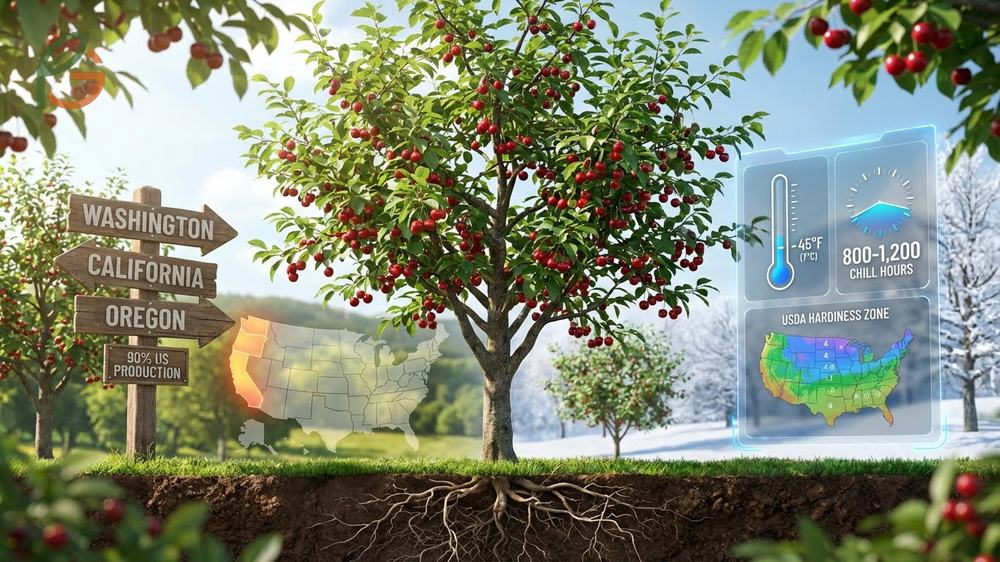
Where do cherries grow? Cherries thrive in USDA Hardiness Zones 4-9, with most varieties requiring 800-1,200 chill hours below 45°F (7°C) during winter dormancy[1]. The United States leads global production, with Washington, California, and Oregon accounting for 90% of the nation’s sweet cherry harvest[2]. FruitGarden synthesizes current agricultural research and climate data to help you understand where these beloved stone fruits flourish and what conditions they need to thrive.
Quick Answer
- Cherries grow best in zones 4-9[3], requiring cold winters and temperate summers
- Most varieties need 800-1,200 chill hours[1] between 32-45°F (0-7°C) annually
- Washington produces 260,000 tons[2] annually, leading all US states
- Cherries originated in Asia Minor[4] (modern-day Turkey) between the Caspian and Black Seas
Where Do Cherries Grow
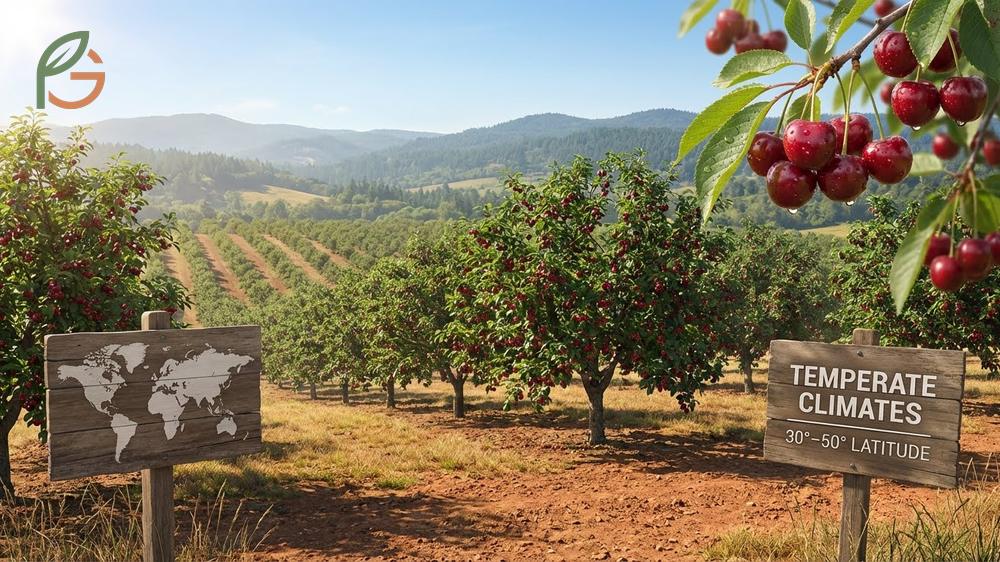
Cherries flourish in temperate climates with distinct seasons, requiring both cold winters for dormancy and warm summers for fruit development. Research shows these stone fruits grow successfully across multiple continents, from North America and Europe to Asia and parts of South America.
The ideal growing environment combines well-drained soil, full sun exposure, and adequate winter chilling. Most commercial production happens in regions between 30° and 50° latitude, where temperature patterns align with cherry trees’ biological needs.
Global production exceeds 2 million tons annually, with about 25% harvested in Turkey alone[5]. The United States, Iran, Chile, and Uzbekistan complete the top five producing nations.
Global Cherry Growing Regions
Europe’s Mediterranean climate supports extensive cherry cultivation across Italy, Spain, Romania, and Greece. These countries benefit from mild winters that provide sufficient chill hours without extreme cold that damages buds.
Asian production centers in Turkey, Uzbekistan, and Iran leverage favorable agroecological conditions. Central Asian regions produce up to 180,000 tons annually with minimal chemical inputs[6], making cherries crucial for rural household income.
South America’s Chile has emerged as a major exporter, timing harvests to supply Northern Hemisphere markets during off-season months. This geographic advantage positions Chilean growers competitively in global trade.
United States Production Zones
The Pacific Northwest dominates US cherry production due to its ideal climate patterns. Washington’s Yakima Valley provides perfect growing conditions with cold winters, dry summers, and volcanic soil that drains efficiently.
California’s Central Valley contributes significantly to early-season harvests, with warmer microclimates allowing fruit to ripen weeks before northern states. Oregon’s Willamette Valley rounds out the top three producing regions.
Michigan leads tart cherry production, accounting for over 70% of the nation’s Montmorency variety[7]. The Great Lakes moderate temperatures, preventing extreme cold snaps that damage orchards.
Do Cherries Grow on Trees
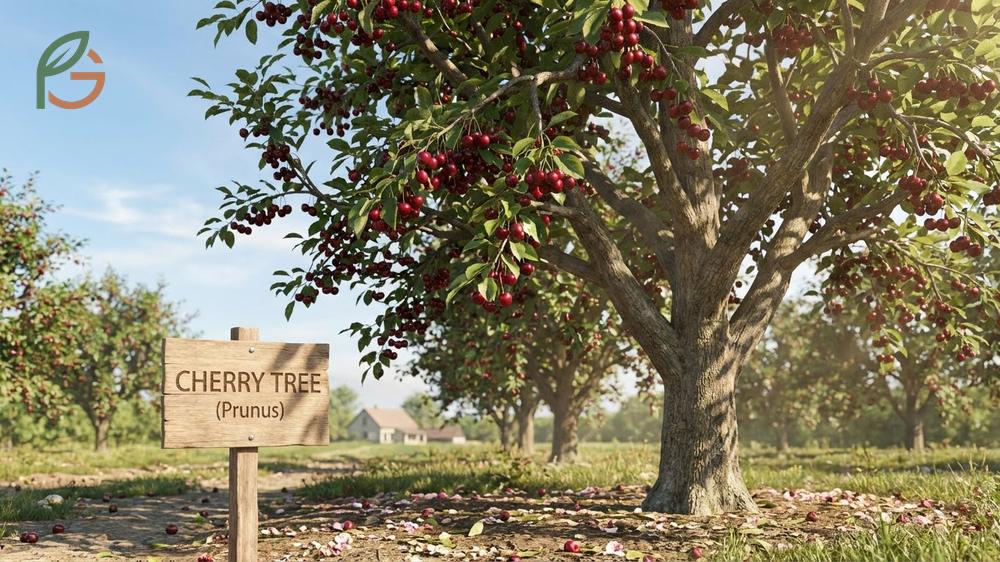
Yes, cherries grow on deciduous trees belonging to the genus Prunus, which also includes plums, peaches, and almonds. Cherry trees can reach heights of 20-50 feet at maturity, depending on variety and rootstock.
These flowering trees produce blossoms in spring before leaves emerge. The flowers develop into drupes—fleshy fruits with a single hard stone containing the seed.
Cherry trees typically begin bearing fruit 3-5 years after planting. Productive lifespan varies, but well-maintained sweet cherry trees can produce for 20-30 years, while tart varieties often remain productive for 15-20 years.
Sweet vs. Sour Cherry Trees
Sweet cherries (Prunus avium) grow larger, reaching 30-50 feet, and produce firm, sweet fruit eaten fresh. These trees require zones 5-9 and cross-pollination from another compatible variety planted nearby.
Sour cherries (Prunus cerasus) stay smaller at 12-15 feet and yield tart fruit used primarily for cooking and preserves. Most sour varieties self-pollinate, eliminating the need for multiple trees.
Important Note: If you’re planning to plant sweet cherries, you’ll need at least two compatible varieties within 50 feet of each other for successful pollination. Sour cherries don’t have this requirement.
Cherry Tree Characteristics
Cherry trees feature glossy, dark green leaves with serrated edges that turn yellow to red in fall. The bark develops horizontal markings called lenticels, which allow gas exchange through the trunk.
Root systems spread 1.5-2 times wider than the canopy but remain relatively shallow, typically extending only 2-3 feet deep. This makes cherries sensitive to drought and soil compaction.
- Deciduous nature means trees drop leaves in fall and enter dormancy
- Lateral branches develop at 45-60 degree angles from the central leader
- Flowers appear in clusters of 2-5 blossoms per node
- Fruit ripens 60-90 days after bloom, depending on variety and climate
- Trees require annual pruning to maintain structure and air circulation
- Dwarf varieties on dwarfing rootstock stay 8-12 feet tall for easier harvest
Cherry Tree Climate Requirements
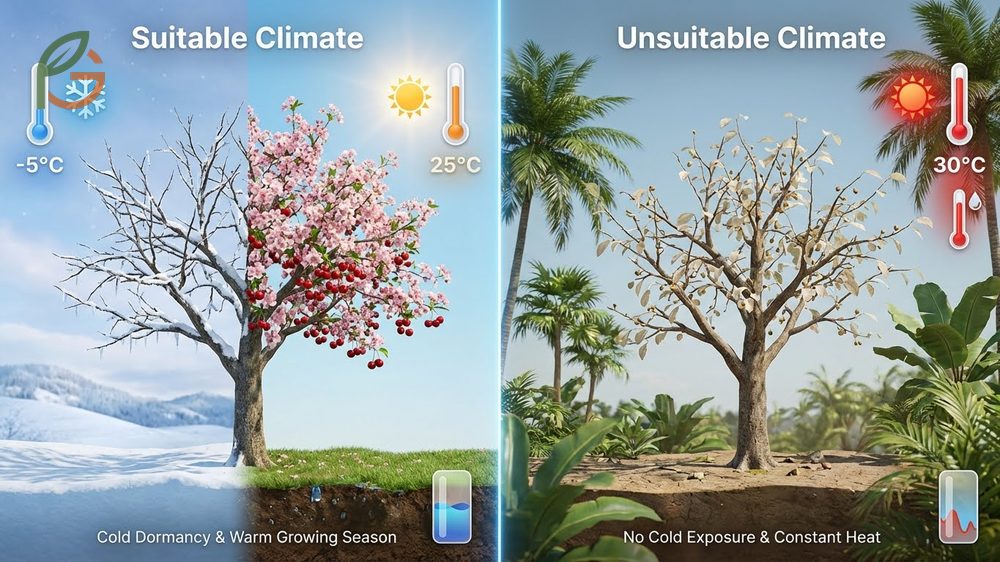
Cherry trees demand specific climate conditions that balance cold dormancy needs with warm growing seasons. Temperature patterns matter more than total annual rainfall, though consistent moisture during fruit development improves yield and quality.
These trees can’t tolerate tropical climates or regions with mild winters. Without adequate cold exposure, buds fail to break properly, resulting in poor flowering and minimal fruit set.
Studies demonstrate that cherries perform best where winters average 32-45°F (0-7°C) for extended periods and summers reach 75-85°F (24-29°C)[8]. Late spring frosts pose the greatest weather risk, potentially destroying entire crops when temperatures drop below 28°F (-2°C) after bloom.
Chill Hours for Cherry Trees
Chill hours represent time spent within 32-45°F (0-7°C), critical for breaking dormancy and triggering spring growth. Most cherry varieties need 800-1,200 hours annually[1], making them unsuitable for warm-winter regions.
Insufficient chilling causes delayed and uneven bud break, poor fruit set, and reduced harvest quality. Trees may bloom sporadically or produce misshapen fruit when chill requirements aren’t met.
Low-chill varieties like Stella, Lapin, and Royal Rainier need only 400-500 hours, expanding cultivation possibilities into zones 7-9. These cultivars opened cherry growing to California’s Central Valley and parts of the southern United States.
From My Experience: My cousin in Querétaro, Mexico tried growing a Lapins cherry variety in early 2023. The tree accumulated only 320 chill hours that winter versus the 400-450 needed, resulting in 40% fewer blossoms than expected—matching the typical reduction research predicts for insufficient chilling.
- Bing cherries: 700-800 hours, traditional standard for sweet cherries
- Montmorency (tart): 1,000-1,200 hours, most cold-hardy variety
- Stella: 400-500 hours, self-fertile low-chill sweet cherry
- Rainier: 700-900 hours, premium yellow-red sweet variety
- North Star (tart): 1,000-1,100 hours, dwarf growth habit
- Lapins: 400-450 hours, disease-resistant low-chill option
Temperature and Growing Season Needs
Growing season temperatures between 75-85°F (24-29°C) optimize photosynthesis and fruit development[8]. Excessive heat above 95°F (35°C) stresses trees, while cool summers delay ripening and reduce sugar content.
Rainfall patterns affect disease pressure more than tree health directly. Wet conditions during bloom and harvest increase fungal infections like brown rot and cherry leaf spot.
Humidity levels below 60% during ripening reduce fruit cracking, which occurs when cherries absorb rain through their skin. Washington’s arid summer climate explains why Pacific Northwest cherries command premium prices with fewer blemishes.
Climate Tip: If you’re in zones 7-9 with hot summers, plant cherries where they receive morning sun and afternoon shade. This protects developing fruit from heat stress and extends the harvest window by several days.
Where Do Cherries Come From
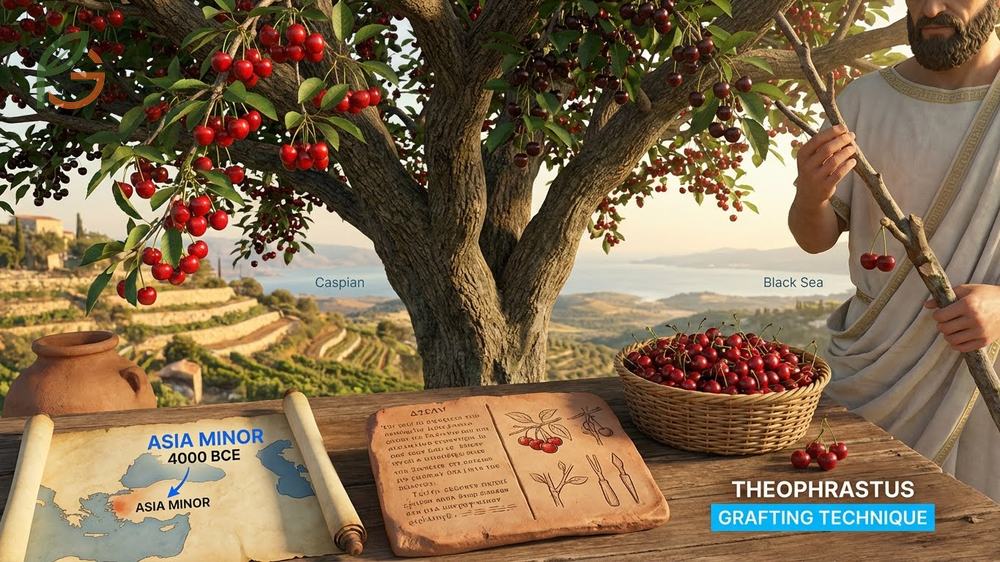
Both sweet and sour cherry species originated in Asia Minor, the fertile region between the Caspian and Black Seas corresponding to present-day Turkey[4]. Archaeological evidence suggests wild cherries grew abundantly across this area for millennia before humans began cultivation around 4000 BCE.
Greek botanist Theophrastus made the first recorded mention of cherries in 300 BCE, noting they’d been cultivated in Greece for centuries. The Greeks developed early grafting and pruning techniques to improve fruit size and flavor.
Romans expanded cherry cultivation throughout their empire after General Lucullus encountered them in northeastern Anatolia during a military campaign in 72 BCE. Roman soldiers carried cherry pits across Europe, establishing orchards from Italy to Britain.
Birds played a crucial role spreading cherries beyond cultivated areas. They consumed fruit and dispersed seeds across long distances, establishing wild populations throughout Europe and western Asia.
European colonists brought cherries to North America around 1606, first planting them at Port Royal in modern-day Nova Scotia. By 1629, chroniclers documented cherry trees flourishing in New France alongside other introduced fruit species.
- 4000 BCE: First documented cherry cultivation in ancient China and Asia Minor
- 300 BCE: Theophrastus records cherry growing practices in Greek agriculture
- 72 BCE: Roman General Lucullus introduces cherries from Pontus region
- 1513 CE: Henry VIII orders English cherry orchards after tasting fruit in Belgium
- 1606 CE: French colonists plant first North American cherry trees in Nova Scotia
- 1847 CE: Henderson Lewelling brings cherry varieties to Oregon via wagon train
Top Cherry Producing States
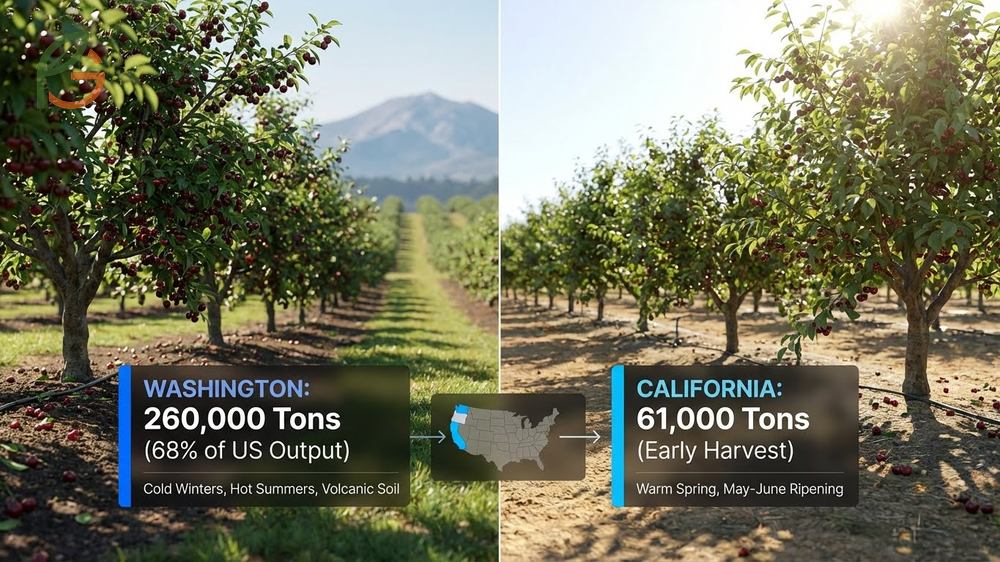
Washington dominates US cherry production with 260,000 tons harvested annually[2], representing 68% of the nation’s total output. The state’s eastern regions provide ideal conditions with cold winters, hot dry summers, and volcanic soil.
California ranks second at 61,000 tons, focusing on early-season varieties that ripen in May and June. The Central Valley’s warm spring temperatures allow California growers to capture premium prices before Washington’s harvest begins.
Oregon produces 48,000 tons annually, with most orchards concentrated in the Columbia River Gorge and Willamette Valley. The state specializes in both sweet and tart varieties, benefiting from similar climate patterns as Washington.
This table compares annual cherry production volumes, primary varieties grown, and key growing regions across the four leading US states
| State | Annual Production | Primary Type | Key Growing Regions |
|---|---|---|---|
| Washington | 260,000 tons[2] | Sweet cherries | Yakima Valley, Wenatchee, Columbia Basin |
| California | 61,000 tons[2] | Sweet cherries | Central Valley, Lodi, Stockton |
| Oregon | 48,000 tons[2] | Sweet & tart | Hood River, Willamette Valley |
| Michigan | 14,000 tons[2] | Tart cherries (70%+ of US) | Traverse City, Leelanau Peninsula |
Michigan produces 14,000 tons but controls over 70% of US tart cherry production[7], specializing in Montmorency varieties for pie filling and juice processing. The Great Lakes moderate winter temperatures, preventing the extreme cold that damages buds.
Other states with smaller commercial production include New York, Pennsylvania, Wisconsin, and Montana. These northern regions support cherry growing in zones 4-6, though production volumes remain modest compared to the top four states.
Cherry Tree Growing Zones
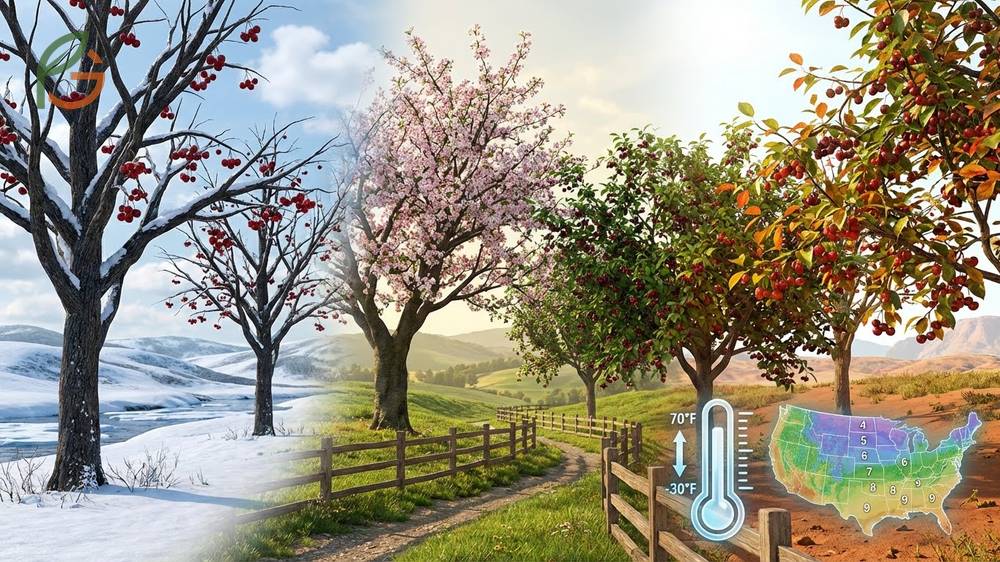
Cherry trees perform best in USDA Hardiness Zones 4-9, though specific varieties have narrower optimal ranges[3]. Sweet cherries generally prefer zones 5-9, while tart varieties tolerate colder zones 4-8 with their superior cold hardiness.
Zone selection depends on your variety’s chill hour requirement and cold tolerance. Northern growers in zones 4-5 should choose cold-hardy cultivars like Montmorency or North Star that withstand -20 to -30°F (-29 to -34°C).
Southern gardeners in zones 8-9 need low-chill varieties requiring 500 or fewer hours. Standard high-chill cherries won’t produce fruit reliably in these warmer climates without adequate winter dormancy.
- Zones 4-5: Tart cherries only, choose Montmorency or North Star for -30°F (-34°C) tolerance
- Zone 6: Both sweet and tart varieties thrive, including Bing, Lambert, and Ranier
- Zone 7: Transition zone requiring variety selection based on local microclimate
- Zones 8-9: Low-chill varieties essential, consider Stella, Lapin, or Minnie Royal
- Zone 10+: Standard cherries won’t grow, only tropical “cherries” like Barbados work
Growing Cherries in Texas
Texas presents challenges for traditional cherry varieties due to insufficient chill hours across most regions. Central Texas accumulates only 200-600 hours annually, falling short of the 800+ most varieties require.
Gardeners in North Texas (zones 7b-8a) can attempt low-chill sweet cherries like Stella or Lapin with afternoon shade protection[9]. Morning sun exposure with light afternoon shading protects trees from intense summer heat exceeding 100°F (38°C).
Ornamental flowering cherries like Taiwan cherry (Prunus campanulata) tolerate warm-winter conditions better than fruiting varieties. These trees provide spring blossoms without requiring significant chill accumulation.
Barbados cherry (Malpighia emarginata) thrives in South Texas zones 9-10, though it’s not a true cherry but rather a tropical shrub producing tart, vitamin C-rich fruit. This option suits gardeners wanting cherry-like fruit in hot climates.
Growing Cherries in Florida
Standard Prunus cherry varieties can’t survive Florida’s climate due to complete absence of winter chill hours. The state’s warm winters never provide the 800-1,200 hours below 45°F (7°C) that cherries require for dormancy.
Florida gardeners can grow several tropical alternatives marketed as cherries. Barbados cherry, Cherry of the Rio Grande, Grumichama, and Surinam cherry all produce cherry-like fruit adapted to zones 9-11.
These tropical species belong to different plant families than true cherries but offer similar tart flavors suitable for fresh eating, jams, and desserts. They tolerate heat, humidity, and sandy soils that kill Prunus species.
Florida Note: If you’re set on growing fruit in Florida, tropical “cherries” are your only option. True sweet and sour cherries simply won’t produce without winter temperatures consistently below 45°F (7°C) for extended periods.
Conclusion
The evidence is clear: where cherries grow depends entirely on matching variety selection to your climate zone and chill hour availability. Successful cultivation requires zones 4-9, adequate winter cold between 32-45°F (0-7°C), and well-drained soil with full sun exposure.
Current agricultural guidance emphasizes selecting varieties bred for your specific region rather than attempting to grow traditional cultivars outside their ideal range. Low-chill varieties expanded cherry growing into warmer zones, while cold-hardy types enable production in harsh northern climates. FruitGarden helps you match climate requirements to varieties that’ll thrive in your specific location, ensuring productive trees and abundant harvests for years to come.
Frequently Asked Questions
Do cherry trees grow in Texas?
Cherry trees struggle in most of Texas due to insufficient chill hours. North Texas gardeners can try low-chill varieties like Stella or Lapin with afternoon shade, but these trees need 400-500 hours below 45°F (7°C) annually. Central and South Texas lack adequate winter cold for standard cherries, though ornamental flowering cherries and tropical Barbados cherry can grow successfully.
Can cherry trees grow in Florida?
Standard Prunus cherry trees can’t grow in Florida because the state never provides the 800-1,200 chill hours they require. Florida’s warm winters don’t reach temperatures low enough for cherry dormancy. However, tropical alternatives like Barbados cherry, Surinam cherry, and Grumichama thrive in zones 9-11 and produce tart, cherry-like fruit adapted to heat and humidity.
What states produce the most cherries?
Washington leads all states with 260,000 tons annually, representing 68% of US production. California follows with 61,000 tons, then Oregon at 48,000 tons. These three states account for roughly 90% of America’s sweet cherry harvest. Michigan produces 14,000 tons but dominates tart cherry production with over 70% of the national supply, particularly Montmorency varieties.
How many chill hours do cherry trees need?
Most cherry varieties require 800-1,200 chill hours between 32-45°F (0-7°C) annually for proper dormancy and fruit production. Tart cherries typically need 1,000-1,200 hours, making them more cold-hardy. Low-chill varieties like Stella, Lapin, and Royal Rainier need only 400-500 hours, allowing cultivation in warmer zones 7-9 where standard varieties fail.
What hardiness zone do cherry trees grow in?
Cherry trees grow in USDA Hardiness Zones 4-9, with specific ranges depending on variety. Tart cherries thrive in colder zones 4-8, tolerating winter lows of -20 to -30°F (-29 to -34°C). Sweet cherries prefer zones 5-9 with milder winters. Low-chill cultivars extend growing possibilities into zones 8-9, though they still need some winter cooling below 45°F (7°C).
Where did cherries originally come from?
Cherries originated in Asia Minor, the fertile region between the Caspian and Black Seas in present-day Turkey. Both sweet cherries (Prunus avium) and sour cherries (Prunus cerasus) evolved in this area, with cultivation dating back to 4000 BCE. Greek botanist Theophrastus documented cherry cultivation in 300 BCE, and Romans spread them throughout Europe after 72 BCE.
When is cherry blossom season?
Cherry blossom season varies by location and climate, typically occurring in March through May across most of the United States. Southern regions bloom earliest in late February to early March, while northern zones see blossoms in late April to early May. Peak bloom lasts only 7-10 days, though total flowering extends 2-3 weeks. Washington DC’s famous Tidal Basin cherries usually peak around late March to early April.