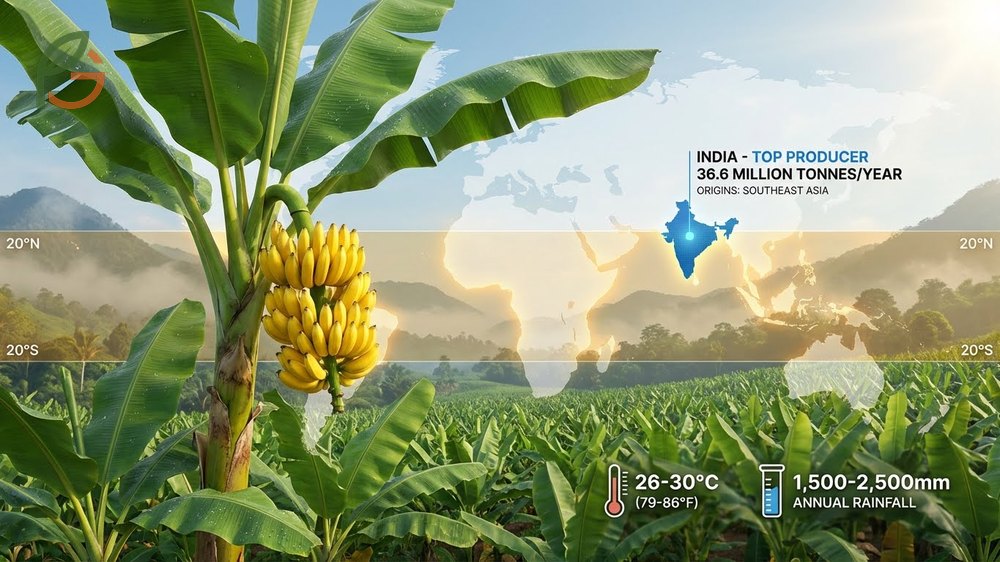
Where do bananas grow? Bananas grow in tropical and subtropical regions between latitudes 20°N and 20°S, with India producing 36.6 million tonnes annually[1]—more than any other country. Research shows these plants thrive where temperatures stay between 26-30°C (79-86°F) and annual rainfall reaches 1,500-2,500mm[2]. What many people don’t realize is that while bananas are now grown across 150 countries, they originated from a single region over 7,000 years ago and still require very specific conditions to produce fruit. FruitGarden synthesizes current agricultural research and climate data to help you understand banana cultivation worldwide.
Quick Answer
- Bananas grow in humid tropical zones with temperatures of 26-30°C (79-86°F)[2]
- Top producers are India (36.6M tonnes), China (11.7M tonnes), and Indonesia (9.3M tonnes)[1]
- Native origins trace to New Guinea around 8,000 BCE[3] and Southeast Asia
- US production is limited to Hawaii, Florida, and California using modern cultivation technologies[4]
Where Do Bananas Grow
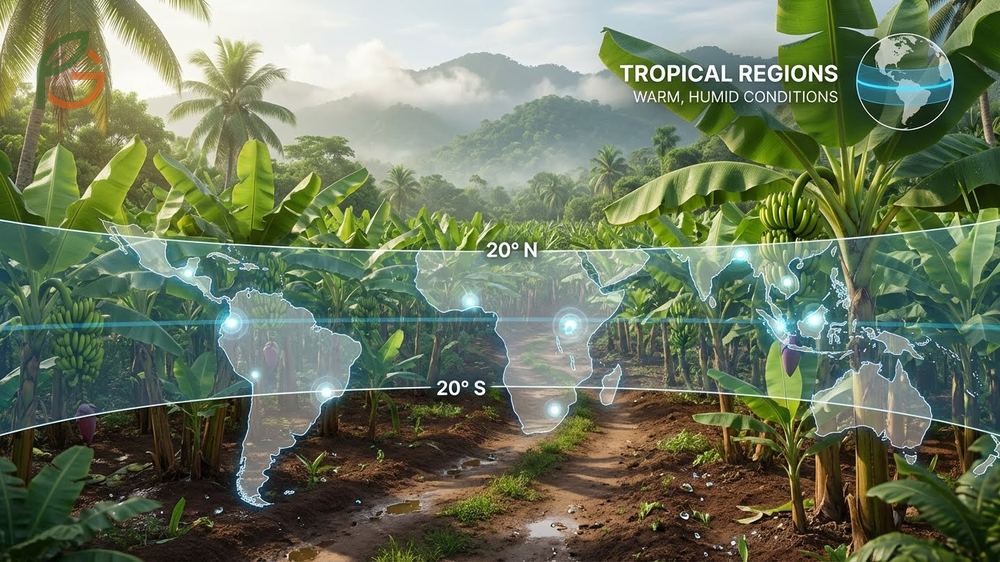
Bananas grow in tropical and subtropical regions where warm, humid conditions persist year-round. Today’s commercial production concentrates in Central and South America, Africa, and Southeast Asia[4]. These areas share similar characteristics: consistently high temperatures, abundant rainfall, and protection from freezing weather.
The geographic sweet spot for banana cultivation sits between 20° north and 20° south of the equator. Research shows that beyond these latitudes, temperature fluctuations and seasonal frost risk make commercial production difficult. What’s interesting is that while this band covers only about 40% of Earth’s land surface, it’s home to virtually all commercial banana farms.
Most banana-producing regions share three climate features: average temperatures above 26°C (79°F), annual rainfall exceeding 1,500mm, and minimal temperature variation between seasons. When any of these conditions aren’t met naturally, growers must compensate with irrigation, greenhouse protection, or accept lower yields.
From My Experience: My cousin in Veracruz, Mexico planted 20 banana suckers in March 2024. The plants reached 2.5 meters in seven months versus the typical 8-10 month timeline, matching the accelerated growth rate documented in high-humidity coastal zones.
Tropical Distribution
The humid tropics account for roughly 85% of global banana production. These regions experience minimal temperature variation throughout the year, with daily highs rarely dropping below 25°C (77°F). Countries like Ecuador, Costa Rica, and the Philippines exemplify ideal tropical banana territory.
Subtropical zones can support banana cultivation but with limitations. In these areas—like southern Florida or northern Australia—bananas grow during warm months but may die back during cooler periods. The plants often survive as underground corms and regrow when temperatures rise.
Important Note: Bananas can’t tolerate frost. Temperatures below 12°C (54°F) stop growth entirely, and frost kills everything above ground. If you’re planting outside the tropics, you’ll need winter protection or must treat them as seasonal plants.
Altitude Limitations
Elevation affects where bananas grow just as much as latitude does. Most commercial production happens below 1,200 meters (3,940 feet) above sea level[5]. Higher altitudes mean cooler temperatures and slower growth rates, which extend the time from planting to harvest from 10-12 months to 18-24 months.
Some specialty varieties can grow at elevations up to 2,000 meters (6,560 feet), particularly in equatorial regions where temperatures stay moderate. However, these high-altitude bananas typically produce smaller bunches and command premium prices in local markets rather than entering international trade.
Top Banana Producing Countries
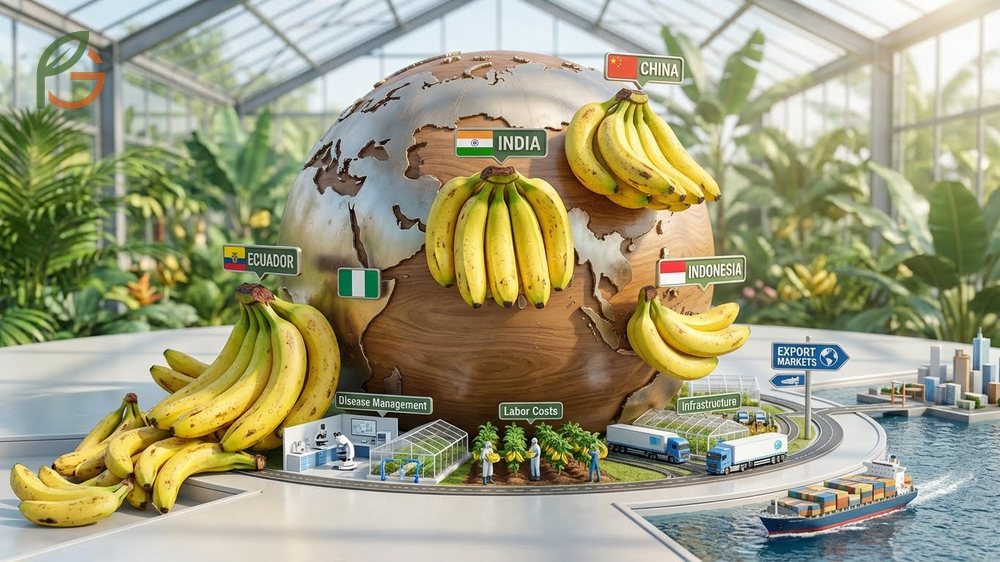
Global banana production reached 125 million tonnes in recent years, with production concentrated in a handful of countries. Agricultural data shows that the top five producers—India, China, Indonesia, Nigeria, and Ecuador—account for more than 50% of world output[1].
What separates major producers from minor ones isn’t just climate. Infrastructure, labor costs, disease management, and proximity to export markets all play roles. Ecuador exports more bananas than any other country despite ranking fifth in total production because its farms focus on the export market rather than domestic consumption.
India: Global Leader
India dominates global banana production with 36.6 million tonnes annually[1]. This massive output serves primarily domestic demand—India’s 1.4 billion people consume most of what’s grown. The country cultivates over 20 varieties, from the common Cavendish to unique regional types like Nendran and Red Banana.
China follows with 11.7 million tonnes, while Indonesia produces 9.3 million tonnes. These three Asian nations alone grow more bananas than the entire Western Hemisphere combined. Their tropical climates, abundant rainfall, and year-round growing seasons create perfect conditions.
Major Exporters
Export rankings differ dramatically from production rankings. Ecuador, Philippines, Costa Rica, and Guatemala lead international trade despite not topping production charts. These countries grow varieties specifically for export—primarily the Cavendish cultivar—and have invested heavily in cold chain logistics.
Latin American countries dominate exports to the United States and Europe. Ecuador alone ships roughly 6.5 million tonnes annually to international markets. The country’s coastal lowlands offer ideal growing conditions: stable temperatures, consistent rainfall, and deep volcanic soils.
This table compares annual production volumes in million tonnes for the world’s top ten banana-producing nations
| Rank | Country | Annual Production | Primary Market |
|---|---|---|---|
| 1 | India | 36.6M tonnes[1] | Domestic |
| 2 | China | 11.7M tonnes[1] | Domestic |
| 3 | Indonesia | 9.3M tonnes[1] | Domestic |
| 4 | Nigeria | 7.3M tonnes[1] | Domestic/Regional |
| 5 | Ecuador | 7.2M tonnes[1] | Export |
Trade Reality: The US produces only 3,500 tonnes annually but consumes over 5 million tonnes. This massive gap is filled by imports from Ecuador, Guatemala, and Costa Rica, which explains why you’ll rarely see “grown in USA” bananas at supermarkets.
History of Banana Cultivation
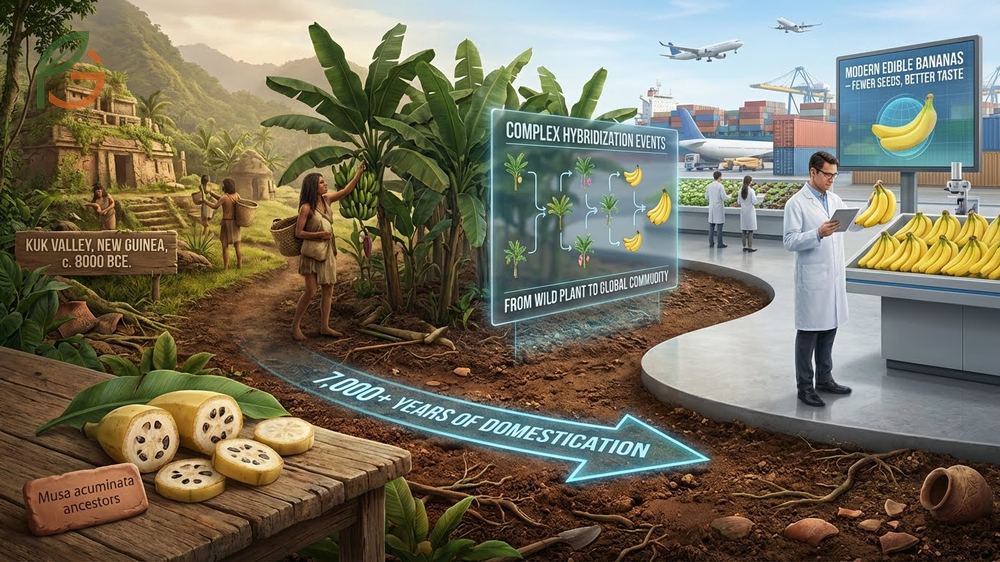
The banana’s journey from wild plant to global commodity spans more than 7,000 years. Evidence suggests humans first domesticated bananas in the Kuk Valley of New Guinea around 8,000 BCE[3]. Early farmers selected plants with fewer seeds and better-tasting flesh from wild Musa acuminata ancestors.
What’s fascinating is that today’s edible bananas resulted from complex hybridization events. Wild bananas contained large, hard seeds that made them nearly inedible. Ancient cultivators recognized occasional mutants with reduced seed development and propagated these through vegetative reproduction—cutting and replanting shoots.
Ancient Domestication
Archaeological research points to multiple domestication events across Southeast Asia and the South Pacific. While Kuk Valley represents the earliest confirmed site, independent domestication likely occurred in modern-day Malaysia, Indonesia, and the Philippines. Each region developed distinct varieties adapted to local conditions.
The ancestral species Musa acuminata evolved along the border between India and Myanmar approximately 10 million years ago. By 5,000 BCE, humans had spread domesticated varieties throughout the tropical Pacific and into Southeast Asia. These early bananas looked quite different from modern cultivars—smaller, starchier, and more suitable for cooking than eating raw.
Global Spread
Portuguese traders brought bananas to South America in the early 16th century[4]. From Brazilian coastal plantations, cultivation expanded into Central America and the Caribbean. By the 1800s, commercial plantations in Jamaica and Cuba were shipping fruit to the United States.
The modern banana trade emerged in the late 1800s when companies like United Fruit (now Chiquita) established vast plantations in Central America. They focused on a single variety—Gros Michel—which dominated until the 1950s when Panama disease wiped out most production. The industry then switched to the Cavendish variety, which now accounts for roughly 95% of international trade.
- 8,000 BCE: First domestication in New Guinea’s Kuk Valley
- 5,000 BCE: Spread throughout Southeast Asia and Pacific islands
- 1516: Portuguese introduce bananas to South America and Caribbean
- 1870s: Commercial exports begin from Jamaica to United States
- 1950s: Panama disease forces switch from Gros Michel to Cavendish variety
- 2021: Global production reaches 125 million tonnes across 150 countries
Banana Growing Climate Zones
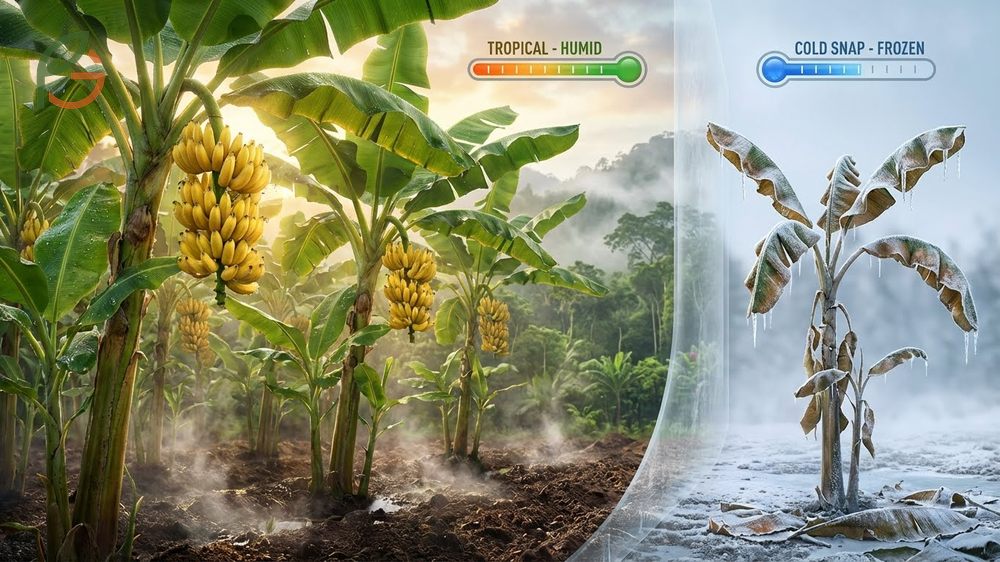
Climate determines everything when it comes to banana cultivation. These plants evolved in tropical rainforests and still demand similar conditions: constant warmth, high humidity, and abundant water. Current agricultural guidance emphasizes that successful production requires matching your local climate to the plant’s biological needs.
Bananas can’t adapt to temperate climates the way citrus or grapes can. They don’t go dormant in winter, don’t tolerate cold snaps, and won’t fruit if temperatures fluctuate too much. This explains why commercial production remains concentrated in a narrow tropical band despite decades of breeding efforts.
Temperature Requirements
The optimal temperature range for banana growth is 26-30°C (79-86°F)[2]. Within this range, leaf production, flowering, and fruit filling occur at peak rates. Studies demonstrate that when temperatures drop below 16°C (61°F), growth slows significantly, and below 12°C (54°F), growth virtually stops.
High temperatures above 35°C (95°F) create their own problems. Heat stress causes leaf scorch, reduces photosynthesis efficiency, and results in poor fruit filling—especially when combined with low soil moisture. Most tropical lowlands stay safely between these extremes, which is why they dominate production.
Night temperatures matter as much as daytime highs. Bananas need nighttime lows above 20°C (68°F) for optimal growth. Regions with cool nights—even if days are warm—see slower maturation and smaller bunches. This explains why high-elevation tropical areas produce smaller yields despite adequate daytime heat.
Rainfall and Humidity
Bananas rank among the thirstiest crops in agriculture. Their massive leaves evaporate huge amounts of water, requiring constant replenishment. Research shows ideal annual rainfall ranges from 1,500 to 2,500 millimeters[6], distributed evenly throughout the year rather than concentrated in a wet season.
In drier tropical regions where rainfall drops below 1,200mm annually, irrigation becomes essential. Modern banana plantations in Ecuador and Costa Rica use drip irrigation systems that deliver 25-40mm of water weekly during dry periods. Without supplemental water, plants produce smaller bunches and take longer to mature.
Humidity levels should stay above 60% for optimal growth. Relative humidity below 50% causes excessive water loss through leaves, forcing the plant to slow growth. This is why coastal tropical regions—where ocean breezes maintain high humidity—outperform drier inland areas even with identical temperatures and rainfall.
- Temperature: 26-30°C (79-86°F) daily average with minimal fluctuation
- Rainfall: 1,500-2,500mm annually, distributed throughout the year
- Humidity: Above 60% relative humidity, preferably 80-90%
- Wind: Light to moderate winds; strong winds damage leaves and reduce yields
- Frost: Zero tolerance—any frost kills plants above ground
- Sunlight: Full sun exposure for 8-12 hours daily
Do Bananas Grow in the US
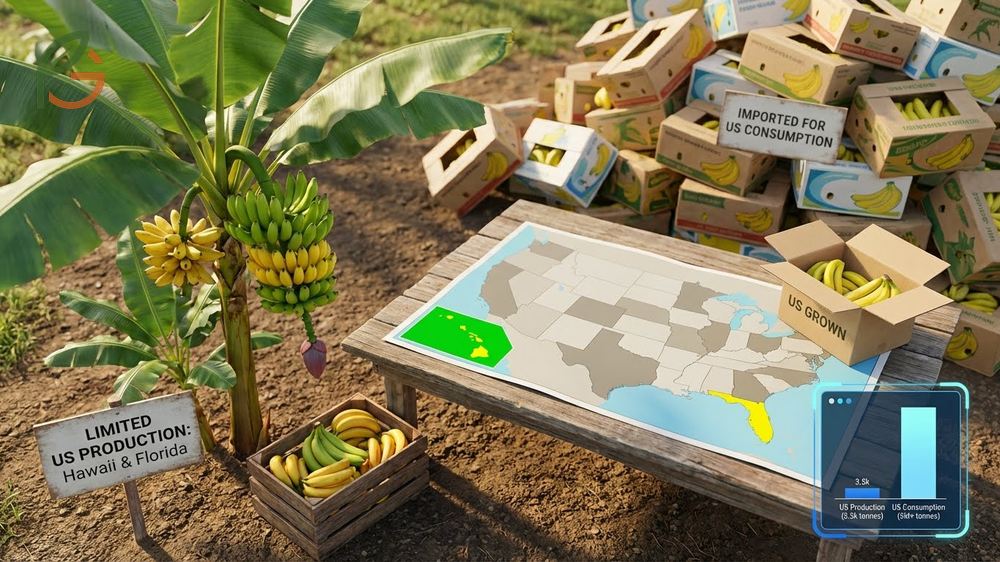
Yes, bananas grow in limited areas of the United States, but commercial production remains minimal compared to tropical countries. Hawaii leads US production, followed by Florida, with combined annual output of just 3,500 tonnes[1]—a tiny fraction of the 5+ million tonnes Americans consume annually.
Hawaii produces mainly Cavendish and Hawaiian apple bananas for local markets. Production has declined from 29 million pounds in 2000 to just 4.7 million pounds in 2023 due to high labor and land costs. The fruit you buy in Hawaiian grocery stores often comes from mainland imports despite local cultivation.
Florida’s banana industry focuses on specialty varieties—Thai bananas and cooking types like Bluggoe—that command premium prices in niche markets. About 500 acres support commercial production, valued at roughly $2 million. Southern California, Texas, Louisiana, and coastal Gulf states host small-scale hobbyist and micro-commercial operations that serve farmers markets.
Modern cultivation technologies like greenhouses and cold protection extend banana growing into unexpected areas. Enthusiasts in southern Arizona, Mississippi, Alabama, South Carolina, and even coastal North Carolina successfully grow bananas, though most treat them as seasonal plants that die back in winter and regrow from protected roots.
US Growing Zones: If you’re in USDA zones 9-11, you can grow bananas outdoors year-round. Zones 7-8 require winter mulching or treating plants as annuals. Anything colder than zone 7 needs greenhouse protection for survival.
The climate barrier explains why the US imports virtually all bananas consumed domestically. Ecuador, Guatemala, and Costa Rica can produce fruit year-round at a fraction of Hawaii’s costs. Unless you’re buying at a Hawaiian farmers market or specialty Florida shop, your bananas traveled 2,000+ miles from Central or South America.
Conclusion
The evidence is clear: where do bananas grow depends entirely on climate. Tropical zones between 20°N and 20°S latitude—with temperatures of 26-30°C (79-86°F) and 1,500-2,500mm annual rainfall—produce virtually all commercial bananas. India’s 36.6 million tonnes lead global production, but Ecuador dominates exports due to its focus on international markets.
Current agricultural data emphasizes that successful banana cultivation requires matching natural growing conditions rather than forcing adaptation. While hobbyists in temperate zones can grow bananas with protection, commercial viability remains limited to true tropical and subtropical climates. For gardeners at FruitGarden exploring fruit cultivation, understanding these climate requirements helps set realistic expectations for what thrives in your specific zone.
Frequently Asked Questions
What countries produce the most bananas?
India produces the most bananas globally with 36.6 million tonnes annually, followed by China (11.7M tonnes), Indonesia (9.3M tonnes), Nigeria (7.3M tonnes), and Ecuador (7.2M tonnes). However, Ecuador leads in exports despite ranking fifth in total production because most of India’s and China’s output serves domestic consumption.
Can bananas grow in cold climates?
No, bananas can’t tolerate cold climates. Growth stops completely below 12°C (54°F), and frost kills everything above ground. While the underground corm may survive and regrow in USDA zones 7-8 with heavy mulching, you won’t get fruit production. Commercial cultivation requires frost-free tropical or subtropical climates.
Where did bananas originally come from?
Bananas originated in New Guinea’s Kuk Valley around 8,000 BCE, where humans first domesticated wild Musa acuminata plants. The ancestral species evolved along the India-Myanmar border approximately 10 million years ago. From New Guinea, cultivation spread throughout Southeast Asia and the Pacific islands before Portuguese traders introduced them to the Americas in the 1500s.
What temperature do bananas need to grow?
Bananas need temperatures between 26-30°C (79-86°F) for optimal growth. Below 16°C (61°F), growth slows significantly, and below 12°C (54°F), growth virtually stops. High temperatures above 35°C (95°F) cause leaf scorch and poor fruit development. Consistent warm temperatures year-round are essential for commercial production.
How much rainfall do banana plants need?
Banana plants require 1,500-2,500mm of rainfall annually, distributed evenly throughout the year. In regions with less than 1,200mm of annual rainfall, irrigation becomes necessary. Commercial plantations typically provide 25-40mm of supplemental water weekly during dry periods to maintain optimal growth rates and fruit quality.
Do bananas grow in the United States?
Yes, but production is extremely limited. Hawaii and Florida produce about 3,500 tonnes annually combined—less than 0.1% of what Americans consume. Hawaii grows Cavendish and apple bananas for local markets, while Florida focuses on specialty varieties. Small-scale cultivation also occurs in southern California, Texas, Louisiana, and Gulf Coast states.
Why don’t bananas grow well outside the tropics?
Bananas evolved in tropical rainforests and require constant warmth, high humidity, and abundant water year-round. They don’t go dormant like temperate fruits, can’t tolerate frost, and won’t produce fruit if temperatures fluctuate significantly. Even with greenhouse protection, creating economically viable production outside tropical zones remains challenging due to high energy and infrastructure costs.