Powdery mildew on cucumber plants shows up as white powdery spots that rapidly expand across leaves and stems, weakening your plants and reducing fruit production. Studies demonstrate this fungal disease thrives in warm, dry conditions with poor air circulation, making it one of the most common problems for cucumber growers. FruitGarden synthesizes current agricultural research to help you identify, treat, and prevent this frustrating disease before it destroys your harvest.
Quick Answer
- White powdery spots appear on both upper and lower leaf surfaces, expanding into large blotches[1]
- Infected cucumber plants produce fewer and smaller fruits that ripen prematurely[1]
- Homemade fungicide using 1 tablespoon baking soda per gallon of water controls spread effectively[2]
- Resistant varieties like ‘County Fair’ and ‘Cross Country’ prevent infection from the start[3]
Powdery Mildew on Cucumber Plants

Powdery mildew appears as white, powdery fungal growth on both sides of cucumber leaves, distinguishing it from other diseases that only affect one leaf surface[4]. Unlike downy mildew, this fungus doesn’t need wet conditions to thrive—it actually prefers warm, dry environments. The disease spreads rapidly through airborne spores, making it highly contagious in garden settings.
Research shows the fungi responsible for powdery mildew on cucumbers include Golovinomyces cucurbitacearum and Podosphaera xanthii[5]. These pathogens feed directly on plant tissue, extracting nutrients that would otherwise support fruit development. You’ll notice symptoms typically appear mid to late summer when conditions favor fungal growth[1].
The fungus spreads fastest when humidity is high but leaves remain dry, creating perfect conditions for spore germination and dispersal. Poor air circulation around plants accelerates the disease’s progression. Most gardeners first spot powdery mildew on older, lower leaves before it climbs to newer growth.
Early Symptoms and Identification
The first sign you’ll see is pale yellow leaf spots that might seem harmless at first[1]. Within days, these spots transform into the characteristic white powdery coating that looks like someone dusted your plants with flour. The fungal growth quickly spreads from small patches to cover entire leaves, petioles, and even stems.
Early detection makes a huge difference in controlling the disease. If you catch it when only a few leaves show symptoms, you can remove those leaves and apply preventive treatments to stop further spread. Once the disease covers most of the foliage, treatment becomes much harder and less effective.
From My Experience: My cousin in Guadalajara, Mexico grows cucumbers every summer and checks plants twice weekly starting in July. When she spotted the first yellow spots in August 2024, she removed just 3 affected leaves and applied baking soda spray—her plants stayed healthy through harvest.
Impact on Cucumber Plants
When powdery mildew infects the majority of foliage, cucumber plants become weak and fruit ripens prematurely[1]. The compromised leaves can’t photosynthesize efficiently, starving the plant of energy. Cucumbers from infected plants often lack their characteristic flavor and may wither on the vine before reaching full size.
Severely infected plants produce fewer fruits overall, and those that do develop are typically smaller than normal. The leaves may drop prematurely, exposing fruits to sunburn. What often gets overlooked is that stressed plants become more vulnerable to secondary infections and pest attacks.
Important Note: Powdery mildew rarely affects cucumber fruits directly, but the weakened plant state dramatically reduces your harvest quality and quantity. Don’t wait until you see white powder—prevention starts with proper spacing and resistant varieties.
Cucumber Plant Diseases with Pictures
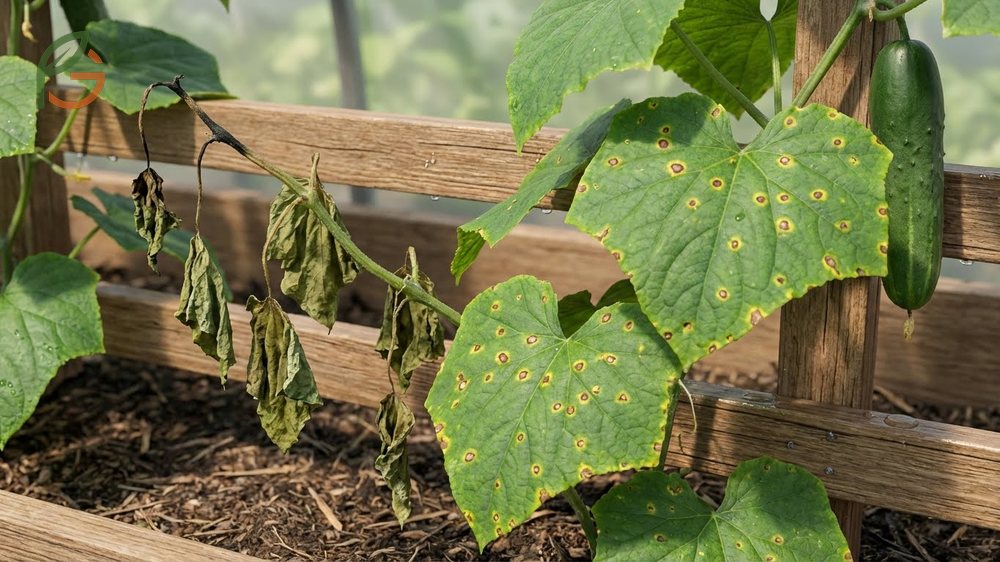
Beyond powdery mildew, cucumbers face several common diseases that cause distinct visual symptoms. Bacterial wilt creates severe wilting followed by rapid plant death, while anthracnose produces small brown spots with yellow edges[6]. Learning to identify these diseases early gives you the best chance at saving your crop.
Each disease has a unique pattern that helps with identification. Bacterial wilt affects one or more laterals starting at vine tips, while downy mildew creates angular spots bounded by leaf veins[7]. Cucumber mosaic virus produces the namesake mosaic pattern of yellow and green patches on young leaves.
Current data indicates that new cucumber varieties offer improved disease resistance, but you’ll still need to monitor plants regularly. Most diseases spread faster in humid, poorly ventilated conditions. Proper plant spacing and sanitation practices significantly reduce disease pressure in your garden.
Bacterial Wilt
Bacterial wilt is caused by Erwinia tracheiphila and starts with severe wilting of individual vines before progressing to the entire plant[6]. The bacteria multiply rapidly within the plant’s vascular tissue, plugging the water-conducting vessels. Once infected, there’s no cure—the plant will die within days to weeks.
The disease spreads through cucumber beetles that carry the bacteria in their digestive systems. These beetles overwinter with the pathogen and transmit it when they feed on cucumber plants in spring. Managing cucumber beetles provides your most effective control strategy since pesticides won’t cure infected plants[8].
- Leaves turn yellow and brown at margins before completely withering
- Individual vines wilt first, then disease spreads to entire plant
- Bacteria can’t survive in soil or seed, only in cucumber beetle guts
- Row covers prevent beetle access during vulnerable early growth stages
- Remove and destroy infected plants immediately to reduce beetle food sources
- Plant varieties like ‘County Fair’ that show some wilt resistance
Anthracnose
Anthracnose is a fungal disease caused by Colletotrichum orbiculare that’s often seed-borne, making seed selection critical for prevention[9]. Small brown circular spots appear on leaves and rapidly grow larger with yellow edges. Pink mold develops on stems and stalks in advanced cases, and the fungus can also infect fruits directly.
The disease spreads through contaminated seeds, airborne spores, and splashing water. Warm, moist conditions like those in greenhouses encourage rapid anthracnose development. Most commercial cucumber varieties now have some built-in resistance, but you’ll still need to start spray schedules at the first sign of symptoms.
- Purchase certified disease-free seeds from reputable suppliers
- Rotate cucumber plantings to different garden areas each year
- Space plants properly to improve air circulation and reduce humidity
- Water at soil level rather than overhead to avoid wet foliage
- Apply copper-based fungicides at first symptom appearance
Homemade Fungicide for Cucumbers

You can make effective organic fungicides using common household ingredients that control powdery mildew without synthetic chemicals. The most popular recipe combines baking soda with oil and soap to create a protective coating that prevents fungal growth. These homemade solutions work best as preventive treatments or for early-stage infections.
Research validates that baking soda sprays effectively control powdery mildew when applied every one to two weeks[2]. The alkaline environment created by baking soda inhibits fungal spore germination and growth. You’ll get better results if you start applications before you see symptoms or at the very first sign of disease.
Timing matters more than you might think—apply sprays early in the morning so leaves dry quickly, reducing the chance of other fungal issues. Never spray in full sun or on hot days, as this can burn foliage. Most gardeners find success with weekly applications throughout the growing season in humid climates.
Baking Soda Spray for Mildew
Mix 1 tablespoon baking soda with 1 teaspoon dormant oil and 1 teaspoon insecticidal or liquid soap per gallon of water to create your base fungicide[2]. The oil helps the solution stick to leaves, while soap acts as an emulsifier to blend oil and water. Shake the mixture thoroughly before each application since oil and water naturally separate.
Spray all leaf surfaces—both upper and lower—until they’re covered with a fine mist but not dripping. You’ll need to reapply after heavy rain or every 7-10 days during disease-prone periods. Some growers increase the baking soda to 2-3 teaspoons per gallon for severe infections, but test this stronger mixture on a few leaves first to check for plant sensitivity.
Pro Tip: Always use baking soda (sodium bicarbonate), not baking powder which contains additional ingredients that can harm plants. Test your spray on a few leaves first and wait 24 hours to check for any adverse reactions before treating the entire plant.
Neem Oil for Cucumbers
Neem oil works as both a fungicide and pesticide, making it a versatile organic treatment for cucumber plants. For a potent organic spray, combine 1 teaspoon neem oil with 2-3 teaspoons baking soda and 10 drops eco-friendly liquid soap in 1 liter of water. The neem oil disrupts fungal growth while also deterring common cucumber pests like aphids and spider mites.
Evidence suggests neem oil performs best when applied as a preventive measure rather than a cure for heavy infections. You can substitute vegetable oils like sunflower or even clove oil if neem isn’t available, though neem provides the strongest antifungal properties. Apply every 7-14 days, avoiding the hottest part of the day to prevent leaf burn.
- Use cold-pressed neem oil labeled for garden use, not cosmetic grade
- Mix fresh batches for each application—neem oil solutions don’t store well
- Spray in early morning or evening when temperatures are below 85°F (29°C)
- Cover all plant surfaces including stem crevices where fungi hide
- Stop applications 7 days before harvest to avoid affecting cucumber taste
- Alternate with other treatments to prevent fungal resistance
Downy Mildew vs Powdery Mildew
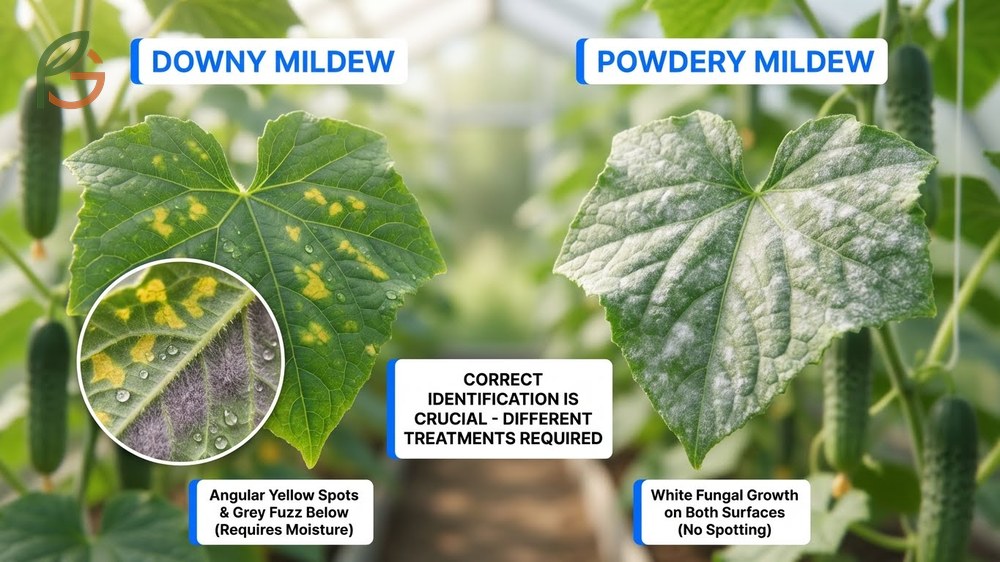
While both diseases affect cucumber leaves, downy mildew and powdery mildew are completely different pathogens with distinct symptoms and treatments. Powdery mildew creates white fungal growth on both leaf surfaces without any leaf spotting, while downy mildew produces angular yellow spots on top of leaves with a velvety grey fuzz underneath[4]. You can’t treat them the same way, so correct identification is crucial.
Downy mildew requires moisture on leaf surfaces to germinate and infect plants, thriving in wet or very humid conditions from 59-68°F (15-20°C)[7]. In contrast, powdery mildew prefers dry conditions with high humidity but actually dislikes direct water contact. This fundamental difference means wetting leaves can help control powdery mildew but will make downy mildew worse.
Current data shows downy mildew can’t survive Minnesota winters outdoors and arrives each year on air currents from southern states. Powdery mildew, however, can overwinter in many regions on plant debris and alternate hosts. There’s no home gardener treatment for downy mildew—you must remove infected leaves immediately or destroy the entire plant if it spreads.
This table compares key differences between powdery mildew and downy mildew including appearance, environmental preferences, and treatment options for cucumber plants
| Characteristic | Powdery Mildew | Downy Mildew |
|---|---|---|
| Appearance | White powdery coating on both leaf surfaces[4] | Angular yellow spots above, grey fuzz below[7] |
| Moisture Needs | Prefers dry conditions, dislikes water contact | Requires wet leaves and high humidity |
| Temperature Range | Warm, dry weather | 59-68°F (15-20°C) optimal[7] |
| Leaf Spotting | No distinct spots, just powdery growth | Angular spots bounded by leaf veins[7] |
| Home Treatment | Baking soda spray, neem oil, fungicides[2] | No effective home treatment available |
- Check leaf undersides—grey fuzz indicates downy mildew, white powder indicates powdery mildew
- Look at spot shapes—angular spots confined by veins mean downy mildew
- Note weather patterns—recent rain or heavy dew favors downy mildew
- Observe disease progression—rapid spread in wet conditions suggests downy mildew
- Test water response—if wetting leaves reduces symptoms, it’s likely powdery mildew
Resistant Cucumber Varieties

Planting resistant cucumber varieties is your first and best defense against powdery mildew. Cornell University research identifies several slicer varieties with excellent resistance including ‘Alcazar F1’ and ‘Ashley’[5]. These varieties don’t eliminate the disease entirely, but they show significantly less damage compared to susceptible types.
Agricultural data shows varieties like ‘County Fair’, ‘Cross Country’, and ‘Burpless Hybrid’ consistently outperform older cultivars in disease trials[3]. The reason is simple—plant breeders have selected these varieties for specific genetic traits that make them less hospitable to fungal infection. You’ll still need to provide good growing conditions, but resistant varieties give you a huge head start.
Most seed catalogs now clearly label disease resistance with codes like “PM” for powdery mildew. When selecting varieties, check for resistance to multiple diseases since cucumbers often face several threats simultaneously. Some newer hybrids offer resistance to 6-8 different diseases, making them worth the extra cost for organic growers who can’t rely on synthetic fungicides.
- ‘County Fair’ – excellent disease package including PM resistance
- ‘Cross Country’ – strong resistance with high yields
- ‘Burpless Hybrid’ – combines PM resistance with superior flavor
- ‘Alcazar F1’ – Cornell-recommended slicer with proven resistance[5]
- ‘Ashley’ – old favorite still performs well in trials
- ‘Adam Gherkin’ – pickling type with natural PM resistance[3]
- ‘Bodega’ – European variety with multiple disease resistances
Seed Selection Tip: Don’t rely solely on resistance—even the best varieties can get infected under severe disease pressure. Combine resistant varieties with proper spacing, good air circulation, and preventive spraying for maximum protection.
Preventing Garden Fungus

Prevention beats treatment every time when it comes to cucumber diseases. Providing good air movement around plants through proper spacing, vertical trellising, and consistent weed control dramatically reduces fungal disease pressure[1]. Space plants at least 12-18 inches apart in rows and 3-4 feet between rows to ensure adequate airflow.
Studies demonstrate that vertical growing systems reduce disease incidence by improving air circulation and keeping foliage off the ground. When you train cucumbers up trellises or stakes, leaves dry faster after rain or dew, leaving less time for fungal spores to germinate. You’ll also find it easier to spot early disease symptoms on trellised plants.
Crop rotation prevents fungal spores and other pathogens from building up in the soil. Don’t plant cucumbers or any cucurbits in the same spot more than once every 3-4 years. Remove and destroy all plant debris at season’s end rather than composting it, since many fungal spores survive on dead plant material through winter.
- Water at soil level early in the day so foliage dries before evening
- Mulch around plants to prevent soil-borne spores from splashing onto leaves
- Prune infected leaves immediately and dispose of them in trash, not compost
- Sterilize pruning tools with rubbing alcohol between cuts to prevent spreading disease
- Monitor plants twice weekly starting in mid-summer when diseases peak
- Apply preventive fungicide sprays before you see symptoms in humid climates
- Avoid working with plants when they’re wet to reduce disease transmission
Soil health plays a bigger role than most people realize. Healthy plants with balanced nutrition resist diseases better than stressed plants. Apply compost annually but avoid excessive nitrogen which creates lush growth that’s more susceptible to fungi. Maintain soil pH between 6.0-7.0 for optimal cucumber health and disease resistance.
Conclusion
The evidence is clear: powdery mildew on cucumber plants is manageable when you combine resistant varieties, proper cultural practices, and early intervention with organic treatments. Research shows that prevention through adequate spacing and air circulation provides your most cost-effective defense, while homemade baking soda sprays offer safe, proven control for early infections. Don’t wait until white powder covers your plants—start monitoring in mid-summer and act at the first pale yellow spots.
Current agricultural guidance emphasizes integrated disease management that combines multiple strategies rather than relying on any single approach. FruitGarden synthesizes these research-based methods to help you grow healthy, productive cucumber plants season after season.
Frequently Asked Questions
Can You Eat Cucumbers from Plants with Powdery Mildew?
Yes, you can safely eat cucumbers from plants with powdery mildew since the fungus rarely affects the fruits directly. Wash cucumbers thoroughly before eating as you normally would. However, severely infected plants produce smaller, less flavorful fruits, so early treatment protects your harvest quality.
What Causes White Spots on Cucumber Plant Leaves?
White spots on cucumber leaves are typically caused by powdery mildew fungus, which appears as white powdery growth on both upper and lower leaf surfaces. The disease thrives in warm, dry conditions with poor air circulation and spreads rapidly through airborne spores during mid to late summer.
How Do You Get Rid of Powdery Mildew on Cucumber Plants?
Mix 1 tablespoon baking soda with 1 teaspoon oil and 1 teaspoon liquid soap per gallon of water, then spray all leaf surfaces every 7-10 days. Remove heavily infected leaves first to reduce disease pressure. For severe cases, potassium bicarbonate fungicides eliminate existing mildew more effectively than baking soda alone.
Why Are My Cucumber Plant Leaves Turning Brown?
Brown cucumber leaves indicate several possible issues including anthracnose (brown spots with yellow edges), downy mildew (angular brown spots), bacterial wilt, or severe powdery mildew that’s progressed to leaf death. Check leaf undersides for grey fuzz (downy mildew) or white powder (advanced powdery mildew) to identify the specific cause.
Does Neem Oil Kill Powdery Mildew on Cucumbers?
Neem oil works best as a preventive treatment rather than a cure for established powdery mildew infections. Mix 1 teaspoon neem oil with 2-3 teaspoons baking soda and 10 drops liquid soap per liter of water for a more potent organic fungicide. Apply every 7-14 days starting before symptoms appear for best results.
What’s the Difference Between Downy Mildew and Powdery Mildew?
Powdery mildew forms a white, flour-like coating on both sides of leaves and prefers dry, warm weather. Downy mildew creates angular yellow spots restricted by leaf veins with purple-grey fuzz on the underside and thrives in wet, cool conditions. Downy mildew is far more destructive and cannot be treated with simple home remedies like baking soda.
Will Powdery Mildew Spread to Other Garden Plants?
Yes, powdery mildew spreads easily via wind-blown spores to nearby susceptible plants like squash, melons, and pumpkins. However, the specific fungus species attacking cucumbers (Podosphaera xanthii) is host-specific to cucurbits and typically won’t infect unrelated plants like roses or tomatoes, which are attacked by different mildew species.