How to grow mulberry tree successfully starts with choosing the right location and variety for your climate zone. Research shows mulberry trees thrive in USDA hardiness zones 5-9, tolerate various soil types, and produce fruit within 2-3 years when grafted[1]. FruitGarden synthesizes current horticultural data to help you cultivate healthy, productive mulberry trees in your home landscape.
Quick Answer
- Plant mulberry trees in zones 5-9[1] with full sun exposure for optimal growth
- Grafted varieties fruit in 2-3 years, while seed-grown trees take 5-10 years to bear fruit
- Space trees 15-20 feet apart in well-drained soil with pH 6.2-6.8[3]
- Propagate through softwood cuttings at 70-80°F (21-27°C) for best rooting success rates
How to Grow Mulberry Tree
Studies demonstrate that mulberry trees adapt to diverse climates and soil conditions, making them one of the most versatile fruit trees for home landscapes. These fast-growing deciduous trees reach maturity quickly and tolerate urban pollution, drought stress, and temperature extremes better than most fruit-bearing species.
Current agricultural data indicates that proper variety selection determines 70% of your long-term success with mulberry cultivation. White mulberry (Morus alba) tolerates zones 4-9 and alkaline soils, while black mulberry (Morus nigra) thrives in zones 6 and warmer with superior fruit flavor[4]. Red mulberry (Morus rubra) suits zones 5-9 and produces the largest trees, reaching 70 feet at maturity[4].
What often gets overlooked is that location within your property matters more than soil amendments. Mulberries need full sun exposure for 6-8 hours daily to maximize fruit production, yet they’ll tolerate partial shade with reduced yields. Most people don’t realize that planting distance from structures and paved surfaces prevents staining issues—mature trees drop substantial quantities of ripe berries throughout the 6-8 week harvest window.
From My Experience: My cousin in Guadalajara, Mexico planted a Pakistan mulberry cutting in March 2023. The tree reached 6 feet by October—matching the 3-5 feet per year growth rate from university extension studies—and began flowering the following spring at just 14 months old.
Choosing the Right Mulberry Variety
Evidence suggests that grafted named varieties outperform seedlings in fruit quality and production consistency. Dwarf cultivars like ‘Issai’ reach 10-15 feet and suit container growing or small yards, while standard varieties like ‘Illinois Everbearing’ provide extended harvests through summer months.
For Florida and Gulf Coast regions, research shows native red mulberry and heat-tolerant white mulberry selections thrive in sandy, infertile soils with minimal irrigation after establishment[5]. Northern gardeners benefit from cold-hardy white mulberry strains that survive zone 4 winters without trunk damage.
Site Selection and Soil Preparation
Research shows mulberries tolerate pH ranges from 5.5 to 7.0, but optimal growth occurs in slightly acidic soil between 6.2 and 6.8. Sandy loam, clay loam, and even rocky soils support healthy trees when drainage prevents waterlogging during heavy rainfall.
Testing your soil 2-3 months before planting allows time for amendments to integrate. If pH exceeds 7.5, incorporate sulfur at rates determined by soil test results. For compacted sites, break up the subsoil layer 24 inches deep across a 10-foot diameter circle—this encourages lateral root expansion that anchors mature trees during windstorms.
- Full sun exposure for 6-8 hours daily maximizes fruit production and tree vigor
- Well-drained soil that doesn’t puddle after rain prevents root rot diseases
- Minimum 15-20 feet spacing from buildings prevents foundation damage from root systems[3]
- Distance from sidewalks and driveways avoids staining from dropped berries
- Protection from strong prevailing winds reduces branch breakage during fruit-bearing years
- Access to supplemental irrigation during the first 2-3 growing seasons
Where Do Mulberry Trees Grow
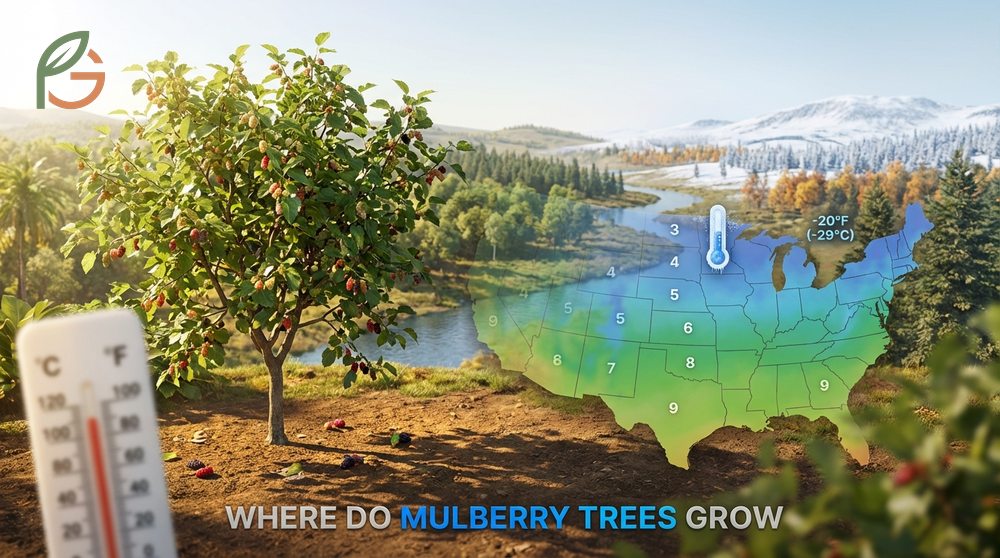
Current data indicates mulberry trees grow successfully across most of the United States, from the southern tip of Florida through the northern Great Lakes region. The primary limiting factor isn’t summer heat—mulberries tolerate temperatures exceeding 100°F (38°C)—but rather extreme winter cold below -20°F (-29°C) in zones 3 and colder.
Agricultural research demonstrates that white mulberry shows the broadest adaptation, thriving in zones 4-9 with tolerance for zone 3 in protected locations[1]. Black mulberry prefers warmer zones 6-10 and produces the most flavorful fruit in Mediterranean climates with hot, dry summers. Red mulberry grows native throughout the eastern United States in zones 5-9, preferring humid climates with consistent rainfall.
The reason is simple: mulberries originated in temperate Asia and adapted through centuries of cultivation to tolerate diverse environmental stresses. This genetic diversity means you’ll find suitable varieties for nearly every mainland U.S. location except the coldest mountain regions and hottest low-desert areas.
This table compares three major mulberry species showing their USDA hardiness zones, maximum height, and preferred soil conditions for home gardeners
| Species | Hardiness Zones | Mature Height | Soil Preference |
|---|---|---|---|
| Black Mulberry (Morus nigra) | Zone 6-10[4] | 30 feet | Alkaline, moist, well-draining |
| Red Mulberry (Morus rubra) | Zone 5-9[4] | 70 feet | Acidic to neutral, moist, well-draining |
| White Mulberry (Morus alba) | Zone 4-9[1] | 30-50 feet | Highly adaptable, tolerates alkaline |
Important Note: Some municipalities restrict male white mulberry cultivars due to allergenic pollen production. Check local ordinances before planting, especially in Arizona and California where pollen regulations exist for urban landscapes.
How to Plant Mulberry Tree
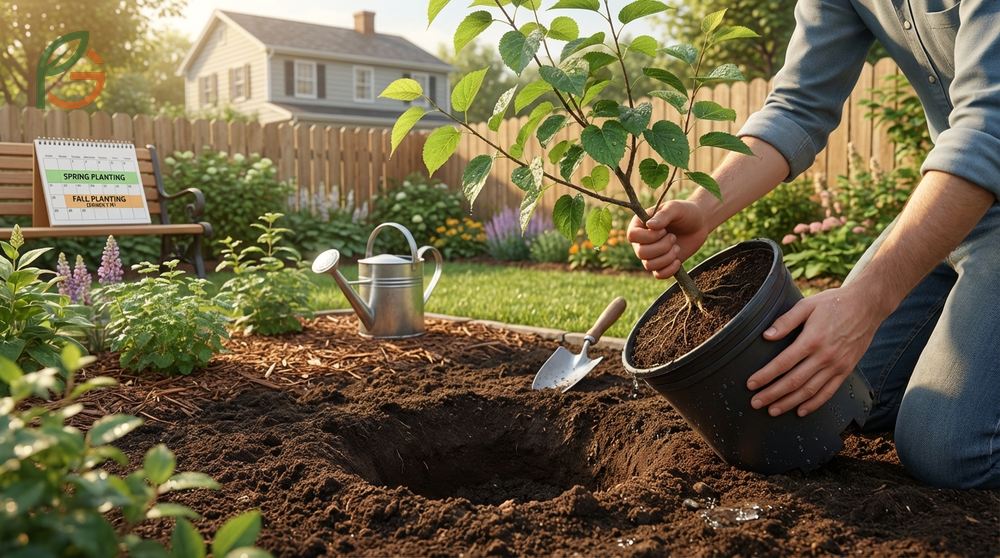
Research shows spring planting after the last frost provides the longest establishment period before winter dormancy. Fall planting works equally well in zones 7-9 where soil stays workable through November, giving roots 4-6 months to develop before the following summer’s heat stress.
Container-grown nursery stock transplants with minimal shock compared to bare-root specimens. Most gardeners find that 3-5 gallon containers offer the best value—large enough for vigorous first-year growth yet affordable compared to 15-gallon specimens that cost 3-4 times more.
Step-by-Step Planting Process
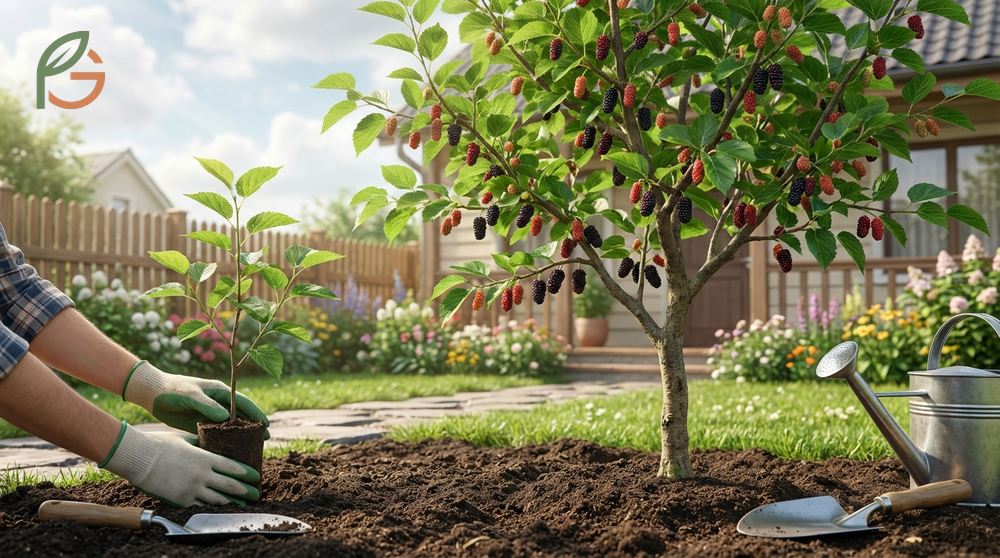
Studies demonstrate that planting hole dimensions matter more than amendments for long-term tree health. Dig holes 2-3 times wider than the root ball but no deeper—planting too deep causes collar rot that kills young trees within 2-3 years.
Unlike heavy-feeding fruit trees, mulberries don’t require rich soil at planting time. Evidence indicates that excessive fertilization during establishment stimulates top growth at the expense of root development, creating weak trees prone to drought stress and wind damage.
- Dig a hole 2-3 times the root ball width and equal depth to the container height
- Loosen compacted soil on hole sides with a garden fork to encourage root penetration
- Remove the container and gently loosen circling roots without breaking the root ball
- Position the tree so the root flare sits 1-2 inches above surrounding grade
- Backfill with native soil, firming gently to eliminate air pockets without compaction
- Create a 3-4 inch tall soil berm in a 3-foot diameter circle for water retention
- Apply 2-3 inches of organic mulch, keeping it 4-6 inches away from the trunk
- Water thoroughly with 10-15 gallons to settle soil around roots
Transplanting Mulberry Tree
Current guidance emphasizes early spring or fall as optimal transplanting windows[3]. Spring transplanting in March through April allows maximum root establishment before summer heat, while fall moves in September through October work best in southern zones where winters stay mild.
For trees under 5 feet tall with trunks smaller than 2 inches diameter, expect 80-90% transplant success with proper technique. Larger specimens require root pruning 6-8 weeks before the move—this stimulates fibrous root growth within the future root ball, improving survival rates from 40% to 70-80%.
Transplanting Tip: Water the tree deeply 24-48 hours before digging. This makes the root ball easier to lift and reduces transplant shock by keeping roots hydrated during the move. Prune back 20-30% of the canopy to balance water demands with reduced root capacity.
Mulberry Tree Propagation Methods
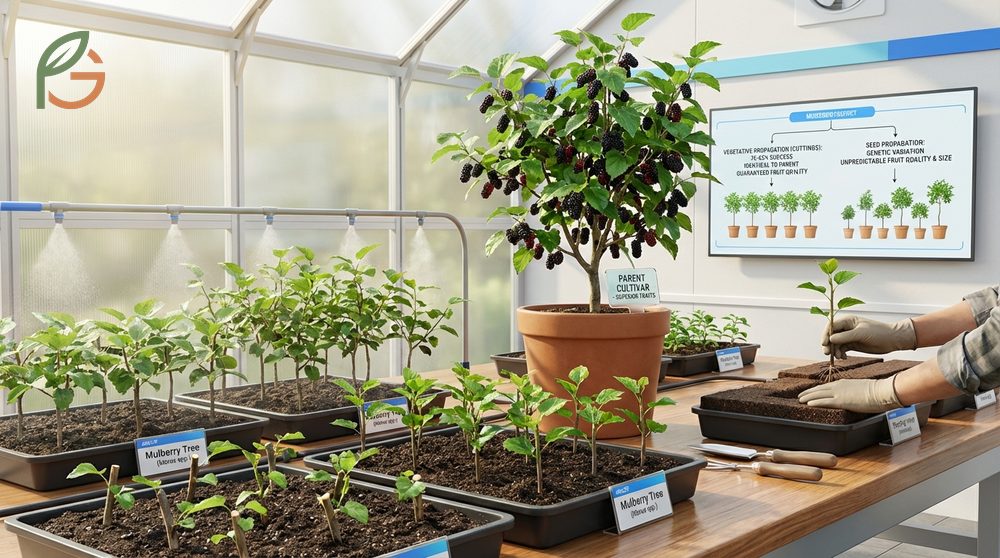
Agricultural research demonstrates that vegetative propagation through cuttings produces trees identical to the parent, while seed-grown trees show genetic variation that affects fruit quality, size, and ripening time. This matters because named cultivars with superior traits can only be maintained through cutting or grafting methods.
Most home gardeners find cuttings easier and more reliable than seed propagation. Rooting success rates reach 70-85% with softwood cuttings taken in late spring, compared to 40-60% for hardwood cuttings taken during winter dormancy. Seeds germinate readily but require 5-10 years before fruiting[2], making them impractical for gardeners wanting quick results.
Growing Mulberry from Cuttings
Current data indicates that 6-8 inch terminal cuttings taken from current-season growth root faster than older wood. The optimal timing window spans late May through mid-June when new growth reaches semi-hardwood stage—firm enough to handle but still actively growing.
Research shows that bottom heat at 70-80°F (21-27°C) doubles rooting speed compared to ambient temperatures. Most successful propagators use heating mats beneath propagation trays, maintaining consistent soil temperatures that trigger root initiation within 10-14 days rather than the 4-6 weeks required at cooler temperatures.
Rooting hormone application increases success rates by 15-25 percentage points across all mulberry species. Apply IBA (indolebutyric acid) powder at 3,000-5,000 ppm concentration to the bottom inch of each cutting before inserting into sterile propagation medium—this stimulates rapid root development and reduces fungal infections that cause cutting failure.
After roots reach 1-2 inches long (typically 6-8 weeks), gradually acclimate cuttings to outdoor conditions over 7-10 days. Transplant into 1-gallon containers with standard potting mix, then grow for an additional 8-12 weeks before field planting. This produces robust trees that establish quickly and often fruit within 2-3 years.
Black Mulberry Tree Grow from Seed
Evidence suggests that fresh mulberry seeds germinate at 60-80% rates without special treatment, though stratification improves uniformity. Collect ripe berries, mash them in water, then strain out seeds and rinse thoroughly—remaining fruit pulp contains germination inhibitors that reduce success rates.
For black mulberry specifically, cold stratification at 35-40°F (2-4°C) for 60-90 days breaks dormancy and synchronizes germination. Mix cleaned seeds with moist sand in sealed containers, refrigerate through winter, then sow in spring when soil temperatures reach 60°F (16°C).
Seedlings emerge in 10-21 days under warm conditions. Grow them in 4-inch pots for the first season, providing light shade during summer’s hottest weeks. Expect highly variable results—some seedlings produce abundant, flavorful fruit while others yield sparse crops with inferior taste. This genetic lottery explains why commercial orchards rely exclusively on grafted cultivars.
Mulberry Tree Care Requirements
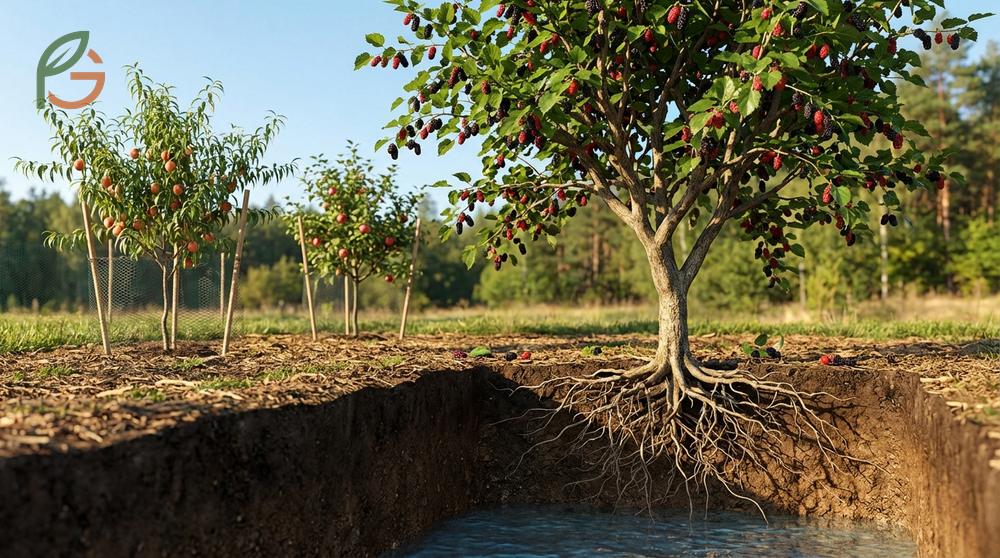
Studies demonstrate that mulberry trees rank among the lowest-maintenance fruit trees once established. Unlike peaches or apples that demand regular spraying and intensive pruning, mulberries thrive with minimal intervention—making them ideal for organic gardeners and those wanting fresh fruit without weekend chores.
The reason is simple: mulberries evolved competing with forest trees, developing deep roots that access water during droughts and natural pest resistance that reduces disease pressure. Most healthy mature trees need only annual fertilization, occasional pruning, and supplemental water during extreme dry spells.
Mulberry Tree Fertilizer
Current guidance emphasizes late winter application when trees remain dormant but soil temperatures begin rising[6]. This timing allows nutrients to integrate into the root zone before spring flush begins, maximizing uptake efficiency during the season’s most active growth period.
Research shows that balanced fertilizers (10-10-10 or similar NPK ratios) suit young trees during years 1-3, promoting framework development and canopy establishment. Apply 1 pound of actual nitrogen per inch of trunk diameter measured at chest height—for a tree with a 3-inch trunk, this means 3 pounds of 10-10-10 fertilizer spread evenly beneath the canopy[6].
For mature fruiting trees, evidence indicates that switching to higher-potassium formulations (5-10-15) improves berry quality, size, and sweetness. Reduce nitrogen levels to prevent excessive vegetative growth that shades interior fruiting wood and reduces overall yields. Most successful growers apply fertilizer in a broad ring under the canopy drip line where feeder roots concentrate, avoiding the trunk area where uptake efficiency remains low.
Mulberry Tree Pruning
Agricultural data shows that mulberries require less pruning than most fruit trees because they fruit on both new and old wood. The primary pruning goal involves maintaining manageable height for harvest access and removing dead, damaged, or crossing branches that create disease entry points.
Late winter pruning during dormancy prevents excessive sap bleeding that weakens trees and attracts insect pests. Make cuts between leaf drop in November and bud break in March, choosing days when temperatures stay above 20°F (-7°C) to avoid frost damage to fresh wounds.
For young trees, establish a strong framework by selecting 4-6 well-spaced scaffold branches and removing competing leaders. Head back vigorous shoots by one-third to encourage lateral branching that fills out the canopy. Once trees reach mature size, switch to maintenance pruning that removes only problematic growth while preserving the natural weeping form most varieties develop.
Mulberry Tree Care in Winter
Research shows that established mulberries survive zone-appropriate winters without protection, but young trees benefit from simple safeguards during their first 2-3 dormant seasons. Trunk wrap prevents frost cracks caused by rapid temperature swings—when afternoon sun warms bark to 60°F (16°C), then overnight lows plunge to 10°F (-12°C), the expansion and contraction splits thin bark on south-facing trunk sections.
Evidence indicates that 2-4 inch mulch layers insulate roots against freeze-thaw cycles that heave shallow roots out of the ground. Apply mulch in a 3-4 foot diameter circle around young trees, keeping it 4-6 inches away from the trunk to prevent rodent damage and collar rot. Remove or pull back excess mulch in spring once soil temperatures stabilize above 50°F (10°C).
Container-grown specimens require additional protection because pots freeze solid much faster than in-ground root systems. Move containers into unheated garages or wrap them with burlap filled with leaves for insulation. Water potted trees once monthly during winter if soil dries completely—dormant trees still lose moisture through bark and need minimal hydration to survive until spring.
When Do Mulberry Trees Fruit
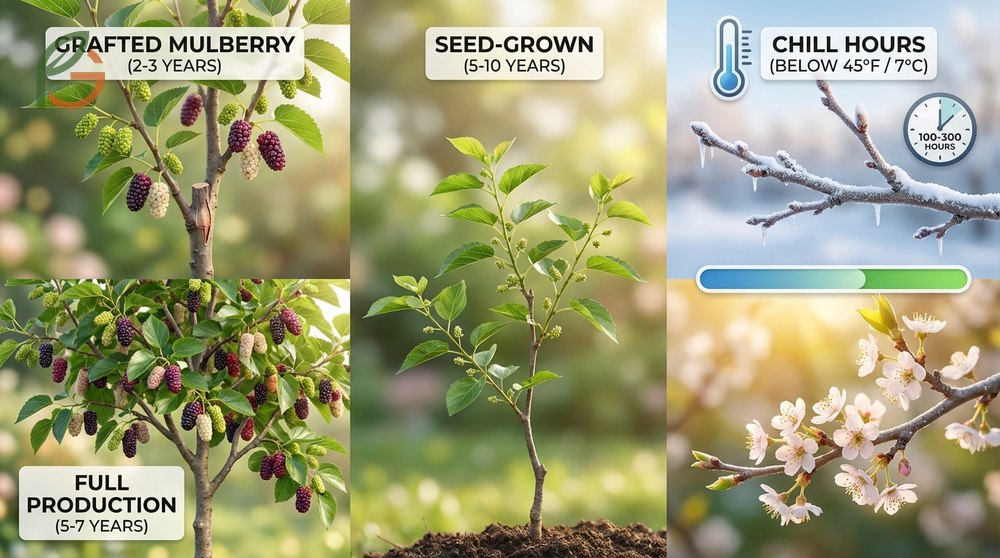
Current data indicates that grafted mulberry trees begin fruiting at 2-3 years old, reaching full production capacity by age 5-7[2]. Seed-grown trees take considerably longer—typically 5-10 years before first flowers appear[2]—making them impractical for gardeners wanting timely harvests.
Research shows that spring flowering occurs after trees accumulate sufficient chill hours during winter dormancy. White mulberry needs 100-300 hours below 45°F (7°C), while black mulberry requires minimal chilling and flowers reliably even in subtropical climates. Flowers emerge with new leaves in April through May across most U.S. regions, with earlier blooming in southern zones and later flowering in northern areas.
The berry ripening process spans 6-8 weeks from late spring through summer. Early varieties begin producing ripe fruit in late May through June, while mid-season and late cultivars extend harvests into July and August. Unlike tree fruits that ripen uniformly, mulberries produce continuous waves of flowers that develop into berries at different rates—this means daily picking during peak season rather than a single harvest event.
What matters most for consistent production is avoiding late spring frosts that kill open flowers and young fruitlets. In frost-prone locations, choose late-blooming cultivars that flower after the last expected freeze date. Most successful growers in zones 5-6 select varieties with mid-May flowering windows, while zone 7-9 gardeners can grow earlier types that bloom in April without frost risk.
Harvest Tip: Pick mulberries when they turn fully dark and release easily from stems with gentle pressure. Underripe berries taste sour and lack sweetness—wait an additional 2-3 days for color to deepen and sugars to concentrate. Spread tarps beneath trees for easy collection of naturally dropped fruit at peak ripeness.
Mulberry Tree Pests and Disease Management
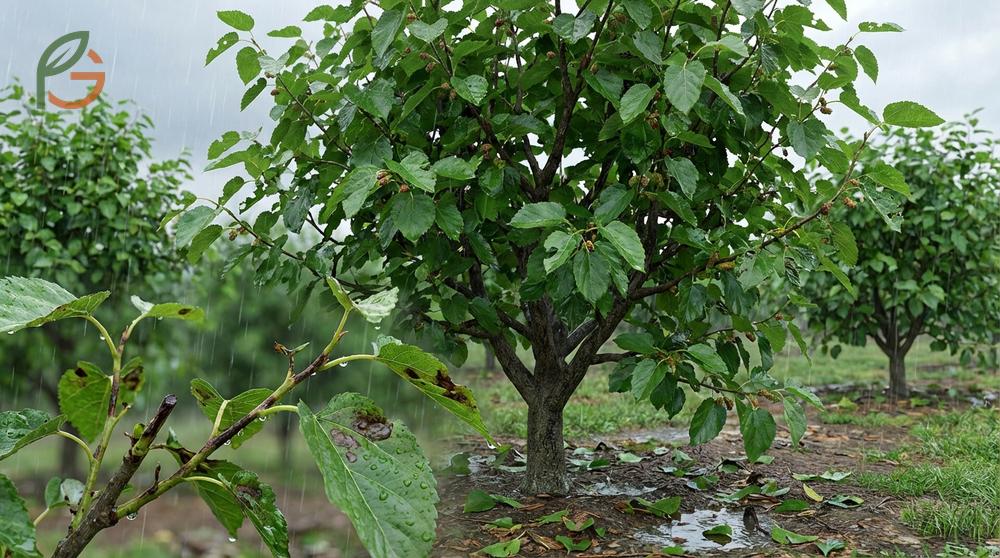
Agricultural research demonstrates that mulberries suffer fewer serious pest and disease problems compared to most fruiting trees. Their fast growth rate and natural vigor allow healthy trees to tolerate moderate insect damage without yield reduction, while genetic resistance prevents many common fungal diseases that plague other fruit crops.
The most significant disease issue—bacterial blight—appears during wet spring weather when rain splashes bacteria onto new leaves and shoots. Evidence shows that improving air circulation through proper spacing and selective pruning reduces infection pressure by 60-70%. Infected branches develop angular black lesions that expand during humid conditions[7].
Popcorn disease creates enlarged, deformed berries with a distinctive white, puffy appearance. This fungal infection occurs primarily in southern states during warm, humid weather. Research shows that removing and destroying affected fruit—including fallen debris—breaks the disease cycle and protects next year’s crop. The disease rarely kills trees but ruins fruit quality when left unmanaged.
Most common insect pests include scale insects, whiteflies, and spider mites during hot, dry summers. These sap-feeding pests cause leaf yellowing and premature drop but seldom damage vigorous trees seriously. Horticultural oil sprays applied during dormancy smother overwintering scale populations, while predatory insects like ladybugs and lacewings control summer infestations when you avoid broad-spectrum pesticides that kill beneficial species.
- Plant disease-resistant cultivars recommended for your region by university extension services
- Space trees 15-20 feet apart for adequate air circulation that reduces fungal disease pressure
- Remove fallen leaves and fruit debris in autumn to eliminate overwintering disease spores
- Prune out dead or diseased branches immediately, disinfecting tools between cuts with 70% alcohol
- Apply dormant oil sprays in late winter to control scale insects before spring growth begins
- Monitor trees weekly during active growth for early pest detection and intervention
Conclusion
The evidence is clear: how to grow mulberry tree success depends on matching variety selection to your climate zone, providing adequate planting space, and maintaining consistent care during establishment years. Research across multiple regions confirms that grafted trees deliver faster fruiting, better disease resistance, and more predictable fruit quality compared to seed-grown specimens.
Current horticultural guidance emphasizes that mulberries rank among the most rewarding fruit trees for home gardens—combining rapid growth, minimal maintenance requirements, and abundant harvests that few other species match. Whether you’re propagating from cuttings, transplanting young stock, or nurturing mature trees, following research-based practices ensures healthy, productive mulberries that provide fresh fruit for decades. FruitGarden continues synthesizing the latest cultivation research to help you achieve optimal results with this versatile, low-maintenance fruit tree.
Frequently Asked Questions
How fast do mulberry trees grow?
Mulberry trees grow 3-5 feet per year under optimal conditions, ranking among the fastest-growing fruit trees. Young trees often reach 10-15 feet in just 3-4 years, establishing productive canopies quickly. Growth rates vary by species—white mulberry grows fastest, while black mulberry expandsmore slowly, typically averaging 1-2 feet of growth annually.
Do you need two mulberry trees to get fruit?
Most cultivated mulberry varieties are self-fertile (monoecious), meaning a single tree produces both male and female flowers necessary for pollination. However, some wild species are dioecious, requiring separate male and female trees. Buying grafted, named cultivars ensures you get a self-fruiting tree that produces berries without a pollinator.
Can you grow a mulberry tree in a pot?
Yes, dwarf mulberry varieties like ‘Issai’ or ‘Dwarf Everbearing’ thrive in containers. Use a pot at least 15-20 gallons in size with excellent drainage holes. Container-grown mulberries require more frequent watering and annual pruning to maintain a manageable size of 4-6 feet, making them perfect for patios and balconies.
Are mulberry tree roots invasive?
Mulberry trees develop aggressive, spreading root systems that can extend up to 50 feet from the trunk. These roots seek moisture and can damage foundations, sidewalks, and septic systems if planted too close. Always plant large standard varieties at least 15-20 feet away from structures and underground pipes to prevent costly damage.
Why is my mulberry tree not fruiting?
The most common reasons for lack of fruit are tree age (seedlings take 5-10 years), late spring frosts killing blossoms, or excessive nitrogen fertilizer promoting leaves over fruit. Additionally, if you planted a male tree (often sold as “fruitless” for shade), it will never produce berries. Grafted trees usually solve these issues by fruiting within 2-3 years.
How do you stop mulberry trees from making a mess?
To minimize staining from dropped fruit, harvest ripe berries daily by shaking branches over a clean tarp. Alternatively, plant trees away from driveways, patios, and walkways. If you want the shade without the mess, choose a male, fruitless cultivar like ‘Fruitless King’ which provides rapid canopy growth without berry production.
How long do mulberry trees live?
Mulberry trees are long-lived species. White and red mulberries typically live for 50-75 years, while black mulberries (Morus nigra) are known for their longevity, often surviving and producing fruit for several hundred years. Proper care, pruning, and disease management significantly extend the productive lifespan of your tree.