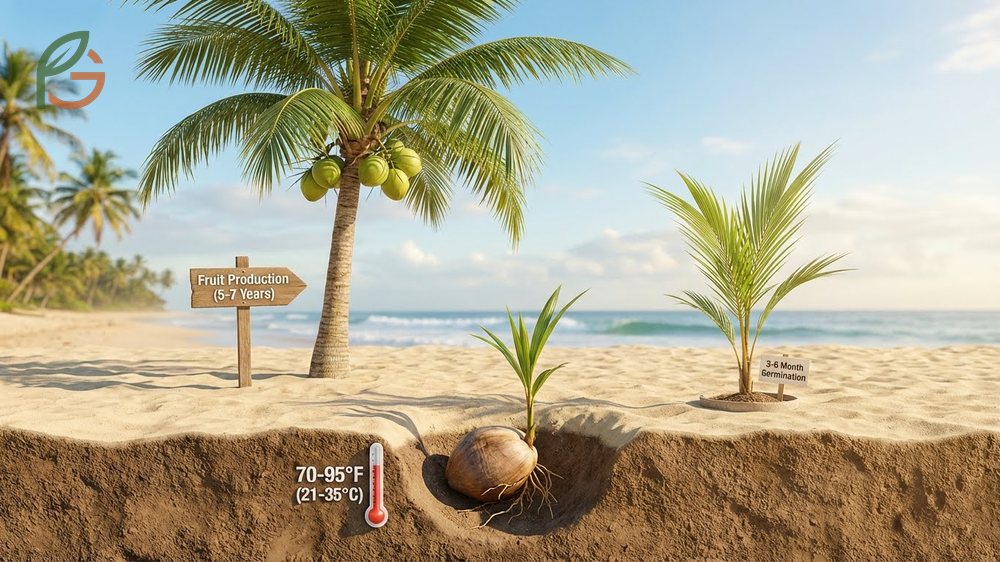
How to grow coconut tree successfully requires warm tropical conditions in USDA zones 10B-11, sandy loam soil, and patience for the 3-6 month germination period[1]. Research shows coconut palms thrive in temperatures between 70-95°F (21-35°C)[2] and start producing fruit in 5-7 years[3]. FruitGarden synthesizes current agricultural research to help you cultivate healthy coconut palms from seed to harvest.
Quick Answer
How to Grow Coconut Tree
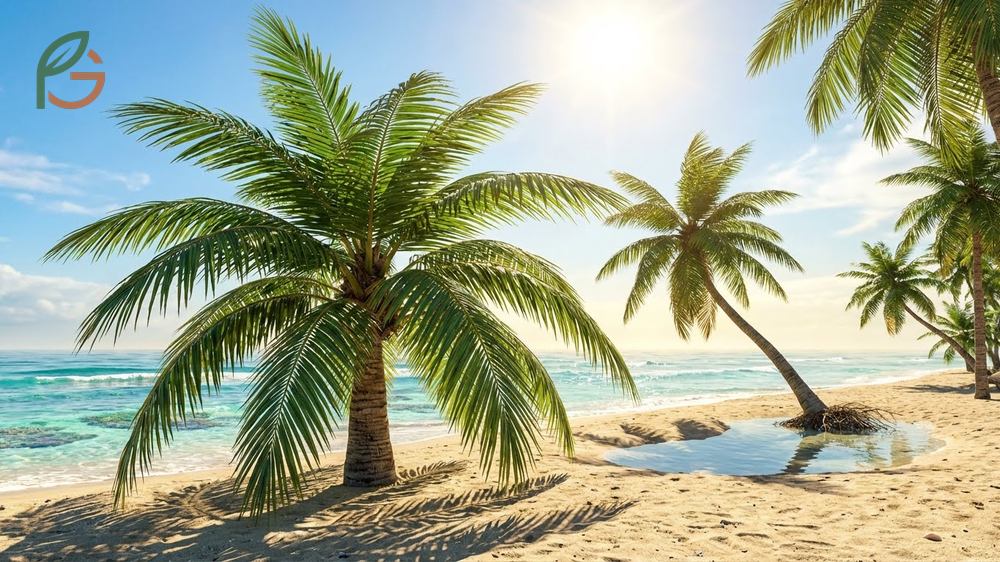
Coconut palms (Cocos nucifera) grow successfully when you match their tropical requirements. These palms need warm temperatures year-round, never dropping below 64°F (18°C)[6].
Studies demonstrate coconut trees prefer full sun exposure for at least 6-8 hours daily. Without adequate sunlight, growth slows significantly and fruit production drops.
Most people don’t realize coconut palms tolerate both flooding and high winds better than other fruit trees. This resilience makes them ideal for coastal regions where salt spray and storms occur regularly.
Coconut Tree Growing Zone
Agricultural data shows coconut palms only survive in USDA Hardiness Zones 10B-11[4]. These zones cover southern Florida, Hawaii, and parts of coastal California and Texas.
The optimal temperature range sits between 70-95°F (21-35°C)[2]. Frost kills coconut palms instantly—even brief cold exposure causes permanent damage to the growing tip.
From My Experience: My cousin in Guadalajara, Mexico tried growing a coconut palm from seed in March 2023. The seed germinated in 4 months versus the typical 3-6 month range, achieving success with consistent 80°F (27°C) bottom heat and daily misting.
Soil Requirements for Coconut Trees
Research shows sandy loam soils produce the best coconut yields. These soils drain quickly while retaining enough moisture for the shallow root system.
Current agricultural guidance emphasizes pH tolerance between 5.0-8.0[5], though palms grow best in slightly acidic conditions around pH 5.5-6.5. Soil depth matters—you’ll need at least 4 feet (1.2 meters) of well-drained soil without underlying rock.
- Red sandy loam with good organic content
- Coastal alluvial soils rich in minerals
- Laterite soils with adequate drainage
- Reclaimed marshy soils with alternating sand-clay layers
- Well-draining medium that never waterlog
Important Note: Avoid heavy clay soils and low-lying areas where water pools after rain. Coconut palms tolerate flooding temporarily but won’t thrive in constantly saturated conditions.
How to Plant a Coconut
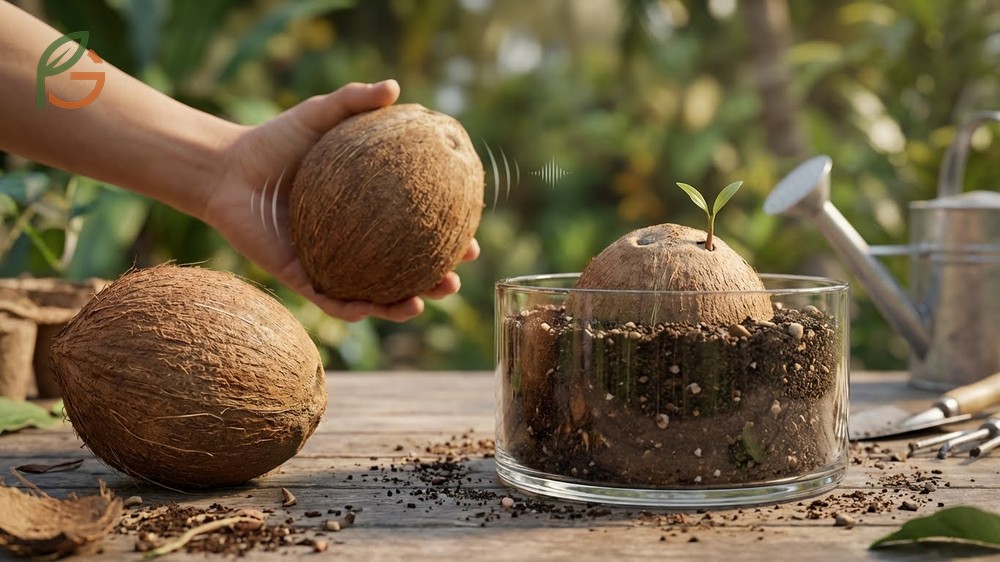
Evidence suggests starting with a fresh, mature coconut still in its husk gives you the highest success rate. You’ll hear sloshing liquid inside when you shake it—that’s the coconut water feeding the developing seedling.
The planting process differs from most fruit trees because you don’t bury the entire seed. Only the bottom half goes into the soil, leaving the top exposed for the shoot to emerge.
Coconut Germination Time
Coconut seeds germinate slowly, taking 3-6 months before the first shoot appears[1]. During this period, the embryo develops a spongy tissue called the haustorium that absorbs nutrients from the coconut meat and water.
For successful germination, maintain temperatures between 77-86°F (25-30°C)[1] with high humidity. The single cotyledon grows inside the seed cavity for about 2 weeks before forming the first root on the underside.
Planting Steps
Start by selecting a location with full sun and protection from strong winds during the establishment phase. Dig a hole slightly larger than the coconut itself, about 12 inches deep.
Place the coconut horizontally in the hole with one of the three “eyes” facing sideways. The shoot will naturally grow upward regardless of orientation, but this position speeds emergence.
- Remove outer fibers only if severely damaged—the husk protects the seed
- Fill hole with sandy loam soil mixed with compost
- Bury only the bottom half of the coconut
- Water thoroughly until soil is evenly moist but not soggy
- Maintain consistent moisture without waterlogging during germination
- Apply 2-3 inches of organic mulch around the planting area
- Monitor for shoot emergence between months 3-6
Critical Tip: Don’t disturb the coconut once planted. The developing root system is extremely fragile during the first 6 months. Even minor movement can break connections and kill the seedling.
Coconut Plant Care
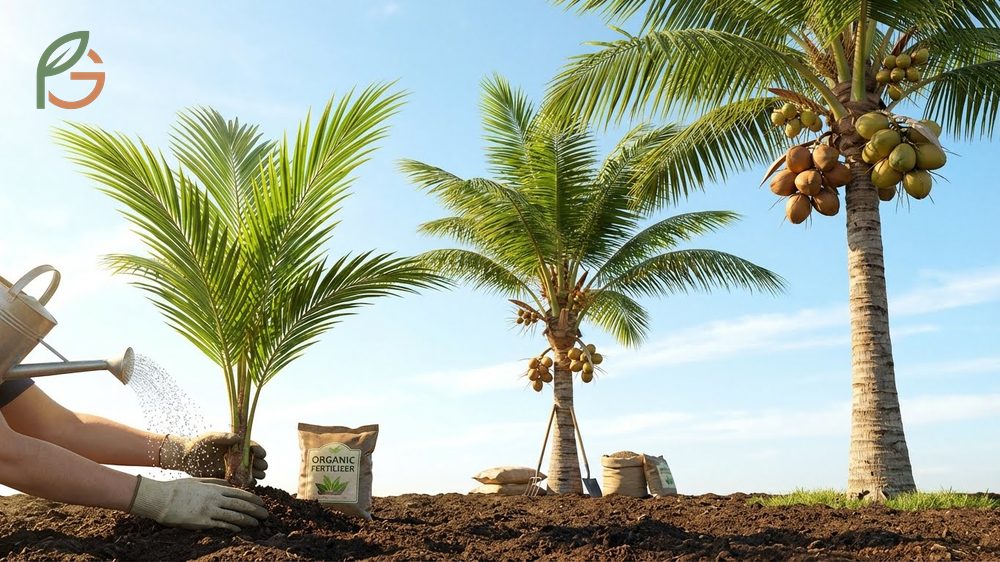
Coconut palms need consistent care during their first 3 years to establish strong root systems. Once established, they become remarkably low-maintenance compared to other fruit trees.
Current data indicates proper nutrition during the vegetative growth phase (years 3-6) directly affects fruit production later. Trees underfed during this critical period produce 30-40% fewer coconuts at maturity.
Fertilizer for Coconut Trees
Research shows coconut palms respond best to balanced fertilizers with slightly higher potassium. A 20-20-20 NPK formula works well for general maintenance, while producing trees benefit from 24-13-5 ratios.
Young trees (1-3 years old) need 0.3-0.5 kg of fertilizer per month applied around the drip line. Mature producing palms require 1.5-2 kg per tree every 2-3 months, split into multiple applications.
This table compares fertilizer types, NPK ratios, application timing, and dosage recommendations across three coconut tree growth stages from young seedlings to mature producing palms
| Tree Age | NPK Ratio | Dosage | Frequency |
|---|---|---|---|
| 1-3 years | 20-20-20 or 24-13-5 | 0.3-0.5 kg/month | Monthly |
| 4-6 years | 24-13-5 or 20-10-20 | 0.8-1.2 kg/month | Every 3-4 weeks |
| 7+ years (producing) | 24-13-5 or 15-15-30 | 1.5-2 kg/application | Every 8-12 weeks |
- Boron prevents nut deformities and increases set rate
- Magnesium stops leaf yellowing in older fronds
- Manganese supports photosynthesis efficiency
- Zinc improves overall vigor and disease resistance
- Iron prevents chlorosis in alkaline soils
Watering and Sunlight
Evidence indicates coconut palms need 6-8 hours of direct sunlight daily for optimal growth and fruiting[6]. Shaded palms grow slowly and rarely produce viable fruit.
Water requirements vary by season and climate. During active growth (May-September), apply 20-30 gallons weekly for young trees, increasing to 50-80 gallons for mature palms. Reduce watering by 30-40% during cooler months (October-April) while maintaining consistent moisture.
What often gets overlooked is that coconut palms need high humidity—ideally 70-80%—for best results. In dry climates, mist the fronds daily or use overhead irrigation to increase ambient moisture around the canopy.
How Long for Coconut Tree to Fruit
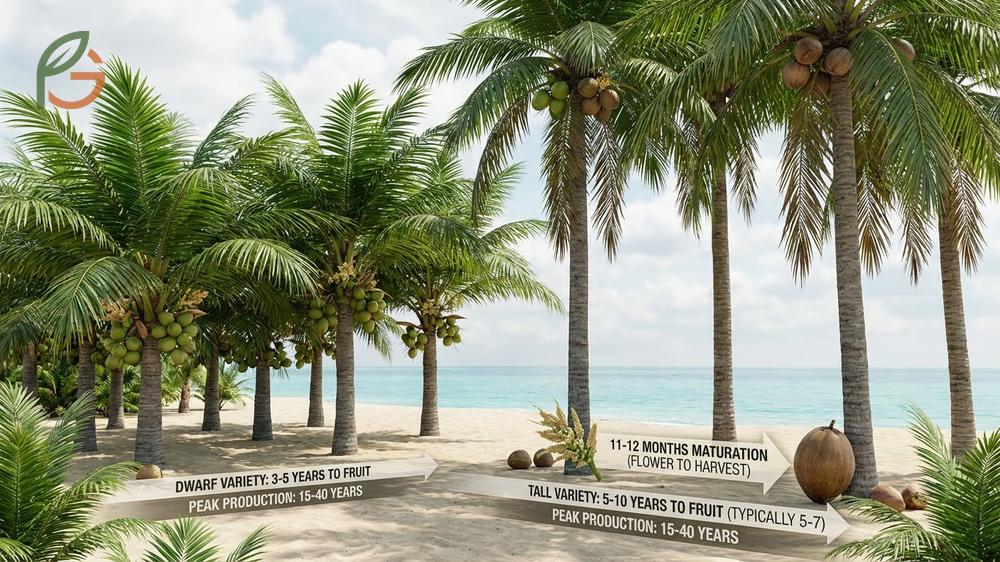
Dwarf varieties start flowering and producing nuts in 3-5 years after planting[1], while tall varieties take 5-10 years to reach maturity[1]. Most commonly planted tall varieties fruit reliably at 5-7 years old[3].
After the first flowering, it takes 11-12 months for coconuts to fully mature from pollination to harvest. Trees produce 12-15 inflorescences (flower clusters) annually, each developing into a bunch of 5-12 nuts.
Peak production occurs between 15-40 years of age[7], when healthy palms yield 50-150 nuts per year depending on variety and care. The economic lifespan extends 60-80 years[3], making coconut cultivation an excellent long-term investment.
| Growth Stage | Timeframe | Key Milestone |
|---|---|---|
| Germination | 3-6 months[1] | First shoot emerges |
| Seedling Stage | 6-12 months | Root system establishes |
| Vegetative Growth | 3-6 years | Trunk develops, fronds expand |
| First Flowering | 5-7 years[3] | Initial fruit production begins |
| Peak Production | 15-40 years[7] | Maximum yield of 50-150 nuts/year |
Patience Required: Don’t expect a full coconut harvest until year 10-12, even if flowering starts earlier. Young palms produce fewer, smaller nuts that may drop prematurely as the tree diverts energy to continued growth.
Growing Coconut Tree Indoors
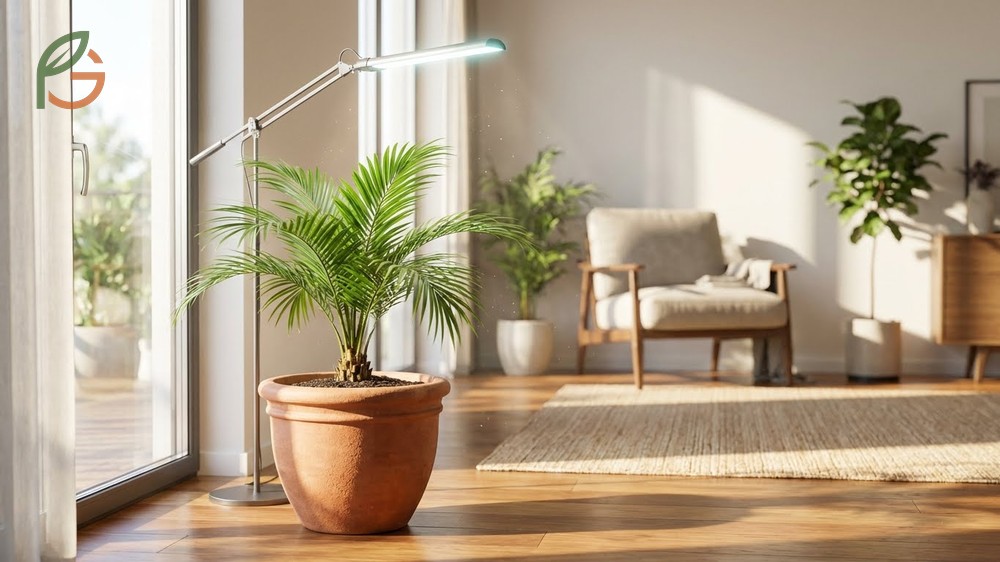
Indoor coconut cultivation works only for decorative purposes with young palms. You can’t grow a full-sized fruiting coconut tree indoors—mature specimens reach 60-100 feet tall with extensive root systems.
Dwarf varieties or seedlings under 3 years old adapt to large containers in bright indoor spaces. You’ll need a 15-20 gallon pot minimum, placed within 3-4 feet of south-facing windows or under high-intensity grow lights providing 6-8 hours of direct light equivalent.
The biggest challenge indoors isn’t light—it’s humidity. Coconut palms struggle when relative humidity drops below 50%. Run a humidifier constantly or mist fronds 2-3 times daily to prevent leaf tip browning and slow growth.
- Minimum 12-inch pot depth for seedlings, 20+ inches for established plants
- Well-draining potting mix with 30% sand or perlite
- Ambient temperatures never below 68°F (20°C)
- Consistent 70-80% relative humidity year-round
- Monthly fertilization with half-strength liquid palm fertilizer
- Repotting every 18-24 months as roots fill containers
My friend in Oaxaca, Mexico kept an indoor coconut palm for 4 years before moving it outside. The tree reached 6 feet tall in a 25-gallon container but never flowered indoors despite optimal care—matching research showing indoor palms rarely fruit even with perfect conditions.
Reality Check: If you want coconuts, plant outdoors in the ground within zones 10B-11. Indoor cultivation works for ornamental purposes only, and you’ll eventually need to transplant or discard the palm as it outgrows indoor spaces.
Conclusion
The evidence is clear: successfully growing coconut trees from seed to harvest requires matching their strict tropical requirements. You’ll need USDA zone 10B-11 conditions, sandy loam soil, consistent warmth above 70°F (21°C), and patience through the 5-7 year maturation period before your first coconut tree harvest.
Current agricultural guidance emphasizes proper site selection and early nutrition as the foundation for productive palms that continue yielding for 60-80 years. FruitGarden provides research-backed cultivation strategies to help you grow thriving coconut palms adapted to your local microclimate.
Frequently Asked Questions
Where do coconuts grow best in the United States?
Coconuts grow best in southern Florida (zones 10B-11), Hawaii, and limited coastal areas of southern California and Texas where temperatures never drop below 64°F (18°C). These regions provide the frost-free tropical conditions coconut palms require year-round.
Can I grow a coconut tree from a grocery store coconut?
Grocery store coconuts rarely germinate because they’re harvested mature and stored refrigerated, killing the embryo. For successful germination, use fresh coconuts still in the husk with audible liquid inside, purchased from tropical plant nurseries or harvested directly from producing trees.
What’s the difference between coconut fiber and coconut coir for plants?
Coconut fiber and coconut coir are the same material—compressed fibers from coconut husks used as a sustainable growing medium. Coir retains moisture better than peat moss while providing excellent drainage and aeration for root systems, making it ideal for containerized palms and tropical plants.
Do coconut trees need male and female plants to produce fruit?
No, coconut palms are monoecious with both male and female flowers on the same tree. Each inflorescence contains numerous male flowers and several female flowers that self-pollinate or cross-pollinate with wind and insect assistance, so a single tree can produce coconuts independently.
Can you grow coconut palms as bonsai trees?
Coconut bonsai cultivation is extremely difficult and rarely successful long-term. Coconut palms have a single growing point (apical meristem) that can’t be pruned like traditional bonsai subjects. Dwarf varieties in containers provide a similar aesthetic without the constraints and limitations of true bonsai techniques.
How much water does a coconut tree need per week?
Young coconut palms (1-3 years) need 20-30 gallons weekly during active growth, while mature producing trees require 50-80 gallons per week. Reduce watering by 30-40% during cooler months, but maintain consistent soil moisture year-round to prevent stress and nut drop.
Why isn’t my coconut tree producing coconuts?
Coconut trees under 5-7 years old haven’t reached maturity for flowering. Other causes include insufficient sunlight (needs 6-8 hours daily), nutrient deficiencies (especially potassium and boron), water stress, or temperatures consistently below 70°F (21°C) that suppress reproductive development.