How to grow cherries? Research shows cherry trees thrive in full sun with well-drained soil at pH 6-7, producing fruit in 3-7 years depending on variety[1]. Success depends on proper spacing, consistent watering, and selecting the right variety for your climate zone. FruitGarden combines current horticultural research with practical growing techniques to help you cultivate healthy, productive cherry trees from planting through harvest.
Quick Answer
- Plant cherry trees in early to mid-spring with 6-8 hours of daily sunlight[2]
- Space dwarf trees 8-10 feet apart, semi-dwarf 12-18 feet, and standard trees 18-25 feet[3]
- Sweet cherries produce fruit in 4-7 years, sour cherries in 3-5 years[4]
- Water with 1 inch every 10 days during growing season, checking soil moisture several inches down[5]
How to Grow Cherries
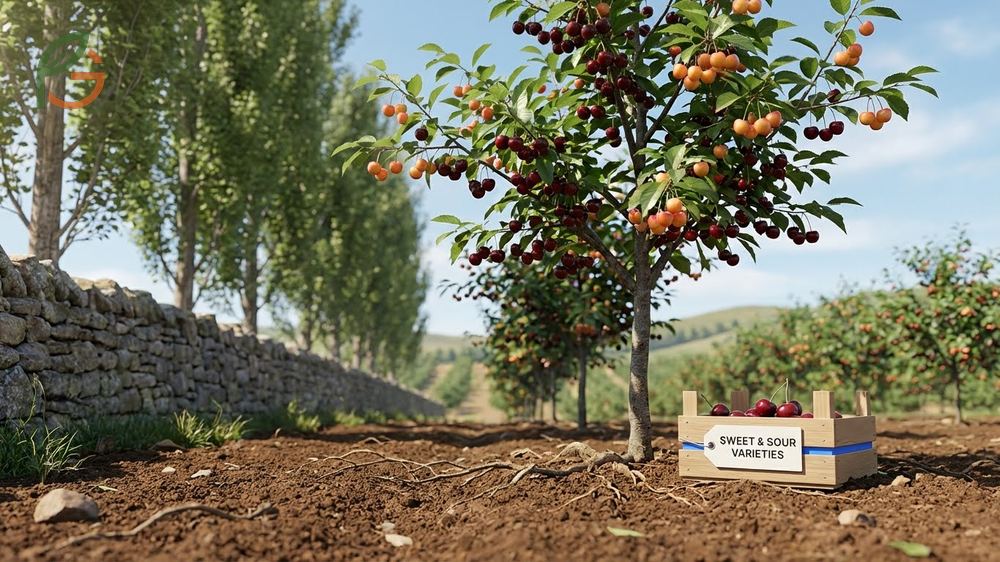
Cherry trees need specific conditions to thrive and produce abundant fruit. Research demonstrates that site selection determines long-term success more than any other factor[1]. You’ll want full sun exposure, protection from strong winds, and well-drained soil that doesn’t collect standing water.
The two main types—sweet cherries and sour (tart) cherries—grow differently and serve different purposes. Sweet varieties like Bing and Rainier work best for fresh eating, while sour types like Montmorency excel in pies and preserves. Most gardeners find sour cherries easier to grow because they’re hardier and self-pollinating[4].
Understanding your USDA hardiness zone helps you select varieties that’ll survive winter temperatures. Sweet cherries typically grow in zones 5-7, while sour cherries handle zones 4-7. Cold-hardy varieties can even thrive in zone 3 with proper site selection and winter protection.
Choosing Cherry Varieties
Sweet cherry varieties require cross-pollination with another compatible variety to produce fruit. Most sweet cherries are self-unfruitful, meaning you’ll need at least two different varieties that bloom at the same time[6]. Popular pairings include Bing with Rainier or Van.
Sour cherries offer a simpler solution—they’re self-fertile and don’t need a pollinator. This makes them ideal for small yards where you only have room for one tree. Dwarf varieties on specialized rootstocks stay compact, reaching just 8-10 feet tall at maturity.
- Stella, Lapins, and Sweetheart (self-fertile sweet cherries)
- Montmorency (most popular sour cherry for pies)
- North Star (compact sour cherry, cold-hardy to zone 4)
- Evans (productive sour cherry with ornamental value)
- Carmine Jewel (dwarf bush cherry, extremely cold-hardy)
Sunlight Requirements for Cherry Trees
Cherry trees demand 6-8 hours of direct sunlight daily for optimal fruit production[2]. Insufficient light leads to weak growth, poor fruit set, and increased disease susceptibility. South-facing locations in the northern hemisphere receive the most consistent sun exposure throughout the growing season.
If you’re gardening in southern zones (8-9), afternoon shade prevents heat stress during summer’s hottest months. Position trees where they’ll catch morning sun but get relief from intense afternoon rays. This balance maintains photosynthesis without scorching leaves or causing premature fruit drop.
Important Note: Cherry trees planted in partial shade produce 40-60% less fruit than those in full sun. They also become more prone to fungal diseases like brown rot and leaf spot due to poor air circulation and prolonged leaf wetness.
How to Plant Cherry Trees
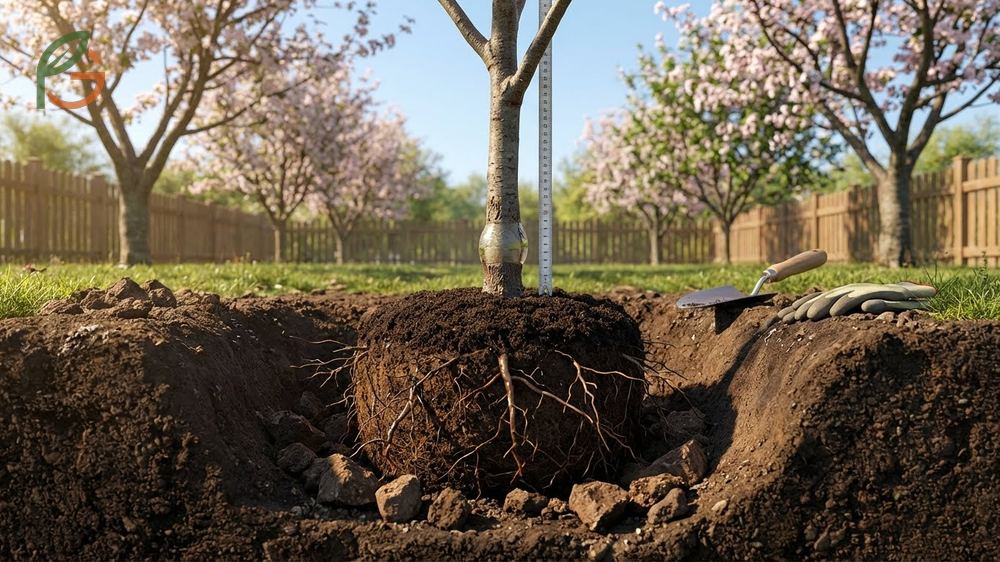
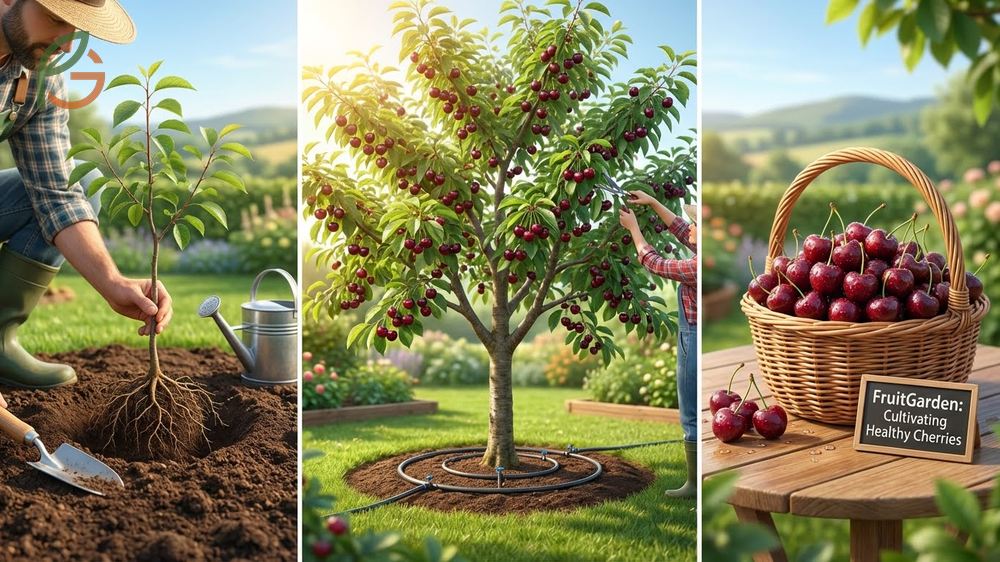
Proper planting technique establishes the foundation for decades of productivity. Studies show that planting depth affects tree survival rates more than most gardeners realize[1]. The graft union—where the desired variety joins the rootstock—must sit 1-2 inches above soil level to prevent the grafted portion from developing its own roots.
Dig holes approximately 1.5-2 times wider than the root ball but no deeper than the container or root system. Breaking up compacted soil around the planting area encourages roots to spread into native soil. Avoid amending the backfill soil too heavily, as this creates a “bathtub effect” where roots circle instead of expanding outward.
For bareroot trees, soak roots for 8-24 hours before planting. Spread roots naturally in the hole without crowding or bending them upward. Backfill with native soil, firming gently to eliminate air pockets while avoiding compaction that restricts oxygen flow to roots.
Soil pH for Cherry Trees
Cherry trees prefer slightly acidic to neutral soil ranging from pH 6.0 to 7.0[2]. Sweet varieties perform best at pH 6.3-7.2, while sour cherries tolerate a slightly wider range of 6.0-7.0. Testing your soil before planting reveals whether amendments are needed to adjust pH levels.
Soils below pH 6.0 limit nutrient availability, particularly calcium and magnesium. Adding agricultural lime raises pH gradually—apply in fall so it has time to react before spring planting. Overly alkaline soils (above pH 7.5) cause iron and manganese deficiencies, resulting in yellowing leaves with green veins.
Sandy soils drain quickly but require more frequent watering and fertilization. Clay soils hold moisture but need organic matter to improve drainage and prevent root rot. Working 2-3 inches of compost into the top 12 inches of soil improves structure in both soil types.
Cherry Tree Spacing
Proper spacing prevents overcrowding and ensures adequate air circulation to reduce disease pressure. Current guidelines recommend spacing dwarf cherry trees 8-10 feet apart, semi-dwarf sweet cherries 15-18 feet, semi-dwarf sour cherries 12-15 feet, standard sweet cherries 18-25 feet, and standard sour cherries 15-18 feet[3]. These distances account for mature canopy spread and equipment access.
Rootstock determines final tree size more than the variety grafted onto it. Dwarf rootstocks like Gisela 5 or Gisela 6 restrict growth to 8-12 feet, making them suitable for small yards and container growing. Standard rootstocks produce full-size trees reaching 25-30 feet tall and wide at maturity.
This table compares spacing requirements, mature height, and years to first fruit across dwarf, semi-dwarf, and standard cherry tree sizes for both sweet and sour varieties
| Tree Size | Spacing (feet) | Mature Height | Years to Fruit |
|---|---|---|---|
| Dwarf Sweet | 8-10[3] | 8-12 feet | 4-5 years |
| Dwarf Sour | 8-10[3] | 8-10 feet | 3-4 years |
| Semi-Dwarf Sweet | 15-18[3] | 15-18 feet | 5-7 years |
| Semi-Dwarf Sour | 12-15[3] | 12-15 feet | 4-5 years |
| Standard Sweet | 18-25[3] | 20-30 feet | 6-7 years |
| Standard Sour | 15-18[3] | 15-20 feet | 5 years |
When to Plant Cherry Trees
Plant cherry trees in early to mid-spring as soon as soil becomes workable and ground temperatures reach 45-50°F (7-10°C)[1]. Spring planting gives roots an entire growing season to establish before winter dormancy. In mild climates (zones 7-9), fall planting works if done 6-8 weeks before the first expected frost.
Bareroot trees require dormant-season planting—late winter through early spring before bud break. Container-grown trees offer more flexibility since their root systems aren’t exposed, allowing planting throughout the growing season. However, avoid planting during heat waves or drought conditions when transplant stress increases.
Timing matters for long-term survival. Trees planted too early risk frost damage to emerging buds, while late planting doesn’t give roots enough time to anchor before summer heat arrives. Most experts recommend planting 2-4 weeks before your area’s last average frost date.
How to Care for Cherry Trees
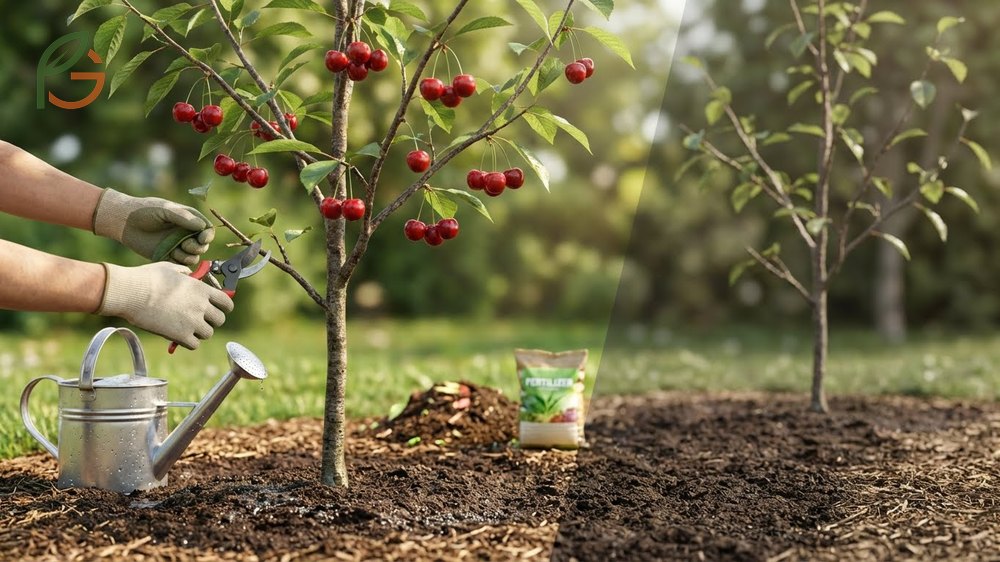
Consistent care during the first three years determines whether your cherry tree becomes a productive specimen or struggles with weak growth and disease. Research indicates that young trees receiving proper water, nutrition, and pruning produce fruit 1-2 years earlier than neglected ones. Establishing good habits from the start saves time and prevents problems later.
Cherry trees need less intervention than many fruit crops but aren’t completely hands-off. Annual pruning, pest monitoring, and soil testing every 2-3 years maintain tree health. Disease prevention through proper spacing and sanitation beats trying to cure established infections.
Watering Schedule for Cherry Trees
Cherry trees require approximately 1 inch of water every 10 days during the growing season[5]. Check soil moisture by inserting your finger 3-4 inches deep—soil should feel moist but not waterlogged. Overwatering causes root rot and nutrient leaching, while underwatering stresses trees and reduces fruit size.
Newly planted trees need more frequent watering—twice weekly for the first month, then weekly through the first growing season. Deep, infrequent watering encourages roots to grow downward rather than staying near the surface. Shallow watering creates weak root systems vulnerable to drought and wind damage.
Reduce watering frequency in fall to help trees harden off before winter. Applying a final deep watering just before ground freezes prevents winter desiccation. Drip irrigation or soaker hoses deliver water efficiently to root zones without wetting foliage, which promotes fungal diseases.
Watering Tip: Water cherry trees every 7-10 days rather than daily light sprinkling. One deep watering session that penetrates 12-18 inches develops stronger, more drought-resistant root systems than frequent shallow irrigation.
Fertilizer for Cherry Trees
Young cherry trees benefit from light nitrogen applications in early spring—about 0.1 pounds of actual nitrogen per year of tree age up to a maximum of 1 pound per tree. Established trees (5+ years old) need 1-2 pounds of nitrogen annually, split between early spring and post-harvest applications. Excessive nitrogen produces lush foliage at the expense of fruit production.
Conduct soil tests every 2-3 years to identify specific nutrient deficiencies. Cherries need balanced NPK ratios plus adequate calcium, magnesium, and boron. Yellowing leaves between veins often indicate iron deficiency in alkaline soils, correctable with chelated iron or acidifying amendments.
- Apply nitrogen in early spring when buds begin to swell
- Spread fertilizer evenly under the canopy drip line, avoiding trunk contact
- Water thoroughly after fertilizing to move nutrients into root zone
- Reduce nitrogen in late summer to encourage hardening before winter
- Use slow-release organic fertilizers to prevent nutrient spikes and leaching
Mulching Cherry Trees
Apply 2-3 inches of organic mulch in a 3-4 foot diameter circle around trees, keeping mulch 4-6 inches away from trunks. Wood chips, shredded bark, or composted leaves work well—they suppress weeds, moderate soil temperature, and conserve moisture. Mulch breaking down gradually adds organic matter and improves soil structure.
Refresh mulch annually as it decomposes, maintaining consistent depth. Excessive mulch (over 4 inches) creates overly moist conditions that encourage crown rot and rodent nesting. Mulch volcanoes piled against trunks cause bark decay and provide entry points for borers and disease pathogens.
Pruning Young Cherry Trees
Prune young cherry trees in late winter while dormant but before spring growth begins. The first pruning happens immediately after planting—cut the central leader back by one-third to one-half to balance top growth with reduced root systems. This heading cut stimulates lateral branch development for future scaffold limbs.
During years 2-4, establish 4-6 main scaffold branches spaced evenly around the trunk at 45-60 degree angles. Remove competing leaders, branches growing toward the tree’s center, and any crossing limbs that rub together. Sweet cherries trained to a central leader system, while sour cherries work well as open-center (vase-shaped) trees.
Limit pruning on mature cherry trees since they compartmentalize wounds poorly and are susceptible to disease entry through cuts. Remove only dead, damaged, or diseased wood. Summer pruning after harvest reduces disease risk compared to dormant-season pruning for established trees.
When Do Cherry Trees Produce Fruit
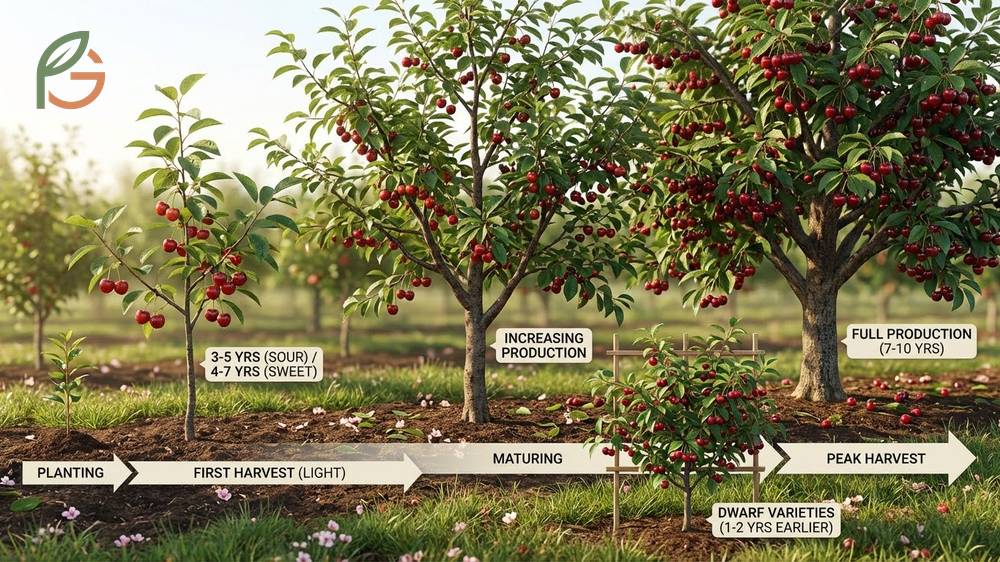
Sweet cherry trees begin producing fruit 4-7 years after planting, while sour cherries start bearing in 3-5 years[4]. Dwarf varieties on precocious rootstocks fruit 1-2 years earlier than standard trees. Tree size and rootstock influence bearing age more than the specific variety grafted onto them.
First harvests are typically light—just a few pounds of fruit. Production increases annually as trees mature, with full production starting around year 7-10. Mature dwarf sweet cherries yield 15-20 quarts, semi-dwarf sweet cherries produce 30-50 quarts, and dwarf sour cherries give 15-20 quarts per season[4].
Cherry trees bloom in early spring, with fruit development occurring over 60-90 days depending on variety and weather. Sweet cherries typically ripen in June, while sour cherries mature by mid-July in most regions. Late frosts during bloom can destroy the entire year’s crop since cherry flowers are cold-sensitive.
From My Experience: My cousin in Guadalajara, Mexico planted a Stella sweet cherry in March 2023. The tree produced its first 8 cherries in spring 2027—exactly 4 years after planting, matching research timelines for dwarf varieties on Gisela rootstock.
- Rootstock type (dwarf produces 1-2 years sooner than standard)
- Tree health and vigor (stressed trees delay fruiting)
- Proper pollination (sweet cherries need compatible partners)
- Climate conditions (adequate chill hours in winter)
- Pruning practices (excessive pruning delays maturity)
Protecting Cherries from Birds
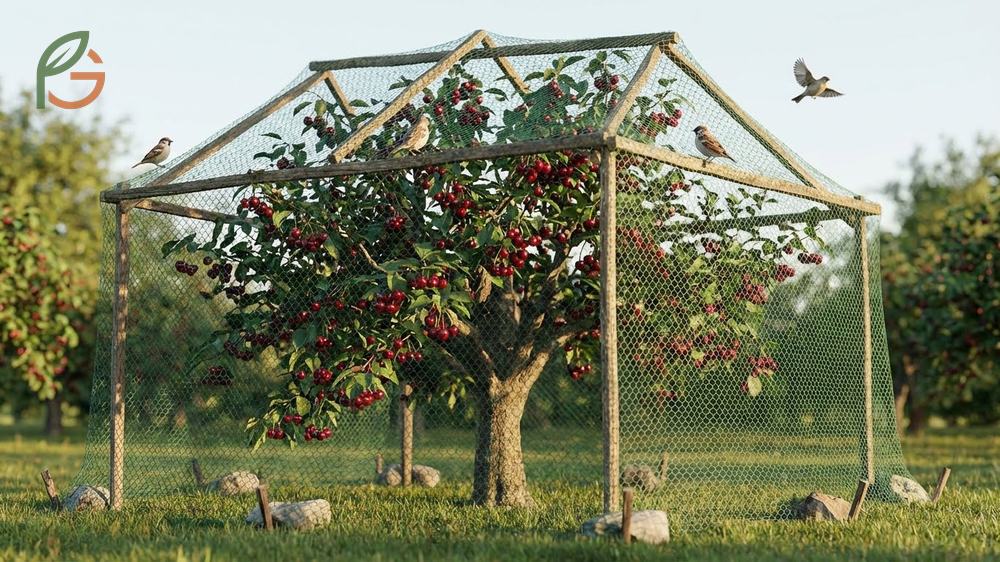
Birds can consume an entire cherry crop in days once fruit ripens. Netting provides the most reliable protection—drape fine mesh with approximately 1/4-inch openings over trees 7-10 days before cherries reach full color. Smaller openings prevent birds from getting caught while blocking access to fruit.
Support netting with poles or a frame to keep mesh from resting directly on branches, which allows birds to peck through and eat fruit. Secure netting at the base by tying around the trunk or staking edges to the ground. Check daily for birds or other wildlife trapped underneath.
Alternative deterrents include reflective tape, predator decoys, and noise makers, but these work inconsistently as birds adapt quickly. Combining methods increases effectiveness—use scare tactics early in ripening, then add netting as harvest approaches. Remove netting immediately after harvest to prevent weathering and wildlife entanglement.
- Install netting when fruit begins changing color but before full ripeness
- Use black or dark netting that’s less visible and blends with foliage
- Drape netting over a PVC or bamboo frame to create a tent structure
- Harvest promptly once fruit ripens to minimize exposure time
- Consider planting mulberry trees nearby as a sacrificial crop birds prefer
Harvesting Cherries
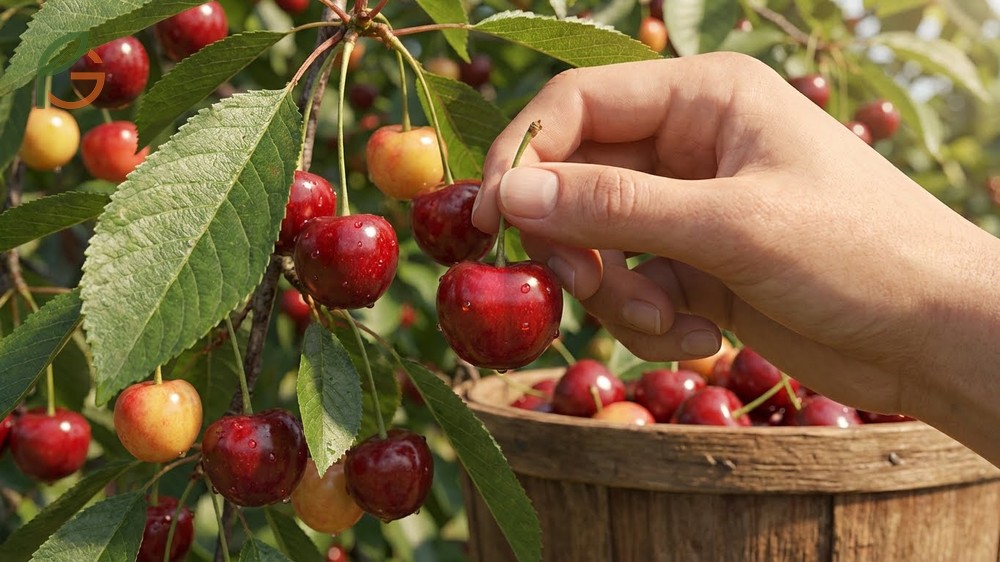
Harvest cherries when they’ve developed full color and firm texture—sweet cherries turn deep red, black, or yellow depending on variety, while sour cherries become bright red. Taste-testing is the best ripeness indicator since cherries don’t continue ripening after picking. Underripe cherries taste tart and lack sweetness, while overripe fruit becomes soft and attracts fruit flies.
Pick cherries with stems attached by grasping the stem close to the fruit and pulling with a slight twisting motion. Harvesting without stems damages fruit and reduces storage life. For cooking or preserving, you can pull cherries off and leave stems on the tree, though this increases bruising.
Sweet cherries ripen in early June in southern regions, mid-June in central areas, and late June to early July in northern climates. Sour cherries typically ripen 2-3 weeks later than sweet varieties. Harvest every 2-3 days once picking begins since cherries ripen unevenly and overripe fruit splits or falls.
Cool cherries immediately after harvest to slow deterioration. Sweet cherries store at 30-31°F (-1°C) for up to 10 days, while sour cherries prefer 32°F (0°C). Place unwashed fruit in perforated plastic bags or containers with slight airflow. Wash cherries in cold water only when ready to eat—moisture accelerates decay during storage.
Harvest Timing: Pick cherries in early morning after dew dries but before afternoon heat. Fruit picked during cool temperatures maintains better quality and lasts longer in storage than cherries harvested in hot weather.
Conclusion
The evidence is clear: how to grow cherries successfully comes down to selecting the right variety for your climate, providing full sun and well-drained soil, and maintaining consistent care through watering, fertilizing, and pruning. Sweet cherries reward patience with 4-7 years until first harvest, while sour cherries produce sooner at 3-5 years.
Current horticultural guidance emphasizes disease prevention through proper spacing and site selection over reactive treatments. FruitGarden combines research-based growing methods with practical techniques that help both new and experienced gardeners cultivate productive cherry trees from planting through decades of harvest.
Frequently Asked Questions
How long does it take to grow cherries from a tree?
Sweet cherry trees produce their first fruit in 4-7 years after planting, while sour cherry trees begin bearing in 3-5 years. Dwarf varieties on precocious rootstocks fruit 1-2 years earlier than standard-size trees, with full production starting around year 7-10.
How fast do cherry trees grow per year?
Cherry trees grow 30-60 cm (12-24 inches) annually during their first 3-5 years of establishment. Growth rate depends on rootstock, soil quality, water availability, and climate conditions. Dwarf trees reach mature height in 5-7 years, while standard trees take 10-15 years to reach full size.
What are the best companion plants for cherries?
Effective companion plants for cherry trees include comfrey for nutrient accumulation, white clover for nitrogen fixation, chives to deter pests, nasturtiums as trap crops, and marigolds for nematode suppression. Plant companions 2-3 feet from the trunk to avoid root competition while providing benefits.
Can you grow cherry trees in containers?
Yes, dwarf cherry varieties on Gisela rootstocks grow successfully in containers 18-24 inches wide and deep. Container cherries need daily watering during summer, annual repotting or root pruning every 2-3 years, and winter protection in cold climates since roots are more exposed to freezing.
Do all cherry trees need two trees to produce fruit?
No—sour cherries and self-fertile sweet varieties like Stella, Lapins, and Sweetheart produce fruit with only one tree. Most sweet cherry varieties require a second compatible variety for cross-pollination. Check pollination requirements before purchasing to ensure fruit set.
What is the best time to fertilize cherry trees?
Fertilize cherry trees in early spring when buds begin to swell, applying 0.1 pounds of nitrogen per year of tree age (maximum 1 pound for young trees). Established trees benefit from a second application after harvest. Avoid late summer fertilizing to prevent tender new growth before winter.
How do you know when cherries are ready to harvest?
Cherries are ready to harvest when they develop full color, firm texture, and sweet flavor. Sweet cherries turn deep red, black, or yellow depending on variety, while sour cherries become bright red. Taste-testing confirms ripeness since cherries don’t ripen further after picking.