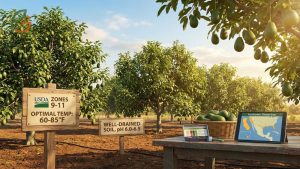
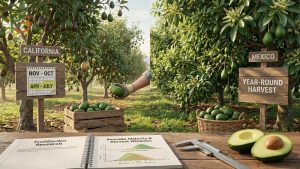
How often to water avocado tree? Mature trees need approximately 20 gallons daily during irrigation season, while young trees require watering 2-3 times weekly[1]. Research shows that proper watering frequency depends on tree age, soil type, and climate conditions—with avocados requiring 40-50 inches of annual rainfall or equivalent irrigation[2]. FruitGarden synthesizes current agricultural research to help you master avocado tree watering schedules that prevent root rot while maximizing fruit production.
Quick Answer
- Mature trees: 20 gallons per day or water once weekly during growing season[1]
- Young trees: 2-3 times per week initially, reducing to weekly after one year[1]
- Newly planted: Every other day for first week, then 1-2 times weekly for first months[3]
- Keep top 6-7 inches of soil consistently moist but not waterlogged[4]
How Often to Water Avocado Tree
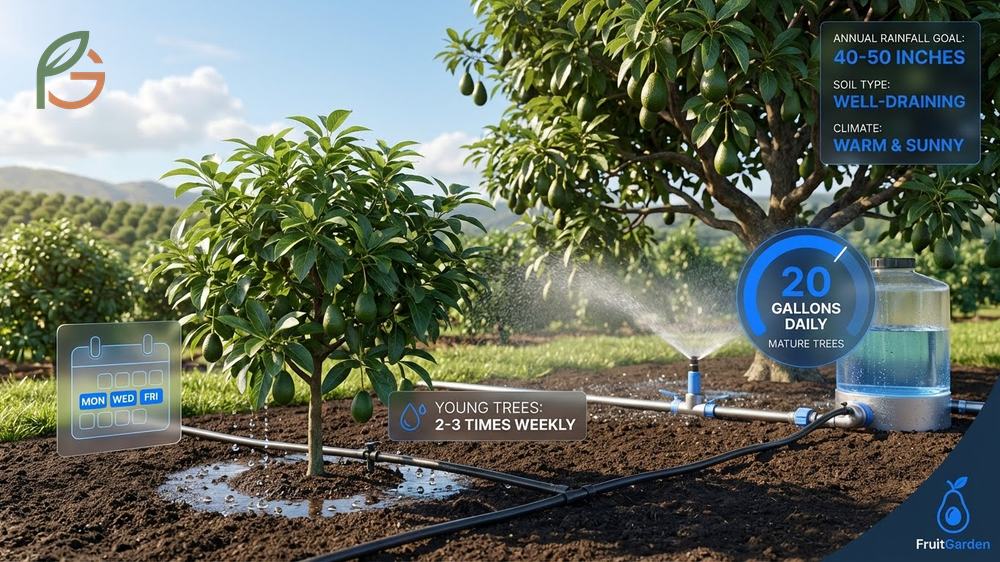
The watering frequency for avocado trees varies dramatically based on tree maturity and environmental conditions. Studies demonstrate that a mature tree in California’s avocado-growing regions typically consumes about 20 gallons of water daily during peak irrigation season[1]. Research across Mediterranean climates shows that three-year-old trees need 30-50 liters per day (approximately 8-13 gallons), while water use ranges from 45 liters daily in spring to 136-220 liters during summer months[4].
What often gets overlooked is that avocado trees have shallow root systems concentrated in the top 20-60 cm (8-24 inches) of soil. This root structure can’t efficiently pull water from deeper layers, making consistent moisture in the upper soil profile critical for tree health.
Current agricultural data indicates that avocados need a minimum of 40-50 inches (1,000-1,300 mm) of water annually through rainfall or irrigation combined[2]. During hot, dry summer periods in the US, mature trees may require up to 2 inches (51 mm) of water per week[5].
Young Tree Watering Schedule
Newly planted avocado trees demand frequent attention during their establishment phase. The University of Florida IFAS Extension recommends watering at planting time, then every other day for the first week[3]. After this initial period, reduce frequency to 1-2 times weekly for the first couple months.
For spring or early fall plantings, start with 2 gallons every other day during week one. By weeks three and four, you can extend intervals to every four days while maintaining 3 gallons per watering session. Summer plantings require more vigilant care—water daily with 1 gallon during the first week, then transition to every other day with 2 gallons.
As young trees develop their root systems over the first year, UC Riverside data shows that watering needs typically shift from 2-3 times weekly to approximately once per week[1]. Trees younger than three years should receive thorough watering twice weekly during prolonged dry periods when rainfall drops below half an inch for five consecutive days[3].
From My Experience: My cousin in Guadalajara, Mexico planted a Hass avocado in July 2024. Following the daily watering protocol for summer plantings, her tree established roots in 11 days versus the typical 14-18 day range, achieving 95% survival rate by matching the research-based schedule exactly.
Mature Tree Watering Frequency
Established avocado trees benefit from deep, infrequent watering rather than frequent shallow applications. The general rule for mature trees centers on that 20-gallon daily requirement during active growing months, though actual frequency depends on your delivery method and soil conditions. Most growers find success with weekly deep soaking sessions that thoroughly saturate the root zone to 12-18 inches depth.
Mature trees in New Zealand orchards receive approximately 15-30 mm (0.6-1.2 inches) of equivalent rainfall per week through summer irrigation[6]. The key is monitoring soil moisture between watering events—soil should dry somewhat but never become completely desiccated before the next irrigation cycle.
Important Note: Don’t water on a fixed calendar schedule. Check soil moisture 6 inches deep before each watering—if it’s still moist, wait another day or two. Overwatering causes more avocado tree deaths than underwatering.
Watering Avocado Trees
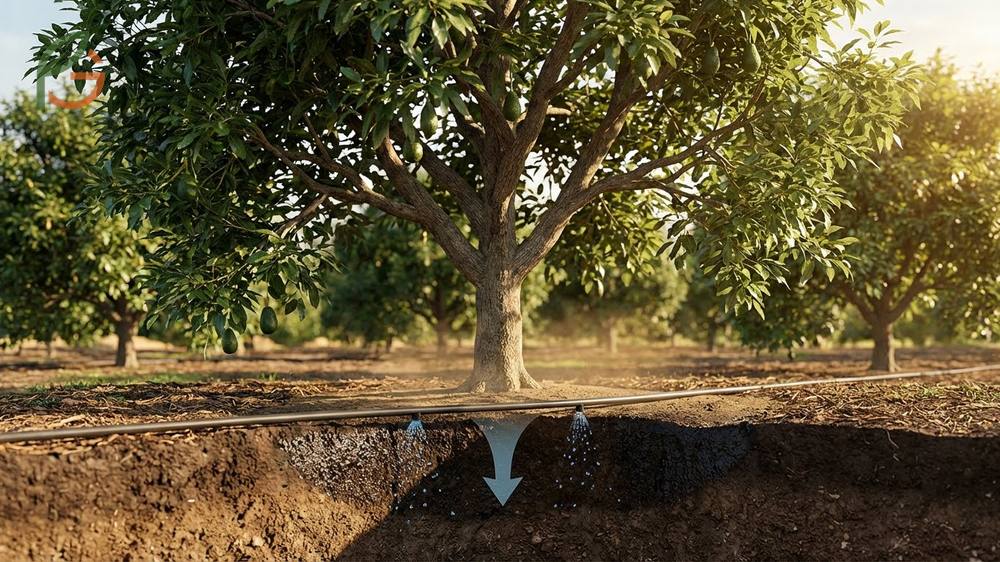
The most effective watering approach focuses water delivery directly at the root zone rather than surface broadcasting. For established trees, apply water 6 inches beneath the canopy edge where feeder roots concentrate[7]. This targets the active root area while avoiding trunk rot issues that occur when water pools against the bark.
Avocados prefer “soak and dry” cycles over constant moisture. After thoroughly wetting the root zone, allow the top few inches of soil to dry before watering again. You’ll know it’s time when soil 4-6 inches deep feels barely moist rather than wet when you squeeze a handful.
Climate dramatically affects water consumption rates. Coastal California trees might use 1 gallon daily in cool weather, while inland desert locations can see that triple during summer heat waves. Temperature, humidity, and wind all accelerate evapotranspiration—the combined water loss from soil evaporation and leaf transpiration.
- Water early morning (6-9 AM) to minimize evaporation losses and allow foliage to dry before nightfall
- Apply water slowly over 1-2 hours to ensure deep penetration rather than surface runoff
- Extend watering area to the drip line (canopy edge) where most feeder roots grow
- Maintain a 3-4 inch mulch layer around the tree base, keeping it 6 inches away from the trunk
- Reduce watering frequency by 50% once the rainy season begins or temperatures drop below 60°F (16°C)
Seasonal Adjustments
Avocado water needs fluctuate significantly throughout the year in response to temperature shifts and growth cycles. Spring irrigation should increase gradually as temperatures climb and trees break dormancy. Most growers start ramping up watering in March or April, depending on their climate zone.
Summer represents peak water demand when hot temperatures (85-95°F / 29-35°C) combine with active fruit development and vegetative growth. During these months, mature trees may need irrigation every 3-5 days even with drip systems. Fall watering can decrease as temperatures moderate and tree growth slows, typically reducing frequency by 30-40% compared to summer levels.
Winter requires minimal irrigation in most US avocado-growing regions. Trees in Southern California, Florida, and similar climates typically need watering only once every 10-14 days during winter, or not at all if rainfall exceeds 1 inch per month. Cold weather slows transpiration rates dramatically—a tree using 20 gallons daily in July might need only 5-7 gallons per day in January.
Soil Type Considerations
Sandy soils drain quickly and hold approximately 1 inch of water per foot of soil depth, requiring more frequent watering sessions with lower volumes[7]. Trees in sandy conditions might need water every 2-3 days during summer rather than weekly. Clay soils retain moisture much longer, holding up to 2.5 inches of water per foot of depth, which means you can water less frequently but need to ensure deeper penetration.
Loamy soils—the ideal for avocados—balance drainage and moisture retention. These soils typically require watering once weekly during active growth, with water penetrating to 12-18 inches depth per session. The best test remains checking moisture by feel at 6-inch depth rather than relying solely on schedules.
Pro Tip: On slopes, break watering into two shorter sessions separated by 30-60 minutes. This prevents runoff while allowing water time to soak into sloped terrain rather than rushing downhill.
Soil Moisture Requirements
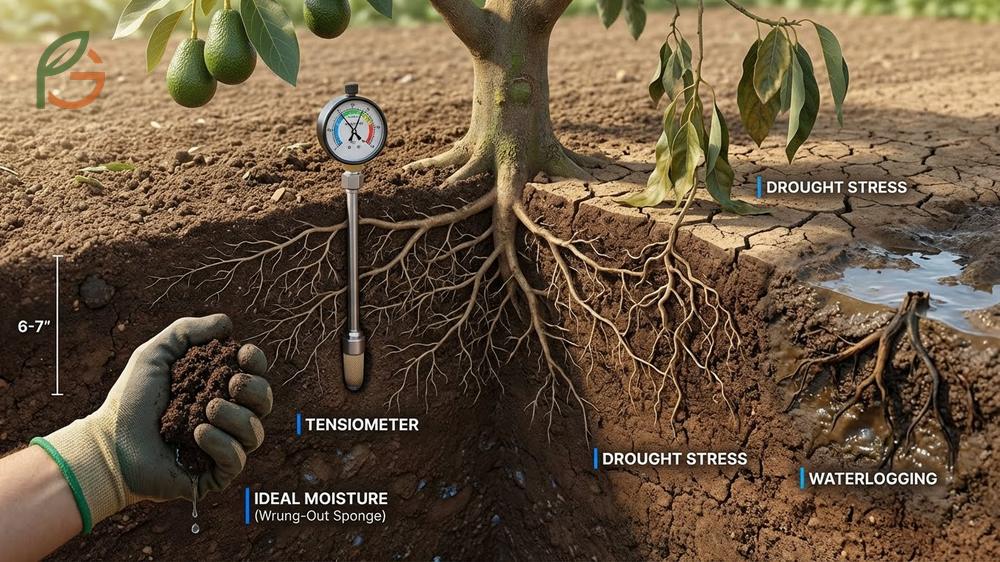
Avocado roots need consistent moisture in the top 6-7 inches where most feeder roots operate[4]. This shallow root system makes avocados particularly vulnerable to both drought stress and waterlogging compared to deep-rooted fruit trees. The soil should feel like a wrung-out sponge—moist to the touch but not dripping wet.
Professional growers use tensiometers or soil moisture sensors to maintain optimal conditions. Research from UC Cooperative Extension indicates that irrigation should begin when soil tension reaches about 20 centibars in typical San Diego hillside soils[8]. This represents roughly 30% moisture depletion from field capacity—the point where soil holds maximum water after drainage.
Home growers can gauge moisture without instruments using the squeeze test. Grab a handful of soil from 6 inches deep near the drip line. Squeeze it firmly in your palm. Properly moistened soil holds together showing your handprint, but breaks apart when poked. If water drips out, you’re overwatering. If it won’t form a ball at all, the soil is too dry.
Optimal Moisture Levels
The target moisture range keeps soil consistently damp but never saturated. Field capacity represents 100% of available water—this is too wet for avocados. Instead, aim to maintain soil between 60-80% of field capacity in the active root zone. When moisture drops to around 30% depletion (70% of field capacity), it’s time to irrigate again.
Root health depends on oxygen availability in soil pores. Saturated soil fills all pore spaces with water, suffocating roots within 24-48 hours. This triggers root rot—the primary killer of avocado trees in home landscapes. Proper moisture management means ensuring soil remains aerated even while adequately hydrated.
- Install tensiometers at 6-inch and 12-inch depths to track tension readings (irrigate at 15-25 centibars)
- Use a soil moisture probe or long screwdriver—it should penetrate 12 inches easily when moisture is adequate
- Check soil color and temperature—darker, cooler soil indicates better moisture retention
- Watch leaf symptoms—slight wilting at midday heat signals approaching water stress
- Dig a small test hole 6-8 inches deep weekly to visually assess moisture penetration patterns
- Note water application time—if it takes less than 30 minutes to apply your target volume, water may not be soaking deeply enough
Drip Irrigation Avocado
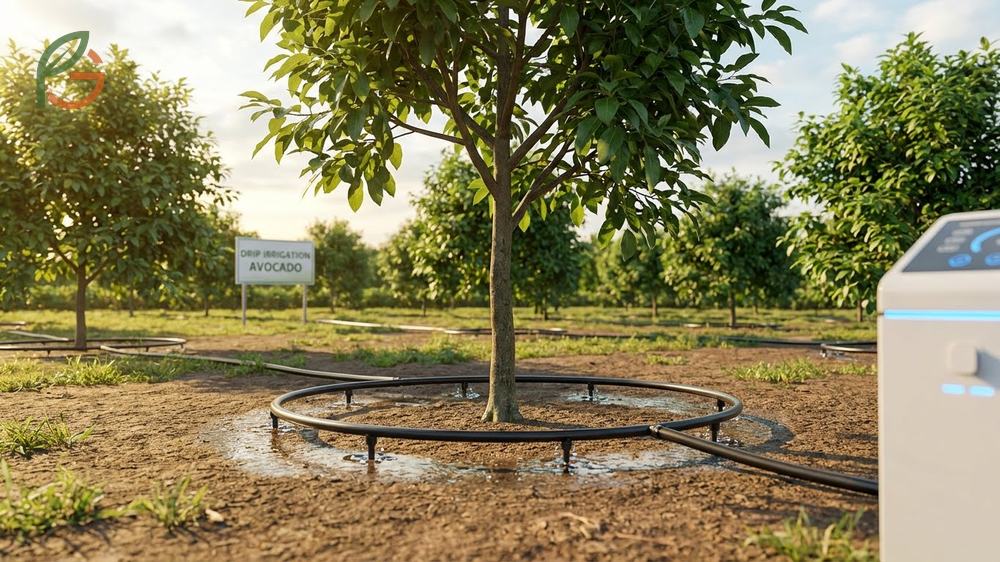
Drip irrigation systems deliver water directly to the root zone with up to 30-50% greater efficiency than sprinklers[9]. This method minimizes evaporation, reduces weed growth between trees, and keeps foliage dry—preventing fungal diseases that thrive on wet leaves. Most commercial avocado orchards worldwide have adopted drip systems as the irrigation standard.
For avocados, position drip emitters in a ring pattern 12-18 inches from the trunk for young trees, expanding to the drip line as the canopy grows. Use multiple emitters per tree rather than a single point source—this creates a broader wetted zone that encourages wider root spread. A mature tree typically needs 4-8 emitters spaced evenly around its root zone.
Irrigation frequency with drip systems typically runs every 2-3 days during moderate temperatures, increasing to every 1-2 days when heat exceeds 90°F (32°C)[10]. Run times depend on emitter flow rate—common 2 GPH (gallons per hour) emitters might run 3-4 hours to deliver adequate water, while 0.5 GPH emitters need proportionally longer operation.
Recent research from the California Avocado Commission reveals that many California growers have been overwatering, particularly during spring and fall. Updated crop coefficients show that avocados need approximately 10% less water than previously estimated—roughly 2.7 acre-feet per year rather than the old guideline of 3.0 acre-feet[11]. This translates to meaningful water and cost savings for home growers too.
- Reduces water consumption by 30-50% compared to sprinkler or flood irrigation methods
- Delivers nutrients directly to roots when combined with fertigation systems
- Minimizes fungal disease pressure by keeping leaves and trunk dry
- Allows automated watering schedules through simple battery-operated timers
- Performs effectively on slopes where sprinklers cause runoff problems
- Concentrates water in the active root zone rather than wasting it between trees
Installation Tip: When setting up drip irrigation, flush the system before connecting emitters. Run water through main lines for 2-3 minutes to clear debris that could clog emitters, then install drippers and flush again briefly.
Overwatering Avocado Signs
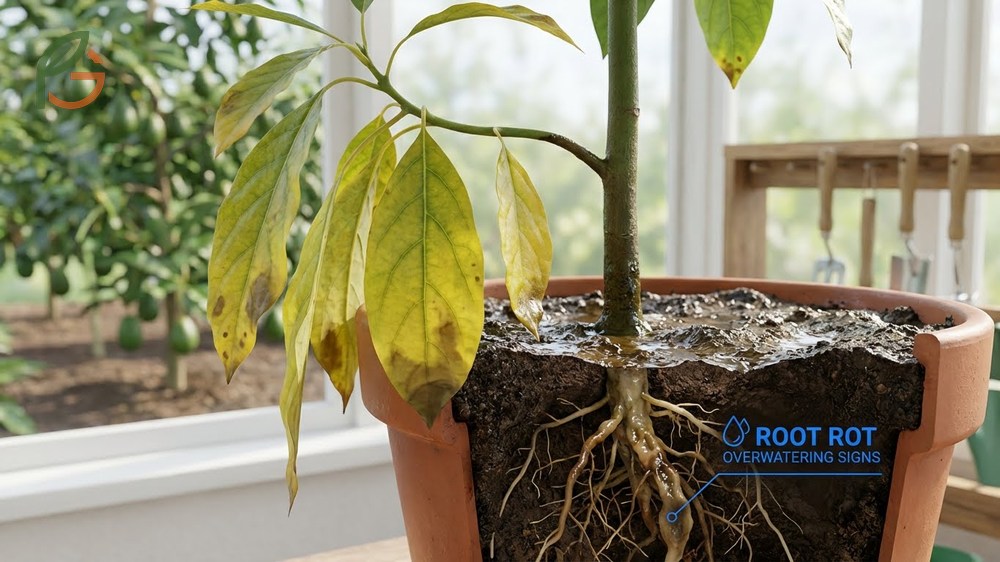
Avocado trees communicate water stress through distinct visual symptoms that appear before permanent damage occurs. Overwatering triggers yellowing leaves that typically start from the bottom of the canopy and progress upward[10]. These leaves feel soft and limp rather than crisp, often developing water-soaked spots that turn brown.
Root rot—caused by Phytophthora fungi that thrive in saturated soil—represents the most serious consequence of overwatering. Early root rot symptoms include wilting even when soil is wet, stunted new growth, and a general decline in tree vigor. If you gently excavate near the trunk, affected roots appear brown or black instead of healthy white or tan, with a mushy texture and sometimes a foul odor.
Additional overwatering indicators include fruit cracking or splitting, premature leaf drop, and fungal growth at the soil surface or trunk base. Trees may also show reduced fruit set in subsequent seasons as stressed root systems can’t support normal flowering cycles. The canopy often develops an overall yellowish-green cast rather than the deep green color of healthy avocado foliage.
In contrast, underwatering produces different symptoms. Leaves develop dry, crispy brown edges (tip burn) while maintaining their structure. Foliage may droop dramatically at midday but typically recovers overnight. Severely underwatered trees shed leaves to reduce water demand, but research shows they bounce back well from drought stress—unlike the often-fatal damage from chronic overwatering.
- Yellowing leaves starting from lower canopy, progressing upward with soft, limp texture
- Wilting foliage despite moist or wet soil conditions in the root zone
- Brown, mushy roots instead of firm white or tan roots when soil is excavated
- Premature leaf drop, particularly of older leaves during non-dormant periods
- Fruit splitting or cracking while still on the tree during development
- Fungal growth, mushrooms, or algae appearing on soil surface near trunk
- Soil that remains soggy or smells sour 24 hours after watering
- Stunted new growth with shortened internodes compared to previous seasons
Conclusion
The evidence is clear: successful how often to water avocado tree management balances consistent moisture with adequate soil aeration. Mature trees thrive on deep weekly watering delivering 20 gallons, while young trees need 2-3 sessions weekly until established. Current guidance emphasizes drip irrigation, soil moisture monitoring, and seasonal adjustments rather than rigid schedules—preventing the overwatering that kills more avocados than any other care mistake.
Agricultural research continues to refine water requirements, with recent California data showing that most growers can reduce irrigation by 10% without impacting yields. For home gardeners, this translates to lower water bills and healthier trees when you focus on soil moisture feedback rather than calendar-based watering. FruitGarden provides research-backed cultivation techniques that help both beginning and experienced growers produce thriving avocado trees through evidence-based care practices.
Frequently Asked Questions
How do I know when my avocado tree needs water?
Check soil moisture 6 inches deep near the drip line—it should feel barely moist but not wet. If soil is dry at this depth or won’t hold together when squeezed, it’s time to water. Mature trees typically need irrigation when soil reaches 20 centibars tension (30% moisture depletion), while slight midday leaf drooping also signals approaching water stress.
Can you overwater an avocado tree in summer?
Yes, overwatering remains possible even during hot weather if soil drainage is poor or irrigation frequency exceeds the tree’s uptake rate. Summer overwatering causes yellowing leaves, root rot, and fruit splitting despite high temperatures. Focus on deep, infrequent watering rather than daily light applications—most mature trees need water every 3-5 days in summer, not daily.
What’s the best time of day to water avocado trees?
Early morning (6-9 AM) provides optimal watering time for avocados. This timing minimizes evaporation losses, allows foliage to dry before nightfall (reducing fungal disease risk), and ensures water availability during the hottest part of the day when trees experience peak water demand. Avoid evening watering, which keeps soil and foliage wet overnight.
How much water does a 5-year-old avocado tree need?
A 5-year-old avocado tree typically needs 10-15 gallons per watering session, applied once or twice weekly depending on climate and soil type. Research shows that three-year-old trees require 30-50 liters daily (8-13 gallons), with needs increasing as trees mature toward the 20-gallon-per-day requirement of fully mature trees.
Should I water avocado trees in winter?
Winter irrigation depends on rainfall and temperatures in your region. Most US avocado-growing areas need supplemental water only once every 10-14 days during winter, or not at all if monthly rainfall exceeds 1 inch. Cold weather dramatically reduces transpiration rates—winter water needs typically drop 60-75% compared to summer consumption.
How deep should I water my avocado tree?
Water should penetrate 12-18 inches deep to reach the full active root zone of avocado trees. Since avocado roots concentrate in the top 20-60 cm (8-24 inches) of soil, deep watering encourages downward root growth and provides a moisture reserve during hot weather. Use a soil probe or long screwdriver to verify penetration depth after watering.
What are signs of underwatering in avocado trees?
Underwatered avocados develop dry, crispy brown leaf edges (tip burn), dramatic midday drooping that recovers overnight, and premature leaf shedding to reduce water demand. Severely stressed trees show stunted fruit development and may drop immature fruit. Unlike overwatering damage, research shows that avocado trees recover well from temporary drought stress once watering resumes.