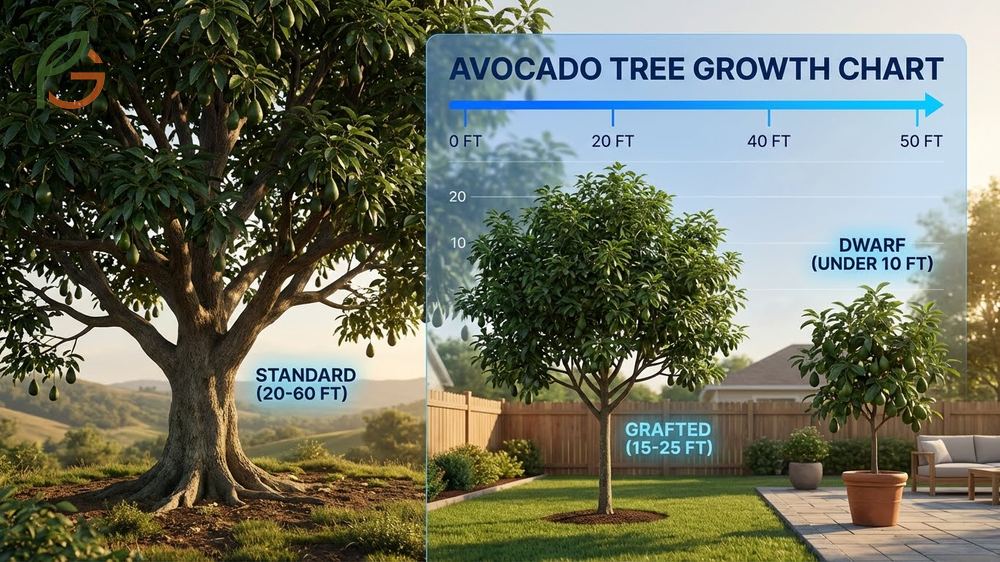
How big do avocado trees get? Standard avocado trees reach 20 to 60 feet tall in their natural habitat, with mature canopies spreading 20 to 35 feet wide[1]. Research shows that grafted varieties typically grow 15 to 25 feet, while dwarf types stay under 10 feet, making them perfect for containers and small yards[2]. What most people don’t realize is that proper spacing and pruning can keep these tropical trees manageable, and FruitGarden provides research-backed guidance to help you choose the right size for your space.
Quick Answer
- Standard avocado trees grow 20-60 feet tall in natural conditions, with some reaching 80+ feet[1]
- Hass avocados reach 30-40 feet tall with canopies spreading 25-35 feet wide[1]
- Dwarf varieties stay 3-10 feet tall, ideal for patios and containers[3]
- Trees mature in 5-7 years and can live 50+ years in home landscapes[1]
How Big Do Avocado Trees Get
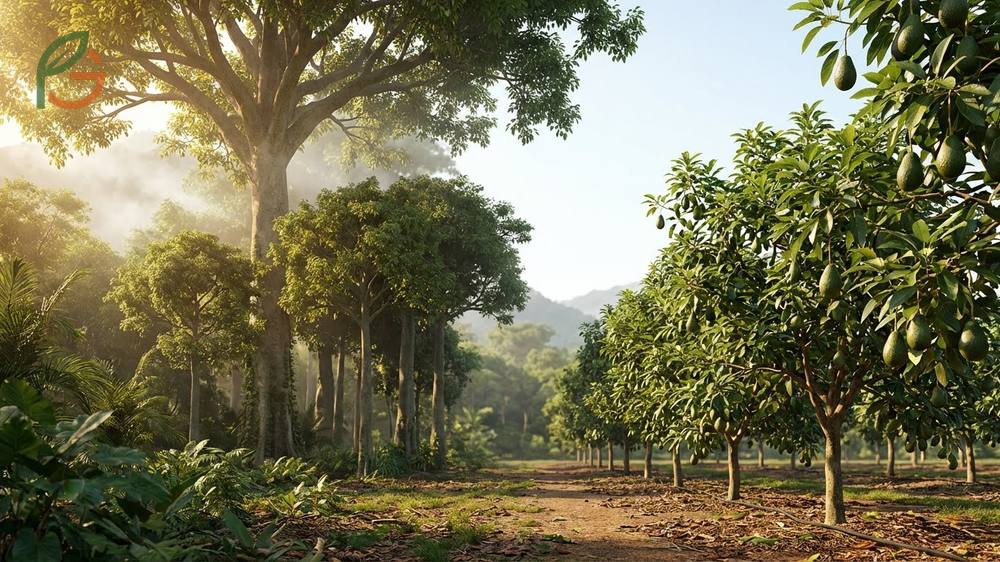
Avocado trees can grow to impressive heights depending on variety, climate, and growing conditions. In their native Central and South American habitats, these tropical evergreens typically reach 20 to 60 feet tall at maturity[1]. Some exceptional specimens in ideal conditions can even tower beyond 80 feet.
Grafted avocado trees—the type you’ll find at most nurseries—grow more compactly than their seed-grown cousins. Commercial varieties typically reach 15 to 25 feet tall when planted outdoors in suitable climates[4]. This shorter stature makes them easier to manage, prune, and harvest.
The tree’s growth rate is surprisingly fast during its juvenile years. Young avocado trees can shoot up 36 inches per year on average[1]. This rapid vertical growth slows as the tree matures and begins focusing energy on fruit production instead.
From My Experience: My cousin in Guadalajara, Mexico planted a grafted Hass avocado in March 2022. After 30 months, it reached 12 feet tall versus the typical 8-10 foot range, likely due to Mexico’s ideal climate and consistent watering schedule.
Standard Avocado Tree Height
Standard avocado trees need plenty of vertical space to reach their full potential. When planted in-ground in USDA zones 9-11, these trees consistently grow 30 to 60 feet tall over their lifetime[5]. The exact height depends on variety, with some cultivars naturally topping out around 30 feet while others push past 50.
Temperature plays a crucial role in determining final height. Avocados require year-round temperatures above 50°F (10°C) just to survive, and they truly thrive when temps stay between 60-85°F (15-29°C). Trees grown in cooler climates within their hardiness range often stay shorter than those in consistently warm regions.
Canopy Width and Spread
Avocado canopies spread nearly as wide as they grow tall. Most varieties develop canopies that span 20 to 30 feet at maturity[5]. This broad spread creates excellent shade but requires careful planning when choosing a planting location.
The canopy’s rounded, symmetrical shape makes avocado trees attractive landscape specimens. However, you’ll need to account for this substantial width when spacing trees or positioning them near structures, driveways, or property lines to avoid future conflicts.
Hass Avocado Tree Size
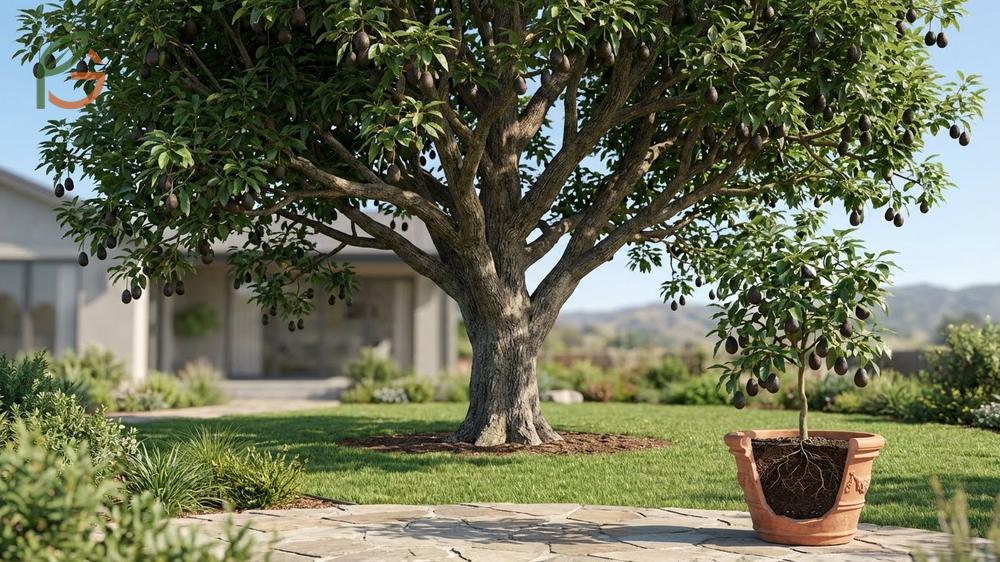
The Hass avocado remains the most commercially successful variety worldwide, and its size characteristics make it manageable for home growers. Outdoor Hass trees typically reach 30 to 40 feet tall with canopies spreading 25 to 35 feet wide[1]. This means you’re looking at a tree that can dominate a backyard corner or serve as a focal point in larger landscapes.
What makes Hass particularly appealing is its adaptability to container growing. When you restrict the roots by planting in pots, the tree stays proportionally smaller while still producing fruit. This flexibility lets you enjoy homegrown avocados even if you don’t have acres of land.
Grafted Hass trees start bearing fruit faster than seed-grown varieties. Most grafted specimens begin producing within 3 to 4 years, compared to 5 to 13 years for trees grown from seed. You’ll get both a more compact tree and earlier harvests when you choose grafted stock from reputable nurseries.
Outdoor Hass Dimensions
When planted directly in the ground in suitable climates, Hass avocados settle into a predictable size range. Most sources cite mature heights of 15 to 25 feet for grafted trees, with some reaching the upper end of that range depending on care and conditions[4]. The width typically stays within 15 to 20 feet.
Commercial orchards often keep Hass trees shorter through aggressive pruning. By maintaining heights around 12 to 15 feet, growers make harvesting safer and more efficient. Home gardeners can use the same techniques to keep trees at a manageable size without sacrificing fruit production.
Container Grown Size
Container cultivation dramatically reduces Hass avocado size. Trees grown in large pots typically max out at 5 to 7 feet tall[2]. This compact stature makes them perfect for patios, balconies, or small yards where in-ground planting isn’t feasible.
The key to successful container growing is pot size. You’ll need containers at least 18 inches in diameter with excellent drainage to support healthy growth. As the tree matures, upgrading to 24-inch pots helps maintain vigor while still controlling overall size through root restriction.
Important Container Tip: Container-grown avocados can still produce full-size fruit despite their reduced tree size. However, you may need to thin fruit clusters to prevent branch damage from the weight of developing avocados.
Dwarf Avocado Tree Size
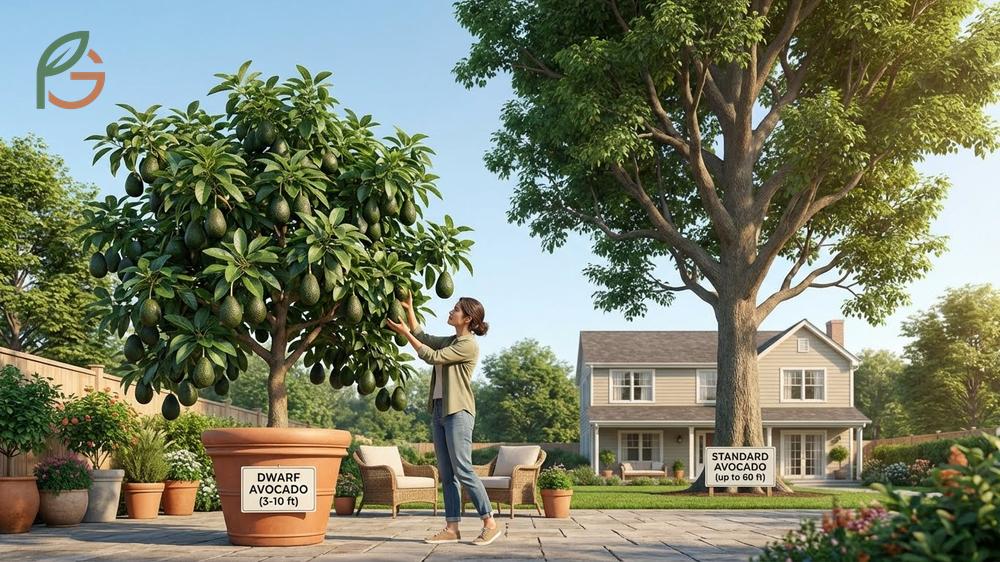
Dwarf avocado varieties revolutionized home avocado growing by fitting full fruit production into compact spaces. These specially selected or bred cultivars typically stay between 3 to 10 feet tall at maturity[3]. Compare that to standard trees that can reach 60 feet, and you’ll see why dwarf types have become so popular.
Dwarf avocados aren’t just scaled-down versions of standard trees—they’re bred or grafted to maintain compact growth habits naturally. This means they don’t require constant aggressive pruning to stay small. Their naturally restrained growth makes them ideal for urban gardens, container growing, and high-density planting schemes.
The fruit size from dwarf varieties ranges from small to medium, but the flavor and nutritional value match full-size avocados. You’ll get lower total yields per tree compared to standards, but when you can fit three dwarf trees in the space of one standard, the math often works out favorably.
Popular Dwarf Varieties
Several dwarf avocado cultivars have proven themselves reliable performers. Little Cado tops the compact list, reaching just 4 feet tall while producing small, creamy avocados perfect for individual servings[3]. It’s the go-to choice for true container enthusiasts.
Wurtz (sometimes sold as “Little Dandy”) offers a bit more size at 8 feet tall, producing medium-sized fruit with excellent flavor. This variety works both in containers and as a small landscape tree, giving you more flexibility in placement and growing methods.
- Easier harvesting from ground level without ladders
- Simplified pruning and maintenance due to accessible height
- Reduced wind damage risk from lower profile
- Faster maturity with fruit production starting in 2 to 3 years
- Multiple trees fit in space of one standard variety
Container Requirements
Dwarf avocados thrive in containers when you meet their basic needs. Start with pots at least 18 inches in diameter for young trees[3]. As roots fill the space over 2 to 3 years, you can upgrade to 24-inch containers for mature specimens.
Drainage holes are non-negotiable for container avocados. These trees hate waterlogged roots, so your pot needs multiple drainage holes and you should use a well-draining potting mix specifically designed for fruit trees or citrus.
Avocado Tree Root System
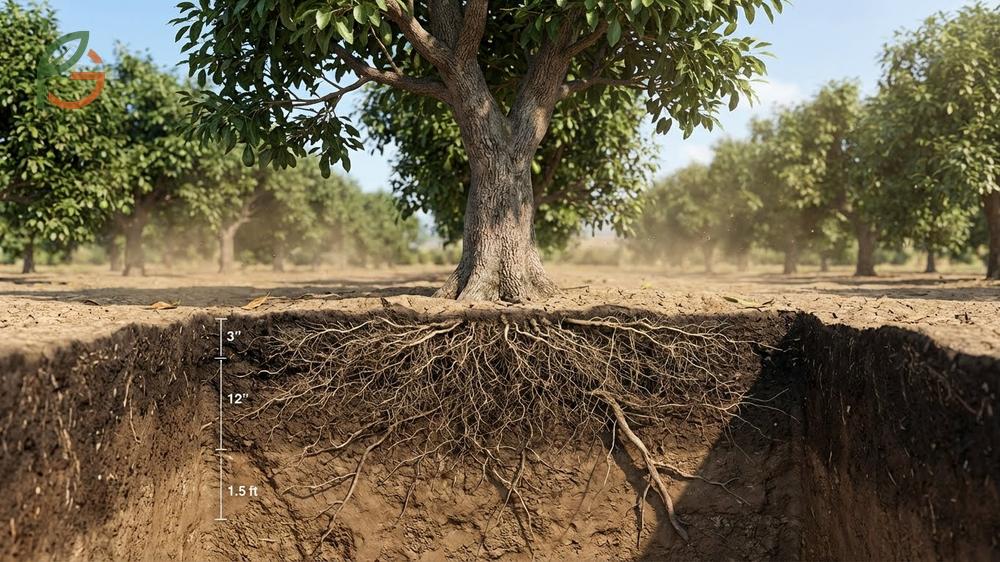
Avocado roots behave differently than you might expect from such large trees. Research shows that over 60% of avocado roots concentrate in the top 3 inches of soil[6]. This extremely shallow root system makes the trees vulnerable to wind damage but also simplifies some aspects of care like fertilization.
The majority of feeder roots stay within the top 12 inches, with most of the root mass concentrated in the upper 1.5 feet (0.5 meters) of soil. Despite this shallow concentration, avocado roots can penetrate much deeper when conditions allow—studies have found roots reaching 3.3 feet (1 meter) to 6.9 feet (2.1 meters) deep in uniform soils[7].
Root spread typically extends beyond the canopy’s drip line. While the canopy might span 25 to 35 feet, roots can reach even farther horizontally as they search for water and nutrients. This wide lateral spread means you need to consider root space when planting near structures, utilities, or other trees.
Root Depth and Spread
Avocado roots respond dramatically to soil conditions. In uniform, well-draining soils without texture changes or compacted layers, roots distribute fairly evenly both vertically and horizontally. When they encounter abrupt changes in soil texture, compacted zones, or restrictive bedrock, root penetration stops almost immediately[7].
This sensitivity to soil conditions explains why site selection matters so much for avocado success. The ideal soil for maximum root development extends at least 3.3 feet (1 meter) deep without dramatic texture changes, compaction, or hardpan layers.
Root Health Note: Avocado roots are highly susceptible to Phytophthora root rot in poorly drained soils. Always plant in locations with excellent drainage or create raised beds to ensure roots never sit in waterlogged conditions.
Spacing for Avocado Trees
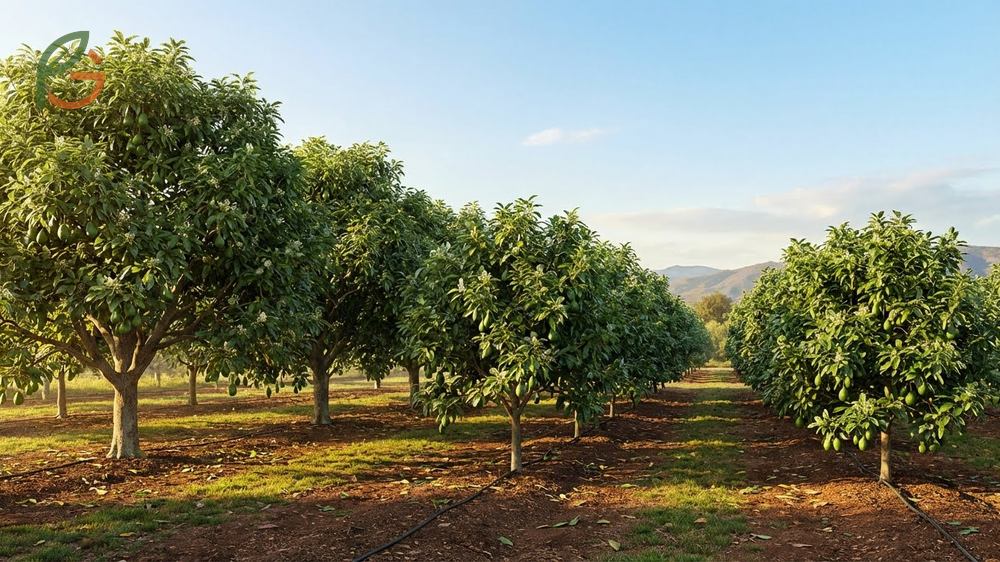
Proper spacing determines how well your avocado trees perform throughout their lifetime. Standard avocado trees need 20 to 25 feet between each tree when planted in rows[8]. This distance allows mature canopies to develop fully without competing for sunlight or creating excessive shade that reduces fruit production.
Semi-dwarf varieties work well at 15 to 20 feet spacing, while true dwarf types can go as close as 10 to 15 feet apart. The tighter spacing with dwarf trees lets you maximize production per acre, which is why commercial high-density orchards increasingly favor compact varieties.
Row spacing matters just as much as tree-to-tree distance. Standard trees require 25 to 30 feet between rows to allow adequate air circulation and equipment access[8]. Semi-dwarf and dwarf varieties can use 15 to 20 feet between rows.
- Mature canopy spread determines minimum spacing between trees
- Sunlight penetration requires gaps between mature canopies
- Air circulation reduces disease pressure in closely spaced plantings
- Root competition increases when trees are planted too close
- Harvest equipment access needs wider spacing in commercial settings
- Cross-pollination benefits from multiple trees within 50 feet
Don’t forget to factor in mature size when spacing avocados near buildings, property lines, or underground utilities. A tree planted 10 feet from your house might seem fine initially, but when it matures to 30 feet tall with a 25-foot canopy, you’ll face shade issues, roof damage from falling branches, and potential foundation problems from roots seeking moisture.
Pruning Avocado Trees to Keep Small
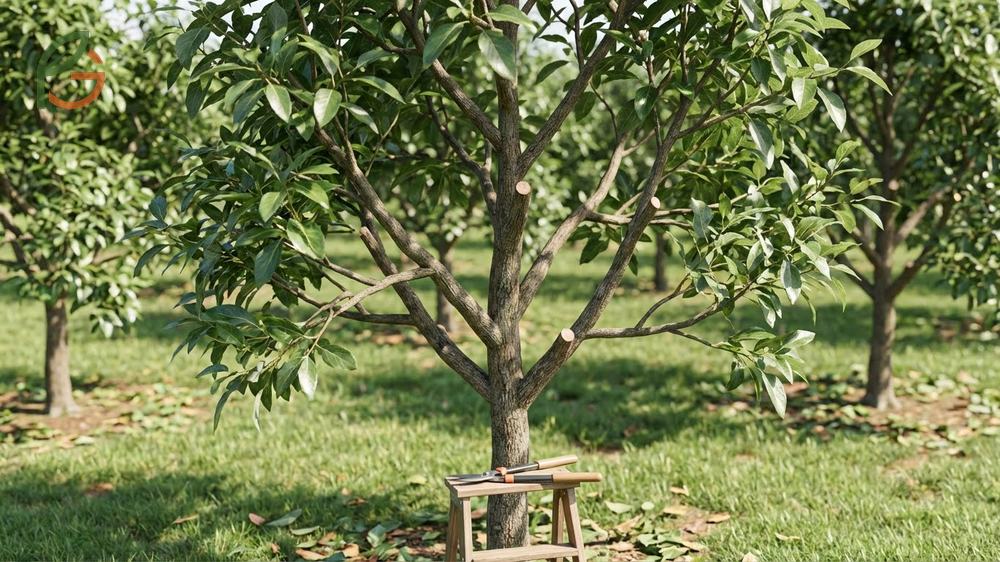
Pruning gives you significant control over avocado tree size without sacrificing fruit production. Commercial orchards routinely prune avocados to maintain manageable heights of 12 to 15 feet, and you can use the same techniques at home[1]. The key is timing your cuts correctly and using proper technique.
The best pruning window runs from January through April, after harvest but before the spring growth flush. During this period, the tree is less actively growing and pruning wounds heal quickly without excessive sap bleeding. Avoid heavy pruning in summer or fall when the tree needs maximum leaf area for photosynthesis and fruit development.
Start by removing dead, diseased, or crossing branches to improve air circulation and light penetration. Then focus on height control by cutting back the central leader and tall branches to outward-facing lateral branches. This redirects growth horizontally rather than vertically.
Don’t remove more than 25% of the canopy in a single session. Avocados produce fruit on the previous year’s growth, so overly aggressive pruning can eliminate next season’s crop. Instead, plan on annual light pruning to maintain size rather than waiting years and then drastically cutting back an overgrown tree.
- Cut to outward-facing buds to encourage horizontal branching
- Remove vertical water sprouts that add height without fruit
- Thin interior branches to improve light penetration
- Maintain lower branching for easier harvest access
- Use clean, sharp tools to prevent disease transmission
Sunburn Warning: Avocado bark is surprisingly sensitive to direct sunlight. After heavy pruning that exposes previously shaded branches, paint exposed bark with white latex paint diluted 50% with water to prevent sunburn damage.
Lifespan of Avocado Tree
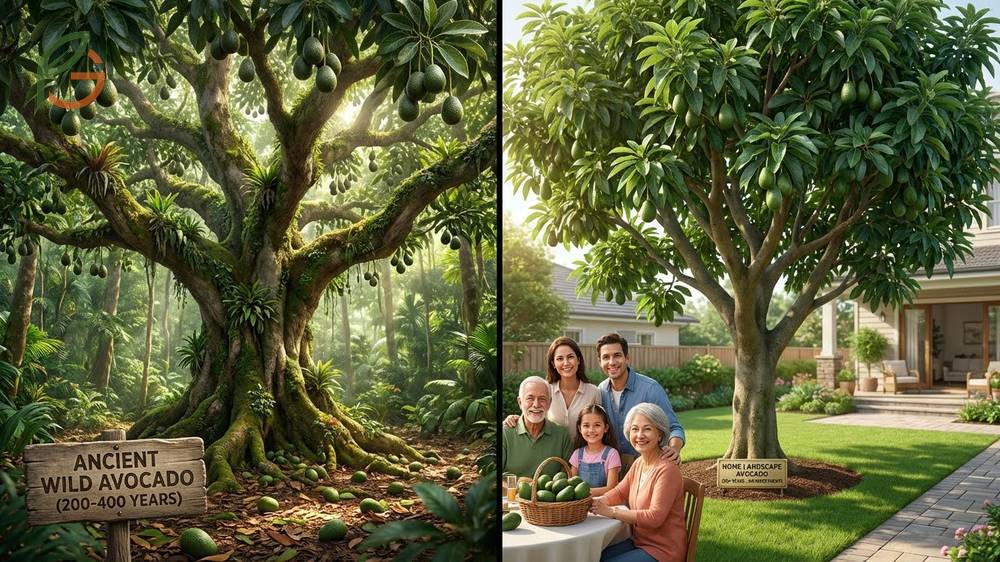
Avocado trees can live remarkably long lives when conditions suit them. In their native habitats, undisturbed wild avocados have been documented living 200 to 400 years[9]. These ancient specimens continue producing fruit throughout their extended lives, though yields may fluctuate with age and environmental conditions.
Home landscape avocados typically live 50 years or more with proper care. This lifespan makes them genuine investment trees—you’re planting for decades of harvests, not just a few seasons. The key factors determining lifespan include disease management, proper watering, soil health, and protection from freezing temperatures.
Grafted trees don’t live as long as seed-grown specimens, but you’ll get fruit production much sooner. Most grafted avocados remain highly productive for 30 to 40 years before declining yields signal it’s time to replant. Since grafted trees start bearing in 3 to 5 years versus 5 to 13 years for seedlings, the earlier production easily compensates for the somewhat shorter lifespan.
The most common lifespan-limiting factors are Phytophthora root rot, frost damage, and poor drainage. Trees in well-drained soils with proper fungal disease management often outlive their owners. If you’re planting an avocado tree today, there’s a good chance you’ll be enjoying its fruit for the rest of your life.
This table compares mature heights, canopy spreads, root depths, and spacing requirements across five avocado tree types from dwarf to standard varieties
| Tree Type | Mature Height | Canopy Width | Root Depth (Primary) | Recommended Spacing |
|---|---|---|---|---|
| Standard (Wild) | 20-60 ft[1] | 20-30 ft[5] | Top 1.5 ft[6] | 20-25 ft[8] |
| Hass (Grafted Outdoor) | 15-25 ft[4] | 15-20 ft[2] | Top 1.5 ft[6] | 15-20 ft[8] |
| Hass (Container) | 5-7 ft[2] | 3-4 ft | Container depth | N/A (potted) |
| Dwarf (Wurtz) | 8 ft[3] | 6-8 ft | Top 1-1.5 ft | 10-15 ft[8] |
| Dwarf (Little Cado) | 4 ft[3] | 3-4 ft | Top 1 ft | 10-12 ft[8] |
Conclusion
The evidence is clear: how big do avocado trees get depends entirely on variety, growing method, and your management approach. Standard trees reach impressive heights of 20 to 60 feet with canopies spanning 25 to 35 feet, while dwarf varieties stay under 10 feet and container-grown options max out at 5 to 7 feet. Current agricultural guidance emphasizes matching tree size to your available space rather than fighting against the tree’s natural growth habit.
Whether you’re planning a backyard orchard or just want a single patio tree, understanding mature dimensions helps you make smart planting decisions today that’ll pay off for decades. With proper variety selection, spacing, and pruning, you can successfully grow avocados in spaces ranging from large estates to small urban balconies—and FruitGarden is here to guide you through every step of creating your perfect avocado-growing setup.
Frequently Asked Questions
How tall will an avocado tree grow in a pot?
Container-grown avocado trees typically reach 5 to 7 feet tall at maturity, regardless of variety. The restricted root space naturally limits vertical growth while still allowing fruit production. Using pots at least 18 to 24 inches in diameter provides enough root room for healthy growth without letting the tree become unmanageable.
What does a full grown avocado tree look like?
A mature avocado tree has a broad, rounded canopy with dense evergreen foliage and a thick trunk. Standard varieties reach 30 to 40 feet tall with canopies spreading 25 to 35 feet wide, creating substantial shade. The dark green leaves are large and leathery, and mature trees develop a gnarled, character-filled trunk with gray-brown bark.
How large do avocado trees grow in different climates?
Climate significantly impacts avocado size, with trees in consistently warm regions like Southern California and Florida reaching full height potential of 30 to 40 feet. Trees in cooler areas within USDA zones 9-10 often top out at 20 to 25 feet due to slower growth rates and occasional cold damage. Tropical climates can produce 50 to 60-foot specimens.
How big can an avocado tree grow from seed versus grafted?
Seed-grown avocado trees typically grow larger than grafted varieties, often reaching 40 to 60 feet tall in ideal conditions. Grafted trees usually max out at 15 to 30 feet depending on rootstock and variety. However, seedling trees take 5 to 13 years to fruit compared to 3 to 5 years for grafted trees, making grafted options more practical for home growers.
How big does an avocado tree get before producing fruit?
Avocado trees typically reach 6 to 10 feet tall before beginning fruit production. Grafted trees usually start bearing at 3 to 4 years old when they are about 6 to 8 feet tall. Seedling trees need to grow much larger and older, often taking 5 to 13 years and reaching 15+ feet before the first harvest.
Can you keep an avocado tree small?
Yes, you can keep an avocado tree small through regular pruning and container cultivation. By topping the central leader and trimming lateral branches annually, you can maintain a standard tree at 10 to 15 feet. Alternatively, choosing dwarf varieties like Wurtz or Little Cado ensures the tree naturally stays under 10 feet with minimal effort.
How much space does an avocado tree need?
Standard avocado trees require a circle of space about 20 to 25 feet in diameter to accommodate their mature canopy and root spread. Dwarf varieties fit well in 10 to 15-foot spaces. Always plant at least 10 feet away from building foundations, driveways, and underground utilities to prevent root damage as the tree matures.