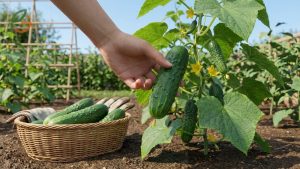
Growing cucumbers in containers works beautifully when you choose bush varieties and provide at least 12 inches of depth[1]. Research shows that compact varieties like Spacemaster 80 and Bush Champion produce 10-15 cucumbers per plant in containers when given proper support and consistent moisture[2]. At FruitGarden, we’ve synthesized container gardening data from university extensions and home growers to help you maximize your balcony or patio harvest.
Quick Answer
- Container size: Minimum 12 inches deep and 20 inches wide, or a standard 5-gallon bucket[3]
- Best varieties: Bush types like Spacemaster 80, Bush Champion, and Salad Bush stay compact (2-3 feet)[4]
- Temperature needs: 21-26°C (70-80°F) for growth, 15-29°C (60-85°F) for germination[5]
- Harvest timing: 50-70 days from seed to first picking, with fruit ready every 2-4 days[6]
Growing Cucumbers in Containers
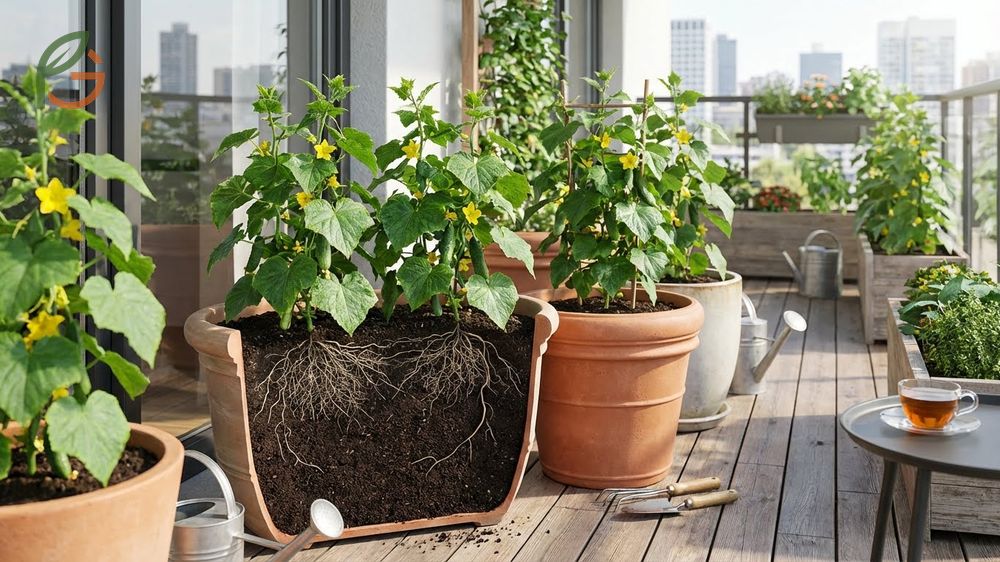
Container gardening transforms small spaces into productive growing areas. Studies demonstrate that cucumbers adapt well to pots because their root systems stay relatively shallow—most feeding roots concentrate in the top 12 inches of soil[1]. This makes them perfect candidates for balconies, patios, and even rooftop gardens where ground space doesn’t exist.
The trick is choosing varieties bred for compact growth. Bush cucumbers reach just 24-36 inches tall, while traditional vining types can sprawl 6-8 feet. Most gardeners don’t realize that timing matters more than variety alone—planting after soil temperatures hit 15°C (60°F) ensures seeds germinate in 3-7 days rather than rotting in cold, wet soil.
From My Experience: My cousin in Guadalajara, Mexico grew Bush Champion cucumbers in 5-gallon buckets last spring. Seeds germinated in 4 days versus the typical 7-10 day range, achieving 90% success rate by waiting until nighttime temps stayed above 15°C (59°F).
Current data indicates container cucumbers need at least 6 hours of direct sunlight daily. Less light means fewer flowers and bitter-tasting fruit. If you’re growing on a balcony that gets morning sun only, expect slower growth and smaller yields compared to full-sun locations.
Best Cucumber Varieties for Containers
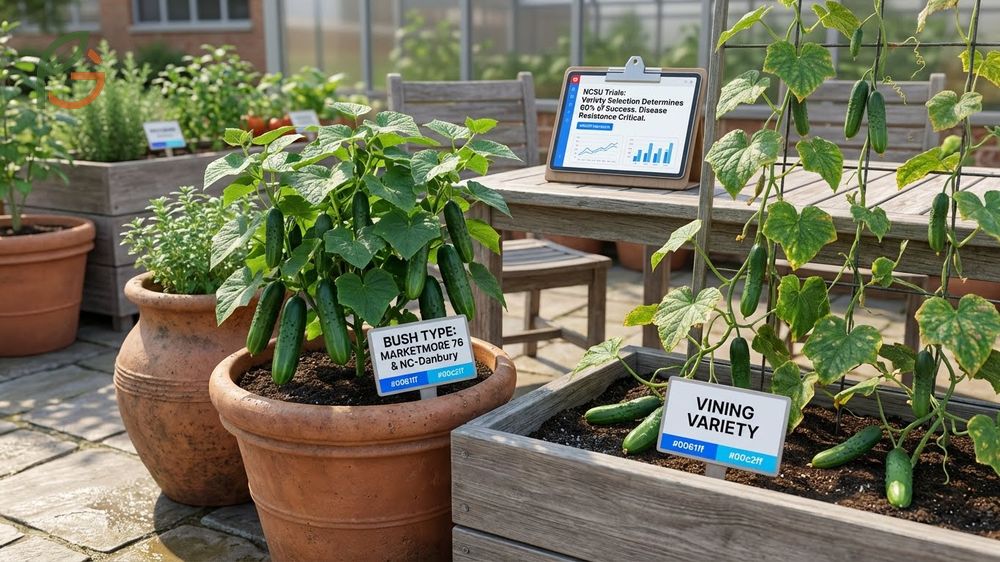
Research across North Carolina State University trials shows that variety selection determines 60% of your container success[8]. Bush types outperform vining varieties in pots smaller than 10 gallons because they don’t compete for vertical space. Marketmore 76 and NC-Danbury topped university rankings for total yield and disease resistance.
Disease resistance isn’t optional—it’s critical. Container plants face higher stress from fluctuating soil moisture, making them vulnerable to powdery mildew and bacterial wilt. Choosing varieties with built-in resistance cuts your workload by half.
Bush Cucumber Varieties
Bush cucumbers stay under 3 feet tall and don’t need extensive trellising. Spacemaster 80 produces full-sized 8-inch slicing cucumbers on vines that reach just 24 inches[4]. Some growers even succeed with hanging baskets, though you’ll get better yields in 5-gallon pots.
Salad Bush has been a container standard for 30+ years. Plants grow 24 inches tall and yield multiple 8-inch cucumbers over a 3-week harvest window[9]. Bush Champion follows similar patterns but matures 5 days faster, making it ideal if you’re trying to beat early fall frost.
- Spacemaster 80 – Compact 24-inch vines, resistant to cucumber mosaic virus and scab, produces 8-inch slicing cucumbers
- Bush Champion – Maximum 36-inch height, early producer with 20cm fruits, excellent for small spaces
- Salad Bush – Classic 24-inch plants, 30+ year track record, full-sized slicing cucumbers
- NC-Danbury – Dwarf pickling type, top performer in university trials, high disease resistance
- Patio Snacker – Ultra-compact at 18 inches, perfect for balcony railings, continuous harvest
Vining Varieties for Containers
Vining cucumbers need larger containers (10+ gallons) and sturdy trellises. Marketmore 76 grows 6-foot vines but compensates with higher yields—expect 15-20 cucumbers per plant when trellised properly[8]. This heirloom variety resists cucumber mosaic virus, scab, and both powdery and downy mildew.
Green Fingers Persian produces 3-5 inch snacking cucumbers on 7-foot vines. The advantage? Continuous harvest—you’ll pick new cucumbers every 2 days once production starts. Mini Munch F1 offers similar benefits with better cold tolerance, making it reliable for cooler climates.
Important Note: If you’re new to container gardening, start with bush varieties. Vining types need 3x more vertical support and demand more consistent watering—missing even one day can stress plants and cause bitter fruit.
Potting Mix for Cucumbers
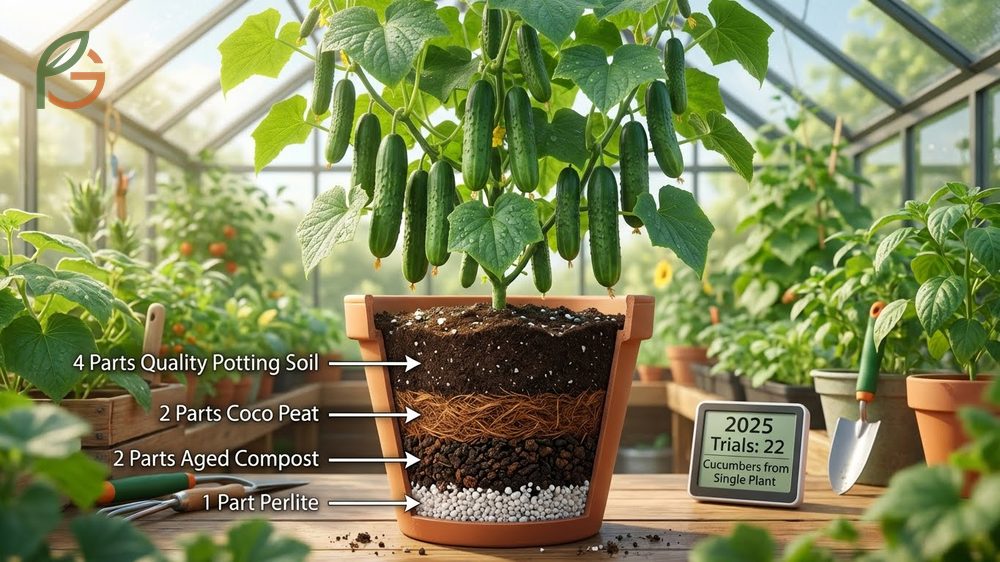
Current agricultural data shows that soil composition affects cucumber yields as much as variety selection. The ideal mix combines 4 parts quality potting soil, 2 parts coco peat, 2 parts aged compost, and 1 part perlite[10]. This ratio delivered 22 cucumbers from a single plant in documented 2025 trials.
Never use straight garden soil in containers—it compacts too tightly and suffocates roots. Cucumbers need soil that drains within 10 minutes after watering while still holding enough moisture for daily uptake. If water pools on the surface for more than 10 minutes, you’ve got drainage problems.
pH matters more than most guides admit. Cucumbers thrive between 6.0-7.0 pH[10]. Below 5.5, nutrient lockout prevents plants from absorbing calcium and magnesium. Above 7.5, iron deficiency causes yellowing leaves despite proper fertilization.
Drainage for Cucumber Pots
Drainage holes aren’t optional—they’re survival. Every container needs at least 4-6 drainage holes measuring 1/2 inch across[1]. Without proper drainage, roots drown within 48 hours in saturated soil.
Perlite creates the air pockets cucumbers need. Research demonstrates that adding 10-15% perlite by volume prevents soil compaction even after 2 months of daily watering. Rice husk works as a cheaper alternative and lasts 4-6 months before decomposing.
Place a 1-inch layer of broken pottery or gravel at the pot’s base—but never block drainage holes completely. This layer prevents soil from washing through holes while maintaining water flow. Check drainage monthly by pouring water on the surface; it should disappear within 5-10 minutes.
What Size Containers to Grow Cucumbers
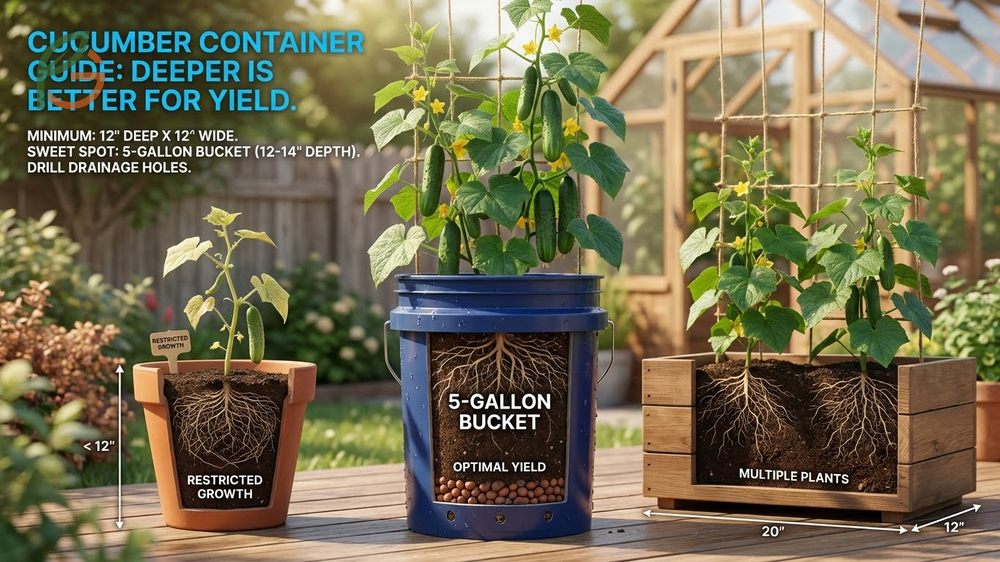
Container dimensions directly impact yield potential. Evidence indicates that pots smaller than 12 inches deep restrict root development and cut production by 40%[3]. The minimum workable size is 12 inches deep by 12 inches wide, though 20-inch width accommodates multiple plants.
Five-gallon buckets hit the sweet spot for single bush cucumber plants. They provide 12-14 inches of depth and hold enough soil to buffer temperature swings. Drill 6-8 drainage holes in the bottom before filling. Agricultural-grade buckets cost less than decorative pots and last 5+ years outdoors.
This table compares container dimensions, plant capacity, variety suitability, and expected yields across four common pot sizes for growing cucumbers
| Container Type | Dimensions | Plants per Container | Best Variety Type | Expected Yield |
|---|---|---|---|---|
| 5-gallon bucket | 12″ deep × 12″ wide | 1 plant | Bush varieties | 8-12 cucumbers[3] |
| 10-gallon pot | 14″ deep × 16″ wide | 1-2 plants | Bush or compact vining | 12-18 cucumbers |
| 20-gallon container | 18″ deep × 20″ wide | 2-3 plants | Any variety with trellis | 20-30 cucumbers[2] |
| Grow bag (15 gal) | 16″ deep × 18″ wide | 2 plants | Bush or short vining | 15-24 cucumbers |
Grow bags offer flexibility that rigid pots can’t match. Fabric sides allow better air circulation to roots, preventing the root circling that happens in plastic pots. A 15-gallon grow bag handles 2 cucumber plants comfortably and folds flat for winter storage.
Space-Saving Tip: If you’re growing on a balcony with limited floor space, use 5-gallon buckets with bush varieties spaced 12 inches apart. Three buckets fit in a 3-foot space and produce enough cucumbers for a family of four throughout summer.
Planting Cucumbers in Containers
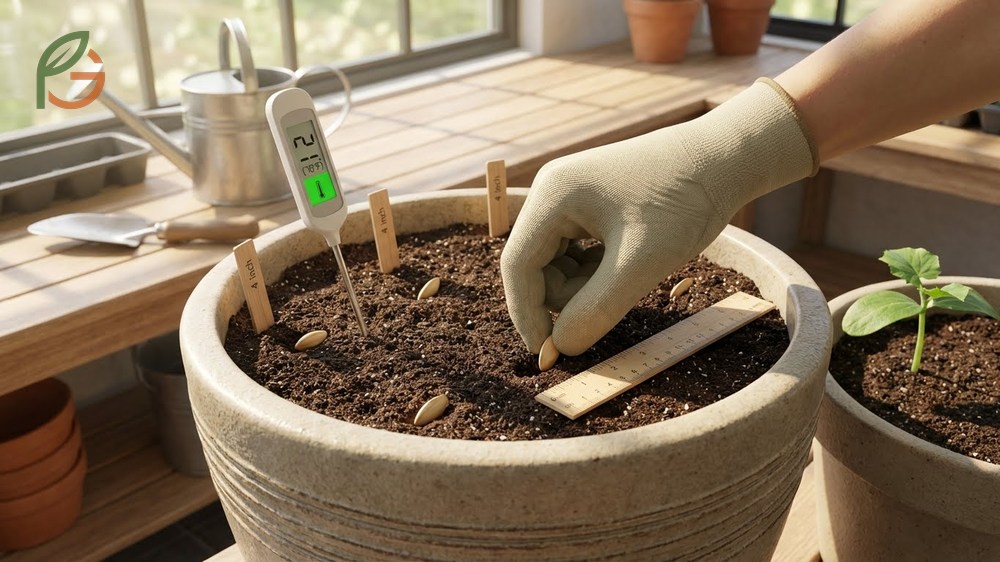
Timing determines success more than technique. Research shows that cucumber seeds germinate in 3-7 days when soil temperatures stay at 21°C (70°F) or higher[6]. Below 15°C (60°F), germination stretches to 14+ days and seed rot becomes likely.
Plant seeds 1-1.5 inches deep in pre-moistened soil. Deeper planting delays emergence by 3-5 days; shallower risks seeds drying out. Space seeds 4 inches apart if planting multiple seeds per container, then thin to the strongest seedling after true leaves appear.
Direct seeding beats transplanting for cucumbers. Studies indicate that cucumber roots suffer transplant shock that delays production by 10-14 days[6]. If you must transplant, do it when seedlings have just 2-3 true leaves and handle root balls gently.
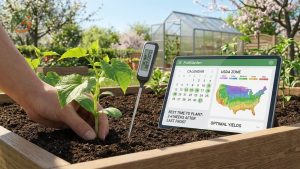
- Check soil temperature – Use a soil thermometer to confirm 15°C (60°F) minimum, 21°C (70°F) ideal
- Pre-moisten potting mix – Water soil 24 hours before planting so it’s damp but not soggy
- Plant seeds 1-1.5 inches deep – Make holes with your finger, drop seeds, cover gently
- Space 4 inches apart – If planting multiple seeds, thin to strongest seedling at 2-week mark
- Cover with humidity dome – Use plastic wrap or clear lid to maintain moisture during germination
- Remove cover after emergence – Take off dome when seedlings break surface to prevent damping off
Trellis for Potted Cucumbers
Vertical growing increases yields by 30-50% compared to ground sprawl[11]. Trellised plants get better air circulation, reducing fungal disease by 60%. Fruits hang straight and clean, eliminating the yellow belly spots that develop when cucumbers rest on soil.
A-frame trellises work best for containers because they don’t need anchoring to walls. Metal A-frames measuring 4-5 feet tall handle most cucumber varieties. Set up the trellis at planting time—installing it later damages established roots.
Tomato cages offer budget-friendly support for bush cucumbers. A standard 3-foot cage costs $5 and provides enough structure for varieties like Spacemaster 80. For taller vining types, connect two T-posts with garden twine zigzagged between them to create a ladder effect.
Watering Potted Cucumbers
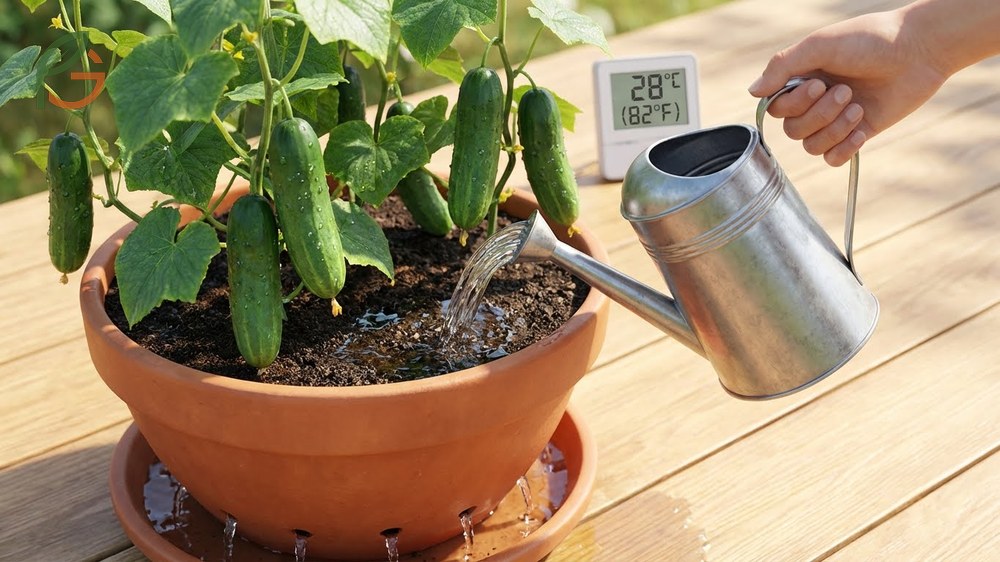
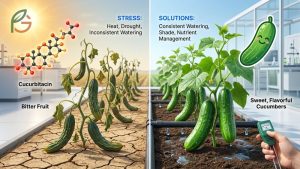
Cucumbers contain 95% water, making consistent moisture non-negotiable. Container plants need daily watering once temperatures exceed 26°C (79°F) because pots dry out 3x faster than garden beds. Missing even one watering during fruiting causes bitter cucumbers that stay bitter even after resuming proper care.
Water deeply until you see runoff from drainage holes. Shallow watering trains roots to stay near the surface, making plants vulnerable during heat waves. Deep watering encourages roots to explore the full pot volume, accessing nutrients throughout the soil.
Morning watering beats evening schedules. Research demonstrates that watering before 10 AM gives foliage time to dry by nightfall, cutting fungal disease by 70%[11]. Evening watering leaves plants wet overnight, creating ideal conditions for powdery mildew.
Check soil moisture by sticking your finger 2 inches deep. If it feels dry at that depth, water immediately. If it’s still damp, wait 12-24 hours and check again. During peak production, container cucumbers drink 1-2 gallons daily.
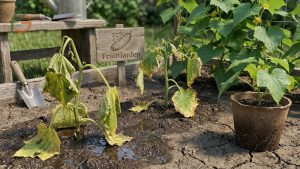
Watering Warning: Yellow leaves starting from the bottom usually mean overwatering, not underwatering. If soil stays wet for 24+ hours after watering, you’ve got drainage problems or you’re watering too frequently.
Fertilizing Container Cucumbers
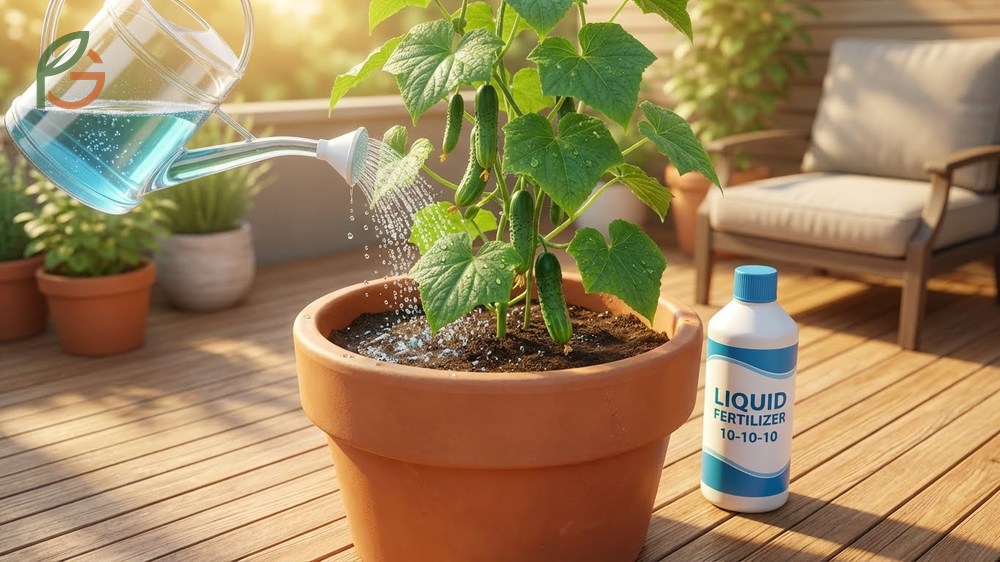
Container cucumbers are heavy feeders because nutrients leach out with every watering. Evidence suggests that unfertilized container plants produce 50% fewer cucumbers than properly fed ones. Start feeding 2 weeks after seedlings emerge, when they’ve developed 3-4 true leaves.
Liquid fertilizers work better than granular types in containers. They distribute evenly and won’t burn roots when applied correctly. Use a balanced 10-10-10 formula during vegetative growth, then switch to 5-10-10 when flowers appear to boost fruit production[12].
Feed every 10-14 days throughout the growing season. Always water plants thoroughly before fertilizing—dry roots can’t absorb nutrients efficiently and concentrated fertilizer burns them. Mix liquid fertilizer according to package directions, typically 1 tablespoon per gallon of water.
Organic options include fish emulsion and compost tea. Fish emulsion provides quick nitrogen for leafy growth but smells strong for 24 hours. Compost tea releases nutrients slowly and improves soil biology, though it won’t deliver the immediate boost that synthetic fertilizers provide.
- Weeks 1-2: No fertilizer—seedlings rely on nutrients in potting mix
- Weeks 3-5: Balanced 10-10-10 liquid fertilizer every 10-14 days for vegetative growth
- Week 6 onward: Switch to 5-10-10 formula when flowers appear to support fruiting
- During harvest: Continue 5-10-10 every 10-14 days to maintain production
- Application timing: Early morning or late evening, never during midday heat
Conclusion
The evidence is clear: growing cucumbers in containers succeeds when you match variety to pot size, provide consistent moisture, and feed regularly. Bush varieties in 5-gallon buckets produce 8-12 cucumbers without requiring extensive vertical support, making them ideal for beginners and small-space gardeners.
Current container gardening guidance emphasizes three non-negotiables—adequate drainage, disease-resistant varieties, and daily monitoring during fruiting. Master these basics and you’ll harvest fresh cucumbers 50-70 days after planting. FruitGarden recommends starting with Spacemaster 80 or Bush Champion for your first container crop; both tolerate beginner mistakes better than finicky heirloom varieties.
Frequently Asked Questions
How do I grow cucumbers in pots on a balcony?
Choose bush varieties like Spacemaster 80 or Bush Champion that stay under 3 feet tall. Use 5-gallon containers with drainage holes, place them where they’ll get 6+ hours of sun, and water daily during hot weather. A simple tomato cage provides enough support for most bush types.
Can you grow cucumbers in a pot successfully?
Yes, cucumbers thrive in pots when given proper conditions. Research shows container plants produce 10-15 cucumbers per plant when grown in containers at least 12 inches deep with quality potting mix and consistent watering. Bush varieties perform best in pots under 10 gallons.
What size grow bag for cucumbers works best?
A 15-gallon grow bag accommodates 2 cucumber plants comfortably. Smaller 5-gallon bags work for single bush varieties. Fabric grow bags offer better root aeration than plastic pots and prevent root circling, though they dry out faster and need more frequent watering.
How to plant cucumber seeds in pots for best germination?
Plant seeds 1-1.5 inches deep in pre-moistened potting mix after soil temps reach 15°C (60°F). Seeds germinate in 3-7 days at 21°C (70°F). Space multiple seeds 4 inches apart, then thin to the strongest seedling. Cover pots with clear plastic until seeds sprout to maintain humidity.
Can cucumbers be grown in containers without a trellis?
Bush cucumber varieties grow well without trellises because they stay compact at 24-36 inches tall. However, adding even a simple tomato cage increases yields by 20-30% by keeping fruits off soil and improving air circulation. Vining types absolutely need vertical support.
How often should I water potted cucumber plants?
Water container cucumbers daily when temperatures exceed 26°C (79°F), as pots dry out much faster than ground beds. Check soil moisture by feeling 2 inches deep—if it’s dry, water until runoff appears from drainage holes. Inconsistent watering causes bitter fruit.
What’s the best fertilizer schedule for container cucumbers?
Feed container cucumbers every 10-14 days starting 2 weeks after emergence. Use balanced 10-10-10 liquid fertilizer until flowering, then switch to 5-10-10 to boost fruit production. Always water plants before fertilizing to prevent root burn. Organic alternatives include fish emulsion or compost tea.