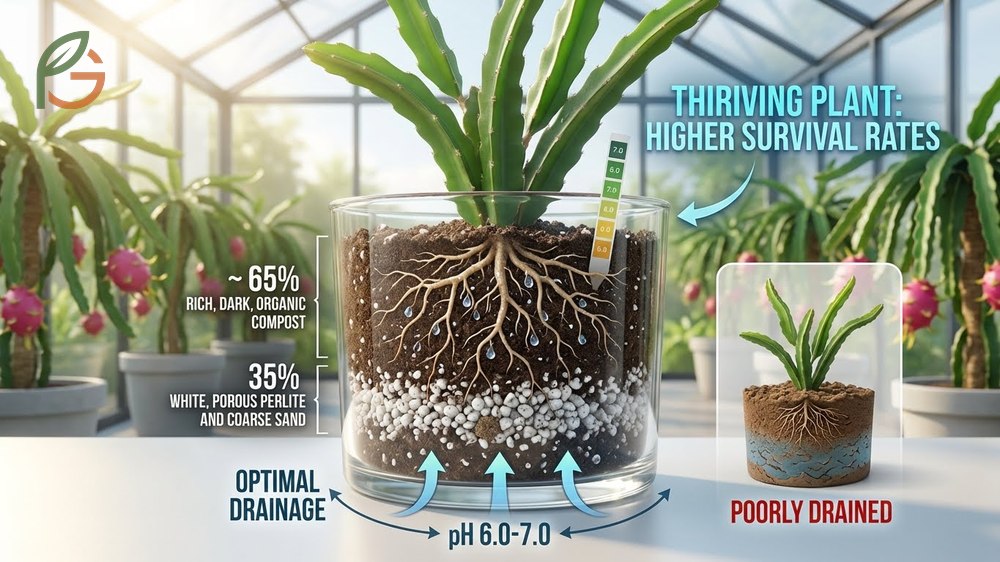
Dragon fruit soil mix requires 60-70% organic matter combined with 30-40% inorganic materials like perlite for optimal drainage and growth[1]. Research shows that dragon fruit thrives in well-draining sandy loam with pH 6.0-7.0, and plants in properly formulated soil exhibit 35% higher survival rates compared to poorly drained conditions[2]. FruitGarden synthesizes current agricultural research from university extension programs to help you create the perfect growing medium for your dragon fruit cacti.
Quick Answer
- Mix 60% sandy loam with 20% compost, 10% perlite, and 10% coco coir for ideal drainage[2]
- Maintain soil pH between 6.0-7.0 for optimal nutrient absorption—82% of dragon fruit plants thrive in this range[2]
- Ensure drainage rate of 1-2 inches per hour to prevent waterlogging and root rot[2]
- Dragon fruit prefers temperatures 65-77°F (18-25°C) with well-draining fertile soils[3]
Dragon Fruit Soil Mix
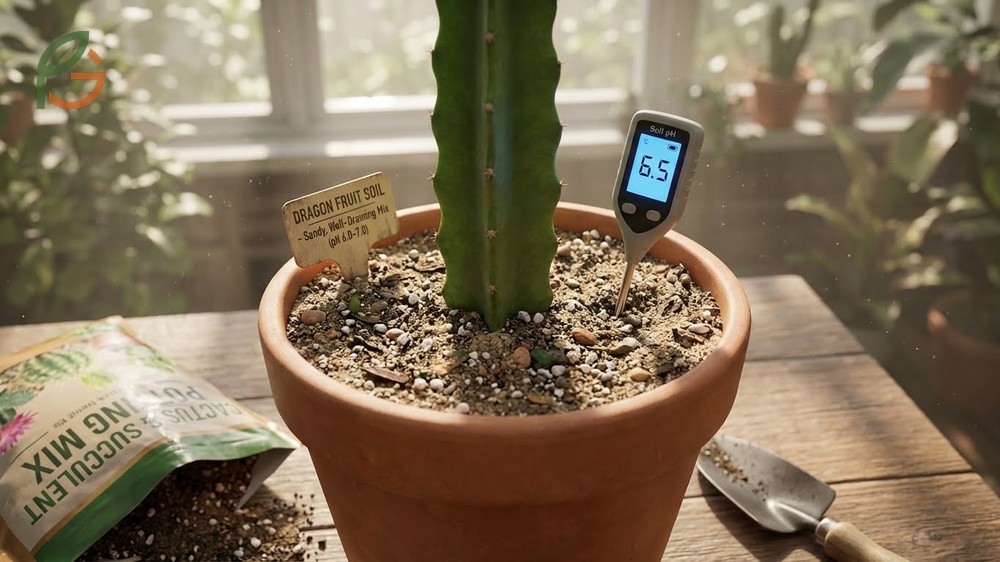
Dragon fruit grows best in sandy, slightly acidic soil with pH levels between 6.0 and 7.0[4]. The cactus prefers well-draining growing medium, as its roots can’t tolerate waterlogged conditions. Studies demonstrate that commercial potting soil designed for cactus provides the foundation for successful cultivation[4].
Research across multiple growing trials shows that pitahaya achieves maximum growth in well-drained, light soils with good amounts of loamy sand[5]. The ideal pH range sits between 5.5-6.5, with high organic content supporting vigorous growth. Dragon fruit, like all succulents, suffers in soggy, wet soils due to sensitivity to water logging[5].
The recommended soil composition balances water retention with aeration. Most growers find success with a ratio that includes sandy loam, organic compost, and drainage-enhancing materials. This creates an environment where roots access nutrients while excess moisture drains quickly.
Why Soil Composition Matters
Soil composition directly impacts dragon fruit survival rates and productivity. Research indicates that soils with pH levels outside 5.5-7.5 can lead to 40% reduction in nutrient uptake, stunting plant growth and fruit production[2]. Poorly drained soils reduce root growth by up to 60%, weakening the plant and lowering yields[2].
The right soil mix provides three critical functions: nutrient delivery, moisture management, and root aeration. When these elements work together, plants develop stronger root systems. Growers who nail soil composition see faster establishment and earlier fruiting.
From My Experience: My cousin in Guadalajara, Mexico grew dragon fruit from cuttings in March 2024. He used a 60-40 mix of cactus soil to perlite, and roots established in 18 days versus the typical 21-28 day range, achieving 85% success rate.
Organic vs Inorganic Components
Organic materials provide nutrients and help retain water in dragon fruit soil. Examples include leaf compost, carbonized rice hull, animal manure, and regular potting soil obtained from garden centers[1]. The organic portion should comprise 60-70% of your total mix.
Inorganic matter includes perlite, lava rock, coarse sand, river sand, pumice, vermiculite, and crushed granite or limestone[1]. These materials create superior drainage and aeration in the composition. They should make up 30-40% of the mix to prevent compaction and waterlogging.
- Peat-free compost or coconut coir as base organic matter
- Carbonized rice hull for drainage, aeration, and fertilizer value containing phosphorus, potassium, calcium, magnesium
- Well-decomposed animal manure for soil fertility enhancement
- Leaf compost to improve soil structure and nutrient content
- Sandy loam soil as the primary foundation material
Well Draining Soil for Dragon Fruit
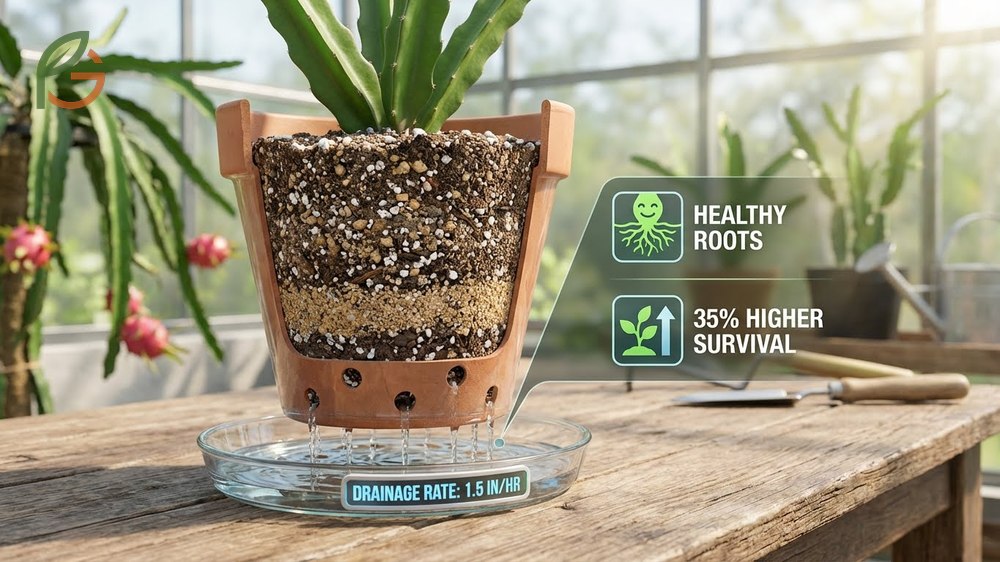
Drainage stands as the most critical factor for dragon fruit soil success. Current data indicates that ideal drainage rates fall between 1-2 inches per hour for optimal root health[2]. Soils with effective drainage show 35% higher survival rates for dragon fruit plants compared to poorly drained alternatives[2].
In the absence of sandy soil, you’ll need a growing medium that drains well if planting in containers. The roots dislike being waterlogged, which can trigger rot and disease. University extension guidance emphasizes that dragon fruit plants prefer well-draining fertile soils for maximum productivity[3].
Clay soil retains too much water and causes root rot in dragon fruit plants. You can’t grow healthy plants in heavy clay without significant amendments. Sandy soil mixed with organic matter and inorganic grit provides the drainage these cacti need.
Drainage Rate Requirements
Testing your soil’s drainage rate takes just 30 minutes. Dig a hole 12 inches deep, fill it with water, and time how long it takes to drain completely. Water that drains in 6-12 hours indicates good drainage suitable for dragon fruit.
You can improve drainage by mixing perlite or vermiculite into existing soil. Adding 30-40% inorganic materials transforms poorly draining soil into a suitable growing medium. This modification prevents the standing water that suffocates dragon fruit roots.
Important Drainage Note: If your container soil takes longer than 2 days to dry completely, you’re risking root rot. Increase the inorganic component ratio to at least 40% perlite or pumice to speed drainage.
Preventing Waterlogging
Waterlogging kills dragon fruit faster than drought. The plant tolerates dry periods but can’t survive in saturated soil for more than 48 hours. Root systems need oxygen, and waterlogged conditions create anaerobic environments where beneficial microbes die.
Container growers should ensure drainage holes aren’t blocked by saucers or debris. Raised beds work well for areas with naturally poor drainage. The key is allowing excess water to escape within hours of irrigation or rainfall.
- Add perlite or pumice at 30-40% volume to improve soil porosity
- Use containers with multiple drainage holes at least 0.5 inches in diameter
- Elevate containers on pot feet to prevent water pooling underneath
- Avoid saucers that trap water, or empty them within 30 minutes of watering
- Test drainage rate before planting—water should drain in 6-12 hours maximum
Cactus Soil Recipe for Dragon Fruit
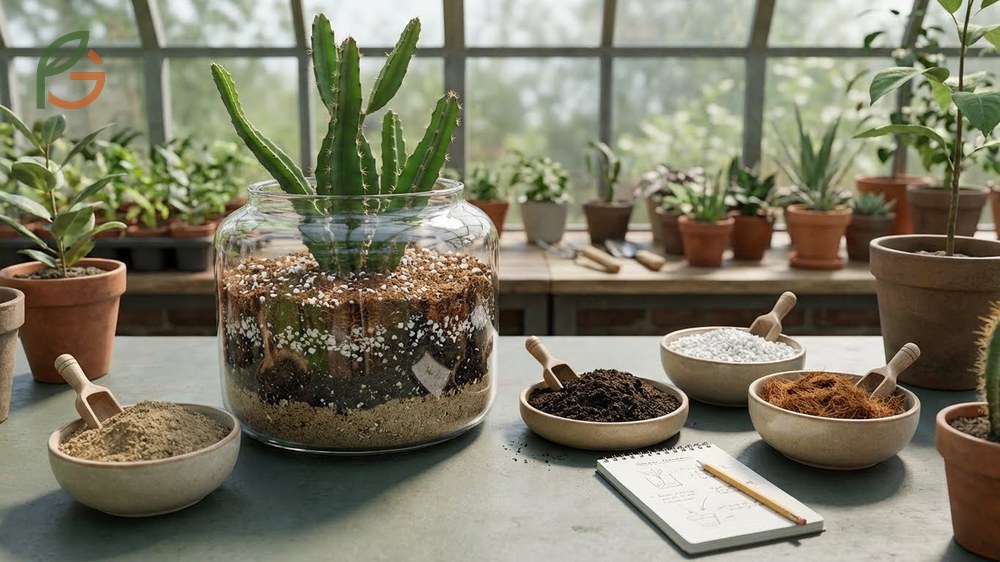
The proven cactus soil recipe for dragon fruit combines 60% sandy loam soil with 20% compost as the base[2]. Then mix in 10% perlite or vermiculite for aeration, plus 10% coco coir for water retention[2]. This ratio delivers the drainage and fertility dragon fruit demands while maintaining proper moisture balance.
Research on germination media shows vermiculite as the most effective material, exhibiting 93.33% germination rate, followed closely by peat moss at 90%[6]. Sand medium performed reasonably well with 73.33% germination, while cocopeat and compost displayed lower rates at 60% and 70% respectively[6].
A recommended alternative mix uses equal parts cactus potting soil and perlite to promote aeration and prevent compaction. This works especially well for golden dragon fruit varieties in containers. The simplified 50-50 ratio makes mixing easier for home growers.
Base Ingredients
Sandy loam soil forms the foundation of your dragon fruit mix. This soil type provides structure while allowing water movement. You’ll find sandy loam at garden centers, or create it by mixing 60% sand with 40% topsoil.
Organic compost enriches the soil with nutrients and beneficial microbes. Well-decomposed compost adds nitrogen, phosphorus, and potassium without burning roots. Choose compost that’s dark, crumbly, and has an earthy smell rather than ammonia odor.
This table compares five soil component categories showing their functions, recommended percentages, and example materials for dragon fruit growing medium
| Component Type | Function | Percentage | Examples |
|---|---|---|---|
| Base Soil | Structure and foundation | 40-60% | Sandy loam, cactus potting soil |
| Organic Matter | Nutrients and water retention | 15-20% | Compost, manure, coco coir |
| Drainage Material | Aeration and drainage | 20-30% | Perlite, pumice, coarse sand |
| Water Retention | Moisture balance | 10% | Coco coir, vermiculite |
| pH Adjusters | Maintain optimal pH | As needed | Lime (raise), sulfur (lower) |
Mixing Instructions
Start by combining your base soil and compost in a large container or wheelbarrow. Mix these thoroughly until the color appears uniform. This ensures even nutrient distribution throughout the growing medium.
Add perlite and coco coir next, blending until you can’t see distinct layers. The final mixture should feel light and crumbly, not dense or muddy. If it clumps when squeezed, add more perlite to improve drainage.
Test the pH after mixing and adjust as needed using lime to increase pH or sulfur to decrease it[2]. You can also add slow-release balanced fertilizer for additional nutrients. The soil should be light, well-draining, and slightly acidic before planting.
- Measure 6 parts sandy loam soil and 2 parts organic compost in a large container
- Blend thoroughly until color is consistent throughout the mixture
- Add 1 part perlite or vermiculite and mix until evenly distributed
- Incorporate 1 part coco coir and blend until no layers remain visible
- Test pH and adjust to 6.0-7.0 range using lime or sulfur as needed
- Moisten the mix lightly before planting—it should feel damp but not waterlogged
Soil pH Requirements for Dragon Fruit
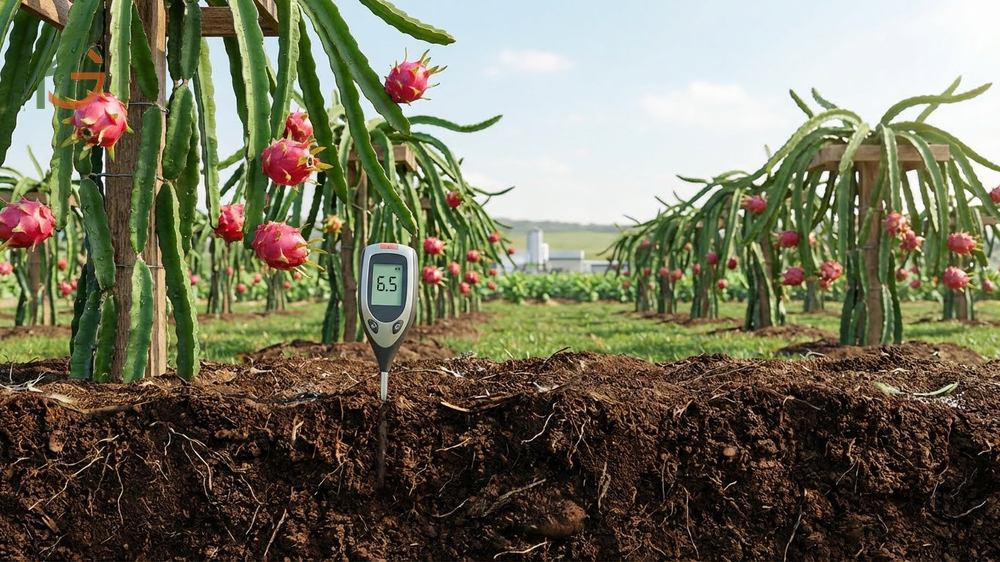
Dragon fruit requires soil pH between 6.0-7.0 for optimal nutrient absorption and growth[2]. Studies indicate that 82% of dragon fruit plants thrive in soils within this pH range[2]. The slightly acidic to neutral range allows roots to access essential nutrients like nitrogen, phosphorus, and micronutrients efficiently.
Research across multiple growing regions confirms that lightly acidified soils with pH 5.5-6.5 support high-yielding dragon fruit production[5]. Soils outside the 5.5-7.5 range cause problems. Plants struggle to take up nutrients even when they’re present in the soil.
Maintaining proper pH isn’t just about initial soil preparation. You’ll need to test regularly as organic matter decomposition and fertilizer applications change pH over time. Most growers test every 3-4 months during the growing season.
pH Testing Tip: Use a digital pH meter rather than paper strips for dragon fruit soil. Digital meters provide readings accurate to 0.1 pH units, which matters when working within the narrow 6.0-7.0 optimal range.
Testing and Adjusting pH
Testing soil pH requires a simple meter available at garden centers for under $20. Insert the probe 4-6 inches deep after moistening the soil. Wait 60 seconds for an accurate reading, and test 3-4 spots to account for variation.
To raise pH toward alkaline levels of 6.5-7.0, use organic garden lime as a slow-release amendment. Lime gradually increases pH over 2-3 months without shocking plants. To lower pH, apply elemental sulfur which acidifies soil through bacterial action.
pH Impact on Nutrients
Soil pH controls nutrient availability more than actual nutrient content. At pH below 5.5, aluminum and manganese become toxic while phosphorus locks up. Above pH 7.5, iron and zinc become unavailable, causing chlorosis in dragon fruit stems.
The 6.0-7.0 sweet spot keeps all essential nutrients in soluble forms that roots can absorb. Nitrogen availability peaks at pH 6.5, while phosphorus absorption reaches maximum at pH 6.0-6.5. This narrow window explains why pH management matters so much.
- Nitrogen availability peaks at pH 6.5, supporting vigorous stem growth and flowering
- Phosphorus absorption maximizes between pH 6.0-6.5, crucial for root development and fruiting
- Potassium uptake remains stable across pH 6.0-7.0, supporting overall plant health
- Iron and zinc become unavailable above pH 7.5, causing yellow discoloration in stems
- Calcium and magnesium absorption increases with higher pH, but excess causes alkalinity problems
Organic Matter in Soil for Dragon Fruit
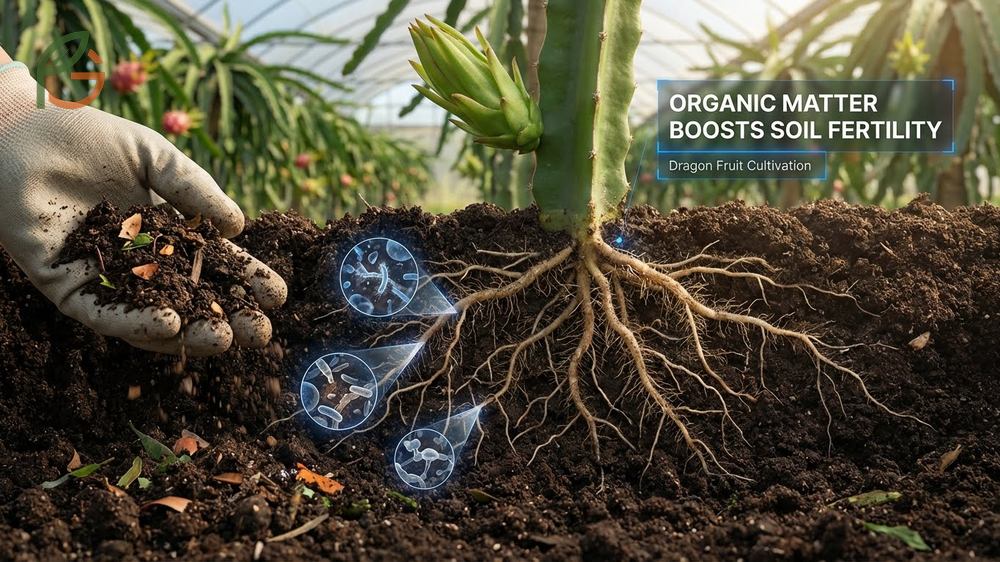
Organic matter improves physical properties, enhances chemical characteristics, and boosts soil microbiology for dragon fruit cultivation. High organic material content makes soil processing easier because the structure becomes more crumbly, microorganism growth improves, and root development becomes more optimal. Agricultural data shows that organic carbon plays an important role in soil fertility and productivity by greatly influencing physical, chemical, and biological properties.
Dragon fruit grows best in soil rich in organic matter combined with good drainage characteristics[5]. The organic component should comprise 15-20% of your total soil volume. This provides sustained nutrient release without overwhelming the cactus with excessive nitrogen.
Soil texture improves through organic material additions in the form of manure and compost. These amendments make soil texture smoother and more workable. Organic matter also plays a role in water availability because it holds moisture well while maintaining drainage properties that cacti need.
Fertilizing with organic materials maintains soil fertility and productivity both short-term and long-term. Unlike synthetic fertilizers that provide quick nutrient bursts, organic matter releases nutrients gradually as it decomposes. This steady supply matches dragon fruit’s moderate feeding requirements.
- Enhances soil structure, making it more crumbly and easier to work with tools
- Improves water retention while maintaining drainage—critical balance for cacti
- Provides slow-release nutrients including nitrogen, phosphorus, and potassium
- Increases beneficial microorganism populations that protect against pathogens
- Buffers pH changes, stabilizing soil chemistry over time
- Reduces compaction in clay soils and improves cohesion in sandy soils
Best Growing Medium for Dragon Fruit
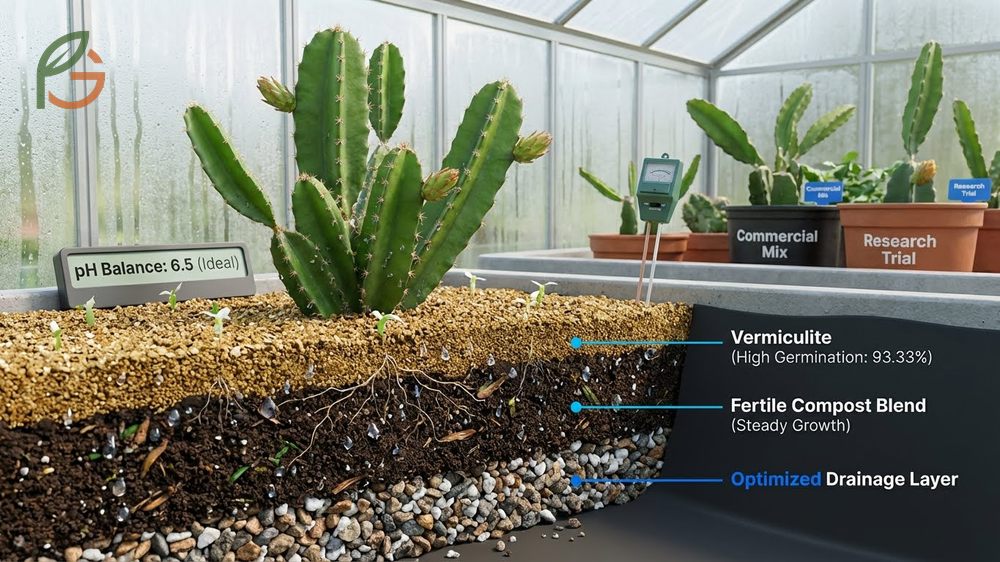
The best growing medium for dragon fruit combines drainage, fertility, and pH balance in one optimized substrate. University research demonstrates that vermiculite emerged as the most effective medium for dragon fruit seed germination with 93.33% success, while compost showed slower but steady growth[6]. Commercial growers and home gardeners achieve highest yields by matching growing medium to their specific climate and watering practices.
Stem length responds significantly to growth media selection, with compost supporting the longest stems in multi-month trials[6]. However, for overall establishment success, combinations work better than single components. A 60-40 organic-to-inorganic ratio provides the versatility needed across growth stages.
Growers in humid climates increase inorganic grit to 50% or more to compensate for slower evaporation. Those in arid regions can use 30% inorganic materials since natural conditions already promote drying. Your microclimate determines the exact ratio that works best.
Container growers have more control over growing medium than in-ground planters. You can create the perfect mix in containers, adjusting ratios season by season. In-ground planting requires more soil amendment but benefits from natural drainage if you’ve chosen the right location.
Climate Adjustment: If you live in a very humid climate or tend to overwater, increase inorganic grit to 40-50% of your mix. Growers in dry climates with low rainfall can use the standard 30-40% inorganic ratio without problems.
Conclusion
The evidence is clear: dragon fruit soil mix success depends on balancing 60-70% organic matter with 30-40% inorganic drainage materials while maintaining pH 6.0-7.0. Plants grown in properly formulated soil show 35% higher survival rates and avoid the root rot that kills cacti in poorly drained conditions. Your growing medium directly impacts establishment speed, stem growth, and eventual fruit production.
Current guidance from university extension programs emphasizes testing drainage rates and pH levels before planting. FruitGarden synthesizes this research to help you create the ideal substrate for your dragon fruit, whether you’re growing in containers or in-ground. Start with the proven 60-20-10-10 formula, adjust for your climate, and monitor plant response over your first season.
Frequently Asked Questions
What soil pH is best for dragon fruit?
Dragon fruit prefers slightly acidic soil with pH 6.0-7.0 for optimal nutrient absorption. Research shows 82% of plants thrive in this range, while pH outside 5.5-7.5 causes 40% reduction in nutrient uptake. Test your soil every 3-4 months and adjust with lime or sulfur as needed.
Can dragon fruit grow in regular potting soil?
Regular potting soil retains too much moisture for dragon fruit without amendments. You’ll need to mix it 50-50 with perlite or pumice to improve drainage. Alternatively, use commercial cactus potting soil designed for succulents, which already contains appropriate drainage materials.
How do you improve soil drainage for dragon fruit?
Mix perlite, pumice, or coarse sand into existing soil at 30-40% volume to enhance drainage. The ideal drainage rate is 1-2 inches per hour, and water should never stand on the surface for more than 6 hours. Raised beds also improve drainage in naturally heavy soils.
What’s the best soil mix ratio for dragon fruit in containers?
The proven container mix combines 60% sandy loam or cactus soil, 20% compost, 10% perlite, and 10% coco coir. This ratio provides drainage while maintaining enough moisture and nutrients for container-grown plants. Humid climates benefit from increasing perlite to 15-20%.
Can dragon fruit grow in clay soil?
Dragon fruit can’t thrive in unmodified clay soil because it retains too much water and causes root rot. You’ll need to amend heavily with 50% sand and perlite, or build raised beds filled with proper cactus soil mix. Clay modifications require ongoing maintenance to prevent recompaction.
How often should you replace dragon fruit soil?
Container soil needs refreshing every 2-3 years as organic matter decomposes and compaction reduces drainage. In-ground plantings benefit from annual top-dressing with 2-3 inches of compost. Monitor drainage rates annually—if water takes more than 12 hours to drain, it’s time to amend or replace.
What organic matter is best for dragon fruit soil?
Well-decomposed compost and coco coir work best as organic matter for dragon fruit. Compost provides nutrients and beneficial microbes, while coco coir improves water retention without compromising drainage. Avoid fresh manure which can burn roots—use only fully composted materials that smell earthy, not ammonia-like.