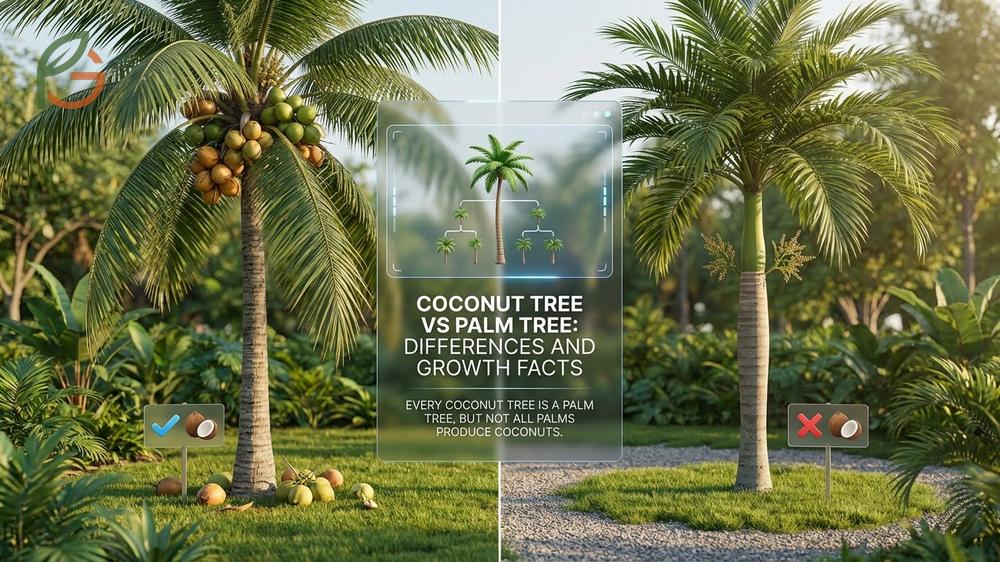
Coconut tree vs palm tree: Every coconut tree is a palm tree, but not all palms produce coconuts. Research shows the palm family (Arecaceae) contains approximately 2,600 species[1] across 181 genera, yet only one species—Cocos nucifera—bears coconuts. Understanding this distinction helps gardeners choose the right palm for their landscape and climate needs. FruitGarden synthesizes current botanical research and cultivation data to guide your palm selection decisions.
Quick Answer
- The coconut palm (Cocos nucifera) is one species among 2,600 palm types[1] in the Arecaceae family
- Coconut palms grow 50-100 feet tall[2] and require USDA zones 10B-11 with temperatures above 64°F (18°C)
- Most palm trees—like date palms, fan palms, and royal palms—don’t produce coconuts but offer different fruits or no fruit at all
- Coconut palms take 6-8 years[3] to bear fruit and live 60-100 years under optimal conditions
Coconut Tree vs Palm Tree: The Core Difference
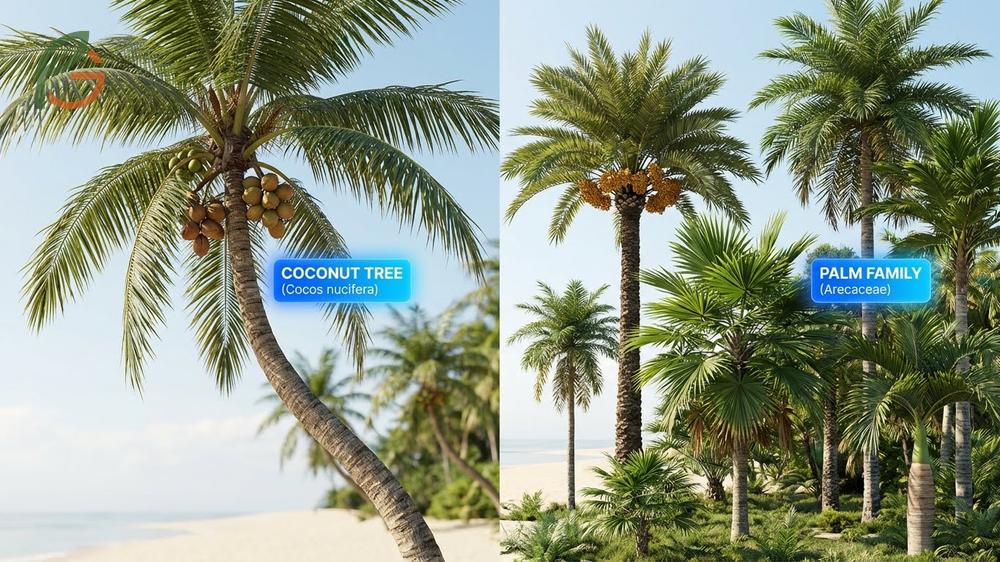
The coconut palm (Cocos nucifera) represents a single species within the diverse Arecaceae family[4]. Think of it this way: all coconut trees are palm trees, but calling every palm a coconut tree would be like calling every dog a golden retriever. The palm family includes roughly 2,600 species spanning 181 genera, from towering date palms to compact fan palms[1].
Most people don’t realize that coconut palms originated in the Indo-Pacific region and spread across tropical coastlines worldwide. What sets them apart isn’t just the fruit—it’s their salt tolerance, coastal adaptation, and economic significance as one of the tropics’ most valuable crops[4].
Botanical Classification
The scientific name Cocos nucifera identifies the coconut palm as the only living species in the genus Cocos[4]. This single-species genus contrasts sharply with other palm genera like Phoenix (date palms), which contain 12-19 species. The family name Arecaceae (sometimes called Palmae) unites all palms through shared characteristics: unbranched stems, large compound leaves arranged at the crown, and flowers in groups of three.
Botanists classify palms into five subfamilies based on leaf structure, flower arrangement, and fruit characteristics. Coconut palms belong to the Arecoideae subfamily, the largest group containing over 100 genera with pinnate (feather-like) leaves[1].
Identifying Coconut Palm Features
Spotting a coconut palm among other palms gets easier when you know the telltale signs. These palms grow 50-100 feet tall with a distinctive curved, gray trunk that’s swollen at the base[2]. The trunk rarely grows straight—that characteristic lean comes from the palm’s adaptation to coastal winds.
The crown features 15-20 foot long pinnate fronds that arch downward gracefully. Unlike fan palms with circular, segmented leaves, coconut palm fronds have leaflets arranged along both sides of a central stem. The coconuts themselves cluster in groups of 10-20, visible year-round since the palm flowers and fruits continuously in tropical climates.
- Single, unbranched trunk with light gray bark and visible leaf scars
- Pinnate fronds 15-20 feet long with downward-arching form
- Large fruits (coconuts) in clusters, 10-12 inches long when mature
- Trunk diameter of 12-18 inches, often curved rather than straight
- Smooth trunk surface without the rough fiber coating seen on some palms
Important Note: Don’t plant coconut palms near buildings, walkways, or parking areas. Falling coconuts from mature trees can weigh 3-4 pounds and cause serious injury or property damage.
Do All Palm Trees Have Coconuts?
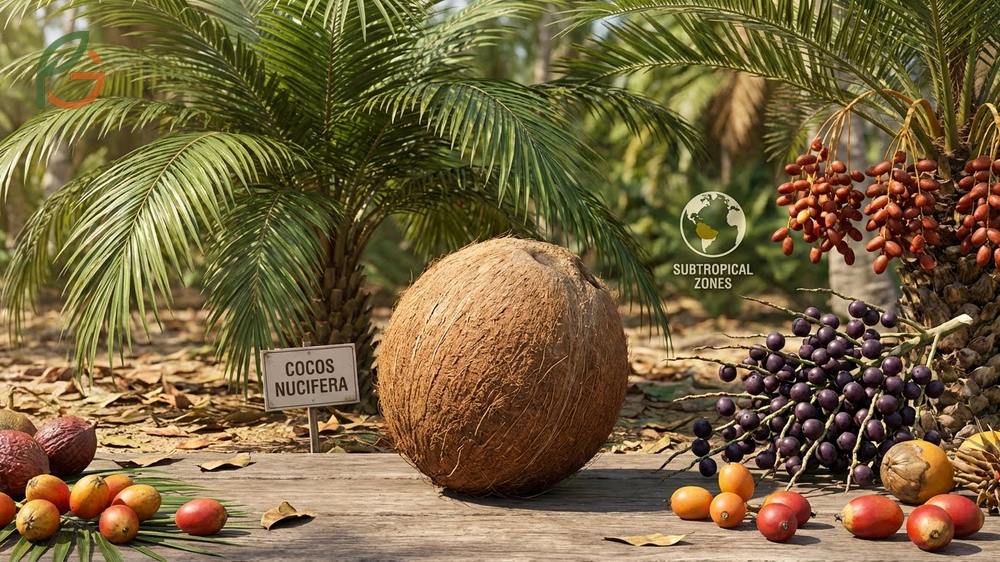
No—only Cocos nucifera produces coconuts. The vast majority of the 2,600 palm species either produce different fruits or no fruit at all. This surprises many people who assume the iconic coconut defines the entire palm family. In reality, palms exhibit remarkable fruit diversity, from dates and açaí berries to inedible ornamental drupes.
Current botanical surveys show approximately 130 palm species grow naturally outside the tropics, primarily in subtropical zones[1]. These temperate-adapted palms never produce coconuts because they belong to entirely different genera with distinct evolutionary histories and fruit types.
From My Experience: My cousin in Guadalajara, Mexico planted three Mexican fan palms (Washingtonia robusta) in 2019 expecting coconuts. After two years with no fruit, he learned these palms produce only tiny black berries—not edible coconuts. He’s since replaced one with a true dwarf coconut variety suitable for his USDA zone 10 climate.
Other Fruit-Bearing Palms
Several palm genera produce economically important fruits that rival coconuts in global trade. Date palms (Phoenix dactylifera) cultivated across North Africa and the Middle East yield sweet dates used in countless culinary applications. Açaí palms (Euterpe oleracea) native to South America produce small purple berries that’ve become a superfood staple in Western markets.
Oil palms (Elaeis guineensis) generate more vegetable oil than any other crop, though their small red fruits look nothing like coconuts. Betel nut palms (Areca catechu) provide stimulant seeds chewed by millions in Asia. Peach palms (Bactris gasipaes) offer starchy fruits popular in Central and South American cuisine.
Non-Fruiting Palm Species
Many ornamental palms grown in US landscapes don’t produce edible fruits. Royal palms (Roystonea regia) develop small purple drupes that birds eat but humans don’t. Queen palms (Syagrus romanzoffiana) bear orange fruits that create messy cleanups without culinary value. Sago palms aren’t true palms at all—they’re cycads with toxic seeds.
Fan palms like California fan palm (Washingtonia filifera) and European fan palm (Chamaerops humilis) produce berry-like fruits that wildlife consumes but offer no commercial harvest potential. These species evolved for different ecological niches than coconut palms, prioritizing drought tolerance or cold hardiness over fruit production.
- Royal palm (Roystonea regia) – tall ornamental with small inedible fruits
- Queen palm (Syagrus romanzoffiana) – produces messy orange drupes
- Mexican fan palm (Washingtonia robusta) – fast-growing with tiny black berries
- Pindo palm (Butia capitata) – cold-hardy with edible but tart fruits
- Foxtail palm (Wodyetia bifurcata) – ornamental with red inedible fruits
- Triangle palm (Dypsis decaryi) – architectural form with small fruits
Types of Coconut Trees
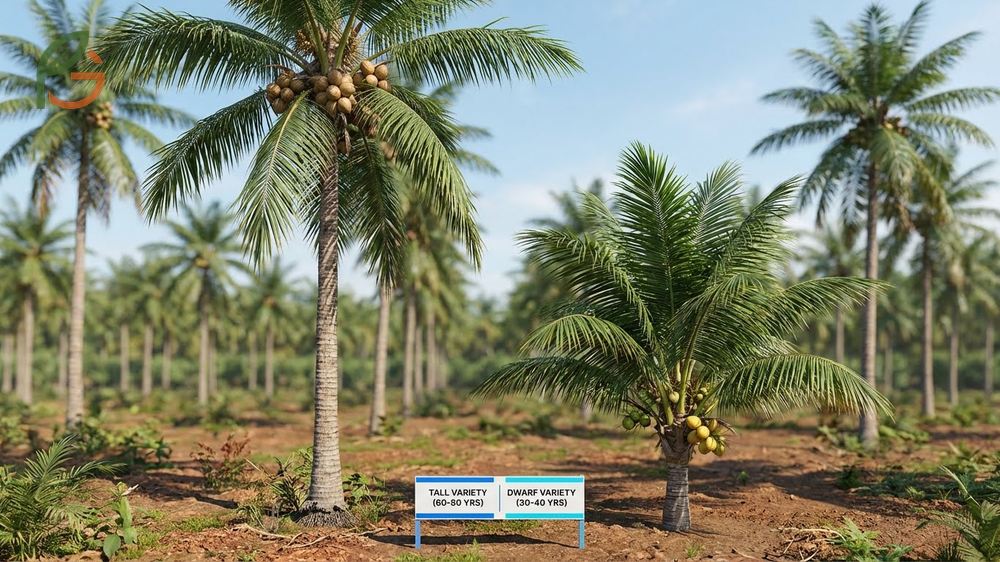
Agricultural research recognizes two main coconut varieties within the Cocos nucifera species: tall and dwarf. Tall varieties dominate commercial plantations, reaching 80-100 feet over 60-80 year lifespans and beginning fruit production at 6-8 years[3]. These palms tolerate diverse soil conditions and resist most pests, though they’re vulnerable to certain viral diseases.
Dwarf varieties mature faster (3-4 years to first fruit) but live shorter lifespans of 30-40 years. They typically reach only 20-40 feet tall, making harvest easier without climbing equipment. Dwarf coconuts produce more nuts per year than tall varieties initially, but total lifetime yield favors taller types.
Hybrid varieties (Tall × Dwarf crosses) combine desirable traits from both parent types. These hybrids start bearing at 4-5 years, show improved disease resistance, and yield high-quality copra (dried coconut kernel) with better oil content. Popular hybrids include Chowghat Orange Dwarf × West Coast Tall and various regional crosses developed for specific climate conditions.
This table compares height, fruit production timeline, lifespan, and typical yield characteristics across tall, dwarf, and hybrid coconut palm varieties
| Variety Type | Mature Height | Years to Fruit | Lifespan | Annual Yield |
|---|---|---|---|---|
| Tall | 80-100 feet | 6-8 years[3] | 60-100 years[3] | 60-80 nuts/palm |
| Dwarf | 20-40 feet | 3-4 years | 30-40 years | 50-150 nuts/palm |
| Hybrid (T×D) | 50-70 feet | 4-5 years | 50-70 years | 80-120 nuts/palm |
Growing Tip: If you’re planting coconut palms in southern Florida, Texas, or Hawaii, choose dwarf or hybrid varieties rated for your specific USDA zone. Tall varieties suffer more wind damage during hurricanes and require professional trimming equipment.
Coconut Palm Growth Facts
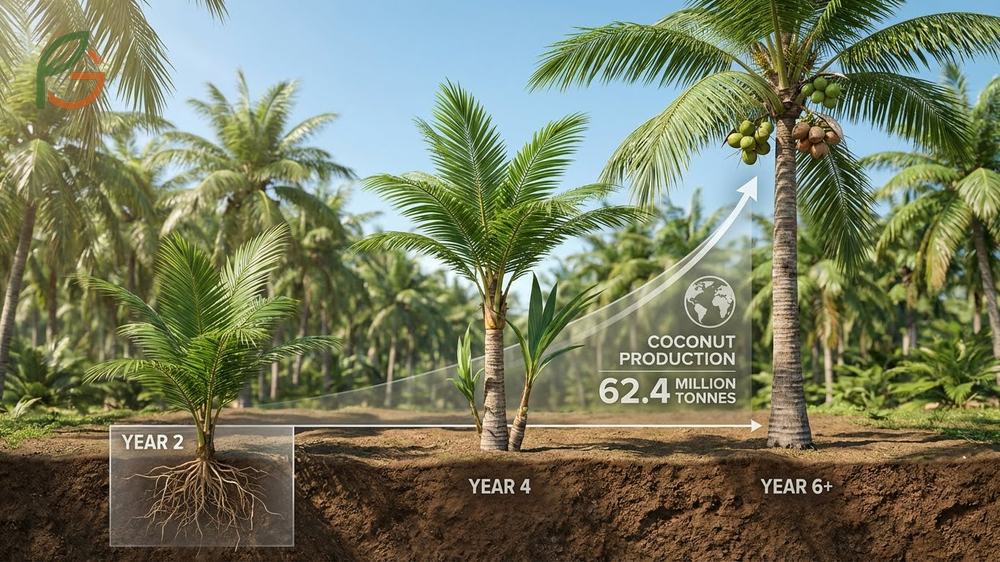
Coconut palms grow fastest during years 2-5 after planting, when root systems establish and vegetative growth dominates[3]. The visible trunk emerges at 3-4 years, then elongates 30-50 cm (12-20 inches) annually during prime growth years. After year six, fruit production increases while vegetative growth slows—the palm reallocates energy from making leaves to producing coconuts.
Global coconut production reached 62.4 million metric tonnes in 2022[5], with Indonesia, the Philippines, and India accounting for roughly 72% of world output. This production supports millions of smallholder farmers across tropical regions, making coconuts one of the world’s most economically important crops.
Climate and Temperature Requirements
Coconut palms thrive exclusively in USDA hardiness zones 10B through 11, where temperatures stay consistently above 64°F (18°C)[6]. In the continental US, this limits successful cultivation to southern Florida, the southernmost tip of Texas, and Hawaii. Southern California’s climate doesn’t provide enough humidity or warmth for optimal coconut palm performance.
Temperature requirements go beyond avoiding frost. Research shows coconut palms grow best with daytime highs of 81-90°F (27-32°C) and nighttime lows no cooler than 70°F (21°C). Prolonged exposure to temperatures below 60°F (15°C) damages fronds and slows growth, even if the palm survives. High humidity (60-90%) matters as much as temperature—dry desert climates prevent proper nut development.
Coastal locations work best because coconut palms tolerate salt spray and thrive in sandy, well-drained soils. They need full sun (8+ hours daily) and consistent moisture without waterlogging. Wind resistance varies—palms withstand tropical storms when properly established, but hurricane-force winds can topple them or snap fronds.
- Temperature range: 70-90°F (21-32°C) year-round with no frost
- Annual rainfall: 60-80 inches evenly distributed or supplemental irrigation
- Soil pH: 5.0-8.0, sandy loam with excellent drainage preferred
- Sunlight: Full sun, minimum 8 hours direct light daily
- Humidity: 60-90% relative humidity for optimal nut development
- Salt tolerance: Moderate to high, handles coastal spray well
Growth Timeline and Lifespan
Understanding coconut palm development helps set realistic expectations for home growers. Year 1 focuses entirely on root establishment—you’ll see minimal above-ground growth as the seedling develops the deep taproot system needed for stability. Years 2-3 bring rapid frond production, with the crown expanding from 4-6 leaves to 20-25 leaves.
The trunk becomes visible at year 3-4, initially just a few feet tall but growing 1-2 feet annually thereafter[3]. Flowering starts at 4-6 years for dwarf varieties, 6-8 years for tall types. First harvests yield 10-20 nuts, but production ramps up to 50-150+ nuts annually by year 10 depending on variety and growing conditions.
Prime production years span from about age 15 to 60, when palms generate consistent yields with proper fertilization and care. After 60 years, tall varieties remain productive but yields gradually decline. Dwarf varieties typically stop economic production around age 30-35. Commercial plantations often replant before palms reach the end of their productive lives.
Patience Required: Don’t expect coconuts from your backyard palm for at least 4-8 years after planting. That timeline assumes optimal growing conditions—cooler climates at the edge of zone 10B may add 1-2 years to fruit production.
Date Palm vs Coconut Palm
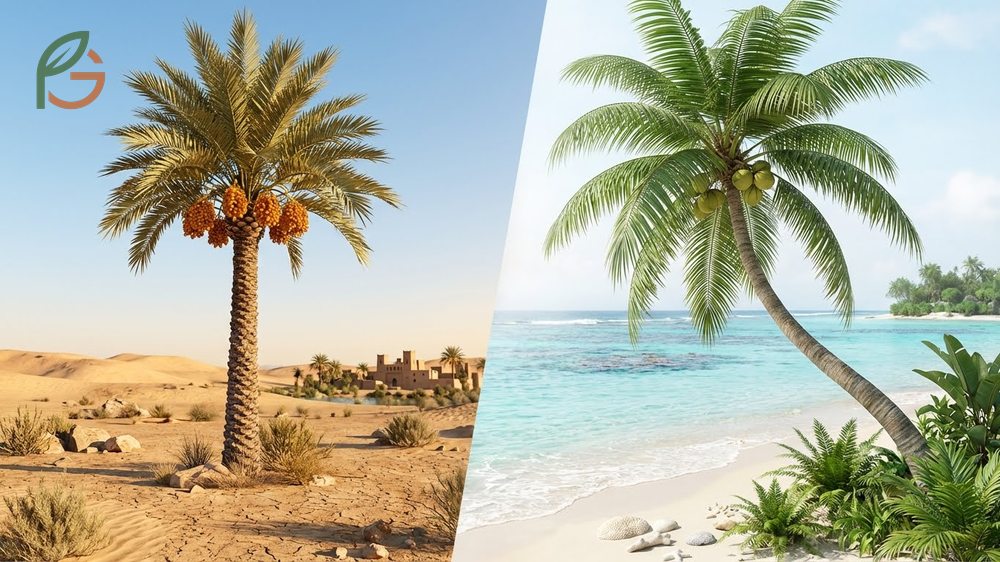
Date palms (Phoenix dactylifera) and coconut palms represent two completely different genera within the Arecaceae family[7]. Date palms evolved in North Africa and the Middle East for hot, arid climates with minimal humidity. Coconut palms originated in humid tropical coastlands with abundant rainfall. These different evolutionary paths created palms suited for opposite growing conditions.
Visual distinctions make identification straightforward. Date palms develop multiple stems from the base (though often trained to single trunks), with dense crowns of stiff, blue-green pinnate fronds. The trunk shows characteristic diamond patterns from old leaf bases. Dates grow in large hanging clusters of oblong fruits, amber to dark brown when ripe. Coconuts dangle individually or in loose groups, much larger and rounder than dates.
Cold hardiness differs dramatically—date palms survive USDA zones 8-11 and tolerate brief freezes to 15°F (-9°C), while coconut palms die at temperatures below 32°F (0°C). This explains why you’ll see date palms throughout California, Arizona, and Nevada, but coconut palms only in frost-free Florida and Hawaii. Date palms also handle low humidity and drought better than coconuts, which need consistent moisture.
| Feature | Date Palm | Coconut Palm |
|---|---|---|
| Scientific Name | Phoenix dactylifera[7] | Cocos nucifera[4] |
| USDA Zones | 8-11 (frost tolerant) | 10B-11 (frost kills)[6] |
| Climate Preference | Hot, dry, low humidity | Hot, humid, coastal |
| Fruit Type | Oblong dates, 1-3 inches | Round coconuts, 10-12 inches |
Conclusion
The evidence is clear: coconut tree vs palm tree comparisons reveal that coconut palms represent just one species among 2,600 palm types in the Arecaceae family. Most palms don’t produce coconuts—they’ve evolved for different climates, produce different fruits, or serve purely ornamental purposes. Current botanical guidance emphasizes choosing palms matched to your specific USDA zone and climate conditions.
If you’re growing palms in zones 10B-11 with tropical conditions, coconut palms offer both landscape beauty and edible harvests after 6-8 years of growth. FruitGarden helps you make informed decisions about which palm species suit your garden goals, whether you want coconuts, dates, or purely decorative fronds swaying in your yard.
Frequently Asked Questions
Do coconuts grow on all palm trees?
No, only Cocos nucifera produces coconuts. The palm family contains approximately 2,600 species, but coconut production occurs exclusively in this single species. Other palms produce dates, açaí berries, oil palm fruits, or no edible fruit at all.
What’s the scientific name for coconut palm?
The coconut palm’s scientific name is Cocos nucifera, and it’s the only living species in the genus Cocos. It belongs to the Arecaceae family (also called Palmae), which includes all palm species worldwide.
Can you grow coconut palms in California?
Coconut palms don’t perform well in California because the climate lacks sufficient humidity and warmth year-round. They require USDA zones 10B-11 with temperatures consistently above 64°F (18°C) and humidity levels of 60-90%—conditions California’s Mediterranean climate can’t provide. Southern California gardeners should choose date palms or Mexican fan palms instead.
How long does it take for a coconut tree to produce fruit?
Dwarf coconut varieties start producing fruit at 3-4 years after planting, while tall varieties take 6-8 years. Hybrid varieties fall in between at 4-5 years. Production remains low initially (10-20 nuts) but increases significantly by year 10, reaching 50-150+ nuts annually depending on variety and growing conditions.
What’s the difference between a date palm and coconut palm?
Date palms (Phoenix dactylifera) and coconut palms (Cocos nucifera) belong to different genera and thrive in opposite climates. Date palms tolerate cold to USDA zone 8 and prefer hot, dry conditions with low humidity. Coconut palms need frost-free zones 10B-11 with high humidity and coastal moisture. Their fruits differ dramatically too—dates are small oblong drupes while coconuts are large round nuts.
How tall do coconut trees grow?
Tall coconut palm varieties reach 80-100 feet at maturity over 60-80 years. Dwarf varieties grow 20-40 feet tall with shorter 30-40 year lifespans. Hybrid varieties (Tall × Dwarf crosses) typically mature at 50-70 feet. Trunk elongation averages 12-20 inches per year during prime growth years.
Are palm trees and coconut trees the same thing?
All coconut trees are palm trees, but the reverse isn’t true—not all palm trees are coconut trees. The Arecaceae family includes about 2,600 palm species across 181 genera. Coconut palms represent just one species specialized for tropical coastal environments. Most palms serve ornamental purposes or produce other fruit types like dates, açaí berries, or betel nuts.