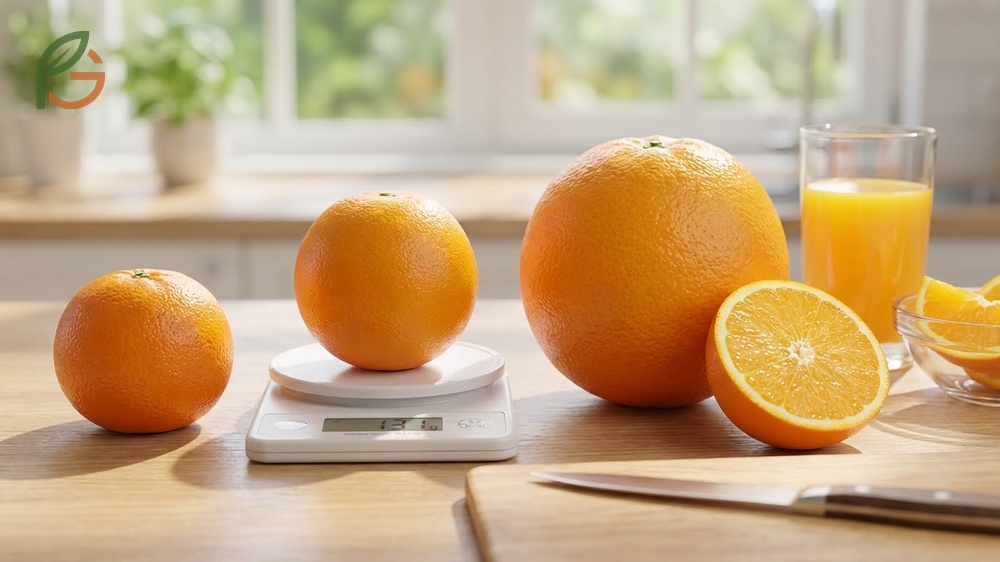
Calories in an orange vary significantly by size—from 45 calories in a small fruit to 90 calories in a large one. Research shows that a medium-sized orange (131g) provides exactly 62 calories along with 3.1g of fiber and nearly 100% of your daily vitamin C needs[1][2]. If you’re tracking calories for weight management or curious about orange nutrition facts, understanding how size affects caloric content helps you make informed choices. FruitGarden provides research-backed guidance on fruit nutrition to help gardeners and health-conscious readers maximize the benefits of homegrown citrus.
Quick Answer
Calories in an Orange

Orange calorie content depends primarily on the fruit’s weight. Studies show that oranges contain approximately 47 calories per 100 grams of edible flesh[4][5]. This means you’re getting about 0.47 calories per gram—a simple calculation that makes portion control easy.
Most people don’t realize that two “medium” oranges from different sources can vary by 20-30 calories. The USDA defines a medium orange as 131 grams (about 2 5/8 inches in diameter), which yields 62 calories[1]. However, what grocers label as “medium” often weighs between 120-160 grams.
Current nutrition data indicates that weighing your oranges provides more accuracy than relying on size labels. If you don’t have a scale, remember that a medium orange fits comfortably in an average adult’s palm and feels similar in weight to a tennis ball.
Why Size Affects Calorie Count
Orange size directly correlates with calorie content because larger fruits simply contain more flesh. Research demonstrates that small oranges (100-150g) contain 45-70 calories, while large ones (200-300g) can reach 87-140 calories[5][3]. The relationship isn’t just about weight—it’s about how oranges store their natural sugars and water content.
Agricultural data shows that larger oranges typically have slightly higher water content (up to 88% compared to 86% in smaller fruits). This means you’re not getting proportionally more calories as size increases. A 200g orange won’t have exactly double the calories of a 100g orange because of this increased water ratio.
- Ripeness level—fully ripe oranges contain more natural sugars
- Growing season—winter-harvested oranges tend to be sweeter and denser
- Variety type—navels differ from valencias in sugar concentration
- Climate conditions—oranges grown in warmer regions develop higher sugar content
- Tree age—mature trees produce fruit with more consistent caloric density
Weight vs. Volume
Many recipes call for “1 cup of orange sections,” but volume measurements can be misleading for calorie tracking. One cup of orange sections (approximately 180g) contains about 85 calories[4]. However, how tightly you pack those sections significantly affects the actual calorie count—loose packing might give you only 140g (65 calories) while tight packing could reach 200g (94 calories).
Weight-based measurements eliminate this guesswork. If a recipe requires 100 calories worth of oranges, you’d need approximately 213 grams of peeled fruit. This precision matters most when you’re meal prepping or following strict dietary guidelines.
Important note: Orange peel accounts for 20-30% of total fruit weight but contains zero calories since it’s inedible. When you see nutritional data for “whole oranges,” it refers only to the edible flesh portion.
Orange Nutrition Facts
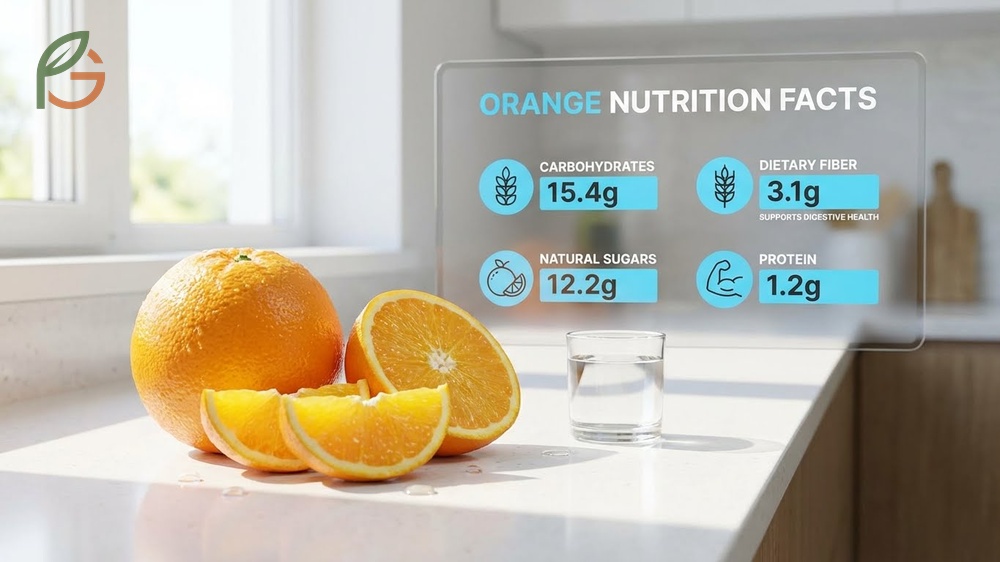
Beyond calories, oranges deliver impressive nutritional value that makes them a standout low-calorie fruit. Current USDA data reveals that a medium orange provides 15.4g of carbohydrates, 3.1g of dietary fiber, 12.2g of natural sugars, and 1.2g of protein[2]. The fiber content is particularly noteworthy—at 11% of your daily value, it supports digestive health and helps regulate blood sugar absorption.
What often gets overlooked is the micronutrient density of oranges. You’re getting significant amounts of vitamin C (70mg, meeting 100% of daily needs), potassium (237mg), and folate (30mcg) in just 62 calories[6]. This nutrient-to-calorie ratio makes oranges exceptionally efficient for meeting nutritional goals without excess energy intake.
Macronutrients Breakdown
Orange macronutrients consist almost entirely of carbohydrates, with negligible fat and minimal protein. The 15.4g of carbs in a medium orange break down into 12.2g of natural sugars (primarily fructose, glucose, and sucrose) and 3.1g of fiber[2]. This leaves you with approximately 9.4g of net carbs per 100g when you subtract fiber.
The protein content (1.2g per medium orange) won’t contribute much to daily protein goals, but it’s still present. Fat content is virtually zero at 0.16g, making oranges an excellent choice if you’re following a low-fat eating pattern.
This table compares macronutrient content across three orange sizes showing calories, carbohydrates, fiber, protein, and fat values
| Size | Weight | Calories | Carbs | Fiber | Protein | Fat |
|---|---|---|---|---|---|---|
| Small | 96g | 45[3] | 11.3g | 2.3g | 0.9g | 0.1g |
| Medium | 131g | 62[1] | 15.4g | 3.1g | 1.2g | 0.2g |
| Large | 184g | 87[3] | 21.6g | 4.3g | 1.7g | 0.2g |
Vitamin and Mineral Content
Evidence suggests that vitamin C stands out as the most significant micronutrient in oranges. A medium orange delivers approximately 70mg of vitamin C—meeting or exceeding the 75-90mg recommended dietary allowance for adults[7][6]. This water-soluble vitamin can’t be stored in your body, so daily intake from sources like oranges is essential for immune function and collagen production.
Potassium content (237mg per medium orange) supports cardiovascular health and helps regulate blood pressure. The 52mg of calcium contributes to bone health, though it’s only about 4% of daily needs. Folate (30mcg) is particularly important for pregnant women, as it supports fetal development and red blood cell formation.
- Vitamin C (70mg)—antioxidant protection and immune support
- Potassium (237mg)—blood pressure regulation and heart health
- Folate (30mcg)—DNA synthesis and cell division
- Calcium (52mg)—bone density and muscle function
- Thiamin (0.09mg)—energy metabolism from carbohydrates
Orange Calorie Count by Variety
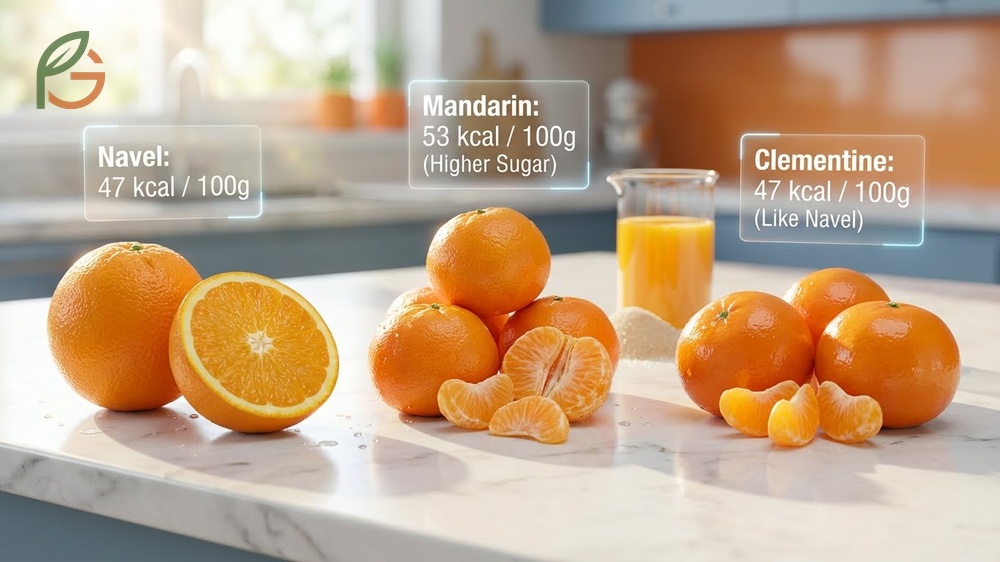
Different orange varieties show slight variations in calorie density. Research shows that navel oranges (the most common variety in US supermarkets) contain 47 calories per 100g, while mandarin oranges have 53 calories per 100g—about 13% more caloric density[8]. This difference comes from mandarins’ higher concentration of natural sugars and slightly lower water content.
Clementines (a mandarin variety) register at 47 calories per 100g—identical to navels—but since clementines are typically smaller (74g average), one fruit contains only 35 calories. Tangerines follow a similar pattern with 53 calories per 100g, making a typical 109g tangerine about 58 calories[8].
Valencia oranges (commonly used for juice) have nearly identical caloric content to navels at 47 calories per 100g. Blood oranges, despite their distinctive color from anthocyanin pigments, don’t differ significantly in calorie count from standard varieties.
Tip for gardeners: If you’re growing oranges at home, fruit size and calorie density depend heavily on irrigation practices. Consistent watering produces larger, more hydrated fruit with slightly lower caloric concentration per gram.
One Orange Calories in Context
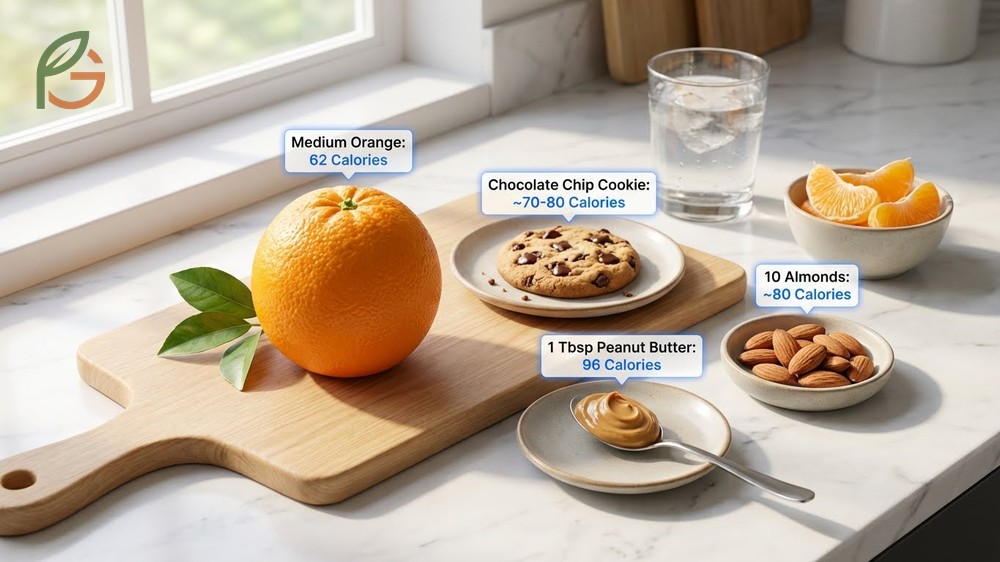
Understanding one orange calories becomes more meaningful when compared to common snacks and meals. At 62 calories, a medium orange contains fewer calories than a single chocolate chip cookie (around 70-80 calories), one tablespoon of peanut butter (96 calories), or a small handful of almonds (about 80 calories for 10 nuts). Unlike these alternatives, oranges provide substantial fiber and hydration that increase satiety.
For weight management, oranges offer excellent volume-to-calorie ratios. You can eat two medium oranges (124 calories total) and feel satisfied, whereas the same 124 calories from crackers (about 5-6 crackers) or cheese (one ounce) won’t provide nearly the same fullness. The high water content (86%) and fiber (3.1g) work together to trigger satiety signals.
In practical terms, if you’re following a 2,000-calorie daily diet, one medium orange represents just 3% of your total caloric intake. You’d need to eat 32 medium oranges to reach 2,000 calories—an impossible feat that highlights how oranges naturally prevent overconsumption through their volume and fiber content.
- Pre-workout snack—one orange provides quick energy without digestive burden
- Breakfast addition—adds 62 calories with full vitamin C coverage
- Afternoon hunger buster—satisfies sweet cravings for minimal calories
- Post-dinner dessert—replaces high-calorie sweets with natural sweetness
- Smoothie base—contributes flavor and nutrition at reasonable calorie cost
Low-Calorie Fruit Comparisons
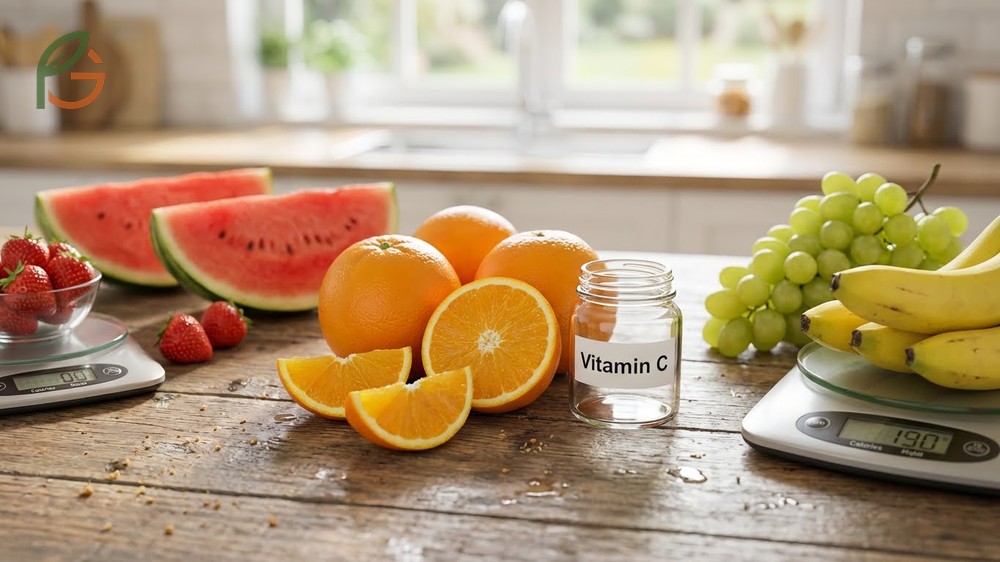
Among low-calorie fruits, oranges rank in the middle tier for caloric density. Studies indicate that watermelon (30 calories per 100g) and strawberries (32 calories per 100g) contain fewer calories, while bananas (89 calories per 100g) and grapes (67 calories per 100g) contain more[9]. At 47 calories per 100g, oranges sit comfortably in the low-calorie category while offering superior vitamin C content compared to most alternatives.
When comparing whole fruit servings (not per 100g), oranges compete well. A medium orange at 62 calories matches papaya and blackberries in caloric content per typical serving[9]. Grapefruit comes in slightly lower at 52 calories for a half-fruit serving, but many people find oranges more palatable and easier to incorporate into daily eating.
| Fruit | Serving Size | Calories | Fiber | Vitamin C |
|---|---|---|---|---|
| Orange (medium) | 131g | 62[1] | 3.1g | 70mg (100% DV) |
| Apple (medium) | 182g | 95 | 4.4g | 8mg (10% DV) |
| Banana (medium) | 118g | 105 | 3.1g | 10mg (12% DV) |
| Grapefruit (half) | 123g | 52 | 2.0g | 38mg (51% DV) |
| Strawberries (cup) | 152g | 49 | 3.0g | 89mg (120% DV) |
The nutritional advantage of oranges becomes clear when you consider vitamin C delivery per calorie. You get 1.13mg of vitamin C per calorie from oranges—significantly more efficient than apples (0.08mg per calorie) or bananas (0.10mg per calorie). If vitamin C intake is your priority, oranges deliver exceptional value alongside their low calorie count.
Conclusion
The evidence is clear: calories in an orange range from 45-90 depending on size, with the standard medium orange delivering 62 calories packed with 3.1g of fiber and 100% of your daily vitamin C needs. Size matters because weight directly determines caloric content, but regardless of which size you choose, oranges remain an exceptionally nutritious low-calorie fruit that supports weight management and overall health.
Current dietary guidance emphasizes whole fruits over processed snacks for good reason—oranges provide natural sugars alongside fiber that moderates absorption, plus micronutrients that processed foods lack. Whether you’re tracking calories precisely or simply want nutritious options, oranges deliver consistent value across all sizes. FruitGarden encourages home gardeners to grow citrus when climate permits, ensuring access to fresh, nutrient-dense fruit year-round.
Frequently Asked Questions
How Many Calories Are in One Medium Orange?
One medium orange (131g, approximately 2 5/8 inches in diameter) contains 62 calories according to USDA data. This serving size also provides 15.4g of carbohydrates, 3.1g of dietary fiber, and 70mg of vitamin C—meeting 100% of your daily vitamin C requirement in just 62 calories.
Do Large Oranges Have Significantly More Calories Than Small Ones?
Yes, size directly affects calorie content. Small oranges (96g) contain about 45 calories, while large oranges (184g) contain approximately 87 calories—nearly double. However, since oranges contain consistent calories per gram (0.47 cal/g), you can easily calculate the caloric content by weighing any orange and multiplying its weight by 0.47.
Are Oranges Considered a Low-Calorie Fruit?
Yes, oranges qualify as a low-calorie fruit at 47 calories per 100g. They rank in the middle of the low-calorie fruit spectrum—lower than bananas (89 cal/100g) and grapes (67 cal/100g), but slightly higher than strawberries (32 cal/100g) and watermelon (30 cal/100g). Their combination of low calories with high fiber and vitamin C makes them an excellent choice for weight management.
Does Orange Juice Have More Calories Than a Whole Orange?
Yes, orange juice contains significantly more calories per serving. One cup (240ml) of orange juice has approximately 110 calories compared to 62 calories in a whole medium orange. Juice also lacks the 3.1g of fiber found in whole oranges, leading to faster sugar absorption and less satiety. Nutrition experts recommend choosing whole oranges over juice whenever possible for better blood sugar control and greater fullness.
How Many Calories in Orange Peel?
Orange peel is typically not consumed and isn’t included in standard nutritional calculations. When nutrition labels list calories for “one orange,” they refer only to the edible flesh portion. The peel accounts for 20-30% of total fruit weight but contributes zero calories to typical consumption since it’s discarded or used only as zest in small quantities.
Do Different Orange Varieties Have Different Calorie Counts?
Varieties show minor differences in caloric density. Navel oranges contain 47 calories per 100g, while mandarin oranges have 53 calories per 100g—about 13% more. However, since mandarins are smaller (74g average), one whole mandarin contains only 39 calories compared to 62 in a medium navel. Valencia oranges match navels at 47 cal/100g, making variety choice less important than size when tracking calories.
Can I Eat Oranges Every Day Without Gaining Weight?
Yes, eating 1-2 oranges daily (62-124 calories) fits easily into most balanced diets without causing weight gain. Research shows that the fiber content (3.1g per orange) promotes satiety and helps regulate appetite, making overconsumption unlikely. The natural sugars come packaged with fiber that moderates absorption, unlike processed sweets. As long as oranges replace higher-calorie snacks rather than adding extra calories to your daily intake, they support weight management goals.