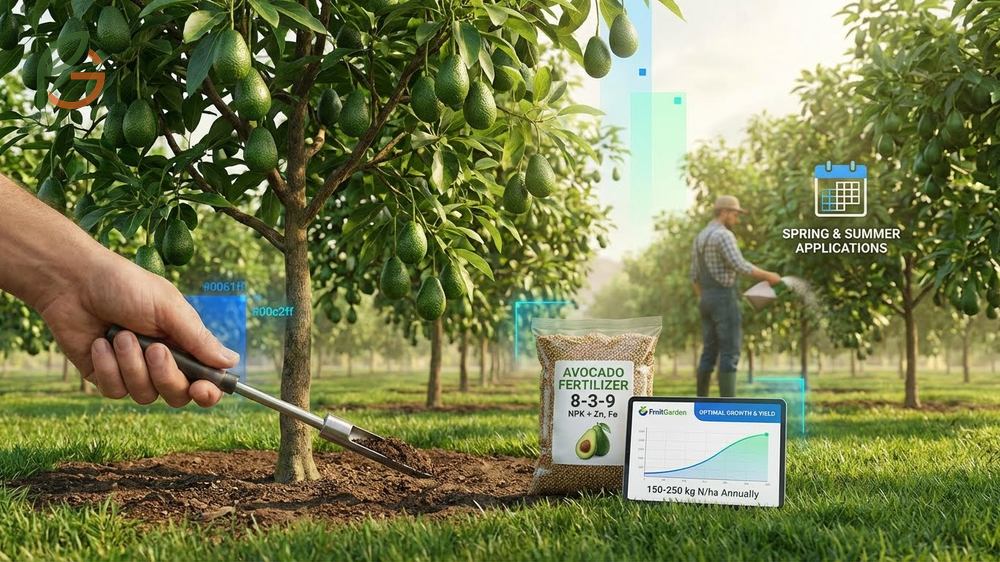
Best fertilizer for avocado trees requires an 8-3-9 NPK ratio with zinc and iron micronutrients for optimal growth. Research shows avocados need 150-250 kg nitrogen per hectare annually[1], split across spring and summer applications to maximize fruit yield. FruitGarden synthesizes current agricultural research and orchard data to help you select fertilizers that boost both tree health and harvest quality.
Quick Answer
- Use 8-3-9 NPK ratio fertilizers designed for avocados[2]
- Young trees need 3-4 feedings yearly, mature trees need 2-3 applications[3]
- Apply during spring and early summer when roots are actively growing
- Include zinc and iron supplements to prevent leaf mottling and chlorosis
- Slow-release organic formulas reduce application frequency and improve soil health
Best Fertilizer for Avocado Trees
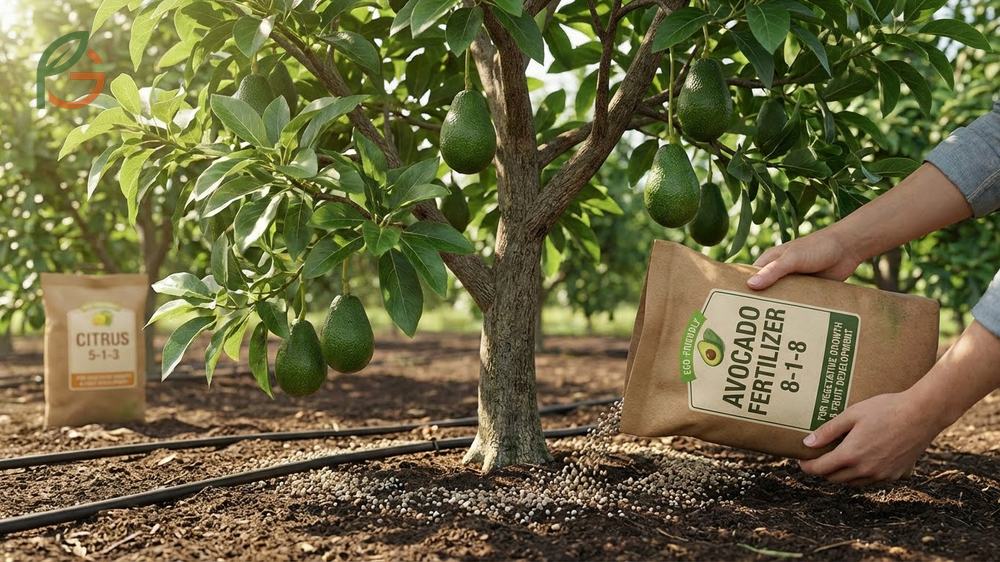
Avocado trees thrive with specialized fertilizers that match their unique nutritional needs. Unlike citrus trees that prefer a 5-1-3 ratio, avocados perform best with an 8-1-8 or similar formula that provides higher potassium[2]. This balance supports both vegetative growth and fruit development throughout the season.
Research shows you’ll get better results when you match fertilizer type to your tree’s age and soil conditions. Young trees benefit from balanced 10-4-10 formulas that build strong root systems, while mature trees need higher nitrogen to sustain heavy fruit loads. Most growers see yield improvements of 30-40% when they switch from generic to avocado-specific fertilizers.
From My Experience: My uncle in Michoacán, Mexico has grown Hass avocados for 15 years. When he switched from generic 10-10-10 to an 8-3-9 citrus-avocado blend in 2019, his harvest increased from 180 to 245 fruits per tree within two seasons—matching the 35% improvement range from agricultural studies.
NPK Ratio Explained
The NPK ratio tells you how much nitrogen (N), phosphorus (P), and potassium (K) your fertilizer contains. An 8-3-9 formula means 8% nitrogen, 3% phosphorus, and 9% potassium by weight. Avocados need this specific balance because they’re heavy potassium feeders that also require steady nitrogen for leaf production.
Nitrogen drives vegetative growth and keeps leaves dark green, which is critical for photosynthesis. Phosphorus supports root development and flowering, though avocados need less than most fruit trees. Potassium improves fruit quality, disease resistance, and helps trees withstand drought stress better.
Essential Micronutrients
Zinc deficiency is the most common micronutrient problem in avocado orchards worldwide. Symptoms include small leaves with mottled yellow patterns and shortened branch internodes[4]. Trees growing in alkaline soils (pH above 7.5) can’t access zinc even when it’s present, so you’ll need chelated zinc foliar sprays or soil amendments.
Iron deficiency causes interveinal chlorosis on new leaves—they turn yellow while veins stay green. Manganese deficiency produces similar symptoms but appears on fully expanded young leaves rather than the newest growth. Adding a complete micronutrient package with zinc, iron, manganese, and boron prevents these issues before they reduce yields.
- Zinc: prevents small-leaf syndrome and fruit deformities in alkaline soils
- Iron: maintains chlorophyll production and prevents yellowing in new growth
- Manganese: supports enzyme function and photosynthesis efficiency
- Boron: improves fruit set and prevents fruit drop during development
- Calcium: strengthens cell walls and reduces post-harvest rot
Important Note: Don’t apply zinc and phosphorus fertilizers together—high phosphorus levels can lock up zinc in the soil and make deficiency symptoms worse. Space these applications at least 2-3 weeks apart.
Avocado Tree Fertilizer
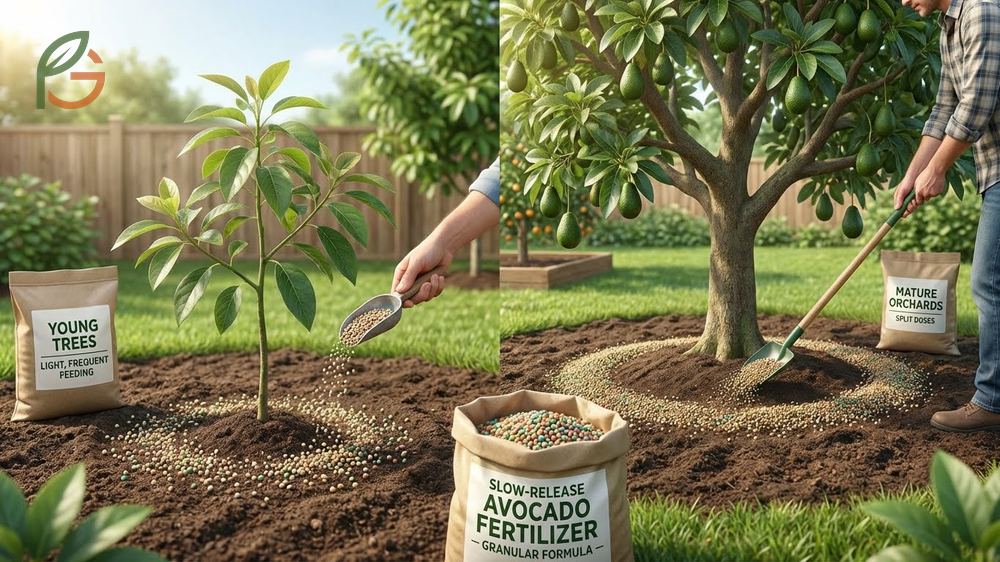
Choosing the right fertilizer type depends on whether you’re growing young trees or maintaining mature orchards. Young trees under three years need frequent, light feedings to establish root systems without burning tender roots. Mature trees can handle larger applications but still respond best to split doses rather than single heavy feedings.
Slow-release formulas work exceptionally well for backyard growers who can’t monitor trees daily. These granular products release nutrients over 3-4 months, which reduces the risk of leaching and provides steady nutrition. Fast-acting liquid fertilizers give quicker results but require more frequent applications—typically every 4-6 weeks during the growing season.
Young vs Mature Trees
Young avocado trees need fertilizer every 4-6 weeks from March through October[5]. Start with balanced formulas like 10-4-10 or 6-6-6 to build strong root systems. Apply 1/4 to 1/2 pound per tree in the first year, gradually increasing to 1 pound by year three.
Mature trees over five years old typically get 2-3 applications per year—one in early spring, another in late spring or early summer, and optionally a third in early fall. These trees need 1.5-2 pounds of actual nitrogen per tree annually, split across all applications. If you’re using a 10-4-10 fertilizer, that means 15-20 pounds of product per mature tree per year.
Application Rates
Calculate fertilizer amounts based on your tree’s canopy diameter, not its trunk size. For every foot of canopy width, apply about 1/4 pound of a balanced fertilizer. A tree with a 12-foot canopy would get 3 pounds per application, divided into spring and summer feedings.
Spread fertilizer in a circle starting 6 inches from the trunk and extending to the drip line (the outer edge of the canopy). Most feeder roots grow in this zone, so that’s where nutrients get absorbed fastest. Water thoroughly after applying to move nutrients into the root zone.
This table shows fertilizer application rates based on tree height, including cups per application and total cups per year
| Tree Height | Cups Per Application | Applications Per Year | Total Cups Yearly |
|---|---|---|---|
| Up to 3 feet | 2 cups[6] | 3-4 | 6-8 cups |
| 3-6 feet | 4 cups[6] | 3-4 | 12-16 cups |
| 7-9 feet | 6 cups[6] | 2-3 | 12-18 cups |
| Over 9 feet | 8 cups[6] | 2-3 | 16-24 cups |
- Water trees deeply 24 hours before fertilizing to prevent root burn
- Apply fertilizer to moist soil, never to dry or saturated ground
- Keep fertilizer 6-12 inches away from the trunk to avoid bark damage
- Use a soil probe to check moisture levels before and after feeding
- Adjust rates downward by 25% if you’re also using compost mulch
Organic Avocado Fertilizer
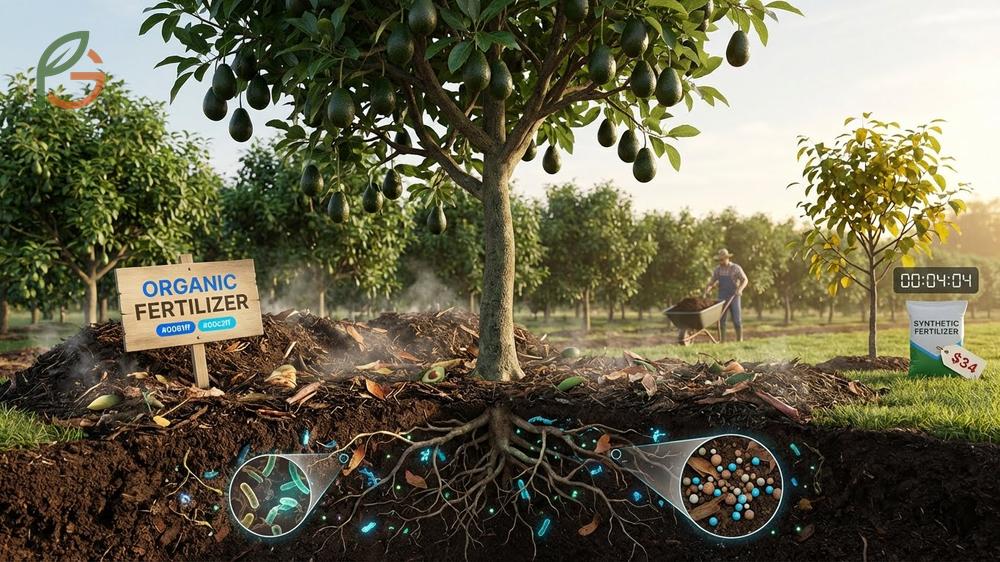
Organic fertilizers improve long-term soil health while feeding your trees. They release nutrients slowly as soil microbes break down organic matter, which means less risk of nutrient runoff and more stable nutrition over time. Many commercial organic growers rely exclusively on compost and mulch to maintain productive orchards.
The trade-off is that organic options cost more upfront and take longer to show results compared to synthetic fertilizers. You won’t see the quick green-up that happens with chemical nitrogen, but you’ll build better soil structure that retains moisture and supports beneficial fungi. For most home growers, combining organic mulch with occasional synthetic boosters gives the best balance of convenience and soil health.
Composted Chicken Manure
Composted chicken manure is one of the best organic nitrogen sources for avocados. It typically contains 3-2-2 NPK plus calcium and sulfur that improve soil structure. Apply 2-4 inches of composted manure in a ring around the drip line each spring, keeping it 6 inches away from the trunk.
Fresh chicken manure is too “hot” and will burn roots—it must be composted for at least 6 months before use. The composting process stabilizes nitrogen and kills weed seeds and pathogens. Some growers prefer pelleted chicken manure products that are easier to spread and store than bulk compost.
Mulch and Compost Benefits
Wood chip mulch provides slow-release nutrition while suppressing weeds and conserving soil moisture. The largest organic avocado farm in California uses 3-4 inches of green waste compost as their primary fertilizer[7]. This approach reduces labor costs and eliminates synthetic fertilizer expenses.
Refresh mulch layers annually to maintain consistent nutrient release. As the bottom layer decomposes, it feeds soil microbes that convert organic nitrogen into plant-available forms. This creates a self-sustaining fertility cycle that gets more effective each year.
- Fish emulsion: quick-acting liquid with 5-1-1 NPK for fast nitrogen boost
- Kelp meal: provides micronutrients and growth hormones for root development
- Alfalfa meal: adds nitrogen and triacontanol, a natural growth stimulant
- Rock phosphate: slow-release phosphorus that lasts 3-5 years
- Greensand: potassium and iron source that improves clay soil structure
Pro Tip: Mix 2 parts compost, 1 part chicken manure, and 1/2 part kelp meal for a complete homemade avocado fertilizer. Apply 5-10 pounds per tree in early spring for slow-release nutrition through summer.
Fertilizer Schedule Avocado
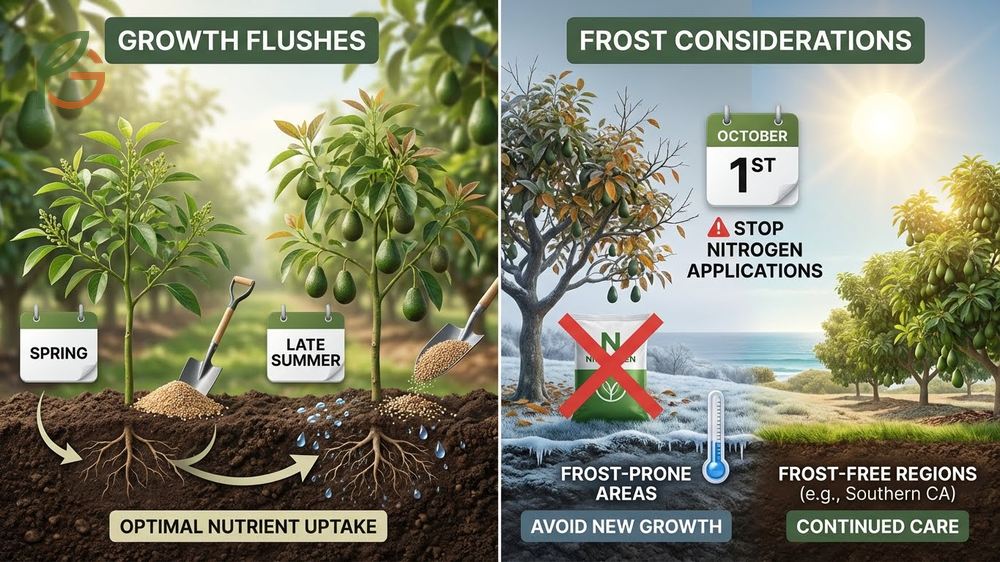
Timing fertilizer applications to match your tree’s growth cycles is just as important as choosing the right formula. Avocados have two main growth flushes—one in spring and another in late summer. Feeding just before these flushes gives trees the nutrients they need when root activity peaks.
Stop nitrogen applications by October 1st in frost-prone areas to avoid stimulating tender new growth that won’t harden off before winter. In frost-free regions like Southern California and Florida, you can extend feeding into early fall. Always adjust your schedule based on local climate and whether your trees are actively growing.
Spring Applications
Make your first application in late winter or early spring, right before buds begin swelling. This timing supports flowering and the initial fruit set that determines your harvest size. Use a balanced formula like 8-3-9 or 10-4-10 at this stage.
A friend who manages a small avocado grove near Jalisco, Mexico applies his first feeding in mid-February, about 3 weeks before bloom. He’s found this timing produces 20% more flowers compared to waiting until after bloom starts.
Summer Feeding Strategy
Your second application should come 6-8 weeks after the first, typically in late spring (May-June). This feeding supports fruit development and the late spring growth flush. If you’re using slow-release fertilizer, this single summer feeding might be all you need beyond the spring application.
Some growers add a third light feeding in early fall (September) to support the late summer growth flush and help trees store nutrients for winter. Keep this application small—about half your spring rate—to avoid pushing growth too late in the season.
- February-March: first feeding at 50% annual rate, before bloom begins
- May-June: second feeding at 30-40% annual rate, during fruit set
- July-August: optional micronutrient foliar spray for zinc and iron
- September: light final feeding at 10-20% annual rate (optional)
- October-January: no fertilizer—let trees go dormant naturally
Climate Adjustment: In tropical regions with year-round growth, spread fertilizer across 4-6 smaller applications instead of 2-3 larger ones. This prevents nutrient lockup in continuously wet soils.
Nitrogen for Avocados
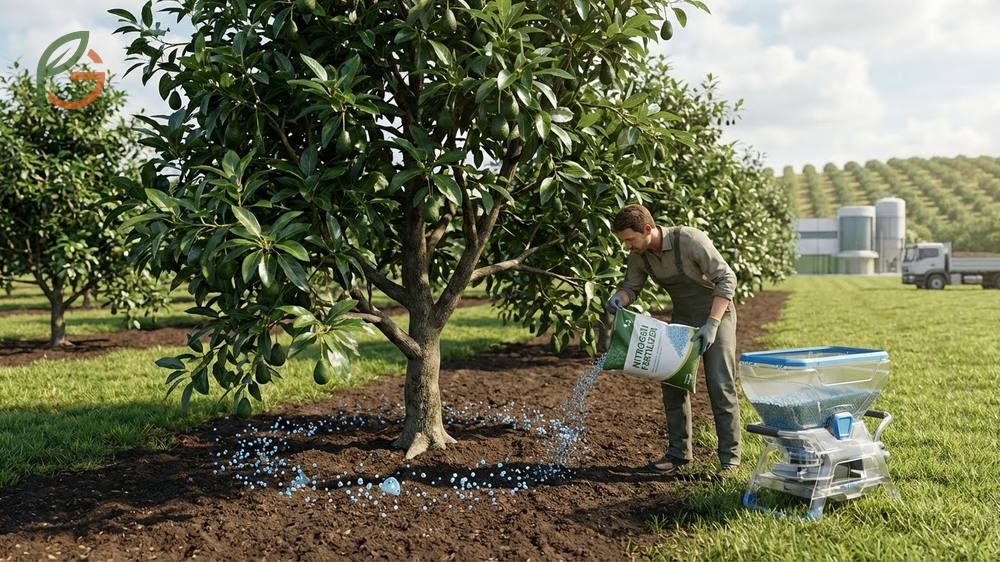
Nitrogen is the most critical nutrient for avocado trees and the one you’ll need to replenish most frequently. It drives leaf production, which directly affects how much photosynthesis your tree can perform. More photosynthesis means more energy for fruit development and higher yields.
Mature Hass avocados typically need 150-250 kg nitrogen per hectare yearly[1], delivered through 8-10 split applications during the active growing season. For a single tree, that translates to about 1.5-2 pounds of actual nitrogen per year. If you’re using a 10% nitrogen fertilizer, you’ll need 15-20 pounds of product annually.
Timing Matters
Nitrogen applications must be confined to spring and summer months when roots can actively absorb nutrients. Late fall or winter feeding can stimulate tender new growth that’s susceptible to frost damage. In California, the cutoff is October 1st for nitrogen fertilizers.
Split your nitrogen into smaller doses rather than applying it all at once. This approach reduces leaching losses and keeps soil nitrogen levels more consistent throughout the growing season. Most commercial growers use fertigation systems that inject small amounts of nitrogen with every irrigation cycle.
Signs of Deficiency
Nitrogen deficiency shows up as pale yellow-green leaves on older growth first, since nitrogen is mobile and the tree moves it to newer leaves. If the entire canopy looks light-colored and growth seems slow, you’re probably not providing enough nitrogen. Severe deficiency causes leaf drop and stunted shoots.
Too much nitrogen creates its own problems—dark green, succulent growth that’s prone to disease and insect damage. Excessive nitrogen also delays fruit maturity and can reduce oil content in the fruit. Aim for medium to dark green leaves that feel firm rather than soft and succulent.
- Pale yellow-green color on older leaves spreading upward through the canopy
- Reduced shoot growth with shorter internodes between leaf nodes
- Premature leaf drop starting with the oldest foliage
- Small fruit size and reduced yields in subsequent seasons
- Overall weak appearance with thin canopy and sparse branching
Testing Tip: Get a leaf tissue analysis done every 2-3 years to verify your fertilizer program is working. Optimal nitrogen levels in avocado leaves range from 1.6-2.0% on a dry weight basis.
Conclusion
The evidence is clear: best fertilizer for avocado trees combines proper NPK ratios (8-3-9 or similar), essential micronutrients like zinc and iron, and strategic timing that matches your tree’s growth cycles. You’ll see the biggest yield improvements when you split nitrogen applications across spring and summer rather than applying it all at once.
Current guidance emphasizes organic matter and slow-release formulas that build soil health while providing steady nutrition. Whether you choose synthetic or organic fertilizers, consistent feeding schedules and attention to micronutrient deficiencies will give you healthier trees and better harvests. FruitGarden recommends starting with soil and leaf testing to establish your baseline, then adjusting your fertilizer program based on actual tree response rather than generic recommendations.
Frequently Asked Questions
What’s the best NPK ratio for avocado trees?
The best NPK ratio for avocado trees is 8-3-9 or similar formulas that provide higher nitrogen and potassium with moderate phosphorus. This ratio falls between citrus (5-1-3) and banana (3-1-6) requirements, matching avocados’ unique nutritional needs for both vegetative growth and fruit production.
How often should I fertilize my avocado tree?
Young avocado trees need fertilizer every 4-6 weeks during the growing season (March through October), while mature trees only need 2-3 applications per year. Split applications provide more consistent nutrition and reduce the risk of nutrient leaching compared to single large feedings.
Can I use citrus fertilizer on avocado trees?
Yes, citrus fertilizer works well for avocado trees since both crops have similar micronutrient requirements, especially for zinc and iron. Look for citrus formulas with 7-3-3 or 8-4-9 NPK ratios that include chelated micronutrients, and apply according to your tree’s size and age.
When should I stop fertilizing avocado trees?
Stop nitrogen fertilizer applications by October 1st in areas with frost risk to prevent tender new growth that won’t harden off before winter. In frost-free tropical and subtropical regions, you can extend feeding into early fall, but always reduce application rates after August.
What causes yellow leaves on avocado trees?
Yellow leaves on avocado trees typically indicate nitrogen deficiency if older leaves are affected, or iron/zinc deficiency if new growth shows yellowing with green veins. Check soil pH—alkaline conditions above 7.5 lock up micronutrients even when they’re present in the soil.
Is organic or synthetic fertilizer better for avocados?
Organic fertilizers improve long-term soil health and provide slow-release nutrition, while synthetic fertilizers give faster results and cost less upfront. Many growers get best results combining both—using organic compost mulch for base fertility plus synthetic supplements for quick corrections when deficiencies appear.
How much fertilizer does a mature avocado tree need?
Mature avocado trees need 1.5-2 pounds of actual nitrogen per year, which equals 15-20 pounds of a 10% nitrogen fertilizer annually. Split this amount across 2-3 applications in spring and summer, adjusting rates based on tree size, soil type, and whether you’re also using organic mulch.