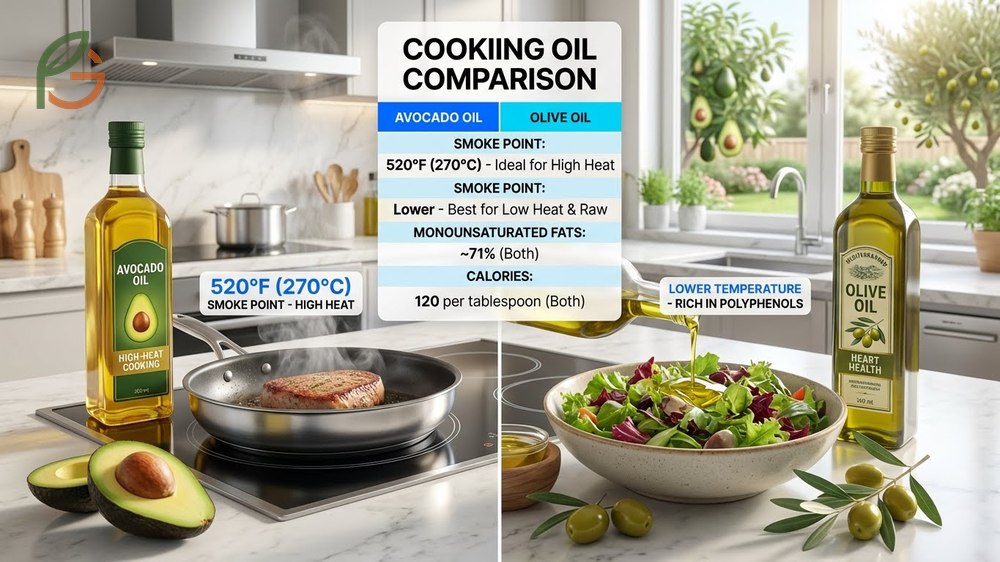
Avocado oil vs olive oil comes down to how you cook. Research shows avocado oil’s smoke point reaches 520°F (270°C), making it ideal for high-heat cooking, while olive oil excels at lower temperatures and provides more polyphenols for heart health.[1] Both oils contain around 71% monounsaturated fats and deliver similar calorie counts at 120 per tablespoon.[2] FruitGarden examines agricultural data and nutritional science to help home gardeners and cooking enthusiasts choose the right oil.
Quick Answer
- Avocado oil tolerates temperatures up to 520°F (270°C) vs olive oil’s 350-410°F (177-210°C)[1]
- Both deliver 120 calories and 14g fat per tablespoon with similar nutritional profiles[1]
- Extra virgin olive oil contains more polyphenols (hydroxytyrosol, oleocanthal) that reduce heart disease risk by 30%[3]
- Olive oil typically costs less—around $0.30-0.44 per fluid ounce vs avocado oil at $0.50+ per ounce[4]
Avocado Oil vs Olive Oil
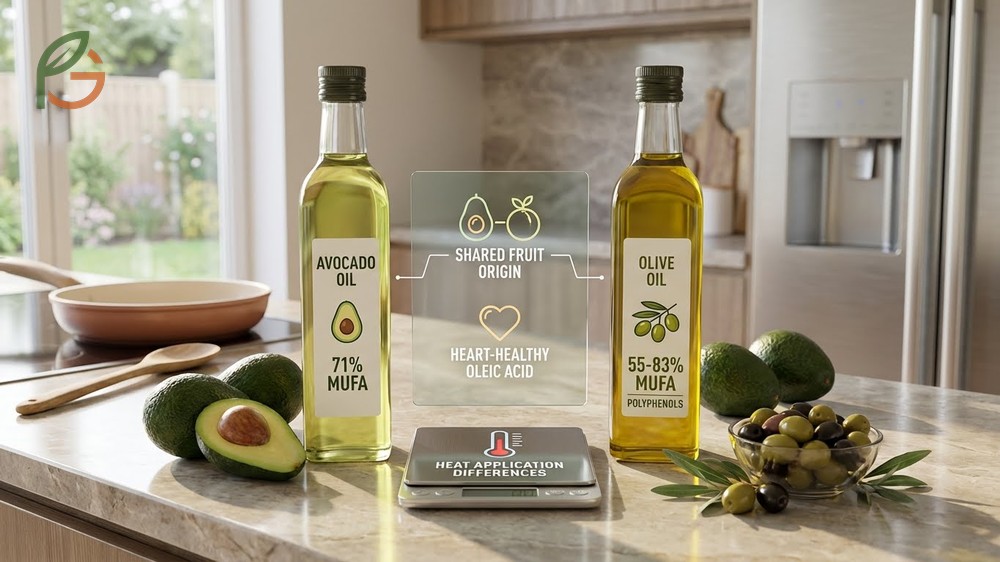
Both oils come from fruit rather than seeds, which gives them similar fatty acid profiles dominated by monounsaturated fats. Avocado oil contains 71% monounsaturated fatty acids (MUFA), while olive oil ranges from 55-83% depending on the variety.[2] This shared composition means you’re getting heart-healthy oleic acid from either choice.
The main differences appear when you apply heat or look at antioxidant content. Studies show that olive oil’s polyphenol levels drop as it ages, losing effectiveness over months of storage.[1] Avocado oil maintains stability longer due to its higher smoke point and lower polyunsaturated fat content.
What often gets overlooked is that cooking method matters more than the oil itself for most home cooks. If you’re searing steak at 450°F (232°C) or stir-frying vegetables over high heat, avocado oil won’t break down and form harmful compounds. For salad dressings or finishing dishes, olive oil’s flavor and antioxidants make it the better pick.
Smoke Point Differences
Smoke point tells you the temperature where an oil starts decomposing and releasing smoke. Avocado oil reaches approximately 520°F (270°C), while extra virgin olive oil typically ranges from 350-410°F (177-210°C).[1] This 110-170°F difference determines which cooking methods you can safely use.
When oil exceeds its smoke point, it oxidizes and breaks down into potentially harmful compounds like aldehydes and free radicals. Research demonstrates that heating olive oil beyond 410°F degrades its polyphenol content and nutritional value.[1] High-quality extra virgin olive oil can handle temperatures up to 410°F at bottling, but exposure to light and heat during storage gradually lowers this threshold.
Important Note: Don’t rely on smoke as your only indicator. Oils can oxidize before visible smoke appears, especially refined oils that’ve been stripped of protective compounds during processing.
Nutritional Profiles
Both oils deliver identical calorie counts and nearly matching macronutrient profiles. One tablespoon provides 120 calories and 14 grams of total fat, with 10 grams coming from monounsaturated fats.[1] The saturated fat content sits at 2 grams per serving for both options, meeting American Heart Association guidelines.
The vitamin E content shows a slight difference—olive oil provides 33% of the Daily Value per tablespoon compared to Avocado oil contains 2 grams of polyunsaturated fat versus olive oil’s 1.5 grams, though this difference doesn’t significantly impact health outcomes for most people.
This table compares calories, fat content, vitamin E levels, and oleic acid percentages between avocado oil and olive oil per one tablespoon serving
| Nutrient | Avocado Oil | Olive Oil |
|---|---|---|
| Calories | 120 kcal[1] | 120 kcal[1] |
| Total Fat | 14g[1] | 14g[1] |
| Monounsaturated Fat | 10g[1] | 10g[1] |
| Saturated Fat | 2g[1] | 2g[1] |
| Vitamin E (% DV) | 23%[1] | 33%[1] |
| Oleic Acid Content | 60-70%[2] | 55-83%[3] |
Avocado Oil Versus Olive Oil for Cooking
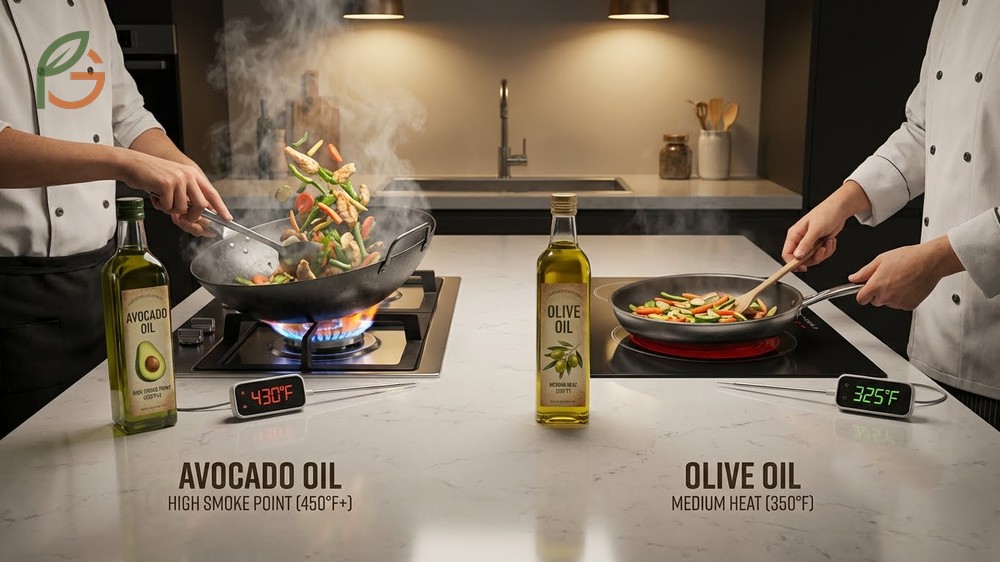
Cooking performance depends on matching the oil’s smoke point to your heat level. Stir-frying typically reaches 400-450°F (204-232°C), while deep frying hits 350-375°F (177-190°C). Avocado oil handles these temperatures without breaking down, but olive oil works fine for sautéing at medium heat around 300-350°F (149-177°C).
Current culinary guidance emphasizes that refined versions of both oils have higher smoke points than unrefined varieties. Refined avocado oil can reach 520°F while maintaining stability, whereas refined olive oil (not extra virgin) tolerates up to 465°F.[1] You’ll sacrifice some antioxidants with refined versions, but gain heat tolerance.
Most home cooks don’t need oil that handles 520°F unless they’re searing steaks or wok cooking at maximum heat. Research from consumer testing shows that medium-high heat cooking (375-400°F) covers most kitchen tasks—roasting vegetables, pan-frying chicken, or making omelets all fall within this range where both oils perform adequately.
Best Oil for High Heat Cooking
Avocado oil dominates the high-heat category because its molecular structure resists oxidation under extreme temperatures. Studies measuring oxidative stability show avocado oil produces fewer harmful aldehydes than olive oil when heated above 410°F.[1] This makes it safer for grilling, searing, and deep frying where temperatures regularly exceed 400°F.
The neutral flavor profile also matters for high-heat applications. Unlike extra virgin olive oil’s distinct taste, avocado oil won’t compete with your food’s natural flavors when you’re cooking steak or stir-frying vegetables. You can also reuse avocado oil more times than olive oil for frying because it degrades slower—typically 3-4 uses versus 2-3 for olive oil before it turns rancid.
- Searing steaks and pork chops at 450-500°F (232-260°C)
- Deep frying chicken, fish, or vegetables at 350-375°F (177-190°C)
- Wok cooking and stir-frying at 400-450°F (204-232°C)
- Grilling and roasting vegetables at 400-425°F (204-218°C)
- Pan-frying eggs and omelets at 300-350°F (149-177°C)
Flavor and Taste Comparison
Extra virgin olive oil brings robust, sometimes peppery notes that work beautifully in Mediterranean cooking and salad dressings. The flavor comes from polyphenols and natural compounds preserved during minimal processing. High-quality oils often have a grassy or fruity taste that can enhance pasta, bread dipping, and vegetable dishes.
Avocado oil tastes neutral to slightly buttery, making it versatile when you don’t want the oil to influence your dish’s flavor profile. This works well for baking, where olive oil’s strong taste might clash with sweet recipes. Some people describe refined avocado oil as having no discernible flavor at all, though cold-pressed versions carry a mild avocado essence.
Flavor Tip: If you’re substituting avocado oil for olive oil in recipes, expect less fruity complexity. You can add a squeeze of lemon juice or fresh herbs to compensate for the missing flavor depth in dressings.
Health Benefits Comparison
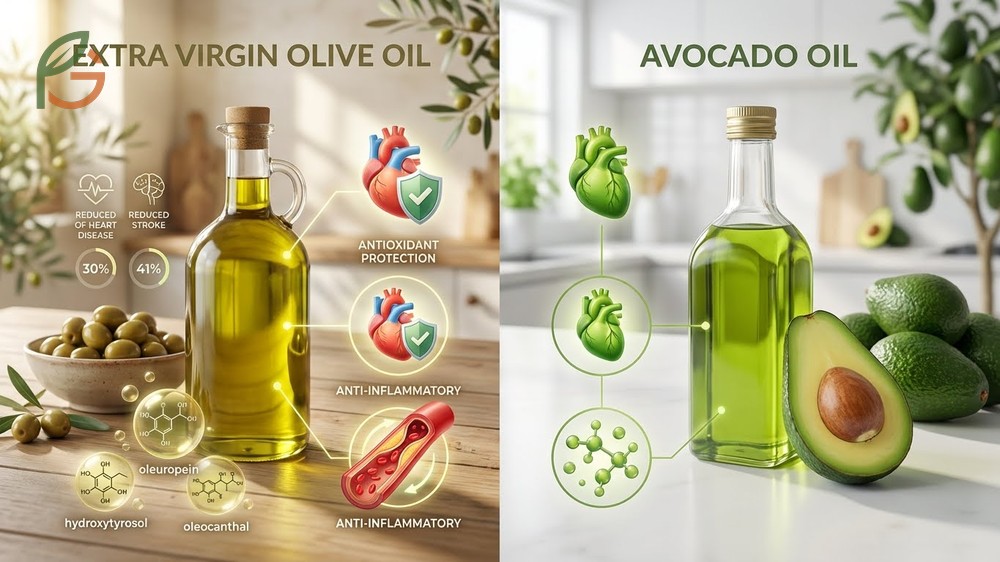
Extra virgin olive oil delivers superior antioxidant protection through polyphenols like hydroxytyrosol, oleocanthal, and oleuropein. Research involving 840,000 participants found that higher olive oil consumption reduced heart disease risk by 30% and stroke risk by 41%.[3] These polyphenols act as anti-inflammatory agents, working similarly to ibuprofen in reducing arterial inflammation.
Avocado oil supports cardiovascular health through different mechanisms. Studies show it can reduce LDL (bad) cholesterol and triglyceride levels while maintaining HDL (good) cholesterol.[2] The oil also contains lutein, an antioxidant that supports eye health and may benefit people with macular degeneration—though you’d get more lutein from 50 grams of cooked spinach than from cooking with avocado oil.
Both oils help your body absorb fat-soluble vitamins (A, D, E, K) from vegetables and fruits. Current nutritional guidance suggests consuming 1.5-2 tablespoons daily of either oil to support metabolic health without exceeding calorie needs. The evidence shows both oils fit well into fat-loss diets when used in moderation, with no clear winner for weight management.
- Support healthy blood lipid profiles by increasing HDL and reducing LDL cholesterol
- Contain oleic acid that enhances fat oxidation and promotes satiety for weight management
- Provide vitamin E with antioxidant properties that protect cells from oxidative damage
- Help enhance bioavailability of fat-soluble vitamins and phytochemicals from other foods
- Meet American Heart Association guidelines with under 4 grams saturated fat per serving
- Support metabolic health through monounsaturated fats that improve insulin sensitivity
Research Note: While both oils offer cardiovascular benefits, olive oil’s polyphenols provide documented anti-inflammatory effects that avocado oil can’t match. Choose olive oil when heart health is your primary concern.
Price and Availability
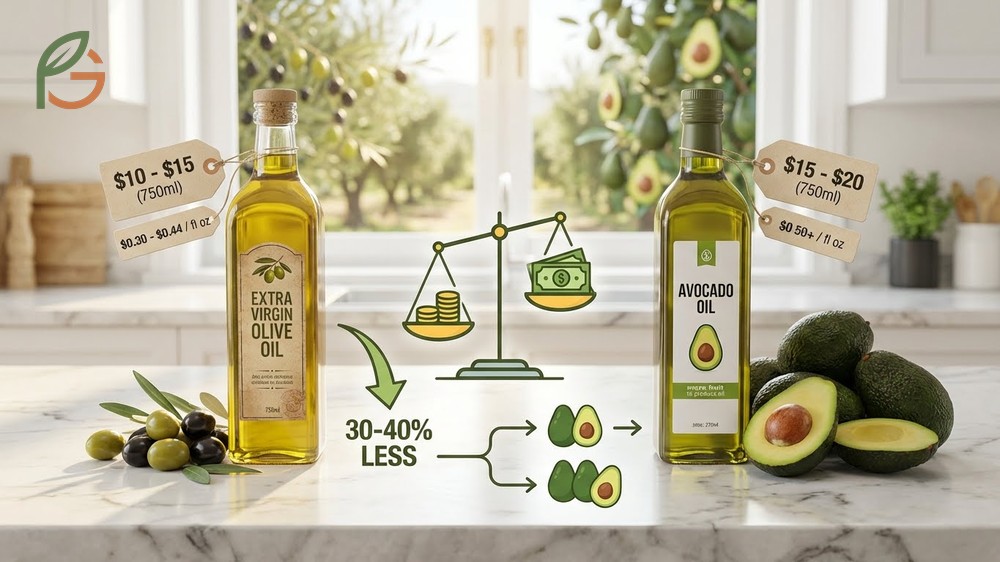
Olive oil typically costs 30-40% less than avocado oil for comparable quality levels. You’ll find olive oil priced around $0.30-0.44 per fluid ounce at most retailers, while avocado oil runs $0.50 or higher.[4] A 750ml bottle of decent extra virgin olive oil costs $10-15, compared to $15-20 for the same amount of avocado oil.
The price difference reflects production costs—extracting oil from avocados requires more fruit per liter than olive pressing. Avocados also grow in fewer regions globally, limiting supply. Some warehouse clubs offer better avocado oil pricing, with costs dropping to around $0.29 per ounce when you buy larger 1-liter bottles.[4]
Availability also favors olive oil—you’ll find it in every grocery store worldwide, with options ranging from budget to premium. Avocado oil remains less common outside areas where avocados grow naturally. Quality matters more than price for both oils, since cheap versions often contain refined or adulterated products that’ve lost nutritional value.
- Look for harvest dates on bottles—oils older than 12-18 months have degraded antioxidants
- Dark glass bottles protect oils from light damage better than clear plastic containers
- Cold-pressed or extra virgin labels indicate minimal processing that preserves nutrients
- Origin information and third-party testing certificates signal legitimate quality standards
- Very cheap oils (under $0.20/oz) are often diluted with lower-quality refined oils
Conclusion
The evidence is clear: avocado oil vs olive oil depends on your cooking method and health priorities. Choose avocado oil for high-heat cooking above 400°F (204°C)—searing, frying, and grilling—where its 520°F smoke point prevents oxidation. Pick extra virgin olive oil for dressings, finishing dishes, and medium-heat cooking up to 375°F (190°C) to maximize its polyphenol content that reduces heart disease risk by 30%.
Current nutritional guidance emphasizes quality over quantity with both oils. FruitGarden recommends keeping both in your kitchen—use avocado oil when you need heat stability and neutral flavor, switch to olive oil when you want antioxidants and robust taste. Since they deliver identical calories and similar monounsaturated fat profiles, the choice won’t impact your weight management efforts as long as you measure portions carefully.
Frequently Asked Questions
Is avocado oil healthier than olive oil?
Neither oil is definitively healthier—both provide 120 calories and 14g fat per tablespoon with similar monounsaturated fat content. Extra virgin olive oil contains more polyphenols that reduce heart disease risk by 30%, while avocado oil offers higher heat stability and more lutein for eye health. Choose based on your cooking needs rather than marginal nutritional differences.
Can I substitute avocado oil for olive oil in recipes?
Yes, you can substitute avocado oil for olive oil in a 1:1 ratio for most recipes. Expect a more neutral flavor profile since avocado oil lacks olive oil’s fruity, peppery notes. This substitution works especially well in baking and high-heat cooking where olive oil’s flavor might be undesirable or where temperatures exceed 410°F.
Which oil is better for frying—avocado or olive?
Avocado oil performs better for frying because its 520°F smoke point exceeds typical frying temperatures of 350-375°F. Olive oil’s 350-410°F range means it can oxidize during deep frying, producing harmful compounds and off-flavors. You can also reuse avocado oil 3-4 times versus 2-3 times for olive oil before it degrades.
Does avocado oil taste different from olive oil?
Yes, avocado oil has a neutral to slightly buttery taste compared to extra virgin olive oil’s robust, fruity, or peppery flavor. This difference comes from polyphenol content—olive oil’s strong taste reflects its high antioxidant levels, while avocado oil’s mild profile makes it versatile for dishes where you don’t want the oil’s flavor to dominate.
Why is avocado oil more expensive than olive oil?
Avocado oil costs 30-40% more because producing it requires more raw fruit per liter than olive pressing, and avocados grow in fewer regions worldwide. Production costs around $15-20 per 750ml bottle versus $10-15 for comparable olive oil. Limited supply and higher extraction costs drive the price difference, though warehouse clubs sometimes offer competitive pricing.
Can I use olive oil for high-heat cooking?
Extra virgin olive oil works for medium-heat cooking up to 375°F but shouldn’t be used for high-heat methods like searing or wok cooking above 410°F. At higher temperatures, olive oil oxidizes and loses its polyphenol content. For temperatures above 400°F, switch to avocado oil or use refined olive oil which tolerates up to 465°F.
Which oil is better for heart health?
Extra virgin olive oil provides stronger cardiovascular protection through polyphenols that reduce heart disease risk by 30% and stroke risk by 41% based on research with 840,000 participants. Both oils contain oleic acid and monounsaturated fats that support healthy cholesterol levels, but olive oil’s anti-inflammatory compounds offer additional benefits that avocado oil can’t match.