
How big do mulberry trees get? Most mulberry trees reach 30-70 feet tall depending on the species, with mature widths spanning 40-50 feet[1]. Research shows these fast-growing shade trees add 1-2 feet of height annually under ideal conditions, making them excellent choices for U.S. gardeners seeking rapid shade and fruit production[2]. FruitGarden provides expert guidance on selecting and managing mulberry varieties to match your landscape needs, from compact dwarf cultivars to towering standard specimens.
Quick Answer
- Standard mulberry trees grow 30-70 feet tall with 40-50 foot spreads at maturity[1]
- Growth rates average 1-2.5 feet per year with trees producing fruit in just 2-3 years[2]
- Dwarf varieties stay compact at 6-10 feet tall, perfect for small yards and containers[3]
- Lifespan ranges from 25-100+ years, with exceptional specimens reaching centuries[4]
How Big Do Mulberry Trees Get
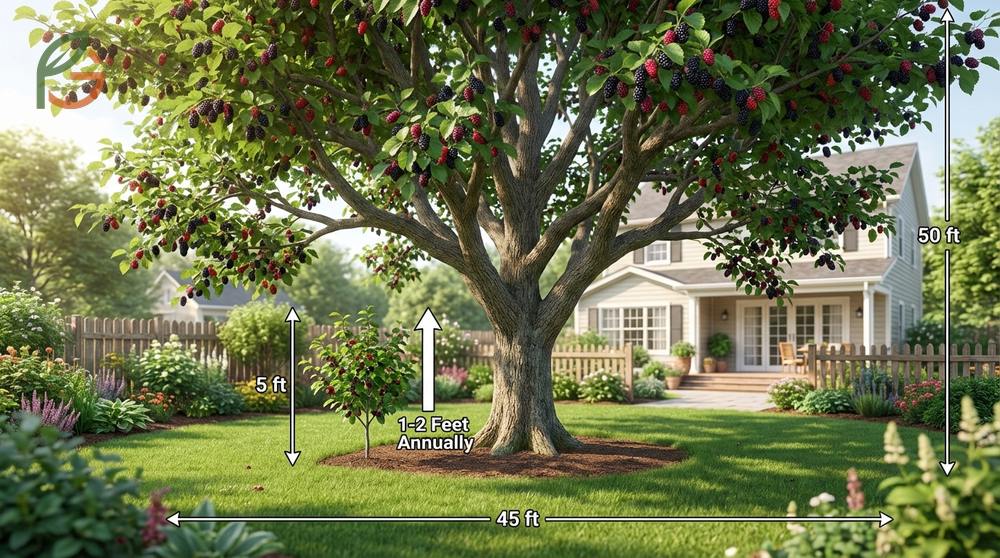
Standard mulberry trees achieve impressive dimensions that vary significantly by species. Red mulberry (Morus rubra) typically reaches 40-70 feet in height with a 40-50 foot spread when fully mature[1]. White mulberry (Morus alba) grows to 59 feet tall with a 32-foot spread, while black mulberry varieties range from 15-30 feet depending on cultivar[2].
These measurements represent ideal growing conditions with full sun exposure and adequate moisture. Trees planted in urban environments or less-than-optimal soils often stay smaller than their potential maximum height. Most U.S. gardeners can expect their mulberry trees to fill out considerably within 10-15 years of planting.
The canopy width often matches or exceeds the height, creating substantial shade coverage. This spreading habit makes mulberries excellent candidates for large yards but problematic near structures, sidewalks, or driveways where falling fruit creates maintenance challenges.
Red Mulberry Tree Size
Red mulberry stands as the largest native North American species. Research from Kansas Forest Service indicates mature specimens reach 30-50 feet in height and width, with exceptional trees exceeding 70 feet[4]. After 20 years of growth, most red mulberries stand 20-22 feet tall in Eastern and Central regions, with slightly smaller heights of 18-20 feet in Western areas.
The trunk diameter can reach 2-3 feet on mature specimens. This substantial girth combined with the tree’s moderate growth rate creates strong, long-lived shade trees ideal for parks and large residential properties.
From My Experience: My cousin in Guadalajara, Mexico planted a red mulberry sapling in March 2022. After three growing seasons, the tree reached 11 feet tall—slightly exceeding the typical 6-10 foot range for that timeframe, likely due to consistent watering and full sun exposure.
White Mulberry Tree Dimensions
White mulberry (Morus alba) grows rapidly to 50-60 feet with a medium spread. This Asian species naturalizes easily across North America, sometimes becoming invasive in favorable climates. Its fast growth rate and adaptability make it both popular and problematic in different contexts.
Dwarf white mulberry cultivars stay much smaller at 6-15 feet tall. These compact varieties offer the same sweet fruit production without the massive size, making them suitable for suburban yards and even container growing.
Black Mulberry Tree Measurements
Black mulberry (Morus nigra) typically reaches 15-30 feet tall with similar spread. This species grows slower than its white and red cousins but produces the highest quality fruit. The more compact stature makes black mulberry a favorite for fruit-focused gardeners with limited space.
Natural dwarf black mulberry varieties grow just 3-6 feet tall and wide. These miniature cultivars thrive in containers and small gardens while still producing abundant crops.
How Fast Do Mulberry Trees Grow
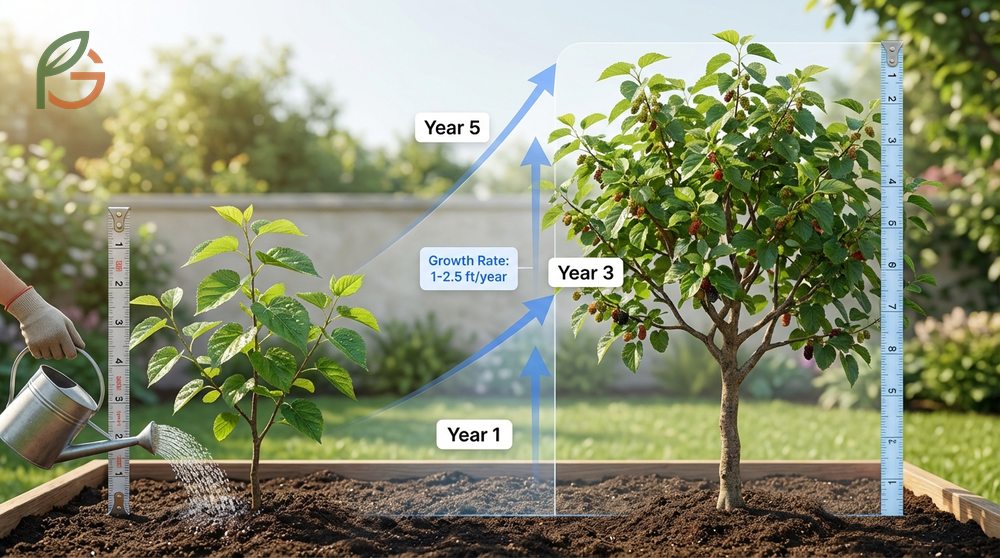
Mulberry trees grow at rates of 1-2.5 feet per year under ideal conditions[2]. This rapid pace makes them one of the faster-maturing fruit trees available to home gardeners. Young trees often exceed these averages during their first 5 years when vegetative growth peaks.
Studies demonstrate that mulberries planted in full sun with adequate water and nutrients can add 18-24 inches annually during establishment. Trees grown in partial shade or poor soils typically slow to 6-12 inches per year. The dramatic difference underscores the importance of site selection and initial care.
Most varieties begin producing fruit within 2-3 years of planting. This quick maturity sets mulberries apart from slower trees like apples or pears that require 4-6 years before bearing. By year five, a well-maintained mulberry can reach 10-15 feet and produce several pounds of berries.
Mulberry Tree Growth Timeline
Year one focuses on root establishment with 6-12 inches of height gain. The tree prioritizes underground development over visible growth, spreading roots widely to anchor itself and access water. Don’t expect dramatic size increases during this critical foundation phase.
Years 2-3 bring rapid vertical growth of 1-2 feet annually. The established root system now supports vigorous shoot development and canopy expansion. Most trees reach 5-10 feet tall by the end of year three and begin flowering.
Years 4-10 see continued strong growth of 12-18 inches per year as the tree approaches mature size. Growth gradually slows as the canopy fills out and energy shifts toward fruit production. By year 10, standard varieties typically stand 20-30 feet tall.
Important Note: Container-grown mulberries grow 30-50% slower than ground-planted trees due to root restriction. Expect 6-12 inches of annual growth in pots versus 12-24 inches in optimal soil conditions.
Factors Affecting Mulberry Growth Rate
Sunlight exposure directly impacts growth speed. Trees receiving 6-8 hours of direct sun daily consistently outperform those in partial shade by 50-100%. The difference between full sun and 4-hour sun exposure can mean 18 inches versus 9 inches of annual growth.
Soil quality plays an equally critical role. Mulberries tolerate various soil types but thrive in deep, well-drained loam with pH 6.0-7.0. Trees planted in compacted clay or sandy soils with poor water retention grow 40-60% slower than those in ideal conditions.
- Full sun exposure (minimum 6 hours daily) boosts growth by 50-100% compared to shade
- Consistent moisture during the growing season, especially in the first 3 years
- Well-drained soil rich in organic matter with neutral to slightly acidic pH
- Annual fertilization with balanced 10-10-10 formula in early spring
- Protection from harsh winds that can damage young branches and slow development
- Regular pruning to shape growth and remove competing branches
- Adequate spacing (15-30 feet) to prevent root competition from nearby trees
Dwarf Mulberry Tree Size
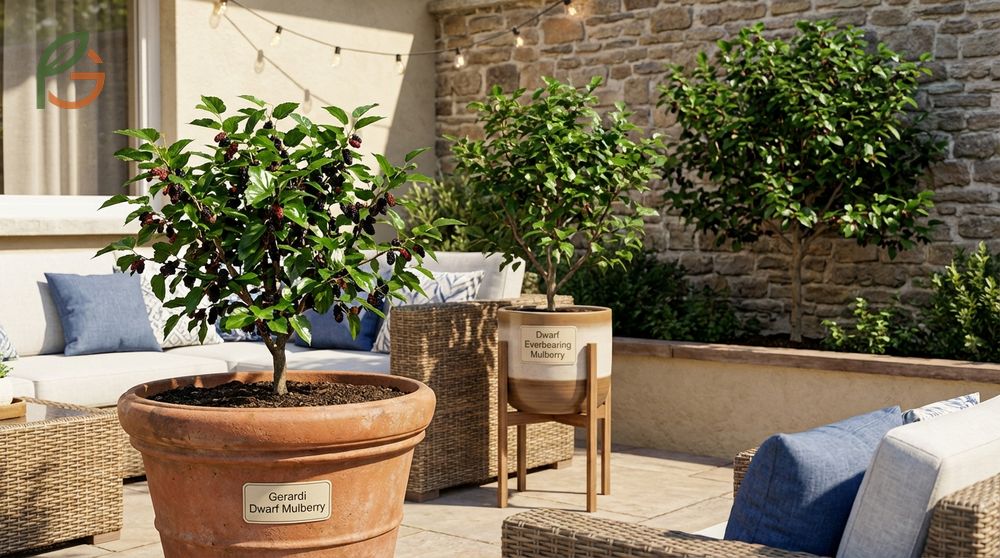
Dwarf mulberry cultivars range from 6-10 feet tall at maturity, making them perfect for small yards and container growing[3]. These naturally compact varieties produce full-sized fruit on trees one-third the size of standard specimens. Popular dwarf options include Dwarf Everbearing, Gerardi Dwarf, and Thai Dwarf.
The smallest varieties like natural dwarf black mulberry reach just 3-4 feet tall and wide. These ultra-compact trees work beautifully in large pots on patios or balconies. Despite their diminutive stature, they produce surprisingly abundant crops when properly maintained.
Container-grown dwarf mulberries need pots at least 20 inches wide and deep to accommodate root growth. Trees can thrive in containers for 10-15 years with proper watering and annual top-dressing of fresh soil. This longevity makes them viable long-term options for space-limited gardeners.
This table compares height, width, and growing zones for five popular dwarf mulberry varieties suitable for small gardens
| Variety | Mature Height | Mature Width | USDA Zones |
|---|---|---|---|
| Dwarf Everbearing | 6-10 feet[3] | 6-8 feet | 7-11 |
| Gerardi Dwarf | 8-10 feet | 6-8 feet | 6-10 |
| Thai Dwarf | 6-8 feet | 5-7 feet | 8-11 |
| Natural Dwarf Black | 3-4 feet | 3-4 feet | 7-10 |
| Weeping Mulberry | 6-10 feet | 8-12 feet | 5-9 |
- Easier harvesting with all fruit within arm’s reach from ground level
- Reduced pruning requirements compared to standard 40-foot specimens
- Container compatibility for patios, decks, and balcony gardens
- Faster time to first harvest, often producing fruit in just 2 years
- Lower staining risk with contained fruit drop in small spaces
- Perfect for urban yards with overhead utility line restrictions
Mulberry Tree Spacing Requirements
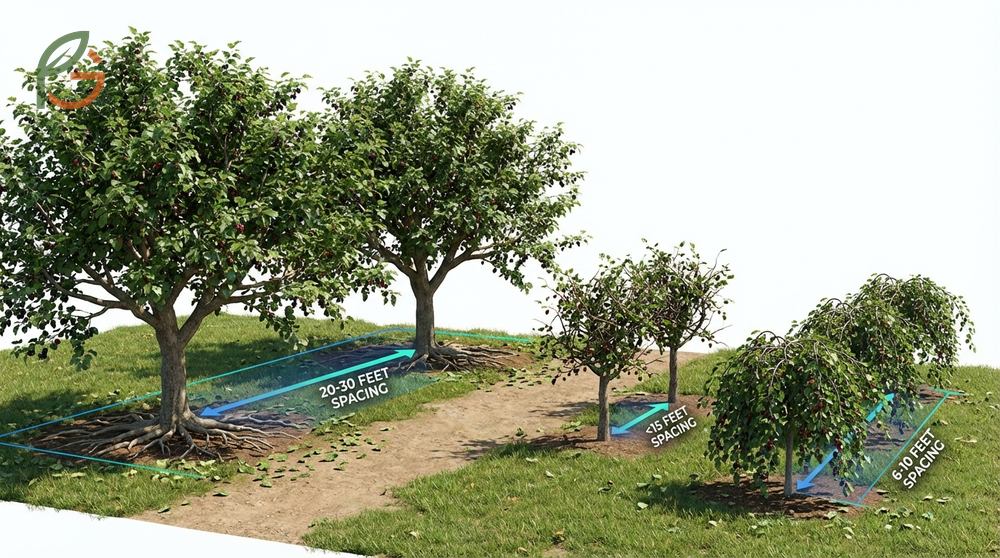
Standard mulberry trees need 20-30 feet of spacing between specimens to prevent root competition and canopy overcrowding[5]. This generous distance allows each tree to develop its natural spreading form without interference. Trees planted closer than 15 feet often show stunted growth and reduced fruit production.
Dwarf and weeping varieties require just 6-10 feet of spacing. Their compact canopies don’t expand as aggressively, allowing tighter planting in small yards. Some gardeners successfully grow dwarf mulberries in hedgerow formations with 4-5 foot spacing when maintained through annual pruning.
Distance from structures matters equally. Plant standard mulberries at least 20 feet from buildings, driveways, and sidewalks to avoid foundation damage from roots and staining from falling fruit. The aggressive root systems can crack pavement and clog drainage pipes when planted too close to hardscaping.
Spacing Tip: If you’re planting multiple rows of mulberry trees for orchard production, maintain 25-30 feet between rows for standard varieties and 15-20 feet for semi-dwarf types. This spacing allows equipment access and provides adequate airflow to reduce disease pressure.
Keeping Mulberry Trees Small
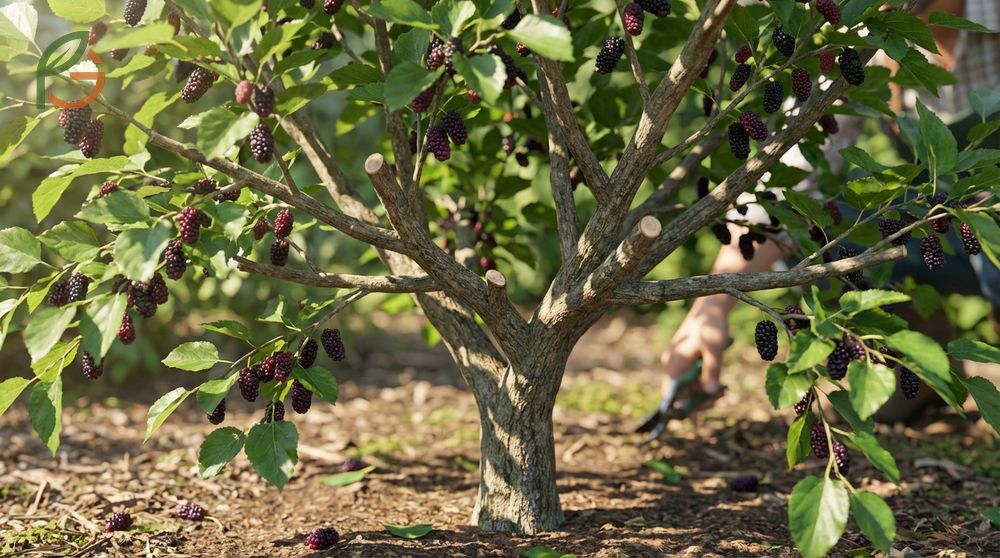
Regular pruning keeps mulberry trees at manageable heights of 8-12 feet for easier harvesting. Late winter pruning, performed in February or early March before buds swell, shapes the tree and controls size without sacrificing fruit production. Remove vigorous upright shoots and head back lateral branches to outward-facing buds.
Summer pruning in July further restricts size by cutting back new growth to 4-5 leaves. This technique redirects energy into fruit development rather than excessive vegetative growth. Trees maintained through both winter and summer pruning stay 40-60% smaller than unpruned specimens.
Container growing naturally restricts size through root confinement. Mulberries in 20-25 gallon pots typically max out at 6-8 feet tall regardless of variety. The limited root volume prevents the vigorous growth seen in ground-planted trees.
- Prune in late winter when dormant, avoiding periods below 50°F (10°C)
- Limit cuts to branches under 2 inches diameter to prevent bleeding and disease entry
- Head back vigorous shoots by one-third to encourage branching instead of height
- Remove crossing or rubbing branches that waste energy and create wounds
- Train to an open center or modified central leader for controlled height
- Summer prune in July to restrict seasonal growth and maintain compact form
- Choose naturally dwarf varieties if you want minimal pruning requirements
Root pruning once every 3-4 years limits underground spread and slows top growth. Use a sharp spade to cut a circle 3-4 feet from the trunk, severing outer roots. This controlled restriction keeps the tree compact without the severe stress of transplanting.
How Long Do Mulberry Trees Live
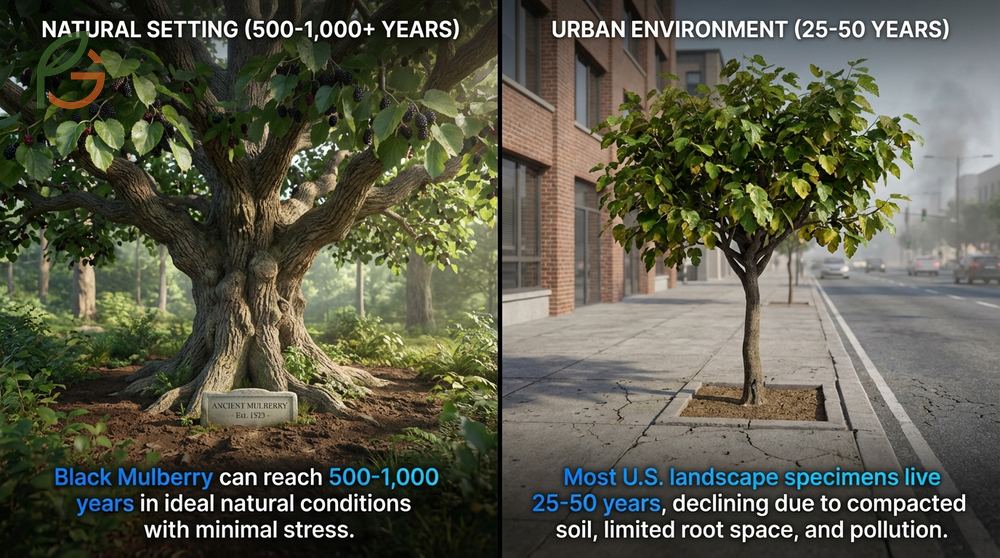
Mulberry trees typically live 30-100 years depending on species and growing conditions[4]. Black mulberry specimens can potentially reach 500-1,000 years in ideal natural settings with minimal stress and disease pressure. Most U.S. landscape specimens live 25-50 years before declining from urban environmental factors.
Urban and suburban trees face shortened lifespans compared to natural forest settings. Compacted soil, limited root space, pollution, and mechanical damage from lawnmowers reduce typical lifespan to 25-40 years. Trees planted in parks or large properties with better growing conditions often exceed 75 years.
Proper care extends productive lifespan significantly. Regular watering during establishment, protection from pests and diseases, and appropriate pruning help trees reach their genetic potential. Well-maintained mulberries continue producing abundant fruit for 30-50 years or more.
| Environment | Average Lifespan | Maximum Potential |
|---|---|---|
| Urban/Landscape | 25-50 years[4] | 75 years |
| Natural Forest | 75-100+ years | 500-1,000 years (black mulberry) |
| Container Grown | 10-20 years[3] | 30 years with repotting |
Conclusion
The evidence is clear: how big do mulberry trees get depends primarily on species selection and growing conditions. Standard varieties reach impressive 30-70 foot heights with comparable spreads, while dwarf cultivars stay manageable at 6-10 feet. Growth rates of 1-2.5 feet annually make mulberries among the fastest-maturing fruit trees for U.S. gardens.
Current horticultural guidance emphasizes matching tree size to available space through careful variety selection and proactive pruning. Whether you choose a towering shade tree or a compact patio specimen, FruitGarden recommends prioritizing proper spacing, consistent care, and annual maintenance to maximize both tree health and fruit production for decades to come.
Frequently Asked Questions
How tall is a full grown mulberry tree?
Full grown mulberry trees typically reach 30-70 feet tall depending on species. Red mulberry grows 40-70 feet, white mulberry reaches about 50-60 feet, and black mulberry stays smaller at 15-30 feet. Dwarf varieties mature at just 6-10 feet, making them suitable for small yards and containers.
What is the growth rate of mulberry trees per year?
Mulberry trees grow 1-2.5 feet per year under optimal conditions. Young trees often add 18-24 inches annually during their first 5 years in full sun with adequate water. Growth slows to 6-12 inches per year in partial shade or poor soil conditions.
When should you prune mulberry trees?
Prune mulberry trees in late winter, ideally February or early March before buds turn green. This timing allows you to see the tree structure clearly and minimizes sap bleeding. Avoid pruning when temperatures drop below 50°F (10°C), as cold weather makes it harder for cuts to heal properly.
How far apart should mulberry trees be planted?
Standard mulberry trees need 20-30 feet of spacing to prevent root competition and allow full canopy development. Dwarf and weeping varieties require just 6-10 feet between trees. Plant at least 20 feet from buildings and sidewalks to avoid foundation damage and fruit staining issues.
Can you keep a mulberry tree small?
Yes, you can keep mulberry trees small through annual pruning and variety selection. Late winter pruning controls height and shape, while summer pruning in July restricts new growth. Choosing naturally dwarf varieties or growing in containers also limits size to 6-10 feet without intensive pruning.
How long do mulberry trees take to bear fruit?
Most mulberry trees begin producing fruit within 2-3 years of planting. This rapid maturity makes them faster than many fruit trees like apples or pears that require 4-6 years. Dwarf varieties often fruit even sooner, sometimes bearing berries in their second growing season.
What is the maximum lifespan of mulberry trees?
Mulberry trees live 30-100 years on average, with exceptional black mulberry specimens reaching 500-1,000 years in ideal natural conditions. Urban landscape trees typically live 25-50 years due to environmental stresses, while well-maintained trees in good locations often exceed 75 years of productive life.





