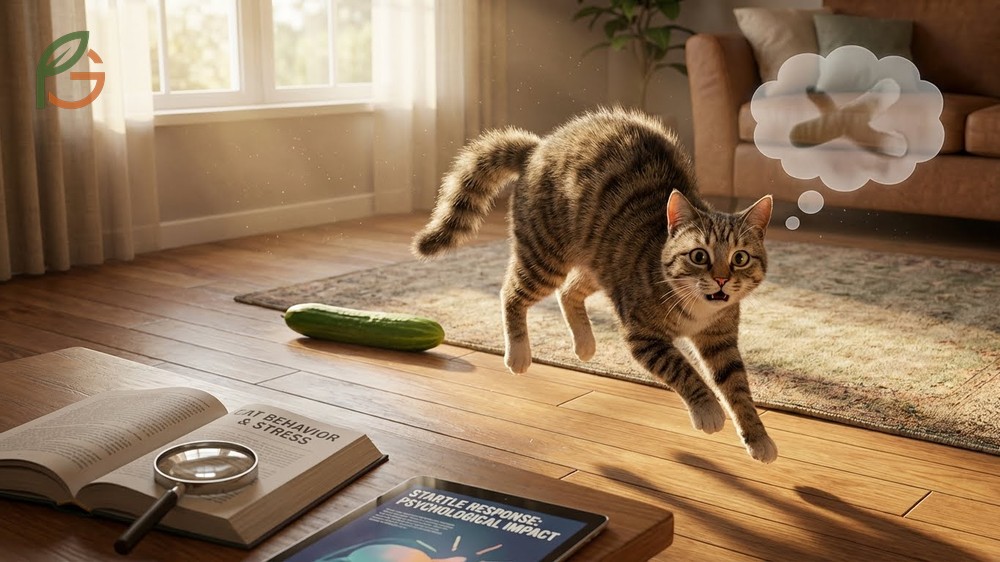
Why are cats scared of cucumbers? It’s not about snake fear—cats react to the sudden appearance of an unexpected object in their safe space. Research shows this startle response triggers intense flight reactions that can cause serious psychological stress[1]. Most people don’t realize that what seems like a harmless prank can lead to long-term behavioral problems in cats. FruitGarden explores the science behind this viral phenomenon and why animal behaviorists strongly discourage it.
Quick Answer
- Cats aren’t naturally afraid of cucumbers—they’re reacting to sudden, unexpected objects appearing in their safe zones[2]
- The startle response involves muscle stiffening and rapid movement as the cat’s body prepares to flee from perceived danger[3]
- Studies show stress from sudden scares can increase disease risk nearly 5 times in affected cats[4]
- Animal behaviorists and veterinarians unanimously condemn this practice as cruel and potentially harmful[1]
Why Are Cats Scared of Cucumbers
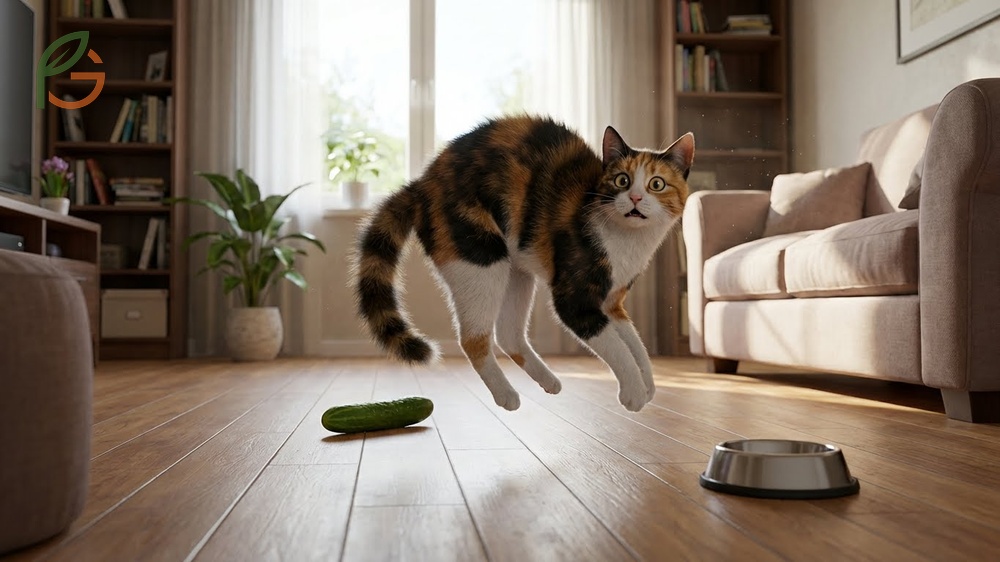
Cats aren’t inherently afraid of cucumbers—they’re reacting to the unexpected appearance of any unfamiliar object in their territory. Dr. Pamela Perry, a behaviorist specialist at Cornell Feline Health Center, explains that the sudden presence of a novel object triggers the reaction, not the cucumber itself[2]. You could get the same dramatic response with a banana, zucchini, or even a toy.
The viral videos work because they exploit a fundamental aspect of feline psychology. Cats are hypersensitive to changes in their environment, especially in areas they consider safe[5]. When they turn around from eating and see something that wasn’t there moments before, their brains interpret it as a potential threat.
Research demonstrates that cats rely heavily on environmental predictability. Unlike dogs, who’ve evolved to be more adaptable to human environments, cats maintain strong territorial instincts. This means they continuously monitor their surroundings for changes that might signal danger.
The Startle Response Explained
The startle response in cats involves visible muscle stiffening followed by rapid body movement. According to research published in the Journal of Feline Medicine and Surgery, this response is recognized by the cat’s muscles visibly stiffening and the cat moving its body very quickly—perhaps jumping in the air when the stressor is intense[3]. It’s an involuntary reaction that prepares the animal to flee from perceived danger.
This automatic response triggers a cascade of physiological changes. The cat’s pupils dilate, fur stands on end (piloerection), and stress hormones flood the bloodstream. These changes happen in milliseconds, which is why the jumps in viral videos look so dramatic.
Why Feeding Areas Amplify the Reaction
Cats are hard-wired to be territorial about their feeding areas. When people place cucumbers near cats during meals, they’re violating what feline behaviorist Pam Johnson-Bennett calls the cat’s safe zone[1]. This amplifies the fear response because the cat associates eating with safety and security.
The confusion is compounded by the cat’s vulnerable position. While eating, cats are focused on their food and can’t maintain their usual vigilance. Discovering an unexpected object during this vulnerable moment creates maximum shock.
Do Cucumbers Look Like Snakes to Cats
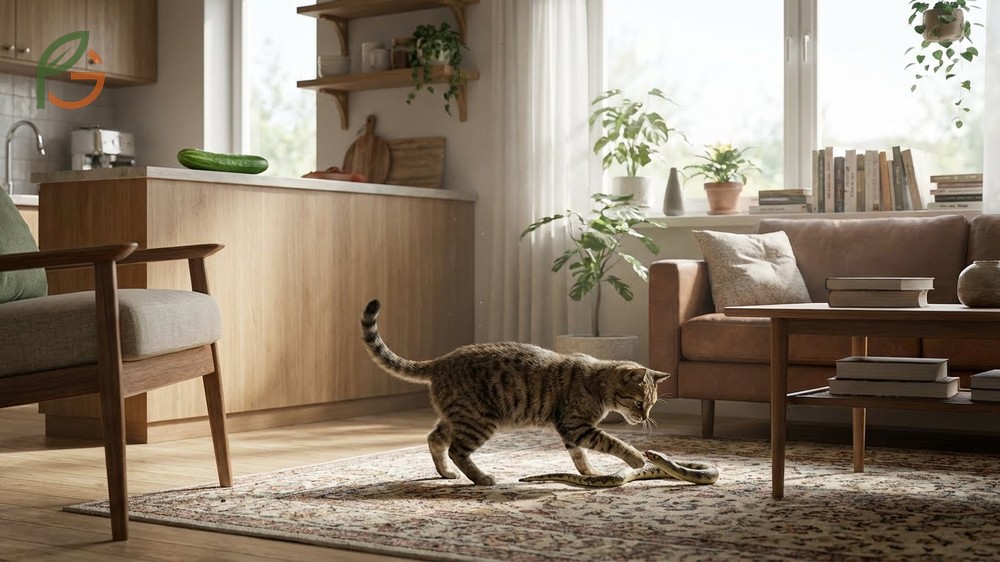
The snake theory is the most popular explanation online, but experts disagree with it. Cornell’s Dr. Perry directly refutes this idea, noting that cats don’t have a natural fear of snakes—in fact, many cats hunt snakes[2]. She’s even had cats bring live snakes as “gifts.”
While cucumbers might resemble snakes in size and shape, this similarity isn’t what drives the reaction. If cats truly feared snakes instinctively, they’d react to cucumbers regardless of placement. Instead, the reaction only happens when the cucumber appears suddenly in an unexpected location.
The Snake Theory Debunked
Some sources cite evolutionary hardwiring against snakes, but this doesn’t hold up under scrutiny. Cats are predators who regularly hunt animals similar in appearance to snakes—including lizards, worms, and even small snakes themselves. An innate fear of snake-shaped objects would actually hinder their hunting abilities.
The green color also doesn’t explain the reaction. Cats have limited color vision compared to humans and rely more on movement and shape. They wouldn’t necessarily perceive green as distinctly as we do.
What Really Triggers the Fear
Current evidence points to three key factors: suddenness, unexpectedness, and context. The object appears without warning in a space the cat just surveyed moments ago. It’s not the cucumber’s appearance but its impossible materialization that triggers alarm.
Jill Goldman, a certified animal behaviorist, explains that cucumbers (and other produce) trigger a natural startle reflex because cats simply don’t expect to encounter such objects on the ground[1]. The unfamiliar smell adds another layer of strangeness to the experience.
Important Note: You’ll get similar reactions if you sneak up behind a cat with almost any unfamiliar object. The cucumber itself isn’t special—it’s just what people happen to use in these videos.
Cat Behavioral Psychology Behind the Reaction
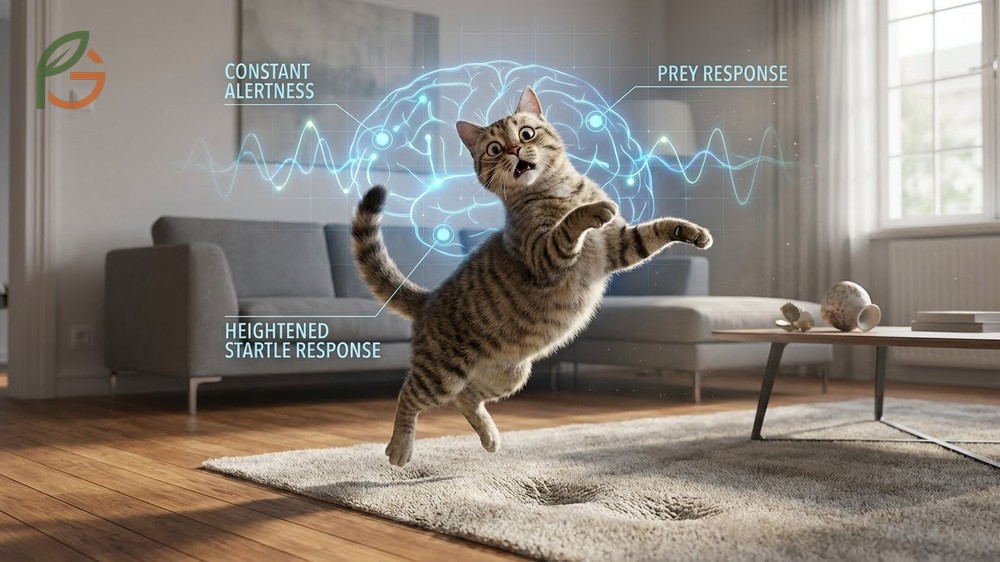
Understanding why cats react so dramatically requires looking at their behavioral psychology. Cats are both predators and prey animals, which means they’ve evolved to be constantly alert for threats. This dual nature makes them especially sensitive to unexpected stimuli in their environment.
Studies show that stressed cats exhibit heightened startle responses—they’ll jump at the slightest noise or sudden movement[4]. Once a cat associates its home environment with unpredictability, this heightened state can become chronic.
How Cats Process Unexpected Stimuli
Cats process threats through a specific behavioral sequence: freezing, assessing, then fleeing or fighting. Research identifies freezing as the initial response to stressors, helping the cat avoid drawing attention to itself[3]. With increasing stressor intensity, this transitions to escape behaviors.
The cucumber videos skip the freezing stage because the stimulus is immediate and high-intensity. The cats go straight to maximum escape response—the dramatic jumps and sprints we see online.
The Flight Response Mechanism
When startled, cats experience a surge of stress hormones including cortisol and adrenaline. Their heart rate spikes, blood pressure increases, and muscles tense for action. This fight-or-flight response is meant to be brief—a quick reaction to immediate danger followed by return to baseline.
The problem with repeated scares is that cats can’t contextualize them as “pranks.” Each incident reinforces the idea that their environment is unpredictable and potentially dangerous. This can lead to chronic stress states where the cat remains constantly vigilant.
- Hiding for extended periods and avoiding social interaction
- Reduced exploratory behavior and less playtime
- Changes in eating patterns, including stress-induced anorexia
- Increased aggression or redirected aggression toward people or other pets
- Development of compulsive behaviors like over-grooming
- Loss of litter box training and inappropriate elimination
- Heightened startle responses to normal household sounds
Is It Cruel to Scare Cats with Cucumbers
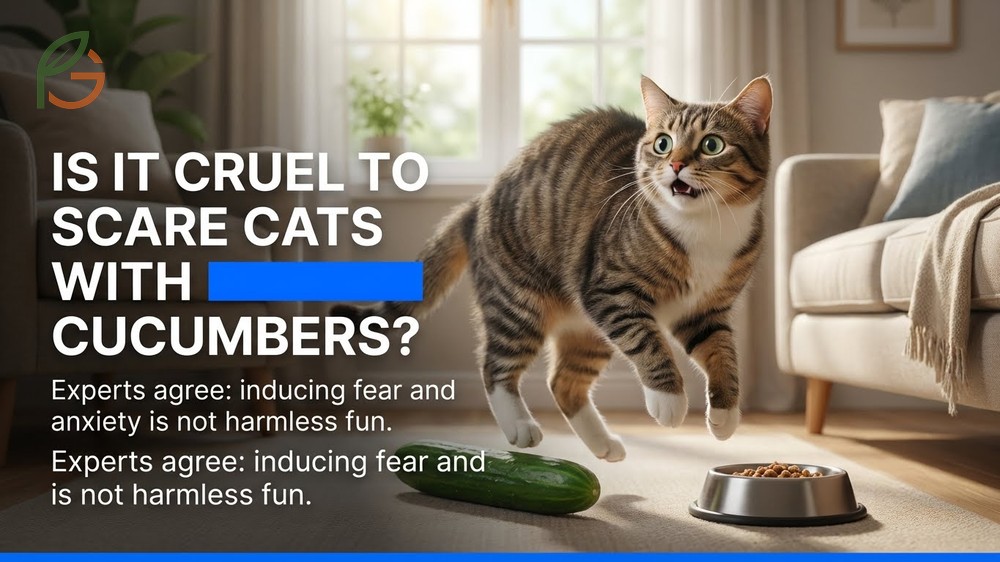
Animal welfare experts and behaviorists unanimously agree that scaring cats with cucumbers is cruel. Goldman states plainly: “If you induce stress in an animal, that’s probably not a good thing”[1]. What seems like harmless fun to humans causes genuine fear and anxiety in cats.
Lara Chan from the Calgary Cat Clinic warns about long-term psychological problems, noting that some cats are quite delicate[6]. The videos show cats reacting because they’re genuinely worried something will hurt them—there’s nothing funny about that fear.
Psychological Stress and Health Risks
Stress doesn’t just affect behavior—it impacts physical health. Research demonstrates that cats with high stress levels are nearly five times more likely to develop upper respiratory infections than cats with lower stress[4]. Chronic stress suppresses immune function and can reactivate dormant infections.
Stress-induced anorexia represents another serious risk. When cats stop eating due to fear or anxiety, they can develop hepatic lipidosis—a potentially fatal liver condition. This is especially common in overweight cats who experience sudden stress.
Long-term Behavioral Consequences
The behavioral fallout from cucumber pranks can be severe. Cats may develop fear of their food bowls, refuse to eat in their usual spots, or become generally anxious about their environment. Some become aggressive or withdraw from family interaction entirely.
Trust is another casualty. Cats depend on their owners for safety and security. When you deliberately frighten them, they start associating you with unpredictable threats rather than protection.
- Creates chronic anxiety and makes cats constantly jumpy and fearful
- Can trigger serious medical conditions including hepatic lipidosis from stress-induced anorexia
- Damages the human-animal bond as cats lose trust in their owners
- May cause irrational fears such as fear of food bowls or feeding areas
- Increases risk of behavioral problems including aggression and compulsive disorders
Warning: Even a single frightening incident can have lasting effects. Some cats develop permanent anxiety about their feeding areas or become hypervigilant throughout their homes. The short-term entertainment isn’t worth the potential long-term harm to your cat’s wellbeing.
Conclusion
The evidence is clear: cats aren’t scared of cucumbers—they’re reacting to the sudden, unexpected appearance of any unfamiliar object in their safe space. This startle response is an involuntary survival mechanism, not entertainment. Current guidance from animal behaviorists and veterinarians emphasizes that these pranks cause genuine psychological stress and can lead to serious health problems.
If you’re like most Americans who love their pets, skip the cucumber videos and find ways to enrich your cat’s life that don’t involve fear. FruitGarden encourages cat owners to build trust through positive interactions, not betray it through pranks that seem harmless to us but feel terrifying to them.
Frequently Asked Questions
Are all cats afraid of cucumbers?
No, not all cats react to cucumbers. The reaction depends on the individual cat’s temperament, the suddenness of the placement, and the context. Some cats barely notice, while others have extreme reactions. It’s the unexpected appearance that triggers fear, not the cucumber itself.
Why do cats jump so high when they see cucumbers?
Cats jump high because their startle response triggers an immediate flight reaction. When startled, cats attempt to escape quickly and evaluate the situation from a safe distance. The high jumps are their bodies’ involuntary attempt to get away from perceived danger as fast as possible.
Can scaring a cat with a cucumber cause permanent damage?
Yes, veterinarians warn that frightening cats can cause long-term psychological problems. Cats may develop chronic anxiety, fear of feeding areas, behavioral issues like aggression or over-grooming, and even stress-related health conditions. Some cats become permanently more fearful and reactive after traumatic scares.
Do cats really think cucumbers are snakes?
No, experts have debunked the snake theory. Cornell behaviorist Dr. Pamela Perry explains that cats don’t have a natural fear of snakes—many cats actually hunt snakes. The reaction is caused by the sudden appearance of an unexpected object, not because cucumbers resemble snakes.
Will other vegetables scare cats the same way?
Yes, any unfamiliar object placed suddenly behind a cat can trigger the same reaction. People have reported similar responses to bananas, zucchinis, water bottles, and toys. It’s the unexpected appearance in the cat’s safe space that causes fear, not the specific object.
How can I tell if my cat is stressed?
Stressed cats show several behavioral changes: hiding more often, eating less, heightened startle responses to normal sounds, reduced play and exploration, changes in litter box habits, over-grooming, or becoming more aggressive or withdrawn. Chronic stress can also weaken their immune system and increase infection risk.
What should I do if I’ve already scared my cat with a cucumber?
Stop immediately and give your cat space to calm down. Rebuild trust through positive interactions—offer treats, engage in gentle play, and maintain consistent routines. Monitor for signs of lasting stress like appetite changes or hiding. If anxiety persists, consult your veterinarian about behavioral support.