
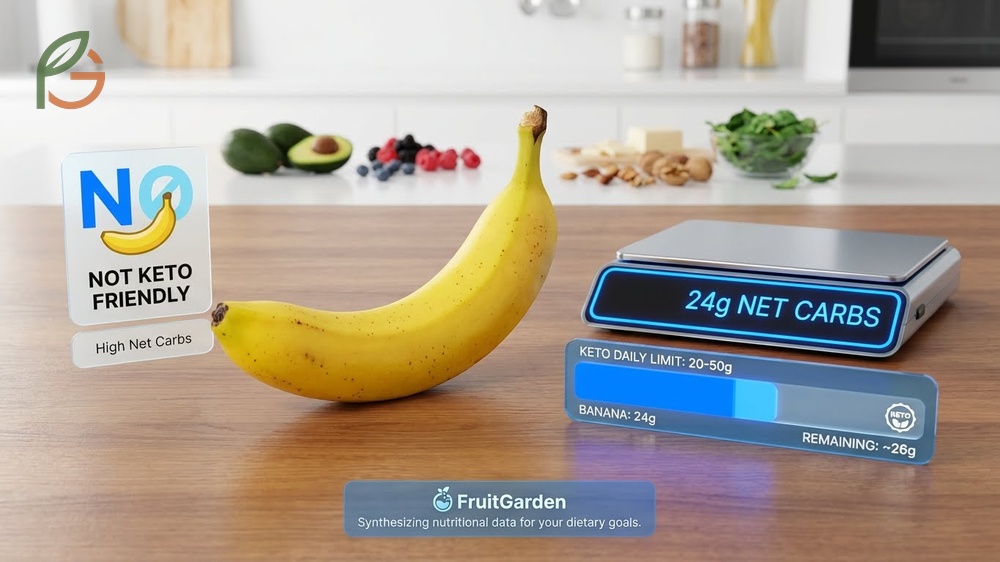
Are bananas keto friendly? No, they’re not—a medium banana contains 24g net carbs, which consumes nearly half of the standard 50g daily keto limit.[1][2] Research shows that successful keto adherence requires keeping net carbs between 20-50g daily to maintain ketosis. FruitGarden synthesizes current nutritional data and agricultural research to help you understand which fruits support your dietary goals and which ones don’t.
Quick Answer
- A medium banana (118g) contains 27g total carbs and 3g fiber, resulting in 24g net carbs[1]
- Standard keto diets limit daily net carbs to 20-50g to maintain ketosis[2]
- One medium banana uses 48-120% of your daily keto carb allowance, making it incompatible with most ketogenic meal plans
- Better alternatives include raspberries (7g net carbs per cup), blackberries (4g per 100g), and avocados (2g per 100g)[3]
Are Bananas Keto Friendly
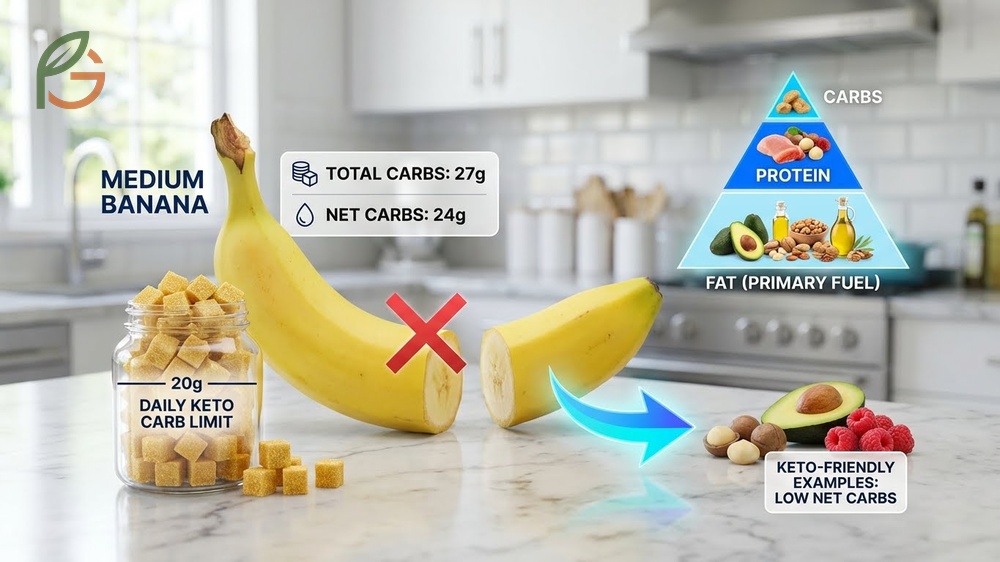
Bananas don’t fit into standard ketogenic diets due to their high carbohydrate content. A medium banana delivers 27g of total carbohydrates with only 3g of fiber, leaving 24g of net carbs that directly impact blood sugar and ketosis.[1] This single serving represents 48% of a 50g daily limit or 120% of a stricter 20g threshold.
The ketogenic diet works by forcing your body into ketosis, a metabolic state where fat becomes the primary fuel source instead of glucose. Studies demonstrate that maintaining ketosis requires limiting net carbohydrates to 20-50g per day, with stricter protocols recommending just 5-10% of total daily calories from carbs.[2] A single banana disrupts this delicate balance.
Current nutritional guidance emphasizes that fruit selection matters significantly for keto adherents. While bananas provide valuable nutrients like potassium (422mg per medium fruit) and vitamin B6, their carbohydrate load makes them incompatible with ketogenic macronutrient ratios.[4] Most people find they can’t include bananas without exceeding their carb limits.
Why Bananas Exceed Keto Limits
The carbohydrate composition of bananas makes them particularly problematic for keto dieters. Research shows that 93% of a banana’s calories come from carbohydrates, with only 4% from protein and 3% from fat—the exact opposite of keto’s desired macronutrient distribution of 70-75% fat, 15-20% protein, and just 5-10% carbs.[5]
Most keto practitioners discover that eating a medium banana for breakfast eliminates flexibility for other carb-containing foods throughout the day. This leaves minimal room for nutrient-dense vegetables like spinach (1g net carbs per cup), broccoli (4g per cup), or cauliflower (3g per cup) that provide essential vitamins without compromising ketosis.
Glycemic Impact
Bananas have a moderate glycemic response that can disrupt ketone production. Evidence suggests that ripe bananas have a glycemic index of 51, with a glycemic load of 13 for a medium fruit—both falling into the moderate category.[6] This triggers an insulin response strong enough to halt ketosis temporarily.
The ripeness factor amplifies this effect. As bananas ripen, resistant starch converts to simple sugars, raising the glycemic index from as low as 30 for green bananas to potentially 62 or higher for fully ripe fruits with brown spots. This sugar conversion makes ripe bananas even less suitable for ketogenic diets than their unripe counterparts.
Important Note: Even a small banana (6 inches, 101g) contains 19g net carbs, which still represents 38-95% of most keto carb limits. There’s no practical way to portion-control bananas into a strict ketogenic diet.
Banana Carb Content
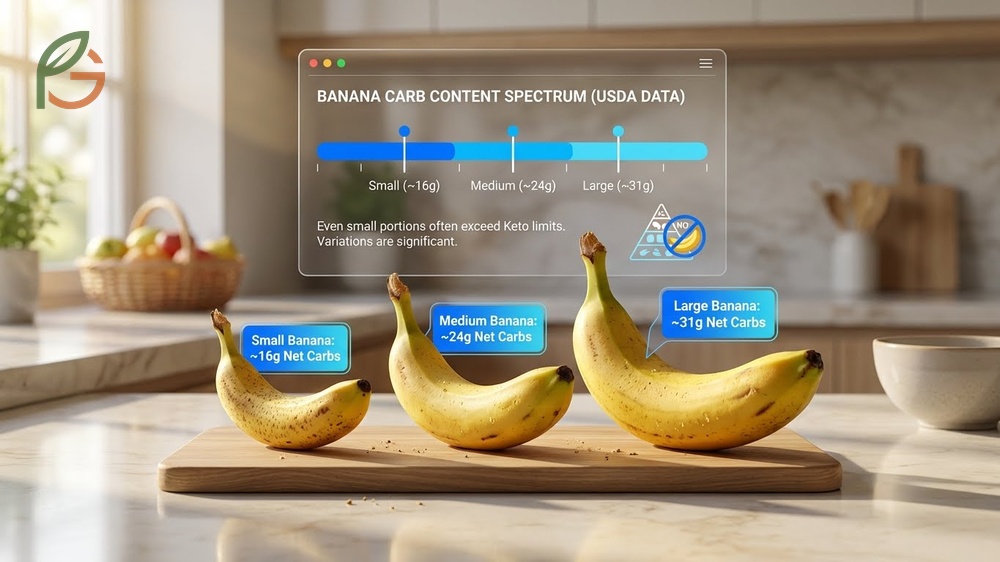
Banana carbohydrate levels vary significantly based on size, with the range spanning from 16g to 31g net carbs depending on the fruit’s dimensions. Understanding these variations helps you recognize why even smaller portions don’t work for keto adherence. The USDA provides standardized measurements that reveal the full spectrum of banana carb content across different sizes.[1]
Most people underestimate banana carbs because they focus on the fruit’s natural, whole-food status. Research shows that consumers often classify bananas as “healthy” and therefore assume they fit various diets. Current data indicates this misconception leads to inadvertent carb overconsumption among keto dieters attempting to reintroduce fruits too early.
Carbs by Size
This table compares total carbohydrates, dietary fiber, net carbs, and calories across five banana sizes from extra small to extra large
| Size | Length | Weight | Total Carbs | Fiber | Net Carbs | Calories |
|---|---|---|---|---|---|---|
| Extra Small | <6 inches | 81g | 19g[5] | 2g | 17g | 72 kcal |
| Small | 6-7 inches | 101g | 23g[5] | 3g | 20g | 90 kcal |
| Medium | 7-8 inches | 118g | 27g[1] | 3g | 24g | 105 kcal |
| Large | 8-9 inches | 136g | 31g[5] | 4g | 27g | 121 kcal |
| Extra Large | >9 inches | 152g | 35g[5] | 4g | 31g | 135 kcal |
This size variation means even the smallest bananas present challenges for keto dieters. An extra-small banana with 17g net carbs still consumes 34-85% of your daily carb allowance, leaving little room for other foods. The reason is simple: bananas pack concentrated carbohydrates into every gram of fruit.
Ripeness Affects Carbs
Green bananas contain significantly more resistant starch, which behaves differently than regular carbohydrates during digestion. Studies demonstrate that unripe bananas can have up to 70-80% starch content by dry weight, with resistant starch comprising nearly 49g per 100g.[7] This resistant starch isn’t fully digested, potentially lowering the effective net carb count.
However, resistant starch’s benefits don’t make green bananas keto-friendly. As bananas ripen, starch converts to simple sugars—sucrose, fructose, and glucose—which can reach 16% of the fruit’s fresh weight. The glycemic index climbs from 30 for green bananas to 51-62 for fully ripe yellow bananas with brown spots, creating a faster blood sugar spike that disrupts ketosis more severely.
Ripeness Tip: While green bananas have a lower glycemic response, their total net carbs remain too high for keto diets. The starch-to-sugar conversion during ripening doesn’t eliminate carbohydrates—it just changes their form and absorption speed.
Low Carb Alternatives
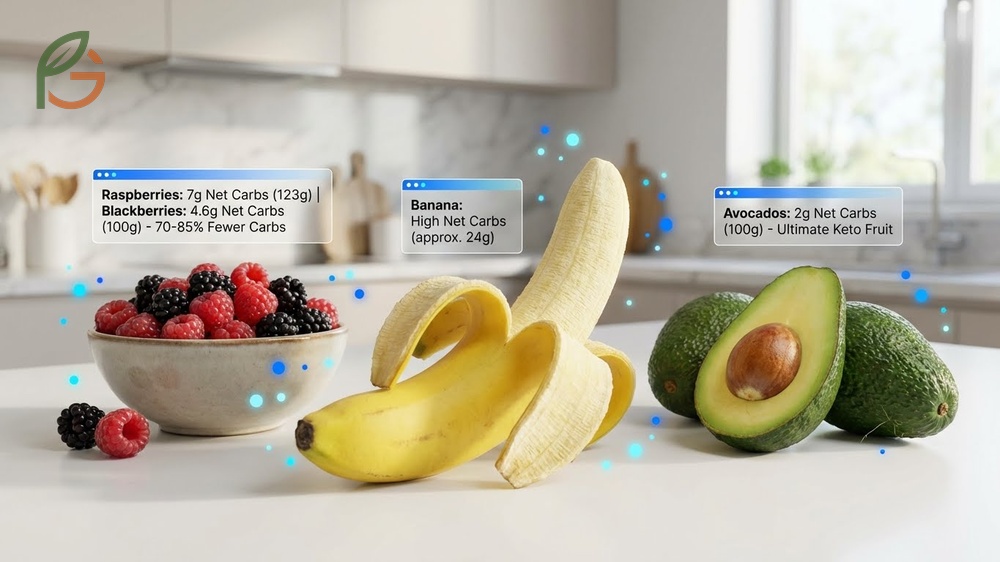
Berries serve as the most practical banana replacement for keto dieters craving fruit. Research shows that raspberries deliver only 7g net carbs per full cup (123g), while blackberries provide just 4.6g per 100g serving—both offering 70-85% fewer net carbs than a medium banana.[3] These berries also pack antioxidants and fiber that support gut health during keto adaptation.
Avocados represent the ultimate keto fruit with only 2g net carbs per 100g serving. Current nutritional guidance emphasizes that avocados provide healthy monounsaturated fats that align perfectly with ketogenic macronutrient ratios. Most people discover that half an avocado (100g) delivers the creamy texture they miss from bananas while contributing beneficial fats that enhance ketone production.
Strawberries offer another viable option with 5.5g net carbs per 100g serving. Evidence indicates that strawberries provide vitamin C, manganese, and folate while maintaining a low glycemic impact. Their sweet flavor satisfies fruit cravings without the carbohydrate overload that bananas impose.
- Raspberries: 7g net carbs per cup (123g) with 8g fiber for digestive health
- Blackberries: 4.6g net carbs per 100g, rich in anthocyanins and vitamin K
- Strawberries: 5.5g net carbs per 100g, excellent vitamin C source (89mg per cup)
- Avocados: 2g net carbs per 100g with 15g healthy fats supporting ketosis
- Cantaloupe: 7.3g net carbs per 100g, provides hydration and electrolytes
- Watermelon: 7.2g net carbs per 100g, refreshing low-calorie option at 30 kcal per 100g
- Lemons/Limes: 5-6g net carbs per fruit, ideal for flavoring water and dishes
These alternatives allow you to enjoy fruit flavors and nutrients while staying within keto parameters. The key difference is portion control becomes easier—you can eat a full cup of raspberries for fewer carbs than a quarter of a medium banana.
Keto Friendly Fruits
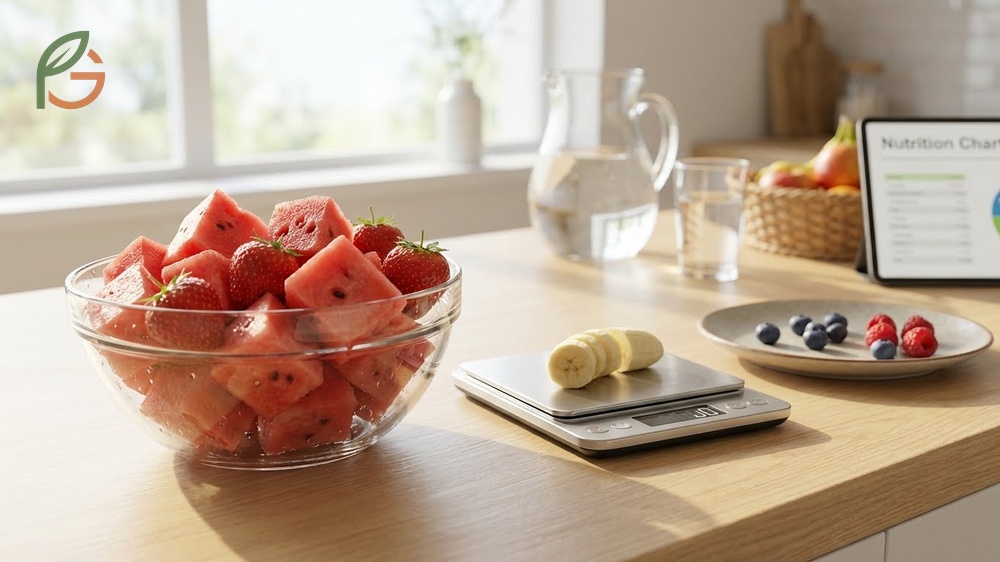
The lowest-carb fruits share common characteristics: high water content, moderate sugar levels, and significant fiber ratios. Studies demonstrate that fruits with 80-90% water content typically deliver fewer net carbs per serving because water dilutes carbohydrate density. This explains why watermelon (92% water) and strawberries (91% water) work for keto while bananas (75% water) don’t.
Portion awareness matters critically for keto fruit consumption. Research shows that even keto-friendly fruits can disrupt ketosis when consumed in excessive amounts. Most people succeed by limiting fruit to one or two small servings daily, preferably paired with fat sources like whipped cream, coconut cream, or nut butters that slow sugar absorption.
Timing your fruit intake strategically enhances keto compliance. Current guidance suggests consuming fruits earlier in the day when insulin sensitivity peaks and physical activity can burn off glucose before it disrupts ketosis. Evening fruit consumption often proves more problematic because carbohydrates consumed before sleep have fewer opportunities for oxidation.
- Coconut (fresh meat): 6g net carbs per 100g with medium-chain triglycerides (MCTs) that convert directly to ketones
- Tomatoes: 3g net carbs per 100g, technically a fruit with lycopene for heart health
- Olives: 3g net carbs per 100g, providing healthy fats and anti-inflammatory compounds
- Star fruit: 4g net carbs per 100g, exotic option with vitamin C and copper
- Rhubarb: 2.3g net carbs per 100g when cooked without sugar, excellent for low-carb desserts
- Cucumbers: 2.2g net carbs per 100g, hydrating with minimal carb impact
Fruit Strategy: Combine keto-friendly fruits with high-fat additions like mascarpone cheese, heavy cream, or macadamia nuts. This lowers the glycemic impact and keeps you fuller longer, preventing carb cravings that lead to overconsumption.
Banana Keto Substitute
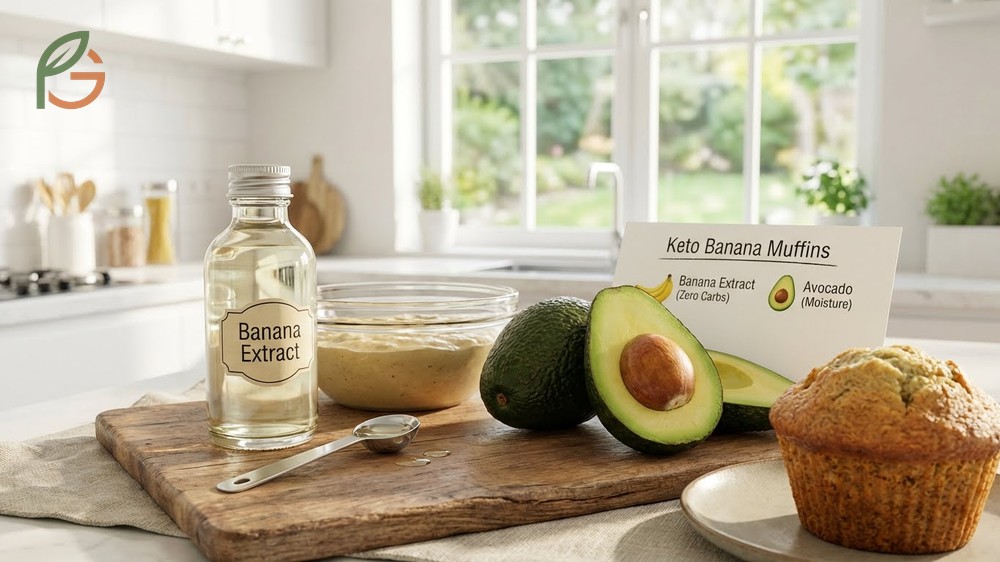
Banana extract offers zero carbs while delivering authentic banana flavor for keto baking and smoothies. Research shows that natural banana extracts capture the fruit’s aromatic compounds—primarily isoamyl acetate—without any carbohydrates or sugars. Just 1/4 to 1/2 teaspoon replicates the taste of a medium banana in recipes while keeping you firmly in ketosis.
Avocado-based substitutions work remarkably well in baking applications where bananas traditionally add moisture and binding. Studies demonstrate that one-third of a ripe avocado (approximately 50g) combined with 1/4 teaspoon banana extract successfully replaces a medium banana in muffins, pancakes, and quick breads. The avocado’s creamy texture mimics banana’s consistency while adding healthy fats that support ketogenic macros.
Chia seed mixtures create texture-appropriate banana substitutes for puddings and overnight “oats.” Evidence indicates that mixing 1 part chia seeds with 4 parts water (example: 1/4 cup chia to 1 cup water), soaking for 20 minutes, and adding 1/4 teaspoon banana extract produces a gel similar to mashed bananas.[8] This provides omega-3 fatty acids and fiber while keeping net carbs under 2g per serving.
- Banana extract + unsweetened almond milk: Creates banana-flavored smoothie bases with less than 1g net carbs per cup
- Frozen ripe avocado + banana extract: Blends into creamy “nice cream” with 2-3g net carbs per serving versus 24g for banana ice cream
- Yellow squash + banana extract: When cooked and mashed, mimics banana bread texture at 3g net carbs per 100g
- Keto banana bread mixes: Commercial options use almond flour and erythritol, delivering 2.5g net carbs per slice
- Banana-flavored protein powder: Adds convenience to shakes with 2-4g net carbs per scoop depending on brand
These substitutions preserve the sensory experience of banana-containing foods without compromising ketosis. Most people find they don’t miss actual bananas once they discover these alternatives that satisfy both taste and texture preferences. The reason is straightforward: your taste buds respond to flavor compounds, not carbohydrate molecules, making banana extract an effective workaround.
Baking Tip: When substituting avocado for bananas, reduce added fats in recipes by 25-30% since avocados contribute oil content that bananas don’t. This prevents overly greasy baked goods while maintaining proper moisture levels.
Conclusion
The evidence is clear: bananas aren’t keto friendly due to their 24g net carb content that consumes nearly half of a standard 50g daily keto limit. Research demonstrates that successful ketogenic diets require strict carbohydrate management, making high-carb fruits like bananas incompatible with maintaining ketosis. Better alternatives like raspberries (7g net carbs per cup), avocados (2g per 100g), and banana extract (0g carbs) provide satisfying options that support your keto goals without sabotaging your metabolic state.
Current nutritional guidance emphasizes that fruit selection matters significantly for long-term keto adherence and metabolic health. FruitGarden provides evidence-based information to help you make informed decisions about which fruits align with your dietary approach and which ones require substitution or elimination.
Medical Disclaimer
Important Medical Disclaimer: This content is for informational and educational purposes only. It’s not intended as a substitute for professional medical advice, diagnosis, or treatment. Always consult a qualified healthcare professional or registered dietitian before starting any ketogenic diet, making changes to your current eating plan, or if you have diabetes, metabolic disorders, or other medical conditions. Individual carbohydrate tolerance varies based on activity level, metabolic health, and other factors that require personalized assessment.
Frequently Asked Questions
Can I Eat Half a Banana on Keto?
No, even half a medium banana contains 12g net carbs, which represents 24-60% of most keto daily limits. Research shows this amount can disrupt ketosis for many people, especially those following stricter 20g protocols. You’re better off choosing a full cup of raspberries at 7g net carbs, which provides more volume and fiber.
What Fruits Can I Eat on Keto Instead of Bananas?
The best keto fruit alternatives include raspberries (7g net carbs per cup), blackberries (4.6g per 100g), strawberries (5.5g per 100g), and avocados (2g per 100g). Studies demonstrate that these berries provide similar nutrients to bananas—like potassium, fiber, and antioxidants—while delivering 70-85% fewer net carbs per serving.
Do Green Unripe Bananas Have Fewer Carbs?
Green bananas contain resistant starch that’s harder to digest, potentially lowering the glycemic impact, but their total net carbs remain around 20-24g. Evidence indicates that while green bananas have a lower glycemic index (30-42 versus 51-62 for ripe bananas), they still exceed keto carb limits. The starch eventually converts during digestion, affecting blood sugar and ketosis.
How Can I Get Banana Flavor Without Carbs?
Banana extract provides authentic banana flavor with zero carbs—just 1/4 teaspoon replicates a medium banana’s taste in smoothies, baked goods, and protein shakes. Current nutritional products also include banana-flavored protein powders (2-4g net carbs per scoop) and keto banana bread mixes (2.5g net carbs per slice) that satisfy cravings without disrupting ketosis.
Will One Banana Kick Me Out of Ketosis?
Yes, a medium banana’s 24g net carbs will likely disrupt ketosis for most people following standard keto protocols. Research shows that consuming carbs in this range triggers insulin release and shifts metabolism back toward glucose burning. Recovery time varies, but most people need 24-48 hours of strict carb restriction to re-enter ketosis after this level of carb intake.
What Has the Same Texture as Banana for Keto Baking?
Ripe avocado provides the closest texture match for banana in keto baking—one-third of an avocado (50g) replaces a medium banana in muffins and quick breads. Studies demonstrate that avocado’s moisture and binding properties work similarly to bananas while adding healthy fats. Combining avocado with 1/4 teaspoon banana extract delivers both proper texture and authentic flavor at just 2-3g net carbs.
Are There Any Keto-Friendly Banana Products?
Yes, several keto-friendly banana-flavored products exist, including banana extract (0g carbs), banana-flavored protein powders (2-4g net carbs per serving), and pre-made keto banana bread mixes (2.5g net carbs per slice). Evidence indicates these products capture banana’s taste through natural and artificial flavorings while using almond flour, coconut flour, and sugar substitutes to maintain keto-compatible macros.





